

Hen’s Egg Processing Market Analysis & Forecast: 2026-2033
The hen’s egg processing market is estimated to be valued at USD 35.04 Bn in 2026 and expected to reach USD 51.23 Bn by 2033, witnessing a CAGR of 5.6% over the forecast period (2026-2033).
Key Takeaways
- Based on Product Type, the liquid egg segment is expected to hold 47.2% share of the market in 2026.
- Based on Region, North America is set to lead the hen’s egg processing market with 35% share in 2026. While, Asia Pacific is anticipated to be the fastest growing region.
Market Overview
The hen’s egg processing market represents an important segment of the global food processing industry, driven by growing demand for convenient, safe, and value-added egg products. Processing involves converting shell eggs into liquid, frozen, or dried forms that are widely used in bakery, confectionery, dairy, sauces, and ready-to-eat food applications. Increasing consumer preference for high-protein foods, along with the expansion of the foodservice and packaged food sectors, is supporting market growth.
Egg processing helps extend shelf life, improve food safety, and provide consistent quality for large-scale food manufacturers. Technological advancements in pasteurization, separation, and drying processes are further improving efficiency and product quality. Additionally, strict food safety regulations and traceability requirements are encouraging producers to adopt advanced processing and packaging solutions. Growing urbanization and changing dietary habits are also increasing demand for processed egg ingredients, particularly in emerging economies where the convenience food market continues to expand.
Current Events and their Impacts on the Hen’s Egg Processing Market
Current Event | Description and its Impact |
Avian Influenza Outbreaks and Biosecurity Measures |
|
Regulatory Changes in Food Safety and Animal Welfare |
|
How Efficient Are Modern Hen’s Egg Processing Systems Today?
Category | Metric | Typical Industry Range |
Egg‑Breaking Capacity | Eggs processed per hour | 45,000 – 200,000 eggs/hour |
Separation Accuracy | White–yolk separation efficiency | >98.5% |
Pasteurization Impact (Whole Egg) | Viscosity loss | 3–5% |
Pasteurization Impact (Egg White) | Protein denaturation | <1% |
Spray‑Drying Yield | Shell eggs required per kg of powder | 3.8 – 4.2 kg shell eggs → 1 kg powder |
Energy Consumption | kWh per ton of dried egg powder | 1,200 – 1,800 kWh/ton |
Product Recovery Rate | Usable product after processing | 92–96% |
Microbial Reduction | Salmonella reduction | 5‑log (99.999%) |
Labor Efficiency | Eggs processed per worker per hour | >25,000 |
Breakage Waste | % of eggs lost during handling | 1.5–3% |
- Current Industry Events of 2026
- Market Size Estimation
- Regional Breakdown
- Competitive Landscape
- Customer Intelligence
- Segmental Analysis
- Pricing Analysis
- Key Market Drivers, Challenges & Future Trends
- Customized Insights Section
Segmental Insights
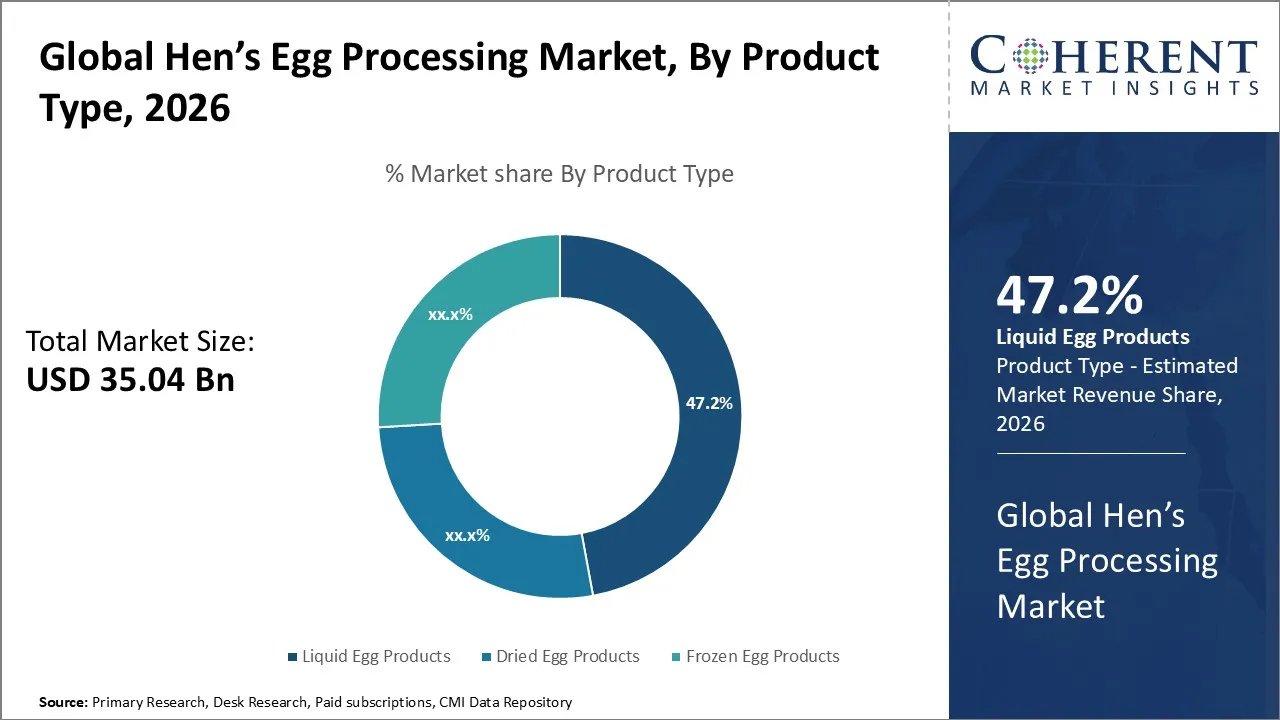
Hen’s Egg Processing Market Insights, By Product Type - Liquid egg products lead the market with unmatched convenience and industrial demand
In terms of product type, the liquid egg segment is expected to hold 47.2% share of the market in 2026. They are extremely popular due to convenience, safety, and versatility. This makes them essential in bakeries, food service, and ready-to-eat meals. They are the best choice over dried and frozen options because they always have high quality and high demand in the industry.
For instance, in May 2025, Thailand's Sa-Nguan Farm was the first to sell cage-free pasteurized liquid eggs. This was a big step forward for animal welfare and food safety. This new idea makes the liquid egg segment even stronger in the hen's egg processing market by meeting the growing demand in the Asia-Pacific and global food industries with a combination of convenience, hygiene, and ethical sourcing.
Regional Insights
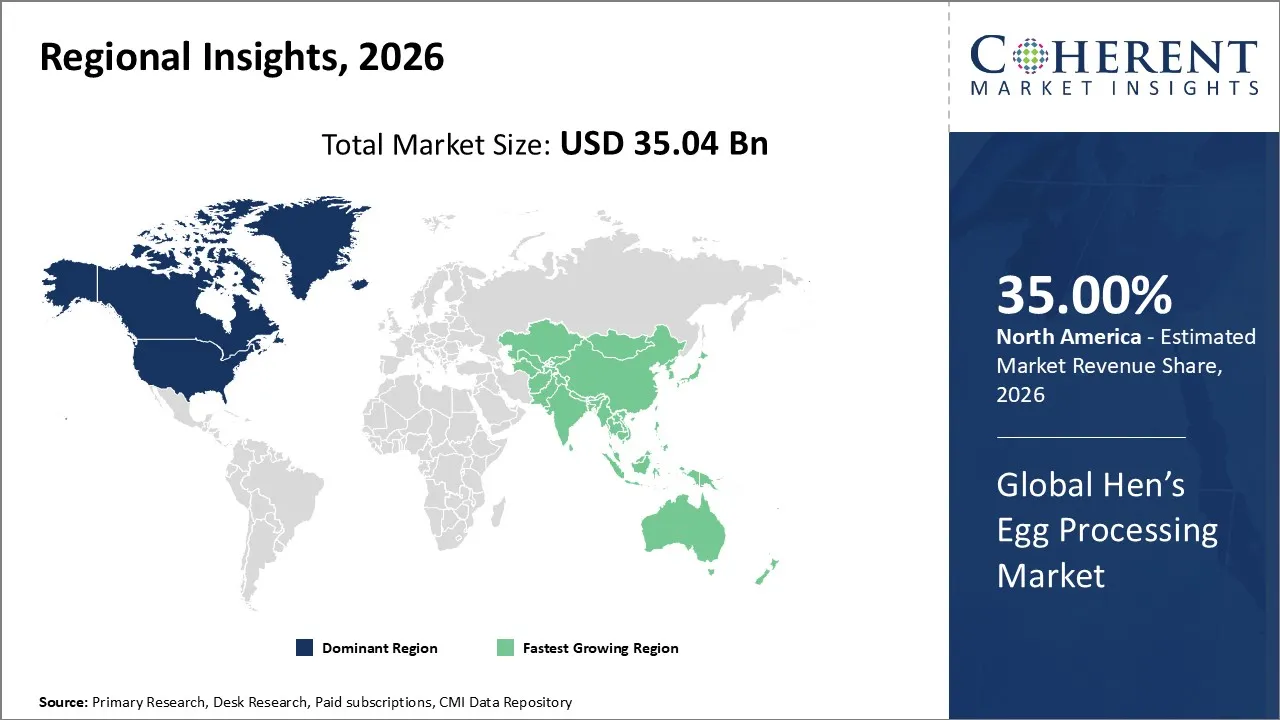
North America Hen’s Egg Processing Market Analysis & Trends
North America is expected to dominate the hen’s egg product market with 35% share in 2026, because of advanced processing infrastructure and strong demand from the foodservice, bakery, and confectionery industries. Strict food safety rules and the widespread use of pasteurized and value-added egg products make this area even more powerful.
For instance, in December 2025, Herbruck's invested more than USD 20 million into a 75,000-square-foot egg processing plant in Kendallville, Indiana. The facility will open in the spring of 2026 and will process about 420 million eggs a year. This will increase the company's egg processing capacity in the U.S. and meet the demand in the region for graded, packed, and processed hen's eggs.
Asia Pacific Hen’s Egg Processing Market Analysis & Trends
Asia Pacific is anticipated to be the fastest growing region. India's large-scale production of more than 142.77 billion eggs a year, China's growing poultry industry, and more people in cities eating protein-rich diets are all factors in this growth. The region's market growth is sped up even more by the industrialization of processing facilities and strategies that focus on exports.
For instance, in November 2025, a large food company in the Philippines promised to buy only cage-free eggs, which is an important move toward more ethical production. This move makes the shell egg part of the hen's egg market stronger. It shows that a growing number of individuals in the Asia-Pacific region want eggs that are good for animals, good for the environment, and of the highest quality.
Hen’s Egg Processing Market Outlook Country-Wise
The U.S. Hen’s Egg Processing Market Trends
The Hen's Egg Processing Market is extremely competitive in the US in 2026 because there is an abundance of demand from the bakery, confectionery, and foodservice industries. Advanced processing infrastructure, strict food safety rules, and customers' preference for pasteurized, value-added egg products keep demand high and strengthen the country's position as the market leader.
For instance, in August 2025, Pete & Gerry's started selling Organic Pasture Raised Eggs all over the United States. Hens are raised on USDA Certified Organic farms with 108 square feet of pasture for each bird. This makes sure that the hens are treated well. The yolks of the eggs are bright, the nutrition is good, and the price is low.
Malaysia Hen’s Egg Processing Market Trends
The Hen's Egg Processing Market in Malaysia is extremely busy in 2026 because people are eating more protein, cities are changing their diets, and the government is promoting poultry as an inexpensive source of nutrition. The processing sector in Malaysia is getting stronger due to the growing bakery and confectionery industries and the increasing exports of egg powders and liquid derivatives.
For instance, a growing percentage retailers, hotels, and food service brands in Malaysia are using humane-certified eggs, and the country is quickly moving toward cage-free egg production. Consumer demand, corporate commitments, and welfare standards are all driving the growth of free-range and cage-free systems. This is making the country's humane egg market stronger and encouraging producers to avoid using caged hens.
Market Report Scope
Hen’s Egg Processing Market Report Coverage
| Report Coverage | Details | ||
|---|---|---|---|
| Base Year: | 2025 | Market Size in 2026: | USD 35.04 Bn |
| Historical Data for: | 2020 To 2024 | Forecast Period: | 2026 To 2033 |
| Forecast Period 2026 to 2033 CAGR: | 5.6% | 2033 Value Projection: | USD 51.23 Bn |
| Geographies covered: |
| ||
| Segments covered: |
| ||
| Companies covered: | SKMEgg.com, Oaklands Farm Eggs Limited, Ovostar, Parmovo S.r.l. Società a Socio Unico, Rose Acre Farms, Ballas Egg Products Corporation, Igreca, Rembrandt Enterprises, Inc., Michael Foods, Inc. and Sovimo Hellas S.A | ||
| Growth Drivers: |
| ||
| Restraints & Challenges: |
| ||
Hen’s Egg Processing Market Driver
Rising awareness of the health benefits of eggs
People are becoming more aware of the health benefits of eggs, which has had a big effect on demand. For example, in India, the average person ate 86 eggs a year in 2010–11, but that number rose to over 100 eggs in 2023–24. This growth shows that people are starting to see eggs as a good source of protein, vitamins, and amino acids. This trend is good for the Hen's Egg Processing Market share because increasingly health-conscious people are choosing processed foods like liquid eggs and powders that are safe, easy to use, and have the same nutritional value every time.
Hen’s Egg Processing Market Opportunity
Value-Added Products Expansion
There is a growing need for egg powders, liquid eggs, and frozen derivatives, especially in the bakery, confectionery, and ready-to-eat food industries. Egg powder is a good choice for both domestic and export markets as it can be stored and shipped cheaply and has a shelf life of up to 12 months. The Hen's Egg Processing Market forecast shows that there are great opportunities to sell fortified and protein-rich egg-based products to health-conscious customers. This is in line with global dietary trends and will help the industry grow over the long term.
For instance, in March 2026, Sigma Foods worked with the Finnish startup Onego Bio to make Bioalbumen, a protein made from egg whites that does not come from animals. It has the same benefits for the environment as ovalbumin, using less land, water, and emissions. The U.S. FDA has approved it, and it is aimed at food manufacturers around the world seeking for reliable egg protein alternatives.
Analyst Opinion (Expert Opinion)
- Production Scale and Efficiency: India made 142.77 billion eggs in 2023–24, which made it the second-largest producer in the world. This scale has sped up the use of automated systems for grading, breaking, and pasteurizing, which reduce wastage and ensure food safety. Mechanized plants can handle tens of thousands of eggs every hour, which helps bakeries and quick-service restaurants get a steady supply. Combining feed supply and logistics in poultry operations makes them even more cost-effective and easy to track.
- Industrial Use and Value Addition: Processed egg products, like liquid eggs, dried powders, and frozen derivatives, are becoming increasingly important for packaged foods and export markets. Egg powder, which can last up to 12 months, is essential for the bakery and confectionery industries because it has a consistent protein content and lowers storage costs. Institutional catering uses a lot of pasteurized liquid eggs as they are safe from bacteria and can handle a lot of orders. This move toward value-added processing is part of a larger trend to make poultry products more useful for the global food system.
Speak to the analyst
Want personalized insights?
Take the findings above to one of our principal consultants, or have the report rebuilt around the segments, geographies and competitors you actually track.
Recent Developments
- In February 2026, Independent Garden centers in the United States launched Peak Beak, a brand from Oberland Agriscience, which makes functional poultry nutrition. These treats and supplements are made for people who keep chickens in their backyards. They help keep the eggs healthy, the shells strong, the yolks bright, and the whole flock healthy. They are also in response to the growing demand for science-based poultry care.
- In April 2025, Happy Egg, which is based in Rogers, Arkansas, added pasture-raised eggs to its product line. These eggs are shipped all over the United States. Small family farmers take care of hens that roam 50 acres of pasture and lay eggs with bright orange yolks. The launch meets the demand for high-quality, ethically sourced eggs, even though there are supply problems.
Market Segmentation
- By Product Type
- Dried Egg Products
- Egg White
- Yolk
- Whole Egg
- Liquid Egg Products
- Egg White
- Yolk
- Whole Egg
- Frozen Egg Products
- Egg White
- Yolk
- Whole Egg
- Dried Egg Products
- By Region
- North America
- U.S.
- Canada
- Latin America
- Brazil
- Argentina
- Mexico
- Rest of Latin America
- Europe
- Germany
- U.K.
- Spain
- France
- Italy
- Russia
- Rest of Europe
- Asia Pacific
- China
- India
- Japan
- Australia
- South Korea
- ASEAN
- Rest of Asia Pacific
- Middle East & Africa
- GCC Countries
- Israel
- Rest of Middle East & Africa
- North America
- Competitive Section
- SKMEgg.com
- Oaklands Farm Eggs Limited
- Ovostar
- Parmovo S.r.l. Società a Socio Unico
- Rose Acre Farms
- Ballas Egg Products Corporation
- Igreca
- Rembrandt Enterprises, Inc.
- Michael Foods, Inc.
- Sovimo Hellas S.A.
Sources
Primary Research Interviews
- Egg Processing Manufacturers
- Egg Shell & Egg White Suppliers
- Egg Product Producers
- Industrial Food Technologists
- Poultry Industry Consultants
- Others
Databases
- Bloomberg Terminal
- Thomson Reuters Eikon
- Euromonitor International
- Others
Magazines
- Poultry Times
- Egg Industry Magazine
- Food Processing Magazine
- Meat & Poultry Magazine
- Others
Journals
- Journal of Food Science
- Poultry Science Journal
- Food Research International
- International Journal of Food Science & Technology
- Others
Newspapers
- The New York Times
- The Guardian
- Reuters
- BBC News
- Others
Associations
- International Egg Commission (IEC)
- American Egg Board (AEB)
- Egg Farmers of Canada
- European Egg Producers (EEP)
- Others
Public Domain Sources
- U.S. Department of Agriculture (USDA)
- Food and Agriculture Organization (FAO)
- U.S. Food and Drug Administration (FDA)
- World Health Organization (WHO)
- National Agricultural Statistics Service (NASS)
- Others
Proprietary Elements
- CMI Data Analytics Tool
- Proprietary CMI Existing Repository of Information for the Last 8 Years
Get access to 250+ pages report
Every segment, forecast, competitor profile and data table behind the analysis above — available for instant download.
- ESOMAR Member
- ISO 9001:2015 Certified
- D-U-N-S Registered
- GDPR & CCPA Compliant
Missing comfort of reading report in your local language? Find your preferred language:
Transform your Strategy with Exclusive Trending Reports
Frequently Asked Questions
The global Hen’s Egg Processing Market size was valued at USD 35.04 Bn in 2026 and is expected to reach USD 51.23 Bn in 2033.
The market for global hen’s egg processing market is estimated to surpass USD 51.23 Bn by 2033, exhibiting a CAGR of 5.6% between 2026 and 2033.
The growth of the market is driven by rising awareness of the health benefits of eggs around the world, such as the availability of protein and vitamins.
Increased chicken egg production to meet rising egg consumption globally, as well as ongoing product launches by key players such as bottled egg whites, are expected to drive the market growth over the forecast period.
Rising health consciousness, vegan diet commitment and several contamination cases in processed egg market are expected to hamper the market growth.
Major players operating in the market include SKMEgg.com, Oaklands Farm Eggs Limited, Ovostar, Parmovo S.r.l. Società a Socio Unico, Rose Acre Farms, Ballas Egg Products Corporation, Igreca, Rembrandt Enterprises, Inc., Michael Foods, Inc. and Sovimo Hellas S.A.