

India Immuno-Oncology Drugs Market Size and Share Analysis - 2026 To 2033
The India immuno-oncology drugs market size is anticipated to grow at a CAGR of 12.6% with USD 6.2 Bn in 2026 and is expected to reach USD 14.37 Bn in 2033. The market is growing with the rising cancer burden and increasing use of advanced therapies such as immune checkpoint inhibitors and monoclonal antibodies. According to the ICMR-NCRP, India documented approximately 1,461,427 cancer cases in 2022. This indicates that nearly one in nine Indians is likely to develop cancer during their lifetime, thereby fueling the demand for targeted as well as immuno-oncology treatment solutions.
Key Takeaways
- The immune checkpoint inhibitors segment is projected to account for the largest share of 45.20% in 2026. The segment growth is due to its strong clinical adoption in oncology care, especially PD-1/PD-L1 and CTLA-4 inhibitors. These inhibitors assist in activating the immune system against cancer cells and improving treatment outcomes in multiple tumor types.
- The lung cancer segment is projected to account for the largest share of 28.30% in 2026. The segment’s growth is attributable to the high lung cancer burden in India. Some of the other factors are increasing use of immunotherapy in advanced non-small cell lung cancer and the growing preference for targeted treatment approaches that support improved survival and disease control. For instance, in August 2025, Intas Pharmaceuticals launched HETRONIFLY (Serplulimab), the first PD-1 inhibitor globally approved for the treatment of Extensive-Stage Small Cell Lung Cancer (ES-SCLC), in the Indian market.
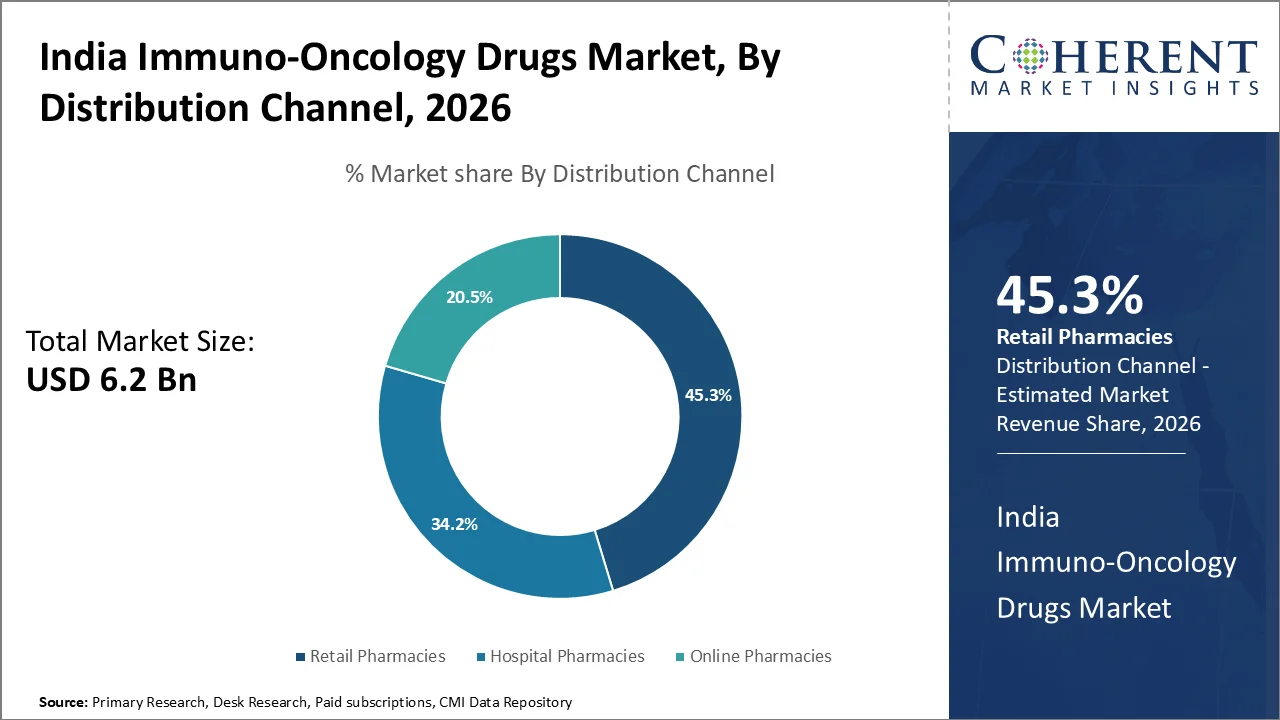
- On the basis of distribution channel, the retail pharmacies segment is projected to account for the largest share of 45.30% in 2026. The growth is owing to wider access to prescribed oncology drugs, expanding specialty pharmacy networks, and increasing patient reliance on retail pharmacy channels for follow-up prescriptions, refill therapies, and supportive cancer care medications. The retail pharmacy channel is highly extensive, with AIOCD representing 12.4 lakh chemists, pharmacists, and distributors across the country.
Segmental Insights
Which Drug Type Segment Dominates the Market?
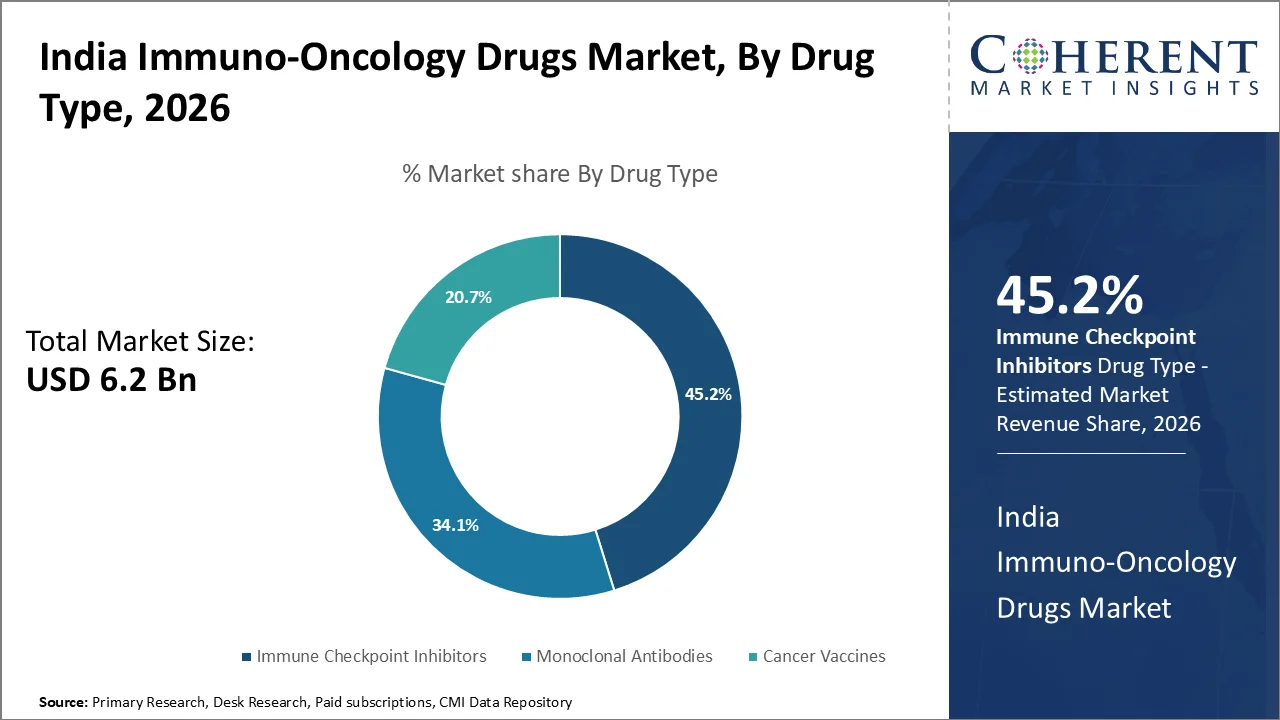
The immune checkpoint inhibitors segment accounts for the largest India immuno-oncology drugs market share of 45.20% in 2026. The growth of the segment is mainly driven by the increasing cancer incidence in India, with the country reporting 15,33,055 estimated cancer cases in 2024, according to ICMR-NCRP data.
In addition, there is a growing preference for immune checkpoint inhibitors, particularly PD-1/PD-L1 inhibitors, which are becoming more widely adopted in the treatment of lung cancer, head & neck cancer, and other cancers. This shift is also facilitated by the approval of new indications by CDSCO for drugs like nivolumab.
One of the notable launches in this segment was Zydus' launch of Tishtha™ in January 2026. It is the world’s first biosimilar of nivolumab, which is expected to be priced at approximately one-fourth the cost of the original drug, thereby making it more accessible to patients across India.
- Current Industry Events of 2026
- Market Size Estimation
- Regional Breakdown
- Competitive Landscape
- Customer Intelligence
- Segmental Analysis
- Pricing Analysis
- Key Market Drivers, Challenges & Future Trends
- Customized Insights Section
Lung Cancer Segment to Secure the Largest Share
The lung cancer segment accounts for the largest India immuno-oncology drugs market share of 28.30% in 2026, owing to high lung cancer prevalence, increasing tobacco use, poor air quality, late‑stage diagnosis, and strong clinical uptake of immuno‑oncology therapies.
The segment’s growth is supported by India’s overall cancer burden, as GLOBOCAN 2022 estimated 81,748 new lung cancer cases in India, representing 5.8% of total cancer incidence, and caused 75,031 deaths, making it a high-priority oncology indication. The advanced cancers like non‑small cell lung cancer rely on immune checkpoint inhibitors, thus boosting market penetration and uptake.
The segment’s growth is also backed by strategic industry partnerships and drug launches that expand treatment options. For example, This launch enhances access to innovative lung cancer treatments across oncology care settings.
Retail Pharmacies Segment to Secure the Largest Share
The retail pharmacies segment accounts for the largest India immuno-oncology drugs market share of 45.30% in 2026. The segment’s growth is owing to the increasing accessibility of immuno-oncology drugs, particularly in urban and semi-urban areas, where retail pharmacies play a vital role in distributing prescription-based cancer medications. The growing cancer burden, the rising demand for affordable oncology treatments, and a greater availability of both branded as well as biosimilar immuno-oncology formulations is contributing substantially to the segment’s growth.
In India’s pharma retail channel, the standalone pharmacies accounted for 54% of the market share in 2023, while retail chain drugstores held 11.6%, thereby highlighting the robust role of offline retail pharmacies in prescription medicine distribution. The expansion of organized pharmacy chains, e-pharmacy-linked retail networks, and specialty pharmacy services is also enhancing patient access to oncology medicines, particularly outside traditional hospital-based pharmacies.
Market Drivers
Faster Adoption of Immune Checkpoint Inhibitors is Transforming the India Immuno-Oncology Drugs Market
The India immuno-oncology drugs market is witnessing strong growth due to the faster adoption of immune checkpoint inhibitors, especially across high-burden cancers such as lung cancer, breast cancer, cervical cancer, head & neck cancer, gastrointestinal cancers, and blood cancers. India’s cancer burden continues to rise, with PIB reporting in February 2025 that India recorded more than 14 lakh cancer cases in 2023, while Lok Sabha data published in August 2025 estimated 15,33,055 cancer cases for 2024. There is increasing demand for advanced oncology therapies which extend beyond traditional chemotherapy owing to the growing number of patients.
The market is experiencing a transition toward biomarker-driven and immune-based treatment strategies, placing increased emphasis on PD-1/PD-L1 inhibitors like nivolumab, pembrolizumab, and durvalumab. In addition, the regulatory innovations are facilitating this transition. For instance, CDSCO’s SEC recommended permission to manufacture and market nivolumab 10 mg/mL for locally advanced or metastatic non-small cell lung cancer in June 2024. In March 2025, AstraZeneca also announced CDSCO approval for durvalumab for patients with limited-stage small cell lung cancer whose disease had not progressed after platinum-based chemoradiation therapy.
These approvals are expanding the use of immune checkpoint inhibitors in major cancer indications and strengthening their position as the leading drug type segment.
Major Breakthrough in India Immuno-Oncology Drugs Market: Affordable Innovation
Affordable innovation is becoming a major breakthrough in the India immuno-oncology drugs market, driven by indigenous R&D, academia industry collaboration, local manufacturing, lower treatment costs, and faster regulatory acceptance of advanced cell and gene therapies. These factors are supporting market growth because India has a high cancer burden and requires advanced therapies that are clinically effective as well as affordable for middle-income patients and public/private hospital systems.
NexCAR19 strongly reflects this transformation. On April 2024, PIB reported that the President of India launched NexCAR19, India’s first home-grown CD19 CAR-T cell therapy, developed by IIT Bombay, Tata Memorial Centre, and ImmunoACT, and described it as the world’s most affordable CAR-T therapy.
Similarly, NCI reported on February 2024, that CDSCO approved NexCAR19 in October 2023 for relapsed/refractory B-cell cancers. Its expected cost is around USD 50,000, compared to nearly USD 400,000 for CAR-T infusion in the U.S., making advanced immuno-oncology treatment more accessible in India.
Current Events and Their Impact on the India Immuno-Oncology Drugs Market
Current Event | Description and its Impact |
Customs Duty and GST Reduction on Durvalumab and Other Cancer Drugs |
|
Union Budget 2025-26 Focus on Cancer Care Infrastructure |
|
India Immuno-Oncology Drugs Market Trends
- The rising adoption of immune checkpoint inhibitors like nivolumab, pembrolizumab, and durvalumab is improving survival prospects and expanding biomarker-led oncology treatment.
- The increasing use of CAR-T cell therapy, monoclonal antibodies, and targeted immunotherapies is strengthening personalized cancer care in tertiary hospitals.
- The domestic biosimilar launches are assisting in lowering the treatment costs, improving affordability, and facilitating wider access to advanced immuno-oncology drugs.
- The growing cancer burden increases the demand for immune-based therapies in lung cancer, breast cancer, oral cancer, cervical cancer, and blood cancers.
- The favorable regulatory approvals, government cancer networks, and affordability programs is broadening access to immuno-oncology treatment. In April 2024, PIB reported the launch of NexCAR19, India’s first home-grown CAR-T therapy, while Zydus launched Tishtha, the world’s first nivolumab biosimilar in India in January 2026 at nearly one-fourth the reference drug cost, boosting market participation.
Who are the Major Companies in India Immuno-Oncology Drugs Market
Some of the major key players in India immuno-oncology drugs market are Amgen Inc., F. Hoffmann-La Roche AG., Intas Pharmaceuticals Ltd., AstraZeneca plc, Mylan N.V., Dr. Reddy's Laboratories, Bristol - Myers Squibb, Merck & Co., Inc., BIOCAD-Biotechnology company, Reliance Life Sciences, Biocon Limited, and Hetero Drugs Limited.
Key News
- In December 2025, ImmunoACT has partnered with Mango Sciences to launch the world’s first bridge financing and value
- In June 2025, Agenus Inc. partnered with Zydus Lifesciences Ltd. to accelerate the clinical development and global manufacturing of its immuno-oncology drugs, botensilimab and balstilimab (BOT/BAL). The deal encompasses Agenus transferring its biologics CMC facilities to Zydus for USD 75 million, along with an additional USD 50 million based on production orders. The firm, Zydus will leverage these facilities to grow its BioCDMO business, thus focusing on biologics contract manufacturing for immuno-oncology drugs.
- In November 2024, Dr. Reddy’s Laboratories launched the immuno-oncology drug Toripalimab in India under the brand name Zytorvi. This drug is specifically approved for the treatment of nasopharyngeal carcinoma (NPC) patients.
Market Report Scope
India Immuno-Oncology Drugs Market Report Coverage
| Report Coverage | Details | ||
|---|---|---|---|
| Base Year: | 2025 | Market Size in 2026: | USD 6.2 Bn |
| Historical Data for: | 2020 To 2024 | Forecast Period: | 2026 To 2033 |
| Forecast Period 2026 to 2033 CAGR: | 12.6% | 2033 Value Projection: | USD 14.37 Bn |
| Segments covered: |
| ||
| Companies covered: | Amgen Inc., F. Hoffmann-La Roche AG., Intas Pharmaceuticals Ltd., AstraZeneca plc, Mylan N.V., Dr. Reddy's Laboratories, Bristol - Myers Squibb, Merck & Co., Inc., BIOCAD-Biotechnology company, Reliance Life Sciences, Biocon Limited, and Hetero Drugs Limited | ||
| Growth Drivers: |
| ||
| Restraints & Challenges: |
| ||
Analyst Opinion
- The India immuno-oncology drugs market is seeing rapid growth due to the increasing cancer burden. India reported nearly 15 lakh new cancer cases in 2023, with a rise in demand for advanced cancer treatments. The growth is fueled not merely by trends but also by an urgent need for effective therapies in order to address the escalating health crisis.
- The rise of immune checkpoint inhibitors like pembrolizumab and nivolumab is transforming the growth of the market. These drugs are becoming more widely used owing to their ability to target specific cancer cells and reduce side effects compared to traditional chemotherapy. For instance, in June 2025, Alvotech and Dr. Reddy’s Laboratories announced a collaboration to co-develop, manufacture, and commercialize a biosimilar to Keytruda (pembrolizumab) for global markets. Keytruda, a treatment for various cancers, had worldwide sales of USD 29.5 billion in 2024.
- The affordable immuno-oncology treatments are making cancer care more accessible in India. The biomarker-driven therapies are helping doctors select more targeted treatment options for patients. As a result, adoption of immuno-oncology drugs is increasing across both urban and rural regions. Thereby bolstering market growth and improving access to life-saving cancer treatments nationwide.
Speak to the analyst
Want personalized insights?
Take the findings above to one of our principal consultants, or have the report rebuilt around the segments, geographies and competitors you actually track.
Market Segmentation
- By Drug Type (Revenue, USD Bn, 2021-2033)
- Immune Checkpoint Inhibitors
- Nivolumab
- Atezolimumab
- Pembrolizuma
- Durvalumab
- Monoclonal Antibodies
- Rituximab
- Trastazumab
- Bevacizumab
- Nimotuzumab
- Pertuzumab
- Ado-Trastuzumab Emtansine
- Cancer Vaccines
- Gardasil
- Cervarix
- Immune Checkpoint Inhibitors
- By Cancer Type (Revenue, USD Bn, 2021-2033)
- Lung Cancer
- Blood Cancer
- Breast Cancer
- Ovarian Cancer
- Cervical Cancer
- Colorectal Cancer
- Stomach Cancer
- Head & Neck Cancer
- Others
- By Distribution Channel (Revenue, USD Bn, 2021-2033)
- Online Pharmacies
- Retail Pharmacies
- Hospital Pharmacies
Sources
Primary Research Interviews
- Immuno-Oncology Drug Manufacturers
- Oncology Drug Distributors
- Hospital Oncologists
- Cancer Care Specialists
- Clinical Trial Investigators
- Oncology Pharmacists
- Cancer Hospital Procurement Managers
- Biopharmaceutical Companies
- Contract Research Organizations
- Cancer Diagnostic Laboratories
- Others
Databases
- Bloomberg Terminal
- Thomson Reuters Eikon
- IQVIA
- gov
- Pharmaprojects
- Others
Magazines
- Pharma Times
- Express Pharma
- BioSpectrum India
- Medical Buyer
- Oncology Times
- Pharmaceutical Technology
- Drug Discovery Today
- Others
Journals
- Journal of Clinical Oncology
- The Lancet Oncology
- Nature Cancer
- Cancer Immunology Research
- Journal for ImmunoTherapy of Cancer
- Indian Journal of Medical Research
- Indian Journal of Cancer
- Others
Newspapers
- The Economic Times
- Business Standard
- Financial Express
- The Hindu Business Line
- Mint
- Reuters
- Bloomberg News
- Others
Associations
- Indian Society of Medical and Paediatric Oncology
- Indian Cancer Society
- Association of Medical Oncologists of India
- Indian Cooperative Oncology Network
- European Society for Medical Oncology
- American Society of Clinical Oncology
- Society for Immunotherapy of Cancer
- Others
Public Domain Sources
- Central Drugs Standard Control Organisation
- Indian Council of Medical Research
- National Cancer Registry Programme
- Ministry of Health and Family Welfare
- Department of Pharmaceuticals
- National Pharmaceutical Pricing Authority
- National Health Authority
- World Health Organization
- National Centre for Disease Informatics and Research
- Clinical Trials Registry – India
- Others
Proprietary Elements
- CMI Data Analytics Tool
- Proprietary CMI Existing Repository of Information for the Last 10 Years
Get access to 250+ pages report
Every segment, forecast, competitor profile and data table behind the analysis above — available for instant download.
- ESOMAR Member
- ISO 9001:2015 Certified
- D-U-N-S Registered
- GDPR & CCPA Compliant
Missing comfort of reading report in your local language? Find your preferred language:
Transform your Strategy with Exclusive Trending Reports
Frequently Asked Questions
The India Immuno-Oncology Drugs Market is expected to reach USD 14.37 Bn in 2033.
Major players operating in the global India Immuno-Oncology Drugs Market include Amgen Inc., F. Hoffmann-La Roche AG., Intas Pharmaceuticals Ltd., AstraZeneca plc, Mylan N.V., Dr. Reddy's Laboratories, Bristol - Myers Squibb, Merck & Co., Inc., BIOCAD-Biotechnology company, Reliance Life Sciences, Biocon Limited, and Hetero Drugs Limited.
The extreme treatment costs, limited reimbursement coverage, and severe rural-urban access disparities are the key factors hampering growth of the market.
The rising prevalence of cancer, increasing adoption of targeted immunotherapy over conventional chemotherapy, and enhanced regulatory support is boosting demand for immuno-oncology drugs.
The India Immuno-Oncology Drugs Market is anticipated to grow at a CAGR of 12.6% between 2026 and 2033.
Among drug type, the immune checkpoint inhibitors segment is expected to account for a largest market share in the India Immuno-Oncology Drugs Market over the forecast period.
Retail pharmacies in India are increasing accessibility to immuno-oncology drugs (such as PD-1/PD-L1 inhibitors like Pembrolizumab and Nivolumab) by expanding the distribution network beyond specialized hospital chains, adopting cold-chain logistics, and partnering with manufacturers for patient assistance programs.