

Industrial Protective Footwear Market Analysis & Forecast- 2026-2033
Industrial protective footwear market size is projected to hold a total of USD 7.21 Bn in 2026 and is expected to reach at sum of USD 12.51 Bn in 2033, expanding a compound annual growth rate (CAGR) of 8.2% from 2026 to 2033.
Key Takeaways
- Based on Application, the Construction segment is expected to account 36.3% market share in 2026.
- By Region, Europe is forecasted to hold the largest market share at around 35% in 2026.
Market Overview
The market for industrial protective footwear is growing steadily because of strict safety rules in the construction, manufacturing, and mining industries. More people are aware of the risks of their jobs, and more money is being put into programs to keep workers safe, which increases demand even more. Rapid industrialization and infrastructure development in emerging economies are both growing the number of users. Also, new technologies that make shoes lighter, more durable, and more comfortable to wear make them more popular.
Current Events and Its Impact on the Industrial Protective Footwear Market
Event | Description and Impact |
Regulatory Compliance Shifts |
|
Macroeconomic Cost Pressures |
|
Technological Adoption Trends |
|
Pricing analysis
Entry Level ($15-35)
- Brahma (Walmart brand): $19-28
- Ever Boots: $22-32
- SAFETOE: $25-35
Mid-Range ($35-80)
- Timberland PRO: $45-75
- Caterpillar: $40-70
- Carhartt: $50-68
- KEEN Utility: $55-85
Premium ($80-150)
- Red Wing Heritage: $85-140
- Danner: $95-145
- Wolverine: $75-125
- Current Industry Events of 2026
- Market Size Estimation
- Regional Breakdown
- Competitive Landscape
- Customer Intelligence
- Segmental Analysis
- Pricing Analysis
- Key Market Drivers, Challenges & Future Trends
- Customized Insights Section
Integration of New Technologies
The industrial protective footwear market is undergoing a transformative shift driven by advanced technologies that enhance worker safety, comfort, and operational efficiency across industries.
Smart Technology Integration has become a key innovation, with IoT-enabled safety boots featuring embedded sensors to monitor worker movement, detect hazards, and ensure compliance with safety protocols in real time.
Brands like Redback Boots and Cat Footwear offer connected footwear that transmits live data to centralized systems, enabling proactive risk management. Workplace safety can now be improved through data analysis due to sensors measuring ground pressure, temperature, and chemicals.
Advanced material sciences develop ultra-lightweight durable compounds like carbon nanotube reinforced toe caps which increase impact resistance and decrease boot weight by 30%. Self-healing polymers enhance product lifespan by repairing minor damage while slip resistant soles strengthened with graphene offer superior protection against electrical hazards. Individual foot scans are now possible through 3D printing and customization for personalized footwear that improves comfort and fit.
Segmental Insights
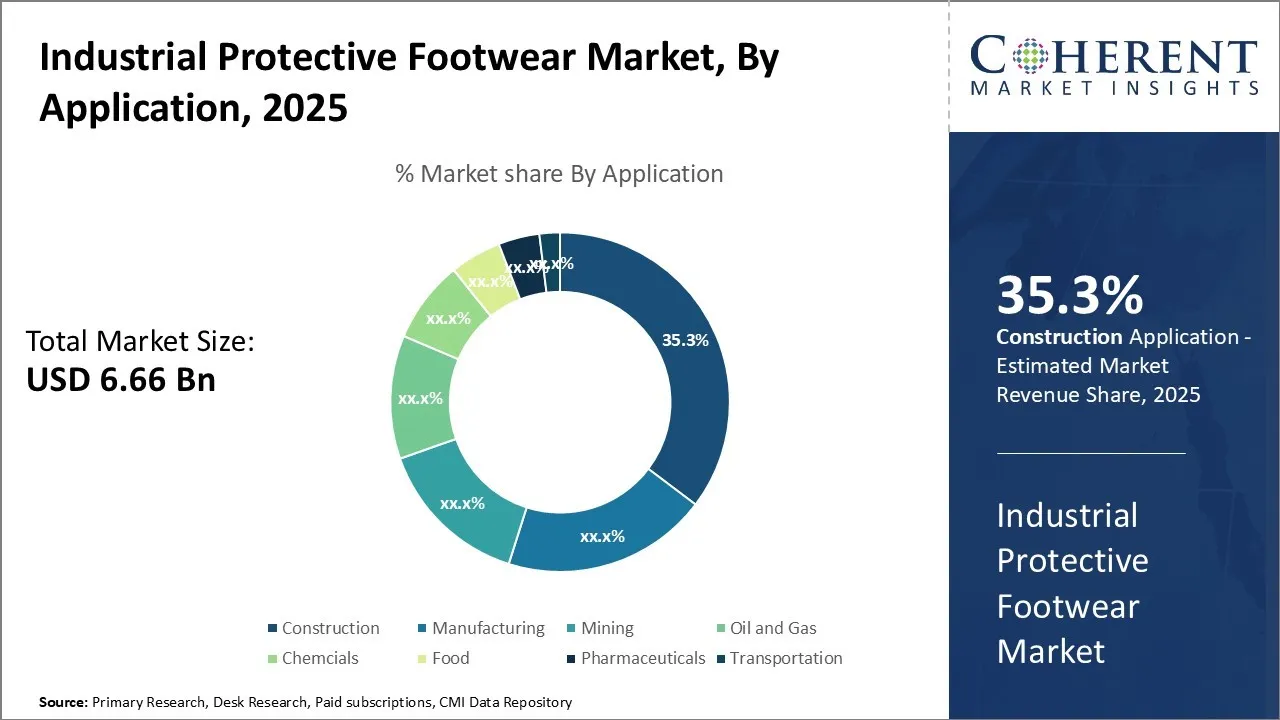
Global Industrial Protective Footwear Market Insights, By Application
The application segment is sub-segmented into construction, manufacturing, mining, logistics, and others. The construction segment is anticipated to hold the largest market share of 36.3% in terms of value in 2026. This dominance is driven by the high demand for protective footwear in construction sites, where worker safety is critical due to exposure to hazards such as heavy machinery, sharp objects, and falling debris.
Construction workers require footwear that offers superior protection against impacts, punctures, and slips, while also providing comfort for long hours on site. Strict safety regulations and industry standards in construction-heavy economies further reinforce the use of certified protective footwear. Ongoing infrastructure development projects and urbanization trends globally continue to propel the need for durable, compliant footwear tailored specifically for the construction sector.
The segment’s growth is supported by technological advancements in materials and ergonomic design, which enhance both protection and wearability, thereby reducing workplace injuries and improving productivity. As safety remains a top priority in construction, protective footwear continues to be an essential component of personal protective equipment (PPE).
Regional Insights
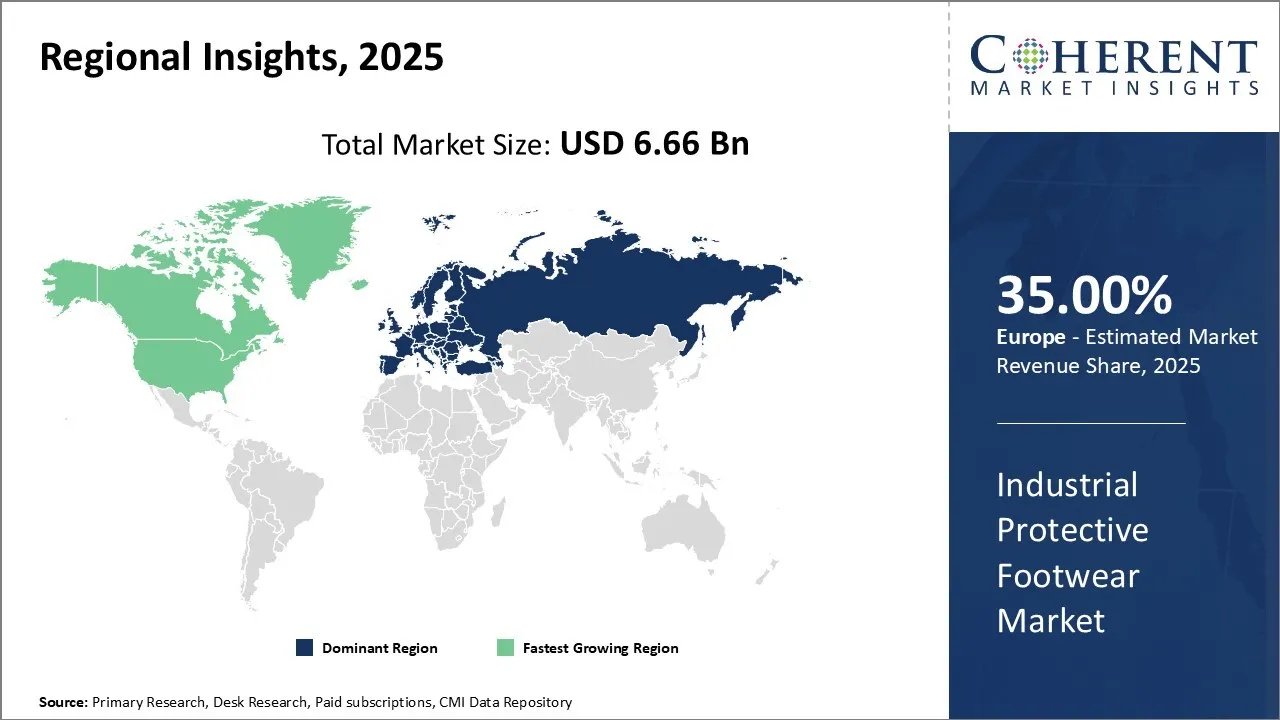
Europe Industrial Protective Footwear Market Analysis and Trends
Europe is projected to lead the global industrial protective footwear market in 2026, capturing an estimated 35.00% share by value. This dominance is supported by well-established industrial safety standards, a mature manufacturing base, and stringent occupational health regulations enforced across sectors such as construction, manufacturing, mining, and logistics. Countries like Germany, France, and the U.K. maintain strict compliance with EN ISO 20345 standards, driving consistent demand for certified protective footwear.
The presence of globally recognized brands and manufacturers—many headquartered within Europe further enhances product availability and innovation. Companies are actively investing in ergonomic designs, advanced materials, and sustainability-driven production methods to align with both safety requirements and environmental regulations. Strong distribution networks and high worker awareness regarding safety protocols contribute to sustained market leadership.
In addition, growing emphasis on workplace safety culture, coupled with ongoing industrial modernization, supports continuous demand for durable and compliant protective footwear across the region’s diverse workforce.
North America Industrial Protective Footwear Market Analysis and Trends
North America ranks as the second-largest market for industrial protective footwear, driven by rigorous safety regulations enforced by agencies such as OSHA and ANSI. The United States and Canada maintain high safety standards in sectors like construction, oil & gas, and warehousing, where foot protection is mandatory. Market growth is also supported by technological innovation, with U.S. based companies focusing on lightweight, breathable, and impact-resistant footwear designs.
Strong adoption of automation and smart manufacturing technologies necessitates updated protective equipment, including specialized footwear. Additionally, the presence of leading manufacturers, widespread awareness campaigns, and investments in safety training contribute to consistent demand across the region.
Asia Pacific Industrial Protective Footwear Market Analysis and Trends
Asia Pacific is positioned as a high-potential growth market for industrial protective footwear, spurred by rapid industrialization, infrastructure development, and rising worker safety awareness. Countries such as China, India, and Southeast Asian nations are witnessing expansion in manufacturing, construction, and energy sectors, creating new opportunities for protective footwear suppliers.
Local governments are increasingly enforcing workplace safety regulations, and multinational companies are driving best practices through joint ventures and regional operations. Affordability, availability of raw materials, and expanding labor-intensive industries further support market penetration. As international brands continue to invest in localized production and distribution, Asia Pacific is expected to see strong growth momentum in the years ahead.
Dominating Countries in the Industrial Protective Footwear Market
Germany Industrial Protective Footwear Market Analysis and Trends
Germany leads the European industrial protective footwear market with its highly regulated industrial sector and emphasis on worker safety. The country’s strong manufacturing base, especially in automotive and heavy industries, creates consistent demand for advanced protective footwear. German manufacturers are known for innovation and compliance with strict EU safety standards.
United Kingdom Industrial Protective Footwear Market Analysis and Trends
The U.K. maintains a significant share in the European market, supported by comprehensive workplace safety legislation and a diverse industrial landscape. Demand is driven by construction, manufacturing, and energy sectors where compliance with safety standards is mandatory.
United States Industrial Protective Footwear Market Analysis and Trends
The U.S. is the largest market in North America, propelled by rigorous OSHA safety regulations and a focus on worker protection in high-risk industries. Innovation in materials and ergonomic designs supports continued growth, along with extensive safety training programs and industry certifications.
China Industrial Protective Footwear Market Analysis and Trends
China is the fastest-growing country market in Asia Pacific, driven by rapid industrialization and urban infrastructure projects. Increasing enforcement of safety regulations and rising foreign direct investment have expanded demand for certified protective footwear across manufacturing, construction, and mining sectors.
India Industrial Protective Footwear Market Analysis and Trends
India’s growing industrial base and government initiatives to improve worker safety underpin market expansion. The rising construction activity and growth in manufacturing industries create sustained demand for cost-effective and compliant protective footwear solutions.
Market Report Scope
Industrial Protective Footwear Market Report Coverage
| Report Coverage | Details | ||
|---|---|---|---|
| Base Year: | 2025 | Market Size in 2026: | USD 7.21 Bn |
| Historical Data for: | 2020 To 2024 | Forecast Period: | 2026 To 2033 |
| Forecast Period 2026 to 2033 CAGR: | 8.2% | 2033 Value Projection: | USD 12.51 Bn |
| Geographies covered: |
| ||
| Segments covered: |
| ||
| Companies covered: | JAL Group, COFRA Holding AG, ELTEN GmbH, Oftenrich Holdings Company Limited (Golden Chang), Honeywell Safety Products, Rahman Group, Rock Fall Ltd., Saina Group Co. Ltd., and VF Corporation | ||
| Growth Drivers: |
| ||
| Restraints & Challenges: |
| ||
Global Industrial Protective Footwear Market: Growth Drivers
Rapidly expanding end-use industries
A growing number of various manufacturing industries and rising awareness regarding the benefits of protective footwear is projected to fuel the market growth. Favorable conditions such as low capital, low labor cost, and easy availability of the raw materials are also expected to foster the market growth of industrial protective footwear. All these factors are projected to propel the market growth of industrial protective footwear.
Industrial Protective Footwear Market Trends
Introduction of the online retail has enabled options for consumers to purchase products at their convenience. This is expected to be a major trend in the market. VF Corporation and Honeywell are two key players that offer products online. The growing trend of online shopping coupled with the growing awareness regarding safety shoes is projected to foster the market growth of industrial protective footwear over the forecast period.
Industrial Protective Footwear Market Opportunity
The advent of advanced protective footwear due to technological advancements is expected to bring new market growth opportunities to the market of industrial protective footwear.
Increasing fatal accidents in the construction industry are driving the demand for personal care protection equipment and this is expected to boost opportunities for the market. This is also attributed to growth in the construction industry due to the increasing construction of new buildings and remodeling of infrastructure across developing regions. Thus, the growing demand for personal care protective equipment in the construction industry is expected to foster the market growth of industrial protective footwear.
Analyst Viewpoint
- The industrial protective footwear market is gaining strong traction, propelled by rigorous workplace safety regulations and increased awareness of occupational hazards across key sectors such as manufacturing, construction, and oil & gas. Rising incidents of workplace injuries and evolving safety standards are compelling organizations to invest in advanced protective footwear. Innovations like composite toe caps, puncture-resistant midsoles, and slip-resistant outsoles are enhancing product performance to meet diverse industrial needs.
- However, growth is challenged by high product costs and limited awareness in developing regions, where traditional footwear often remains the preferred choice. Additionally, price sensitivity among small and medium enterprises restricts wider adoption, especially in emerging cost-conscious markets.
- The market offers significant opportunities through technological advancements, including smart footwear integrated with IoT sensors that enable real-time monitoring of worker safety parameters. Increasing focus on ergonomic, lightweight designs further supports product differentiation and customer acceptance.
- Regionally, Europe leads due to well-established regulatory frameworks, mature industrial infrastructure, and a strong culture of worker safety, sustaining steady demand. Meanwhile, North America followed by Asia-Pacific is the fastest-growing market, driven by rapid industrialization, expanding manufacturing sectors, and heightened regulatory enforcement. Countries such as China and India are experiencing accelerated adoption as multinational companies implement standardized global safety protocols.
Global Industrial Protective Footwear Market: Key Developments
- In August 2022, Mallcom India Limited, India’s first integrated manufacturer of Head-to-Toe Personal Protection Equipment, entered a new segment with the introduction of aesthetically designed lifestyle safety shoes — “FREDDIE”.
- In September 2023, Cat Footwear launched its new Invader Mid Vent - a shoe that boasts unbeatable traction, unmatched style, and unwavering confidence.
- In September 2022, Simac, the international machinery and technology exhibition for shoes, will once again be opening its doors. Also, This year BASF (hall 14 booth, F33/F37/G34/G38) will exhibit its wide range of new solutions for the shoe industry: a concept shoe made entirely out of BASF materials, boots which stay soft even at minus 40 degrees, light and high rebound soles for safety shoes and sustainable footwear solutions. On top BASF will present 3D printed shoes as well as coatings solutions to protect the soles.
- In February 2022, ISM, the international building trade fair BOUWBEURS took place in Utrecht from February 6th to 10th, 2023. More than 675 exhibitors presented their products, services, or current trends in the field of construction and brought together exhibitors and interested parties from the areas of interior design, wood, building materials, commercial vehicles, safety, workwear, and others.
Market Segmentation
- Global Industrial Protective Footwear Market, By Type (Revenue, USD Bn, 2021 - 2033)
- Leather footwear
- Waterproof footwear
- Rubber footwear
- Plastic footwear
- Global Industrial Protective Footwear Market, By Application (Revenue, USD Bn, 2021 - 2033)
- Construction
- Manufacturing
- Mining
- Oil and Gas
- Chemicals
- Food
- Pharmaceuticals
- Transportation
- Global Industrial Protective Footwear Market, By Region (Revenue, USD Bn, 2021 - 2033)
- North America
- U.S.
- Canada
- Latin America
- Brazil
- Argentina
- Mexico
- Rest of Latin America
- Europe
- Germany
- U.K.
- Spain
- France
- Italy
- Russia
- Rest of Europe
- Asia Pacific
- China
- India
- Japan
- Australia
- South Korea
- ASEAN
- Rest of Asia Pacific
- Middle East
- GCC Countries
- Israel
- Rest of Middle East
- Africa
- South Africa
- North Africa
- Central Africa
- North America
- Company Profiles
- JAL Group
- COFRA Holding AG
- ELTEN GmbH
- Oftenrich Holdings Company Limited (Golden Chang)
- Honeywell Safety Products
- Rahman Group
- Rock Fall Ltd.
- Saina Group Co. Ltd.
- VF Corporation
Sources
Primary Research Interviews
- Safety Equipment Manufacturers
- Industrial Safety Managers
- Occupational Health & Safety Consultants
- Footwear Distribution Partners
- Others
Magazines
- Industrial Safety & Hygiene News
- Occupational Health & Safety Magazine
- Safety+Health Magazine
- Footwear News Industrial Section
- Others
Journals
- Journal of Safety Research
- International Journal of Industrial Ergonomics
- Applied Ergonomics Journal
- Others
Newspapers
- Financial Times (Industrial Safety Section)
- The Wall Street Journal (Manufacturing & Safety)
- Industrial Safety & Security Source
- Manufacturing Business Technology
- Others
Associations
- American Society of Safety Professionals (ASSP)
- International Safety Equipment Association (ISEA)
- Footwear Distributors and Retailers of America (FDRA)
- National Safety Council (NSC)
- Others
Public Domain Sources
- Occupational Safety and Health Administration (OSHA) Reports
- International Labour Organization (ILO) Publications
- European Agency for Safety and Health at Work
- National Institute for Occupational Safety and Health (NIOSH)
- Others
Proprietary Elements
- CMI Data Analytics Tool
- Proprietary CMI Existing Repository of information for last 8 years
Get access to 250+ pages report
Every segment, forecast, competitor profile and data table behind the analysis above — available for instant download.
- ESOMAR Member
- ISO 9001:2015 Certified
- D-U-N-S Registered
- GDPR & CCPA Compliant
Missing comfort of reading report in your local language? Find your preferred language:
Transform your Strategy with Exclusive Trending Reports
Frequently Asked Questions
The industrial protective footwear market size is estimated to be valued at USD 7.21 Bn in 2026, and is expected to reach USD 12.51 Bn by 2033.
The market for industrial protective footwear is estimated to surpass USD 12.51 Bn by 2033, exhibiting a CAGR of 8.2% between 2026 and 2033.
A growing number of manufacturing industries and rising awareness regarding the benefits of protective footwear are projected to fuel the market growth. Favorable conditions such as low capital, low labor cost, and easy availability of the raw materials are also expected to foster the market growth of industrial protective footwear. All these factors are projected to propel the market growth of industrial protective footwear.
The CAGR of the industrial protective footwear market is projected to be 8.2% from 2026 to 2033.
The key Companies are JAL Group, COFRA Holding AG, ELTEN GmbH, Oftenrich Holdings Company Limited (Golden Chang), Honeywell Safety Products, Rahman Group, Rock Fall Ltd., Saina Group Co. Ltd., and VF Corporation
Lack of awareness regarding the industrial protective footwear among employees in small and mid-sized industries is expected to hamper the market growth over the forecast period.