

Laboratory Accessories Market Size and Forecast — 2026-2033
The Global Laboratory Accessories Market size is estimated to be valued at USD 6.01 billion in 2026 and is expected to reach USD 9.84 billion by 2033, exhibiting a compound annual growth rate (CAGR) of 7.3% from 2026 to 2033.
Overview
Laboratory accessories comprise the essential tools and consumables that support accurate and safe experimental workflows in diagnostic and research laboratories. These products include pipettes, beakers, test tubes, racks, funnels, clamps, tubing, and microplates used for sample preparation, handling, and analysis. Modern accessories are engineered for precision, durability, and ergonomic efficiency, with many incorporating automation compatibility to align with high-throughput laboratory systems. The adoption of sterile, disposable materials and smart labeling solutions enhances traceability, reduces contamination risk, and ensures compliance with stringent laboratory quality standards.
Key Takeaways
In terms of product type, the glassware segment is dominating with a 39% market share, innovations in chemical-resistant coatings are driving demand within chemical and environmental analysis applications. Plasticware is the fastest-growing subsegment, gaining traction for single-use lab accessories owing to contamination control practices.
In the pharmaceutical & biotechnology application segment, the market sees steady expansion reinforced by continuous R&D investments and regulatory compliance mandates. Academic and research institutes are rapidly adopting advanced accessories, signaling upward market trends in this subsegment.
North America remains the leading region in the laboratory accessories market share due to high research activities and significant presence of pharmaceutical manufacturing, accounting for over 35% of total market revenue. Asia Pacific demonstrates the fastest growth with a robust CAGR supported by government initiatives to enhance scientific infrastructure and rising biotech startups.
Europe’s diversification in application and end-user industries promotes a balanced market share, with strong uptake in hospital diagnostic laboratories driven by growing healthcare expenditure.
Laboratory Accessories Market Segmentation Analysis
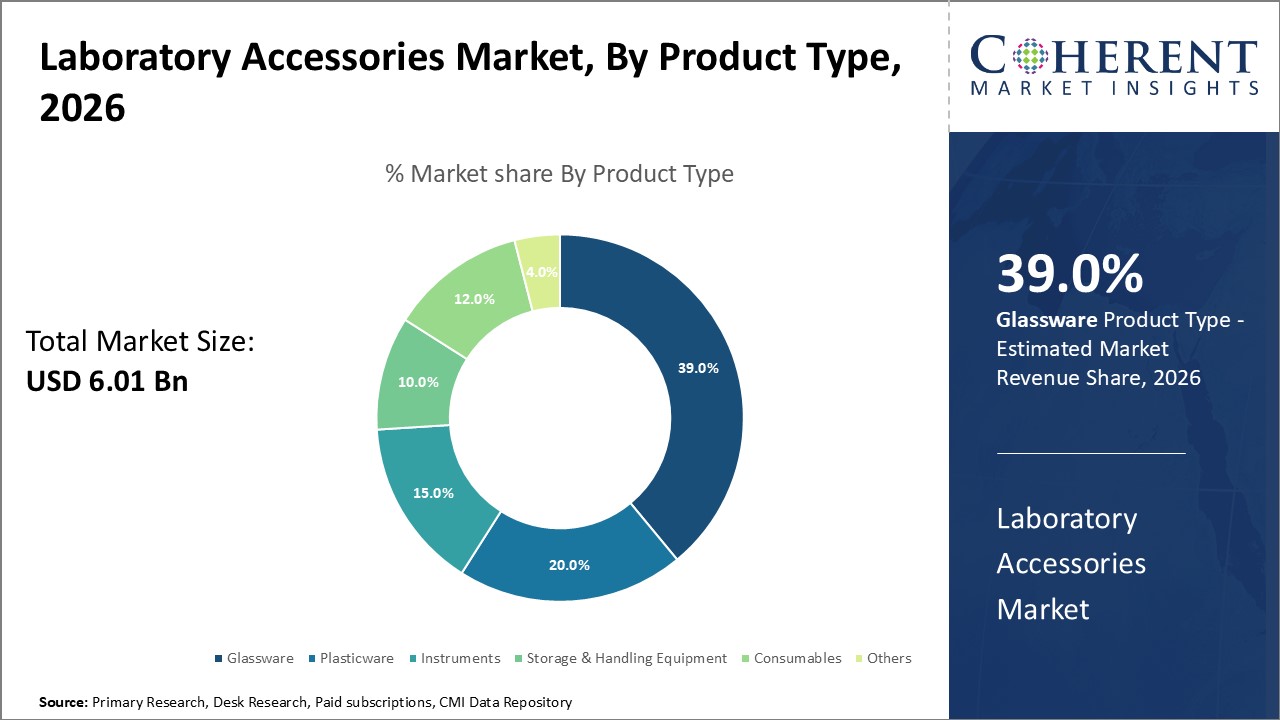
Laboratory Accessories Market Insights, By Product Type
Glassware dominates the market share with 39%. Glassware remains fundamental owing to its chemical inertness and accuracy in critical measurements, driving consistent demand, especially in chemical and environmental applications. Plasticware is the fastest-growing subsegment due to its lightweight properties and contamination control, preferred for single-use lab processes and biosafety protocols. Instruments cover essential accessories like pipettes and vortexers that aid laboratory operations, contributing steadily to market revenue. Storage & Handling Equipment subsegments provide solutions for efficient sample management.
Laboratory Accessories Market Insights, By Application
Pharmaceutical & Biotechnology dominate due to intensified drug development activities and biotechnology innovation requiring high precision accessories. Academic & Research Institutes are the fastest-growing sector as universities upgrade labs to cutting-edge standards, reflected in increased budgets and equipment procurement in 2025. Chemical & Environmental Analysis applications continue to rely heavily on durable glassware and consumables for regulatory compliance and safety. Food & Beverage Testing demands high-standard accessories to ensure quality and safety, maintaining a steady market share.
Laboratory Accessories Market Insights, By End-User
In terms of End users, the Hospitals & Diagnostic Laboratories hold market dominance attributable to expanding healthcare diagnostics and demand for reliable accessories supporting clinical testing. Contract Research Organizations are the fastest-growing end-user segment due to outsourcing trends in the pharmaceutical and biotech sectors, accelerating accessory procurement. Industrial Laboratories contribute significantly with a focus on quality control and material testing. Others include academic and government research facilities requiring specialized accessories for varied experimental setups, adding to the diversity and depth of the market landscape.
Laboratory Accessories Market Trends
The Laboratory Accessories Market is witnessing accelerated digitalization, whereby smart accessories embedded with IoT sensors enable enhanced tracking, improving laboratory workflow efficiency.
For example, in 2025, several North American laboratories adopted smart racks and automated inventory systems, boosting productivity by roughly 18%.
Furthermore, additive manufacturing applications for customized accessory solutions have gained momentum, particularly in academic research, allowing faster prototyping and reduced costs.
Sustainability is becoming a core trend, with notable investments in bio-based plastics that reduce toxic waste, aligning with global environmental policies.
Laboratory Accessories Market Insights, By Geography
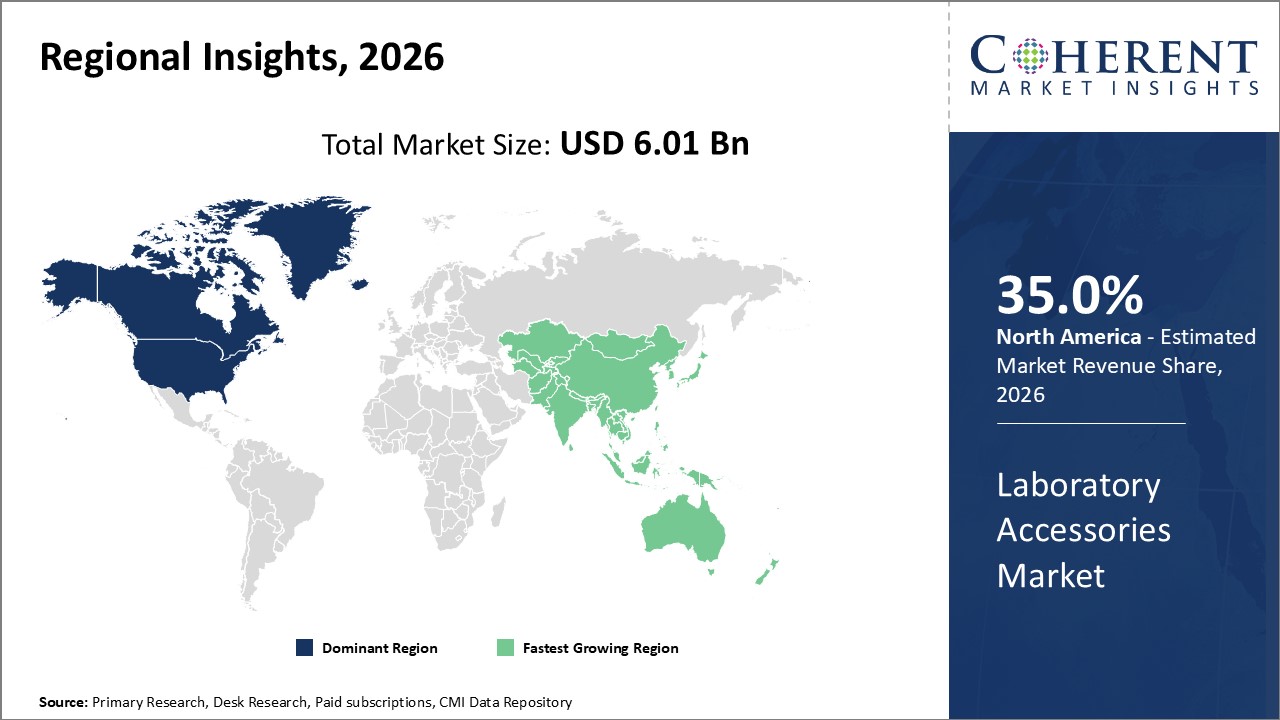
North America Laboratory Accessories Market Analysis and Trends
In North America, the dominance in the Laboratory Accessories Market is attributable to robust pharmaceutical R&D infrastructure and high adoption of advanced laboratory automation. The region accounts for approximately 35% market share, supported by substantial government funding and the presence of key market companies like Thermo Fisher Scientific and Sartorius AG. Enhanced regulatory standards in experimental laboratories further reinforce demand.
Asia Pacific Laboratory Accessories Market Analysis and Trends
Meanwhile, the Asia Pacific exhibits the fastest growth with a CAGR exceeding 9%, led by investments from countries like China and India in expanding biotech hubs and upgrading laboratory infrastructure. Government incentives for scientific innovation and the rise of contract research organizations are pivotal factors driving this rapid expansion. Major market companies have established manufacturing bases and distribution networks here, leveraging cost advantages and regional demand surges.
Laboratory Accessories Market Outlook for Key Countries
USA Laboratory Accessories Market Analysis and Trends
The USA’s Laboratory Accessories Market is driven by heightened pharmaceutical innovation and a growing number of high-throughput laboratories. Industry leaders such as Eppendorf AG and VWR International have expanded their offerings with smart accessories integrating AI and IoT capabilities in 2025, contributing to a 10% uplift in market revenue compared to the previous year. The country’s stringent regulatory framework also boosts demand for high-quality accessories compliant with FDA norms, making it a critical contributor to industry size and market growth.
China Laboratory Accessories Market Analysis and Trends
China’s Laboratory Accessories Market is rapidly expanding due to government-backed initiatives promoting biotech research and increased healthcare infrastructure investments. Local manufacturers are increasingly innovating with cost-effective and customized laboratory solutions to cater to domestic and export demands. In 2025, the country saw a surge in accessory imports by approximately 15%, indicating strong growth. Companies in China are also focusing on eco-friendly product development, enhancing business growth opportunities within the Asia Pacific market scope.
Analyst Opinion
The escalating adoption of automation tools in laboratories directly influences market size expansion. In 2025, laboratory automation systems contributed to a 13% increase in accessory demand due to improved throughput and contamination control evidenced by several biotech firms scaling operations. The shift toward automated liquid handling and sample preparation has boosted overall laboratory accessory requirements significantly.
Pricing dynamics have been a crucial micro-indicator shaping market revenue in 2026. Raw material cost fluctuations, particularly polymers and glass components, elevated accessory pricing by approximately 5% in the first two quarters, affecting supply chain mechanisms globally, especially in Asia Pacific manufacturing hubs. These price shifts have prompted manufacturers to adopt efficient cost management strategies to maintain market competitiveness.
The surge in import activities of laboratory glassware and plasticware in regions such as North America illustrates a growing demand pipeline from diversified end-use industries. For instance, imports increased by 8% in 2023 compared to the prior year, mainly driven by rising pharmaceutical testing requirements and academic institutions upgrading facilities.
Market growth strategies focusing on advanced material integration such as chemically resistant polymers have gained traction recently. In 2025, innovations in fluoropolymer blends enhanced accessory durability, fostering higher adoption rates in chemical and environmental testing setups, consistent with industry size growth trends.
- Current Industry Events of 2026
- Market Size Estimation
- Regional Breakdown
- Competitive Landscape
- Customer Intelligence
- Segmental Analysis
- Pricing Analysis
- Key Market Drivers, Challenges & Future Trends
- Customized Insights Section
Market Scope
| Report Coverage | Details | ||
|---|---|---|---|
| Base Year: | 2025 | Market Size in 2026: | USD 6.01 billion |
| Historical Data for: | 2020 To 2024 | Forecast Period: | 2026 To 2033 |
| Forecast Period 2026 to 2033 CAGR: | 7.3% | 2033 Value Projection: | USD 9.84 billion |
| Geographies covered: |
| ||
| Segments covered: |
| ||
| Companies covered: | Sartorius AG, Thermo Fisher Scientific Inc., Eppendorf AG, Cole-Parmer Instrument Company, DWK Life Sciences GmbH, Avantor Inc., Merck KGaA, VWR International LLC, Labconco Corporation, Corning Incorporated, Fisher Scientific. | ||
| Growth Drivers: |
| ||
Laboratory Accessories Market Growth Factors
The increasing focus on laboratory automation drives significant market growth as laboratories seek efficiency improvements in sample management and testing accuracy. The rise in pharmaceutical R&D activities, fueled by increased drug discovery efforts, continues to propel accessory demand, as demonstrated by a 9% year-over-year rise in accessory procurement by CROs in 2025. Additionally, regulatory frameworks emphasizing quality control in testing laboratories, such as more stringent FDA and EMA guidelines, are accelerating the adoption of high-performance laboratory accessories. Another strong growth driver is the shift toward green chemistry and sustainable laboratory practices, prompting the development of reusable and environmentally friendly accessories, a trend backed by rising investments reported in 2026.
Laboratory Accessories Market Development
In March 2026, Alkem Laboratories Ltd introduced its generic version of empagliflozin and its fixed-dose combinations in India under the brand name “Empanorm.” The compound is an SGLT-2 inhibitor indicated for type 2 diabetes mellitus (T2DM), chronic kidney disease (CKD) and chronic heart failure (HF). The launch features pricing approximately 81% lower than the innovator product, anti-counterfeit security bands on packaging, smaller tablet size for patient convenience, and rich patient-education materials (Hindi/English, QR-code access in 11 languages). This rollout underscores Alkem’s strategic expansion in its chronic-disease portfolio and its commitment to improving treatment accessibility.
In August 2026, the Navi Mumbai Municipal Corporation (NMMC) launched a digital “E-Water Quality Monitoring System” (WQMS) at its Environment Laboratory, marking a major enhancement in water-quality governance for the region. The system digitizes the entire sample workflow—from requisition to testing, approval and reporting—providing real-time dashboards, automatic alerts for re-inspection, and online report access with digital signatures for officials and citizens. The launch forms part of an effort to align with ISO standards and pursue NABL accreditation, reinforcing data-driven water-supply oversight in the NMMC area.
Key Players
Leading Companies of the Market
Sartorius AG
Thermo Fisher Scientific Inc.
Eppendorf AG
Cole-Parmer Instrument Company
DWK Life Sciences GmbH
Avantor Inc.
Merck KGaA
VWR International LLC
Corning Incorporated
Fisher Scientific
Several leading companies have recently adopted market growth strategies such as strategic mergers and collaborations. For example, Thermo Fisher’s acquisition of smaller niche accessory manufacturers in 2025 enabled expansion of its product portfolio and increased market share in precision instruments by 7%. Sartorius AG’s investment in R&D for eco-friendly and reusable laboratory accessories in 2023 has resulted in a 16% growth in its sustainable product line revenue, demonstrating a key business growth approach aligned with industry trends.
Laboratory Accessories Market Future Outlook
The next decade will see laboratory accessories evolve toward smart, automation-compatible, and sustainable designs. Integration of RFID tags, digital inventory tracking, and IoT-enabled storage systems will improve laboratory efficiency and compliance. Demand for eco-friendly materials and recyclable consumables will reshape production methods as laboratories aim for carbon neutrality. Customizable, 3D-printed lab tools and modular accessories are likely to gain traction, particularly in research institutions emphasizing flexibility and efficiency. The convergence of digitalization and sustainability will thus redefine how laboratory accessories are manufactured, used, and managed globally.
Laboratory Accessories Market Historical Analysis
Laboratory accessories have traditionally formed the backbone of scientific experimentation, with glassware, pipettes, and test tubes dominating laboratory operations since the early 20th century. Manual tools gave way to precision-engineered components with the rise of analytical instrumentation in the 1980s and 1990s. The growth of biopharmaceutical research, diagnostic automation, and biosafety protocols led to a shift from reusable to disposable and sterile plastic consumables. Material innovation, particularly in polymers, enhanced durability, chemical resistance, and sterility assurance. Over time, ergonomic design and compatibility with robotic systems became key drivers, ensuring seamless integration with automated laboratory equipment.
Sources
Primary Research Interviews:
Laboratory Managers
Biomedical Engineers
Pathology Technicians
R&D Scientists
Databases:
GlobalData Laboratory Equipment Reports
WHO Laboratory Infrastructure Data
MarketLine Instruments Database
NIH Research Facility Data
Magazines:
Laboratory Equipment Magazine
Clinical Lab Products
Medical Laboratory Observer
Lab Manager
Journals:
Journal of Laboratory Automation
Analytical Chemistry
Lab on a Chip
Nature Methods
Newspapers:
The Washington Post (Science)
The Guardian (Technology)
The Times of India (Health)
Bloomberg Science
Associations:
International Federation of Clinical Chemistry (IFCC)
American Association for Clinical Chemistry (AACC)
ISO
ASTM International
Get access to 250+ pages report
Every segment, forecast, competitor profile and data table behind the analysis above — available for instant download.
- ESOMAR Member
- ISO 9001:2015 Certified
- D-U-N-S Registered
- GDPR & CCPA Compliant
Missing comfort of reading report in your local language? Find your preferred language:
Transform your Strategy with Exclusive Trending Reports
Frequently Asked Questions
The dominant market players include Sartorius AG, Thermo Fisher Scientific Inc., Eppendorf AG, and Merck KGaA, all of whom have substantial product portfolios and innovative offerings driving the industry growth.
The market size is projected to reach USD 9.84 billion by 2033, driven by increased laboratory automation and rising pharmaceutical R&D expenditure.
The pharmaceutical and biotechnology sectors hold the largest growth opportunity due to escalating drug discovery programs and stringent compliance requirements.
The trends are likely to focus on IoT-enabled accessories, 3D printed products, and sustainable materials, reflecting emerging technology adoption and environmental considerations.
The market comprises established global players competing on innovation and quality, while challenges include raw material cost volatility and regulatory compliance complexities.
Strategies include acquisitions, product portfolio expansion, R&D investment for sustainability, and geographic market penetration focusing on emerging economies.