

Malaria Vaccines Market Analysis & Forecast
The Global Malaria Vaccines Market is estimated to be valued at USD 700.0 Mn in 2026 and is expected to reach USD 1,636.6 Mn by 2033, exhibiting a compound annual growth rate (CAGR) of 12.9% from 2026 to 2033.
Key Takeaways of the Malaria Vaccines Market
- Based on Vaccine Type, The Pre-Erythrocytic Vaccines Segment is expected to contribute the highest share of the market with 43.6% in 2026
- Based on Agent, The Plasmodium Falciparum Segment is expected to contribute the highest share of the market with 47.1% in 2026
- Based on Age, The Pediatric Segment is expected to contribute the highest share of the market with 53.8% in 2026
- North America is expected to top the global market with 38.9% share, followed by Asia Pacific with 28.2% share in 2026
Market Overview
The global Malaria Vaccines Market is witnessing robust growth, driven by rising incidences of malaria in endemic regions, increased funding for vaccine development, and growing public health initiatives. Advancements in antigen identification and targeted vaccine technologies are accelerating market expansion. The focus on paediatric immunization, especially in high-burden countries, is further propelling demand. North America leads in R&D and pharmaceutical innovation, while regions such as Africa and Asia Pacific are expected to see the highest deployment due to large vulnerable populations.
Current Events and its Impact on the Malaria Vaccines Market
Current Event | Description and its impact |
WHO Approvals and Global Endorsements |
|
Government and International Funding Initiatives |
|
Manufacturing and Supply Chain Expansion |
|
Pipeline Analysis: Malaria Vaccines Market
The malaria vaccines market features a dynamic pipeline comprising several promising candidates in various stages of clinical development. Following the landmark WHO recommendation of RTS,S/AS01 (Mosquirix) for broad use in 2021, additional vaccines such as R21/Matrix-M are progressing rapidly through Phase III trials, showing higher efficacy and potential for wider adoption.
Key players including Oxford University, Bharat Biotech, and GSK are actively expanding trials across malaria-endemic regions like sub-Saharan Africa and South Asia. Novel vaccine platforms, including mRNA-based and transmission-blocking vaccines, are also under investigation to enhance protection and interrupt parasite transmission cycles.
Public-private partnerships involving entities such as PATH, Gavi, and CEPI are providing critical funding and logistical support, accelerating R&D. The pipeline reflects a shift toward multi-stage and multivalent vaccines aimed at improving durability and coverage. Continued innovation and regulatory support are expected to expand the commercial and humanitarian impact of malaria vaccines globally.
- Current Industry Events of 2026
- Market Size Estimation
- Regional Breakdown
- Competitive Landscape
- Customer Intelligence
- Segmental Analysis
- Pricing Analysis
- Key Market Drivers, Challenges & Future Trends
- Customized Insights Section
Patent Landscape: Malaria Vaccines Market
The patent landscape of the malaria vaccines market is characterized by a steady rise in intellectual property filings, reflecting growing innovation in antigen discovery, adjuvant technologies, and novel delivery platforms. Major pharmaceutical companies like GlaxoSmithKline, Bharat Biotech, and emerging biotech firms are securing patents for multi-stage malaria vaccine formulations, including liver-stage, blood-stage, and transmission-blocking candidates.
Notably, patents for the RTS,S/AS01 vaccine, owned by GSK and PATH, protect key components such as the circumsporozoite protein and AS01 adjuvant system. New entrants like the R21/Matrix-M vaccine, developed by Oxford University and Serum Institute of India, are also contributing to the evolving IP landscape.
Additionally, patents related to mRNA-based platforms and nanoparticle carriers are emerging, potentially broadening future vaccine strategies. The majority of filings originate from the U.S., Europe, China, and India. This expanding patent portfolio underlines competitive intensity, fosters collaboration, and supports market exclusivity for next-generation malaria vaccine developers.
Reimbursement Scenario: Malaria Vaccines Market
Globally, malaria vaccines remain low-cost or free at the point of care in endemic countries, typically funded by governments, Gavi, and the Global Fund. Many African and Southeast Asian national immunization programs incorporate WHO-recommended vaccines like RTS,S/AS01 and R21/Matrix-M into routine schedules, ensuring government or donor reimbursement for procurement, distribution, and administration.
In non-endemic regions such as North America and Europe, malaria vaccines are not publicly reimbursed due to the absence of local transmission, but limited-use travel vaccines may be covered by private insurers or employer-sponsored travel health plans.
As RTS,S receives wider WHO endorsement and R21 nears approval, Gavi's expanded investment safeguards funding continuity through 2028, reducing financial uncertainty for low-income countries. Public-private partnerships and volume-based procurement are lowering per-dose costs over time. Future inclusion of transmission-blocking and mRNA-based candidates could require new assessment frameworks and pricing negotiations, potentially involving tiered pricing and co-financing models to balance affordability and recovery of development costs.
Malaria Vaccines Market Trends
- Increasing prevalence of malaria in endemic regions
Malaria continues to be a major challenge for many developing nations, particularly in sub-Saharan Africa. For decades, the disease has burdened these resource-limited regions, hindered economic growth and caused preventable deaths year after year. While efforts have been made to curb the spread through vector control measures and anti-malarial drugs, the complex transmission dynamics and ever-evolving parasite resistance poses a constant challenge.
In December 2021, according to data from WHO, there were an estimated 241 million cases of malaria in 2020 compared to 227 million cases in 2019, maintaining an unacceptable status-quo. Most casualties occurred among children in Africa, the group most vulnerable to its severe complications. Prospering nations have long gained control through sustained strategies but for many tropical and subtropical developing countries, malaria remains entrenched in their healthcare systems, social fabric, and national economy.
In May 2024, The Times of India covered the Serum Institute of India’s shipment of 43,200 doses of the R21/Matrix-M malaria vaccine to African nations, marking the first delivery batch. This vaccine, co-developed with the University of Oxford and using Novavax’s Matrix-M adjuvant, follows a WHO recommendation and aims to bridge supply gaps.
Opportunities in the Malaria Vaccines Market
- Rising focus on public health initiatives and malaria elimination programs
One of the major opportunities for the global malaria vaccines market is the rising focus on public health initiatives and malaria elimination programs around the world. Governments and international organizations have intensified efforts towards eradicating malaria through a combination of preventive, diagnostic, and treatment measures. Mass drug testing administration campaigns, insecticide treated bed nets, and rapid diagnostic tests are being scaled up through sustained funding.
Global initiatives like the WHO's Global Technical Strategy have provided an impetus towards introducing malaria vaccines as an additional control tool. Increased advocacy and large donation-funded pilot programs also aim to develop sustainable commercial models. Successful development of even a partially effective vaccine against the deadliest Plasmodium Falciparum parasite could significantly boost such public health efforts. This presents considerable commercial opportunities for malaria vaccine manufacturers in partnering with governments and global health agencies.
Segmental Insights
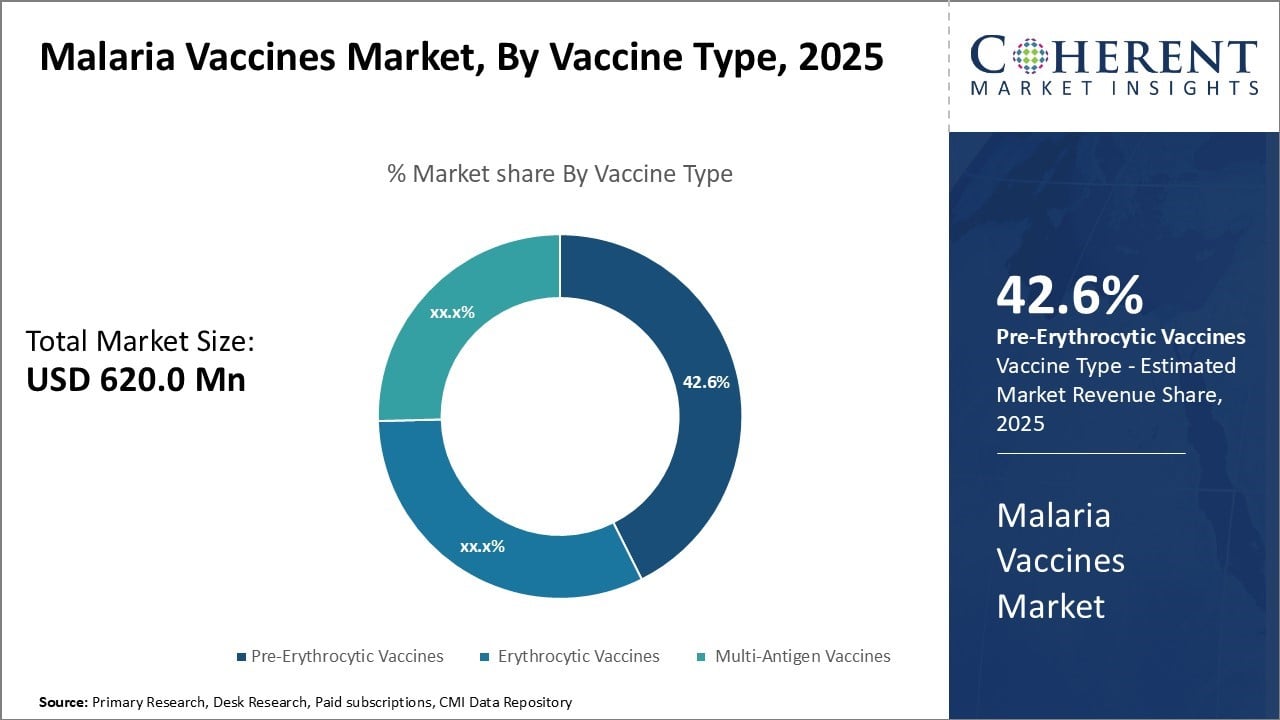
Malaria Vaccine Market Insights, By Vaccine Type
The pre-erythrocytic vaccines segment is projected to dominate the global malaria vaccines market in 2026, accounting for 43.6% of the total share. This commanding position stems from advancements in antigen identification and cultivation techniques specifically targeting the liver stage of the malaria parasite's lifecycle. These vaccines stimulate strong immune responses before the parasite enters the bloodstream, offering critical preventive protection.
Global health authorities and immunization programs increasingly favor these vaccines due to their high efficacy in early-stage prevention, aligning with the broader strategy of reducing infection incidence rather than managing treatment post-infection. As clinical trials and WHO endorsements strengthen confidence, the segment continues to attract research investments and policy-level support, reinforcing its dominant market position.
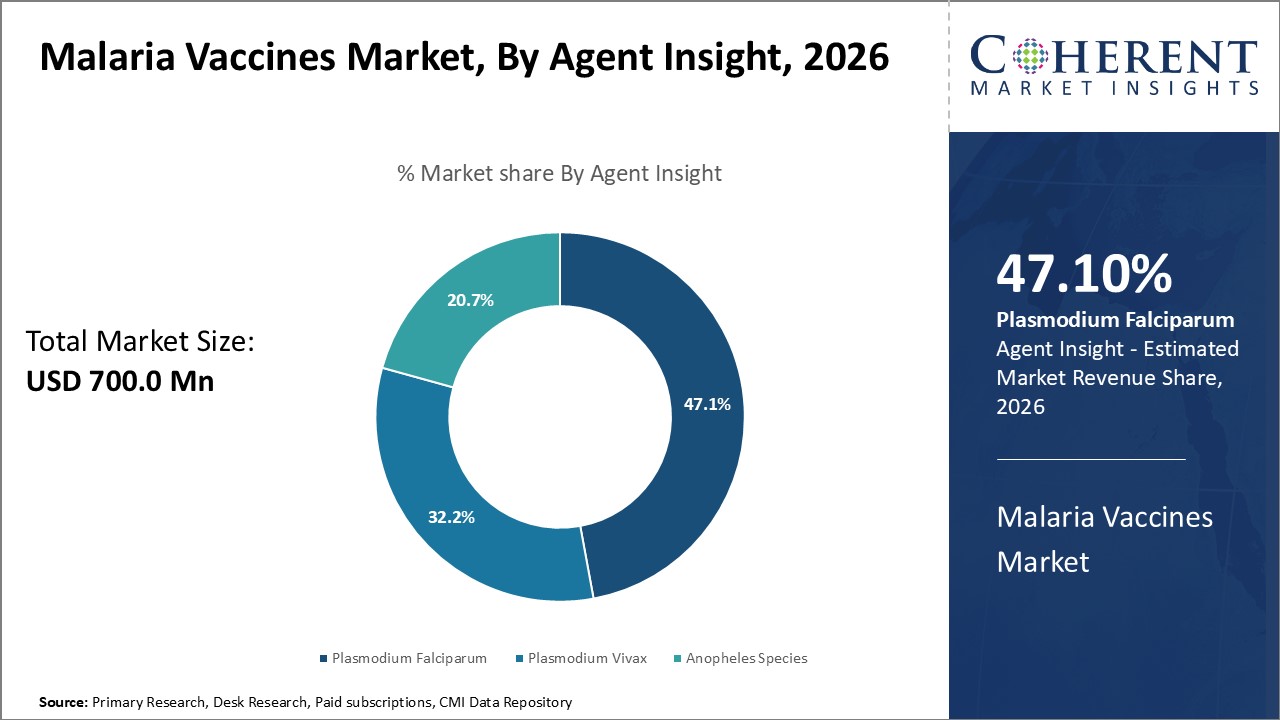
Malaria Vaccine Market Insights, By Agent Insight
The Plasmodium falciparum segment is expected to hold the largest share of the malaria vaccines market at 47.1% in 2026. This dominance is driven by the global burden posed by this parasite, which is responsible for the deadliest and most widespread malaria infections, particularly across sub-Saharan Africa.
Vaccine development efforts are increasingly targeted toward agent-specific formulations capable of neutralizing P. falciparum, given its resistance patterns and severe health outcomes. Public-private partnerships, international funding initiatives, and focused R&D pipelines are accelerating innovation in this space, bolstering the segment’s growth and ensuring it remains the central focus of eradication strategies.
Malaria Vaccine Market Insights, By Age Insight
The paediatric segment is anticipated to account for the highest market share of 53.8% in 2026, reflecting the global prioritization of early childhood immunization in regions with high malaria prevalence. Infants and children under five years of age are at the greatest risk of severe malaria-related complications and mortality, making them the primary beneficiaries of vaccination programs.
Inclusion of malaria vaccines in national childhood immunization schedules and funding from global health agencies such as Gavi and UNICEF have significantly expanded access and coverage. As governments strengthen healthcare infrastructure and outreach efforts, the paediatric segment is poised to drive long-term demand, reinforcing its leadership in the market.
Regional Insights
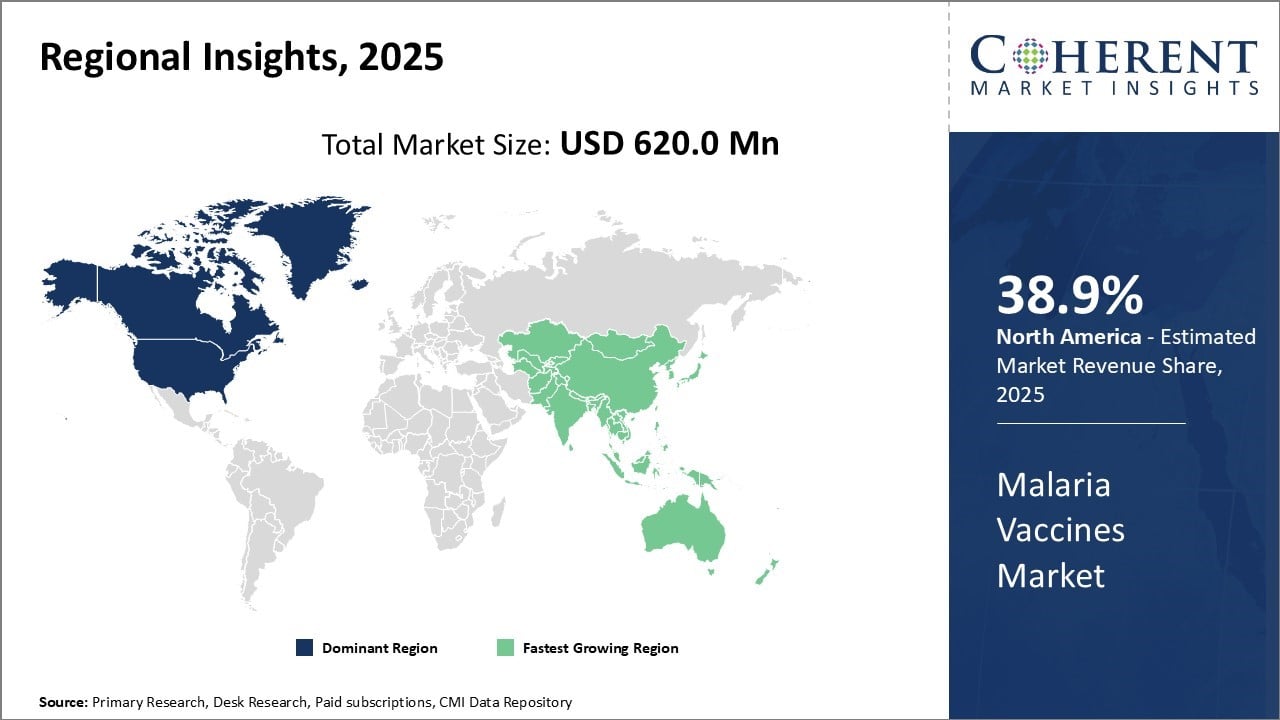
North America Malaria Vaccines Market Trends and Analysis
North America is projected to lead the malaria vaccines market in 2026, holding a dominant 38.9% share. This regional leadership is driven by the presence of major pharmaceutical and biotechnology companies actively engaged in vaccine development, alongside strong governmental support for tropical disease research.
Favourable regulatory environments enable accelerated clinical trials and swift approvals, while strategic collaborations with international health agencies, such as the WHO and Gavi, bolster funding and innovation.
Despite not being a malaria-endemic region, North America plays a critical role in the global malaria vaccine ecosystem through R&D leadership, advanced manufacturing capabilities, and supply chain logistics. This proactive role ensures the region remains at the forefront of global vaccine advancements.
Asia Pacific Malaria Vaccines Market Trends and Analysis
Asia Pacific is rapidly emerging as a critical region for malaria vaccine deployment and adoption, particularly across Southeast Asia and parts of South Asia where malaria remains endemic. Countries like India and Indonesia are intensifying their focus on malaria elimination through public health campaigns and immunization initiatives, thereby driving vaccine demand.
Government-backed malaria eradication programs, rising healthcare expenditures, and international support from global health organizations are fostering rapid market growth. In addition to deployment, regional R&D activities are also increasing, with local manufacturers contributing to cost-effective production solutions tailored to regional needs. The region’s population size and endemicity make it a pivotal driver of market expansion.
Malaria Vaccines Market Dominating Countries
United States and Canada
The United States plays a leading role in the global malaria vaccines market, largely due to its robust pharmaceutical sector and government-backed initiatives supporting vaccine research and innovation. Organizations like the NIH and the Bill & Melinda Gates Foundation actively fund malaria vaccine development programs.
Additionally, the U.S. FDA's expedited approval processes and partnerships with the WHO and PATH facilitate the rapid advancement of novel malaria vaccines. Despite the low domestic incidence of malaria, the U.S. remains central to global R&D, clinical trials, and supply chain distribution networks.
Canada also contributes significantly to the malaria vaccines landscape, particularly through its investments in global health initiatives and biotechnology research. Canadian institutions and pharmaceutical companies collaborate with international bodies to develop and test vaccines aimed at high-burden regions.
The Canadian government’s commitment to global infectious disease control bolsters funding for vaccine R&D, while its regulatory system supports efficient international deployment strategies, strengthening North America’s leadership in this space.
Market Report Scope
Malaria Vaccines Market Report Coverage
| Report Coverage | Details | ||
|---|---|---|---|
| Base Year: | 2025 | Market Size in 2026: | USD 700.0 Mn |
| Historical Data for: | 2020 To 2024 | Forecast Period: | 2026 To 2033 |
| Forecast Period 2026 to 2033 CAGR: | 12.9% | 2033 Value Projection: | USD 1,636.6 Mn |
| Geographies covered: |
| ||
| Segments covered: |
| ||
| Companies covered: | GlaxoSmithKline plc, Sanaria Inc., Nobelpharma Co., Sumaya Biotech, GenVec, Merck & Co., Inc., Pfizer Inc., Johnson & Johnson, Bharat Biotech, Serum Institute of India, Takeda Pharmaceutical Company, Novavax, Inc., Inovio Pharmaceuticals, Vaxart, Inc., and BioNTech SE | ||
| Growth Drivers: |
| ||
| Restraints & Challenges: |
| ||
Analyst Viewpoint – Malaria Vaccines Market
- Analysts express a strongly positive outlook for the global malaria vaccines market, fuelled by increasing global efforts to combat malaria through immunization. The recent WHO prequalification and wider adoption of vaccines such as RTS,S/AS01 and the promising R21/Matrix-M candidate have generated momentum, especially in malaria-endemic regions. Growing support from global health organizations, including Gavi, the Global Fund, and UNICEF, reinforces market growth prospects.
- Experts note that the market is shifting towards large-scale paediatric immunization programs, with governments and NGOs prioritizing vaccine deployment among children in sub-Saharan Africa and parts of Asia. Continued R&D focused on multistage, transmission-blocking, and mRNA-based malaria vaccines is expected to diversify the pipeline and enhance vaccine efficacy and durability.
- Regionally, North America remains the innovation hub due to its robust pharmaceutical ecosystem, while Asia Pacific and Africa are projected as the primary deployment markets. Analysts anticipate sustained expansion, driven by public-private collaborations, rising health investments, and global disease eradication goals.
Malaria Vaccines Market: Key Development
- In April 2025, nineteen African nations—including Nigeria, Kenya, Ghana, Uganda, and Cameroon—began rolling out WHO-prequalified malaria vaccines (RTS,S and R21/Matrix‑M) via routine childhood immunization programs. This marks a pivotal transition from pilot projects to national-scale implementation, significantly boosting vaccine demand and embedding malaria immunization into public health frameworks.
- In March 2025, the OPT-MVAC Africa–Europe consortium formed to optimize malaria vaccine uptake across 14 Central and West African countries. By facilitating best practices in distribution, community messaging, and integrated prevention approaches, the consortium enhances program efficiency and supports broader adoption in endemic zones.
- In February 2025, the Serum Institute of India announced plans to double its annual production capacity for the R21/Matrix-M vaccine—from 100 million to 200 million doses—to meet rising global demand. Scaling manufacturing addresses earlier vaccine shortages, lowers unit costs, and strengthens supply chains targeting Africa and Southeast Asia.
- In November 2024, the World Health Organization granted prequalification status to R21/Matrix‑M, making it the second WHO-endorsed malaria vaccine. This enables procurement via UN channels (e.g., UNICEF, Gavi), accelerating global rollout and expanding vaccine accessibility and funding opportunities.
- In January 2024, Cameroon became the first country to integrate malaria vaccines into its routine national immunization program, beginning with RTS,S/AS01 on January 22 in prioritized high-risk districts. As a trailblazer in transitioning from pilot trials to nationwide implementation, Cameroon set a regulatory and operational precedent for other African countries to follow.
Market Segmentation
- Vaccine Type Insights (Revenue, USD Mn, 2021 - 2033)
- Pre-Erythrocytic Vaccines
- Erythrocytic Vaccines
- Multi-Antigen Vaccines
- Agent Insights (Revenue, USD Mn, 2021 - 2033)
- Plasmodium Falciparum
- Plasmodium Vivax
- Anopheles Species
- Age Insights (Revenue, USD Mn, 2021 - 2033)
- Pediatric
- Adult
- Distribution Channel Insights (Revenue, USD Mn, 2021 - 2033)
- Public
- Private
- End Users Insights (Revenue, USD Mn, 2021 - 2033)
- Hospitals
- Specialty Clinics
- Community Health Centers
- Homecare
- Regional Insights (Revenue, USD Mn, 2021 - 2033)
- North America
- U.S.
- Canada
- Latin America
- Brazil
- Argentina
- Mexico
- Rest of Latin America
- Europe
- Germany
- U.K.
- Spain
- France
- Italy
- Russia
- Rest of Europe
- Asia Pacific
- China
- India
- Japan
- Australia
- South Korea
- ASEAN
- Rest of Asia Pacific
- Middle East
- GCC Countries
- Israel
- Rest of Middle East
- Africa
- South Africa
- North Africa
- Central Africa
- North America
- Key Players Insights
- GlaxoSmithKline plc
- Sanaria Inc.
- Nobelpharma Co.
- Sumaya Biotech
- GenVec
- Merck & Co., Inc.
- Pfizer Inc.
- Johnson & Johnson
- Bharat Biotech
- Serum Institute of India
- Takeda Pharmaceutical Company
- Novavax, Inc.
- Inovio Pharmaceuticals
- Vaxart, Inc.
- BioNTech SE
Sources
The Stakeholders Consulted
- Public health officials and malaria program directors
- Representatives from ministries of health in endemic countries
- Vaccine developers and biotechnology firms
- NGOs and global health organizations (e.g., Gavi, PATH, WHO)
- Clinical researchers and tropical disease specialists
- Representatives from immunization logistics and supply chain management
- Procurement managers from international donor agencies
- Pediatricians and infectious disease experts in endemic and non-endemic regions
Databases Opened
- World Health Organization (WHO) – Malaria Data and Vaccine Reports
- UNICEF – Immunization Coverage Statistics
- Gavi, the Vaccine Alliance – Vaccine Access and Funding Databases
- PATH – Malaria Vaccine Implementation Program (MVIP) Resources
- World Bank Open Data – Health and Disease Burden Indicators
Magazines & Trade Publications
- The Lancet Infectious Diseases
- Vaccine – Journal from Elsevier
- Global Health Now – Johns Hopkins Bloomberg School of Public Health
- Nature Reviews Immunology
- STAT News – Vaccines and Global Health
- BioSpectrum – Asia and Global Editions
Scientific and Industry Journals
- Vaccine
- The Lancet Global Health
- Clinical Infectious Diseases
- Malaria Journal
- PLOS Neglected Tropical Diseases
- American Journal of Tropical Medicine and Hygiene
Newspapers & Media Outlets
- The Guardian – Global Development Section
- Reuters – Global Health News
- The Economic Times – Healthcare and Life Sciences
- BBC News – Health and Science
- The New York Times – Global Health Coverage
Associations and Regulatory Bodies
- World Health Organization (WHO)
- Centers for Disease Control and Prevention (CDC)
- European Medicines Agency (EMA)
- Drugs Controller General of India (DCGI)
- African Union – Africa CDC
- Bill & Melinda Gates Foundation – Malaria Programs
Public Domain Sources
- WHO Malaria Dashboard
- UNICEF Data – Vaccine Coverage
- World Bank – Global Health Expenditure Database
- Global Health Observatory (GHO)
- UNDP Human Development Reports – Health Focus
- G-FINDER – Global Funding for Malaria R&D
Proprietary Research Elements
- CMI Data Analytics Tool
- Proprietary CMI Repository of Market Data (covering the last 8 years)
- CMI Expert Interviews and Transcripts (focusing on malaria vaccine pipelines, market access, regulatory pathways, and regional deployment dynamics)
Get access to 250+ pages report
Every segment, forecast, competitor profile and data table behind the analysis above — available for instant download.
- ESOMAR Member
- ISO 9001:2015 Certified
- D-U-N-S Registered
- GDPR & CCPA Compliant
Missing comfort of reading report in your local language? Find your preferred language:
Transform your Strategy with Exclusive Trending Reports
Frequently Asked Questions
The Malaria Vaccines Market size is estimated to be valued at USD 700.0 Mn in 2026, and is expected to reach USD 1,636.6 Mn by 2033.
The CAGR of the global Market is projected to be 12.9% from 2026 to 2033.
Increasing prevalence of malaria in endemic regions and growing investment in malaria vaccine research and development are the major factor driving the growth of global market.
High costs associated with vaccine development and distribution and limited access to healthcare infrastructure in low-income countries are the major factors hampering the growth of the global market.
In terms of vaccine type, the pre-erythrocytic vaccines segment is estimated to dominate the market revenue share in 2026.
GlaxoSmithKline plc, Sanaria Inc., Nobelpharma Co., Sumaya Biotech, GenVec, Merck & Co., Inc., Pfizer Inc., Johnson & Johnson, Bharat Biotech, Serum Institute of India, Takeda Pharmaceutical Company, Novavax, Inc., Inovio Pharmaceuticals, Vaxart, Inc., and BioNTech SE are the major players.
North America is expected to lead the global malaria vaccines industry in 2026.