

Melamine Powder Market Size and Forecast — 2026-2033
The Global Melamine Powder Market size is estimated to be valued at USD 1.44 billion in 2026 and is expected to reach USD 2.09 billion by 2033, exhibiting a compound annual growth rate (CAGR) of 6.4% from 2026 to 2033.
Overview
Melamine powder is an organic compound derived from urea, widely utilized in resin manufacturing, laminates, coatings, and flame-retardant materials. When polymerized with formaldehyde, it forms melamine-formaldehyde resin—known for its hardness, scratch resistance, and thermal stability. This resin is used extensively in decorative laminates, kitchenware, and surface coatings. In the construction sector, melamine powder is valued for producing thermosetting plastics and high-pressure laminates. Advanced production methods now emphasize energy-efficient synthesis and low-formaldehyde emissions to align with safety and environmental norms. Additionally, melamine-based additives are incorporated into coatings and textiles to enhance fire resistance and durability.
Key Takeaways
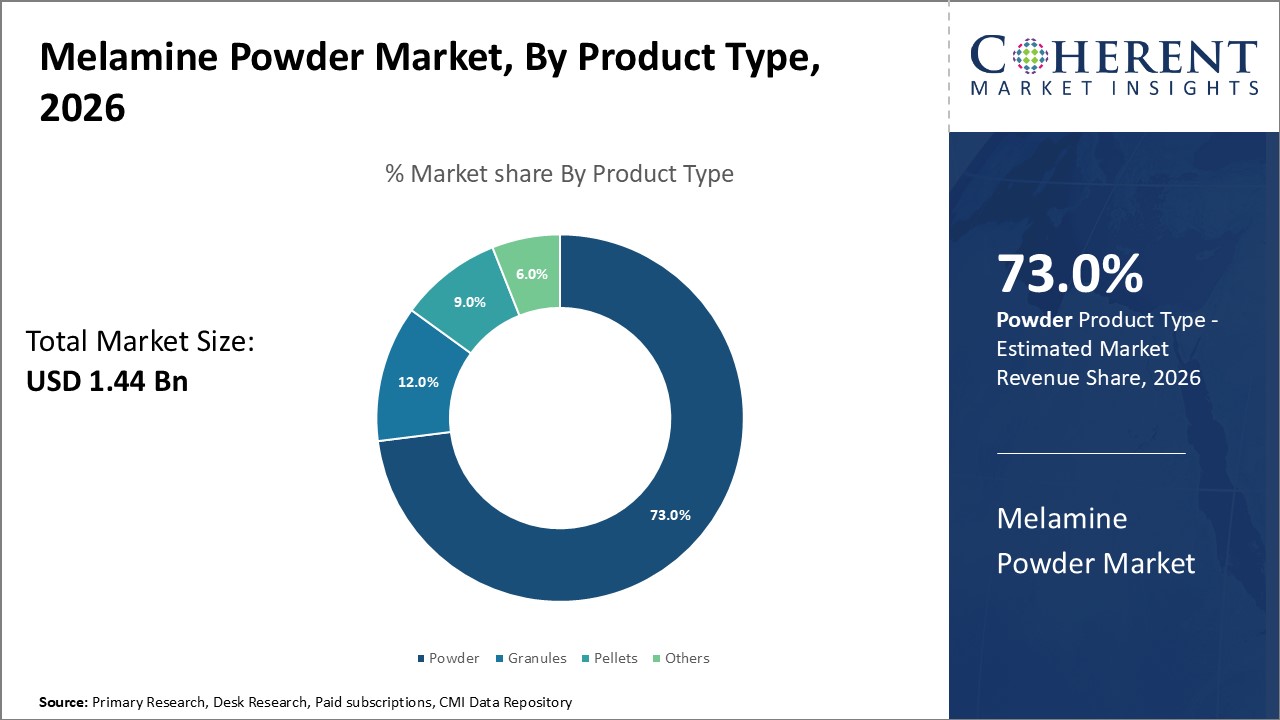
The Powder product segment dominates the Melamine Powder market segment with a commanding 73% market share, primarily due to its wide applicability and cost-effectiveness.
Laminates continue to be the dominant application segment, representing 39% of total market revenue, driven by strong end-user demand in construction and household sectors.
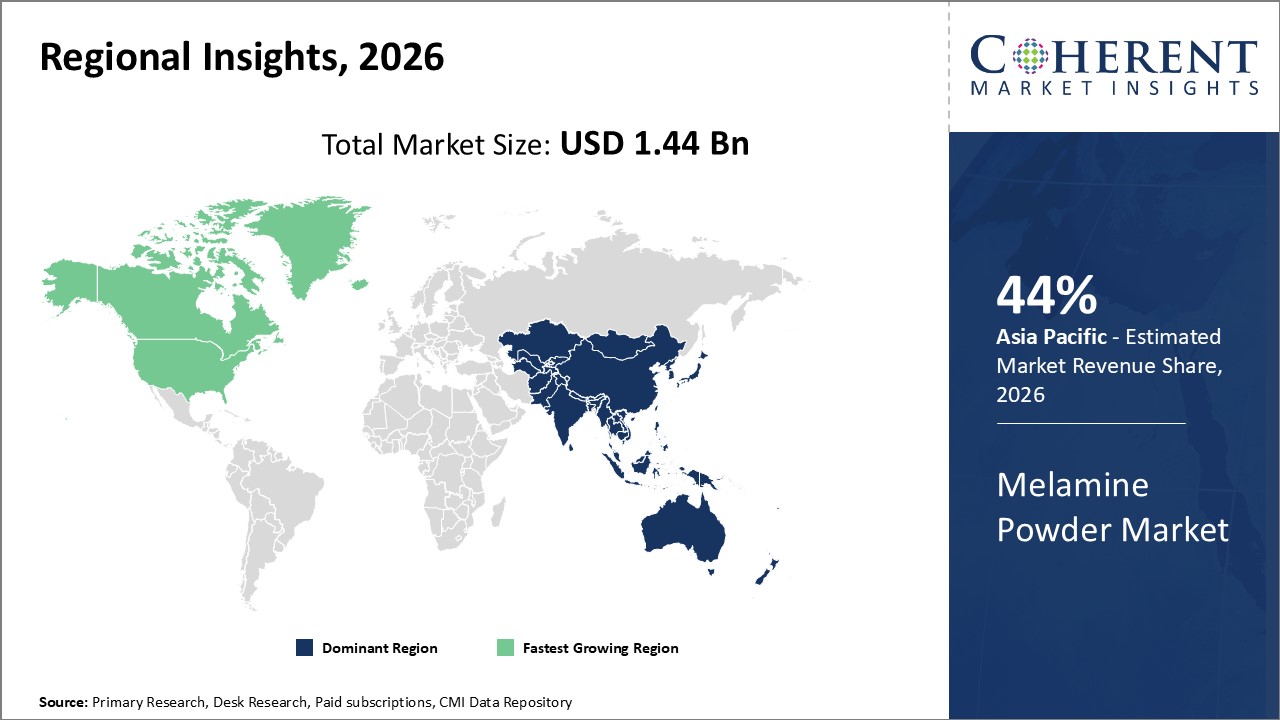
Asia Pacific represents the largest regional share of the Melamine Powder market, benefiting from extensive manufacturing ecosystems and supportive government policies promoting chemical production.
North America emerges as a key growth region due to stringent fire safety standards and increased demand from the automotive sector, supported by a CAGR that remains above the global average owing to advanced research initiatives.
Melamine Powder Market Segmentation Analysis
Melamine Powder Market Insights, By Product Type
Powder dominates the market share, commanding 73%. This dominance is largely attributed to its superior versatility and ease of integration across multiple applications, including laminates and adhesives. The Powder segment enjoys widespread adoption due to its cost-effectiveness and better dispersion properties, making it the preferred choice for large-scale industrial use. Granules and Pellets, while smaller in volume, are gaining traction for specialized uses such as precise metering in custom compound formulations.
Melamine Powder Market Insights, By Application
Laminates hold a substantial market share of 38%, primarily due to the product’s widespread use in surface finishing and furniture manufacturing. The durability and chemical resistance offered by melamine powder-based laminates are pivotal in driving demand. Meanwhile, Adhesives are experiencing rapid growth fueled by expanding construction activities and automotive assembly lines requiring stronger bonding agents. Coatings are also evolving as a critical segment, especially with the rising emphasis on flame retardants and weather-resistant finishes. Automotive Components, although relatively niche, demonstrate promising growth, leveraged by melamine powder’s thermal stability and lightweight attributes.
Melamine Powder Market Insights, By End-Use Industry
Construction dominates with approximately 33% of the share, driven by large-scale infrastructure projects requiring melamine powder-based laminates and adhesives known for their durability and safety. Automotive represents the fastest-growing subsegment, witnessing accelerated adoption of melamine powder for advanced composites and flame-retardant materials, particularly in lightweight vehicle manufacturing. Household Goods continue to maintain steady demand due to melamine’s use in kitchenware and furniture. The Textiles segment, including melamine-treated fabrics, is witnessing modest growth supported by innovation in stain repellency.
Melamine Powder Market Trends
The melamine powder market is currently witnessing three significant trends.
Firstly, sustainability has become a dominant theme, with suppliers developing bio-based and recyclable melamine powders that reduce environmental footprints, as exemplified by product launches in 2025 across Europe.
Secondly, digitalization in manufacturing processes enhances quality assurance, lowering defect rates and boosting efficiency.
Thirdly, application diversification, especially into automotive composites and flame-retardant materials, is leading manufacturers to innovate aggressively.
These trends collectively underpin a shift towards more resilient and adaptable market dynamics, fostering sustained revenue growth and broadening market scope worldwide.
Melamine Powder Market Insights, By Geography
Asia Pacific Melamine Powder Market Analysis and Trends
In the Asia Pacific, the dominance in the Melamine Powder market is attributed to vast chemical manufacturing resources, abundant raw materials, and expansive construction activities. The region accounts for approximately 44% of the global market share. Countries like China and India have implemented supportive policies that encourage local production and export. Major companies such as FORMOSA Chemicals and Shandong Haili Chemical have greatly amplified regional output, fulfilling both domestic and international demand with improved market revenue streams.
North America Melamine Powder Market Analysis and Trends
Meanwhile, North America exhibits the fastest growth with a CAGR surpassing 7% during 2026-2033 due to stringent safety regulations driving demand for advanced melamine-based flame retardants and adhesives. The U.S. automotive industry’s focus on lightweight components and eco-compliant materials significantly stimulates market expansion. Innovation hubs in the U.S. have contributed to product development breakthroughs that foster sustainable business growth.
Melamine Powder Market Outlook for Key Countries
USA Melamine Powder Market Analysis and Trends
The USA’s melamine powder market is driven by strong automotive and construction segments demanding high-performance laminates and coatings. In 2025, the U.S. domestic market witnessed a 10% year-over-year increase in melamine imports despite rising local production capacity. Key players such as BASF and Huntsman have established strategic partnerships with automotive OEMs, focused on lightweight composites, accelerating revenue growth. Additionally, government incentives supporting green building materials have broadened market scope, making the U.S. a pivotal contributor to the North American market size and share.
China Melamine Powder Market Analysis and Trends
China’s melamine powder market benefits from substantial investments in chemical manufacturing infrastructure, supported by national industrial policies emphasizing export acceleration. In 2025, the country accounted for over 38% of the Asia Pacific’s melamine production volume. Domestic producers such as Shandong Haili Chemical Industry and FORMOSA Chemicals expanded operational capacity by 15% last year to satisfy rising regional and global demand. Furthermore, China’s increasing construction expenditures and automotive production volumes have cemented its status as a critical driver of global market growth dynamics.
Analyst Opinion
Production Capacity Enhancements: Recent expansions in production capacity, particularly in Asia Pacific, have significantly boosted melamine powder availability, resulting in a 12% increase in output in China during 2025 alone. This surge supports global supply chains and reduces cost pressures, enabling manufacturers to meet growing demand from diverse industries. For instance, Southeast Asian manufacturers increased exports by 8% in early 2026, reflecting improved production efficiencies.
Demand from Construction and Automotive Sectors: Growing urbanization and infrastructure projects in developing regions have driven melamine powder consumption, with the construction segment accounting for approximately 38% of total demand in 2025. Automotive manufacturers' focus on lightweight, durable components has also elevated melamine powder use in coatings and adhesives. Recent contracts from European manufacturers to source high-quality melamine powder have increased import volumes by 15% year-over-year.
Pricing Dynamics and Raw Material Costs: Melamine powder pricing in 2025 reported an upward trend by 6% attributable to fluctuations in raw material costs such as formaldehyde and urea. However, innovations in raw material sourcing and chemical recycling have begun to moderate these increases, helping maintain price stability for industrial buyers. For example, German suppliers achieved cost optimization by integrating bio-based feedstocks, reducing dependence on volatile petrochemical prices.
Application Diversification: Beyond traditional uses in laminates and molding, the emergence of melamine powder in specialty resins and eco-friendly coatings has broadened the application spectrum. Awareness of sustainability has pushed companies to adopt melamine powder in producing biodegradable composites, contributing to a 7% rise in demand within niche markets in 2025-2026. North American companies reportedly increased R&D investments by 10% to exploit these emerging use cases.
- Current Industry Events of 2026
- Market Size Estimation
- Regional Breakdown
- Competitive Landscape
- Customer Intelligence
- Segmental Analysis
- Pricing Analysis
- Key Market Drivers, Challenges & Future Trends
- Customized Insights Section
Market Scope
| Report Coverage | Details | ||
|---|---|---|---|
| Base Year: | 2025 | Market Size in 2026: | USD 1.44 billion |
| Historical Data for: | 2020 To 2024 | Forecast Period: | 2026 To 2033 |
| Forecast Period 2026 to 2033 CAGR: | 6.4% | 2033 Value Projection: | USD 2.09 billion |
| Geographies covered: |
| ||
| Segments covered: |
| ||
| Companies covered: | Trisino Chem, BASF SE, Mitsui Chemicals, Inc., Hexion Inc., Toray Industries, Inc., Sumitomo Bakelite Co., Ltd., INEOS Melamine GmbH, Celanese Corporation, DIC Corporation, Huntsman Corporation, Shandong Haili Chemical Industry Co., Ltd., DSM Engineering Materials. | ||
| Growth Drivers: |
| ||
Melamine Powder Market Growth Factors
Rising infrastructure developments globally have been a primary driver, as melamine powder's role in laminates and adhesives, essential to construction, continues to grow. This sector contributed to over a third of the total market volume in 2025. Secondly, increasing automotive production aiming at lightweight materials, favors higher melamine powder incorporation due to its durability and thermal resistance. Regional implementation of stringent fire safety and environmental regulations has additionally boosted demand for melamine-based flame-retardant applications, particularly in Europe and North America. Finally, technological advancements focused on eco-friendly melamine resins have attracted sustainable product demand, driving growth in green building materials and composites, with a reported 9% increase in eco-conscious applications in 2026.
Melamine Powder Market Development
In August 2022, PETRONAS Chemicals Group Berhad (PCG) launched its melamine plant project in Gurun, Kedah, Malaysia, in the presence of the Kedah Chief Minister and senior PCG executives. The green-field facility will have 60,000 tonnes per annum capacity, be the first commercial melamine producer in Southeast Asia (making PCG the sole regional producer), and is targeted to come on-stream in 2025. The plant will integrate with PCG’s existing urea feedstock facility (PC FK) and apply Switzerland-origin technology for energy efficiency and full integration.
Key Players
Leading Companies of the Market
Trisino Chem
BASF SE
Mitsui Chemicals, Inc.
Hexion Inc.
Toray Industries, Inc.
Sumitomo Bakelite Co., Ltd.
INEOS Melamine GmbH
Celanese Corporation
DIC Corporation
Huntsman Corporation
Shandong Haili Chemical Industry Co., Ltd.
DSM Engineering Materials
Several market players are adopting vertical integration as a competitive strategy to secure raw material supply and enhance cost efficiency. For example, Trisino Chem's 2025 acquisition of a formaldehyde-producing facility enabled them to reduce production costs by 7%. Additionally, BASF’s strategic partnership with automotive OEMs for customized melamine-based components resulted in a 12% increase in contract volumes in 2026, underlining the importance of collaboration and innovation in maintaining market leadership.
Melamine Powder Market Future Outlook
The melamine powder market is expected to grow steadily as global construction, automotive, and furniture industries demand high-performance, durable surface materials. Future product development will focus on low-formaldehyde and formaldehyde-free formulations to comply with stringent environmental standards. Additionally, innovations in resin chemistry, such as hybrid and bio-based alternatives, will gain prominence as industries transition toward greener production processes. The growing trend of modular furniture and decorative laminates in emerging economies will support strong demand. Moreover, melamine’s versatility in producing fire-resistant coatings and lightweight composites will expand its application base. Asia-Pacific will remain the largest manufacturing hub, while Europe will lead in regulatory-driven innovation and sustainable product development.
Melamine Powder Market Historical Analysis
The melamine powder market emerged as a key segment of the chemical and materials industry in the mid-20th century, with its primary applications in laminates, molding compounds, coatings, and adhesives. Early products were used extensively in decorative laminates for furniture, flooring, and kitchenware due to their hardness, heat resistance, and durability. Over time, melamine-formaldehyde resins became a preferred alternative to urea-based resins in high-performance surfaces. However, concerns regarding formaldehyde emissions prompted significant regulatory scrutiny in the 2000s, leading manufacturers to develop low-emission and modified resin systems. The introduction of improved curing agents, filler blends, and powder formulations optimized for fast processing enhanced product efficiency and environmental compliance. In recent years, melamine’s use has expanded into flame-retardant materials and coatings for the automotive and construction industries.
Sources
Primary Research Interviews:
Polymer chemists
Resin formulators
Construction material manufacturers
Adhesive compounders
Databases:
European Chemicals Agency (ECHA) Substance Database
U.S. EPA Chemicals Dashboard
REACH Compliance Data
OECD Chemical Safety Database
Magazines:
Chemical Week
Coatings World
Plastics & Rubber Asia
Paint & Coatings Industry Magazine
Journals:
Journal of Applied Polymer Science
Polymer Degradation and Stability
Surface Coatings International
Newspapers:
The Economic Times (Chemicals)
Financial Times (Manufacturing)
Nikkei Asia (Materials)
Associations:
American Chemistry Council (ACC)
European Chemical Industry Council (Cefic)
ASTM International
Get access to 250+ pages report
Every segment, forecast, competitor profile and data table behind the analysis above — available for instant download.
- ESOMAR Member
- ISO 9001:2015 Certified
- D-U-N-S Registered
- GDPR & CCPA Compliant
Missing comfort of reading report in your local language? Find your preferred language:
Transform your Strategy with Exclusive Trending Reports
Frequently Asked Questions
The market is led by key companies such as Trisino Chem, BASF SE, Mitsui Chemicals, and Hexion Inc., which hold significant market share due to their extensive production capacity and innovation focus.
The market size is projected to grow from USD 1.44 billion in 2026 to USD 2.09 billion by 2033, underpinned by a consistent CAGR of 6.4% driven by increasing end-use applications and expanding regional demand.
The construction industry presents the largest growth opportunity, due to rising infrastructure projects worldwide.
Market trends will focus increasingly on sustainability, bio-based product introductions, and digital quality control processes to enhance product performance and regulatory compliance.
The competitive landscape is characterized by strategic collaborations, vertical integration, and innovation in eco-friendly materials, with challenges including raw material cost volatility and stringent environmental regulations.
Leading market players often utilize partnerships with the automotive and construction industries, invest in capacity expansion, and pursue R&D in green technologies as key market growth strategies.