

Membrane Bioreactor (MBR) Systems Market Analysis & Forecast: 2026-2033
Membrane Bioreactor (MBR) Systems Market is estimated to be valued at USD 3,437.5 Mn in 2026 and is expected to reach USD 4,934.5 Mn in 2033, exhibiting a compound annual growth rate (CAGR) of 5.3% from 2026 to 2033.
Key Takeaways
- Based on the Product Type, the Hollow Fiber segment dominates the market due to its high surface area-to-volume ratio.
- Based on the Application, the Municipal Wastewater Treatment segment dominates the market due to the Growing Urban Population.
- Based on the Configuration, where the Submerged segment dominates the market due to its high adoption in the municipal sector.
- On the basis of Region, the Asia Pacific dominated the global membrane bioreactor (MBR) systems market in 2026, accounting for a 41.8% share.
Market Overview
The growth of the Membrane Bioreactor (MBR) systems market is primarily driven by increasing water pollution, stricter wastewater discharge regulations, and rising urbanization. MBR technology offers superior effluent quality, compact footprint, and operational flexibility, making it ideal for municipal and industrial applications. Growing urbanization and industrialization accelerate wastewater generation, boosting MBR adoption. Additionally, advancements in membrane materials and declining costs enhance system reliability and affordability. The rising focus on water reuse and sustainable practices further propels Membrane Bioreactor (MBR) systems market growth, alongside government incentives promoting green technologies.
Current Events and Its Impact
Current Events | Description and its impact |
Technological Innovations and AI Integration |
|
Regional Market Dynamics |
|
End-user Feedback and Unmet Needs in the Membrane Bioreactor (MBR) Systems Market
End-user Feedback
- Operational Efficiency Appreciated: Users often highlight the compact footprint and high-quality effluent output of MBR systems, especially in municipal and industrial applications.
- Ease of Automation: Positive feedback is received for the compatibility of MBR systems with automated control systems, enabling reduced manual intervention.
- Flexibility in Retrofitting: Many users appreciate that MBR systems can be retrofitted into existing wastewater treatment plants, especially in space-constrained urban areas.
Unmet Needs
- High Capital and Operating Costs: Users in developing markets often cite affordability and cost recovery as major concerns, especially for small-scale applications.
- Energy Consumption: Blower energy for air scouring and membrane filtration contributes to high energy costs, prompting demand for more energy-efficient designs.
- Limited Skilled Workforce: In some regions, the lack of trained personnel to operate and maintain MBR systems restricts broader adoption.
- Current Industry Events of 2026
- Market Size Estimation
- Regional Breakdown
- Competitive Landscape
- Customer Intelligence
- Segmental Analysis
- Pricing Analysis
- Key Market Drivers, Challenges & Future Trends
- Customized Insights Section
Segmental Insights
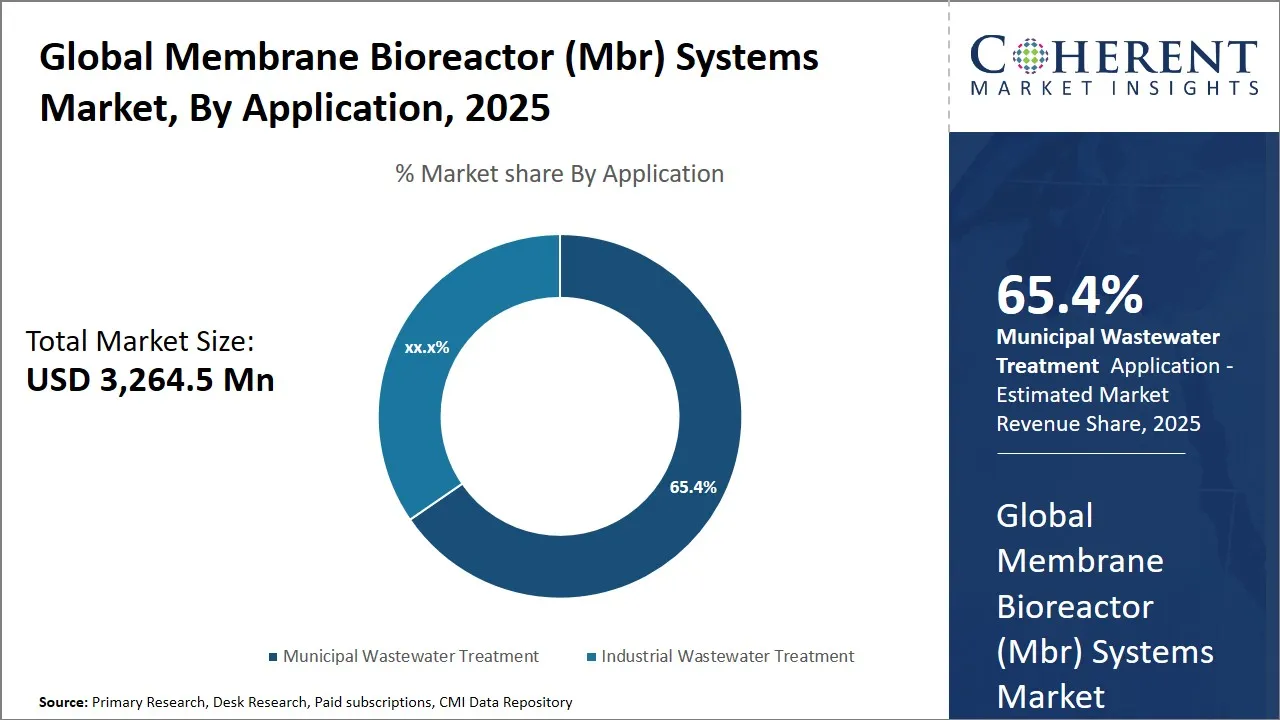
Membrane Bioreactor (MBR) Systems Market Insights, by Application - Municipal wastewater treatment segment dominates the market due to the Growing Urban Population
On the basis of application in 2026, the municipal wastewater treatment segment has accounted for the largest market share of 66.4% in terms of value. For instance, ZeeLung has developed a product called SUEZ a membrane-aerated biofilm reactor (MABR) designed to treat wastewater in a small footprint It is optimal for upgrading existing wastewater treatment plants in communities experiencing sudden growth or more stringent regulatory changes as the cassette that retrofits into existing plants, supporting microbial biofilms directly on membranes.
-systems-market-by-product-type.webp "Membrane Bioreactor (Mbr) Systems Market, By Product Type")
Membrane Bioreactor (MBR) Systems Market Insights, by Product Type - The Hollow Fiber segment dominates the market due to High Surface Area-to-Volume Ratio
Based on the Product Type, the Hollow Fiber segment dominates the market due to the High Surface Area-to-Volume Ratio. The Hollow fiber membrane offers a greater surface area per unit volume compared to flat sheet and tubular membranes, enhancing filtration efficiency.
In December 2024, LG Water Solutions launched two new products at the IDRA World Congress in Abu Dhabi: QuantumFlux UF/MBR membranes and QuantumPure IX resins. The QuantumFlux UF and MBR membranes feature advanced Polyvinylidene Fluoride (PVDF) technology using the thermally induced phase separation (TIPS) process. These hollow fiber membranes offer enhanced chemical and mechanical durability, meeting growing demand for dependable ultrafiltration and membrane bioreactor solutions in diverse water treatment applications.
Membrane Bioreactor (MBR) Systems Market Insights, by Configuration - The Submerged segment dominates the market due to High adoption in the municipal sector
Based on the Configuration, where the Submerged segment dominates the market due to high adoption in the municipal sector. Submerged systems are preferred in municipal water and wastewater treatment due to their reliability, simplicity, and lower lifecycle costs. For instance, Kubota has developed new SP-A series submerged membrane units, which enable efficient MRB plant operation with increased membrane areas per footprint. This innovation enables the same level of treatment with a smaller physical footprint, which can be particularly beneficial for resource-constrained locations.
Regional Insights
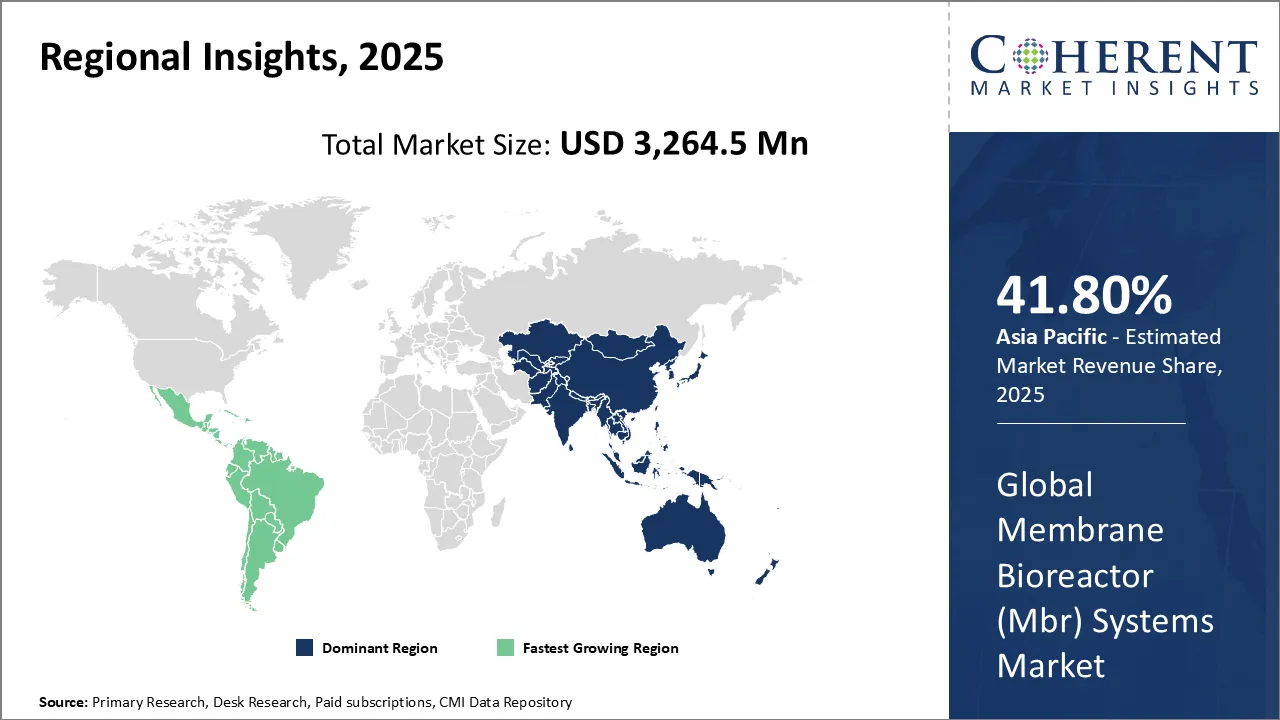
Asia Pacific Membrane Bioreactor (MBR) Systems Market Trends
Asia Pacific region dominated the global membrane bioreactor (MBR) systems market in 2026, accounting for a 41.8% share in terms of value, followed by Latin America and MEA. For instance, BioWater Solutions, a global leader in MBR solutions, has partnered with a chemical company to develop specialized membranes for the removal of emerging contaminants like pharmaceuticals and microplastics. The collaboration aims to address the growing concerns of pharmaceuticals, microplastics, and other pollutants in wastewater streams. This is further contributing to the membrane bioreactor systems market share.
North America Membrane Bioreactor (MBR) Systems Market Trends
North America’s MBR landscape is evolving rapidly, with a clear shift towards next-gen biofilm technologies, optimized membrane designs, and integrated systems combining MBR with anaerobic/aerobic processes and further driven by efficiency, environmental resilience, and cost-effectiveness in municipal and industrial wastewater treatment. For instance, M|MBR Systems has launched a technology hub with pre-built, pre-tested MBR units (BluBox) and molecular systems that can be easily integrated or upgraded, which is further anticipated to accelerate the membrane bioreactor systems market growth.
India Membrane Bioreactor (MBR) Systems Market Trends
India’s Membrane Bioreactor (MBR) systems market is increasing robustly, driven by regulations, water scarcity, and infrastructure expansion moving forward, expect decentralized models, innovative membranes, and nutrient/energy recovery systems to lead the evolution of India’ Membrane Bioreactor (MBR) system market landscape. For instance, Bulfox is a prominent supplier of High-performance MBR membrane systems in India, known for its innovative and sustainable wastewater treatment solutions. The company delivers durable, energy-efficient products that improve filtration performance and extend system life for both industrial and municipal use.
United States Membrane Bioreactor (MBR) Systems Market Trends
The U.S. membrane bioreactor (MBR) systems market is rising due to stricter wastewater discharge regulations and the growing adoption of water reuse initiatives, especially in drought-prone states like California and Arizona. Additionally, advancements in modular and energy-efficient MBR technologies are lowering operating costs and boosting scalability. For instance, the USA’s QUA Group has launched three advanced membrane technologies, including high-flow electro-deionization technology, outside-in ultrafiltration modules, and simplified MBR operations. Such innovations are propelling the membrane bioreactor systems market demand.
Market Report Scope
Membrane Bioreactor (MBR) Systems Market Report Coverage
| Report Coverage | Details | ||
|---|---|---|---|
| Base Year: | 2025 | Market Size in 2026: | USD 3,437.5 Mn |
| Historical Data for: | 2020 To 2024 | Forecast Period: | 2026 To 2033 |
| Forecast Period 2026 to 2033 CAGR: | 5.3% | 2033 Value Projection: | USD 4,934.5 Mn |
| Geographies covered: |
| ||
| Segments covered: |
| ||
| Companies covered: | Beijing Origin Water Technology Co., Ltd., GE Water and Process Technologies, Koch Membrane Systems, Inc., Tianjin MOTIMO Membrane Technology Ltd. (MOTIMO)., GLV Group (GLV Inc.)/ Ovivo Water, United Environment Ltd., Suzhou Litree UF Membrane Technology Co. Ltd., Evoqua Water Technology/Siemens Water Technologies, Toray Industries, Inc., Mitsubishi Chemical Group, and Asahi Kasei | ||
| Growth Drivers: |
| ||
| Restraints & Challenges: |
| ||
Membrane Bioreactor (MBR) Systems Market Drivers
- Growing usage of membrane bioreactors across the municipality sector is primarily driving the market growth of membrane bioreactors. This is attributed to a growing population coupled with the increasing need for clean and safe freshwater. The rising prevalence of water pollution due to various environmental factors and industrialization around the globe is projected to foster market growth over the forecast timeframe.
- Rapid growth in the refineries is one of the driving factors creating demand for water treatment chemical which is expected to propel the market growth of the membrane bioreactor. Growing awareness regarding the benefits of membrane bioreactor such as smaller footprint, excellent effluent quality, and high biodegradation efficiency, is fueling the market growth of the membrane bioreactor over the forecast timeframe.
Membrane Bioreactor (MBR) Systems Market Opportunities
- Growing awareness regarding proper sanitization across developing regions due to rising initiatives by the government of the region to promote the need for proper sanitization is expected to bring new market opportunities. The decline in the availability of fresh and clean water on earth is again expected to propel the market growth of the membrane bioreactor. Moreover, rapid urbanization coupled with the changing lifestyle of the consumers is further projected to propel the market growth.
- Increasing adoption of submerged membrane bioreactors across the industrial sector is projected to offer enormous opportunities over the forecast period. Industries such as food & beverages, textiles, oil & gas, power generation, mining, and pulp & paper are rapidly adopting such technology due to its effluent quality and lower sludge production. This is expected to foster the market growth of the membrane bioreactor over the forecast period.
Recent Developments
In February 2025, BluMetic secured a CA$ 3.3 million deal to deliver an MBR plus seawater RO system to a Bahamian resort, with delivery slated for the calendar year 2025.
In February 2025, xAI partnered with Germany’s Cerafiltec to build Shelby County’s first membrane bioreactor water-recycling plant in Memphis. Cerafiltec will supply its ceramic flat-membrane modules.
In March 2023, GE Water & Process Technologies partnered with Xylem in the U.S. to develop integrated Membrane Bioreactor (MBR) systems solutions targeting both municipal and industrial wastewater applications.
Analyst Opinion (Expert Opinion)
- The MBR systems market is at a pivotal inflection point where technological maturation is converging with escalating environmental regulations to drive unprecedented adoption rates. From my vantage point, the accelerating deployment of MBR technology in municipal and industrial wastewater treatment reflects not only its operational superiority but also a broader shift toward sustainable, high-efficiency water management solutions.
- A critical driver underscoring this trend is the robust performance of MBRs in handling high-strength wastewater streams with significantly reduced footprints. For instance, the case of Veolia’s implementation of MBR technology in Singapore’s Deep Tunnel Sewerage System demonstrates a 30-40% reduction in plant footprint compared to conventional activated sludge processes—an indispensable factor in urban areas where land is a premium commodity.
- Furthermore, the decline in membrane fouling through next-generation materials—such as hydrophilic coatings and advanced backflushing techniques—has pushed membrane lifespan beyond the historical 5-7 years to an impressive 8-10 years. This leap is a game-changer for total cost of ownership, which until recently has been the primary hesitation point for widespread MBR adoption, especially in cost-sensitive emerging markets.
- However, it is critical to recognize that the market’s trajectory will hinge on continued innovation in energy optimization. Current energy consumption for MBR systems remains approximately 15-30% higher than conventional processes, primarily due to aeration demands. Leading players who integrate AI-driven process controls to dynamically optimize aeration cycles are already realizing energy savings upwards of 20%, as evidenced by Xylem’s Smart MBR pilot projects in Europe.
- Moreover, the nuanced integration of MBRs with nutrient recovery systems will soon redefine wastewater treatment economics. Case studies, such as those emerging from Denmark’s Aarhus Water utility, highlight the viability of coupling MBRs with phosphorus recovery technologies, turning waste into a resource and creating new revenue streams that offset operational costs.
Speak to the analyst
Want personalized insights?
Take the findings above to one of our principal consultants, or have the report rebuilt around the segments, geographies and competitors you actually track.
Market Segmentation
- Global Membrane Bioreactor (MBR) Systems Market, By Product Type (Revenue, USD Mn, 2021 - 2033)
- Hollow Fiber
- Flat Sheet
- Multi Tubular
- Global Membrane Bioreactor (MBR) Systems Market, By Application (Revenue, USD Mn, 2021 - 2033)
- Municipal Wastewater Treatment
- Industrial Wastewater Treatment
- Global Membrane Bioreactor (MBR) Systems Market, By Configuration (Revenue, USD Mn, 2021 - 2033)
- Submerged
- Side Stream
- Global Membrane Bioreactor (MBR) Systems Market, By Region (Revenue, USD Mn, 2021 - 2033)
- North America
- U.S.
- Canada
- Latin America
- Brazil
- Argentina
- Mexico
- Rest of Latin America
- Europe
- Germany
- U.K.
- Spain
- France
- Italy
- Russia
- Rest of Europe
- Asia Pacific
- China
- India
- Japan
- Australia
- South Korea
- ASEAN
- Rest of Asia Pacific
- Middle East
- GCC Countries
- Israel
- Rest of Middle East
- Africa
- South Africa
- North Africa
- Central Africa
- North America
- Company Profiles
- Beijing Origin Water Technology Co., Ltd
- GE Water and Process Technologies
- Koch Membrane Systems, Inc.
- Tianjin MOTIMO Membrane Technology Ltd. (MOTIMO)
- GLV Group (GLV Inc.)/ Ovivo Water
- United Envirotech Ltd.
- Kubota Membrane Europe Ltd
- Suzhou Litree UF Membrane Technology Co., Ltd
- Evoqua Water Technologies/Siemens Water Technologies
- Toray Industries, Inc.
- Mitsubishi Chemical Group
- Asahi Kasei
Sources
Primary Research
Interviews from the following stakeholders
Stakeholders
- In-depth interviews with marketing managers, business development heads, plant operations managers, R&D directors, supply chain leaders, and procurement heads involved in the manufacturing, distribution, and application of Membrane Bioreactor (MBR) systems across key sectors such as municipal wastewater treatment, industrial wastewater treatment, pharmaceuticals, food and beverage, and chemical processing.
Databases
- Euromonitor International
- IBISWorld
- Mintel GNPD
Magazines
- Water & Wastewater International (WWi)
- WaterWorld Magazine
- Environmental Science & Engineering Magazine
- Treatment Plant Operator (TPO)
- Industrial WaterWorld
Journals
- Journal of Membrane Science
- Bioresource Technology
- Journal of Environmental Management
- Water Research
- Chemical Engineering Journal
Newspapers
- The Wall Street Journal – Industry & Infrastructure Section
- Financial Times – Global Utilities & Sustainability Insights
- The New York Times – Energy & Environment
- Reuters – Water and Environmental Tech News
- The Economic Times – Infrastructure & Utilities
Associations
- Water Environment Federation (WEF)
- International Water Association (IWA)
- American Membrane Technology Association (AMTA)
- Indian Desalination Association (InDA)
- European Water Association (EWA)
Public Domain Sources
- U.S. Environmental Protection Agency (EPA) – Wastewater Treatment Regulations and Standards
- European Environment Agency (EEA) – Water and Wastewater Statistics
- Central Pollution Control Board (CPCB), India – Industrial Effluent Standards
- Eurostat – Wastewater Treatment and Infrastructure Data
- World Health Organization (WHO) – Water Quality and Sanitation Data
Proprietary Elements
- CMI Data Analytics Tool and proprietary CMI repository of Membrane Bioreactor systems market intelligence, trend analyses, and end-use sector insights developed over the past 8 years
*Definition - Membrane bioreactor is one of the highly efficient wastewater treatment technologies as it uses a microbial process. It separates the effluent from wastewater via a filtration membrane. Moreover, membrane bioreactor is a high-speed process and also offers better environmental sustainability. Municipal wastewater treatment and industrial wastewater treatment are two major applications of the membrane bioreactor.
Get access to 250+ pages report
Every segment, forecast, competitor profile and data table behind the analysis above — available for instant download.
- ESOMAR Member
- ISO 9001:2015 Certified
- D-U-N-S Registered
- GDPR & CCPA Compliant
Missing comfort of reading report in your local language? Find your preferred language:
Transform your Strategy with Exclusive Trending Reports
Frequently Asked Questions
The Membrane Bioreactor (MBR) Systems Market is estimated to be valued at USD 3,437.5 Mn in 2026 and is expected to reach USD 4,934.5 Mn by 2033.
Rapid growth in the refineries is one of the driving factors creating demand for water treatment which is expected to propel the market growth of the membrane bioreactor system market.
The CAGR of the Membrane Bioreactor (MBR) Systems Market is projected to be 5.3% from 2026 to 2033.
The membrane bioreactor systems market is expected to grow at a CAGR of 5.3% during the forecast period (2026-2033).
Major players functioning in the global membrane bioreactor systems market include Beijing Origin Water Technology Co., Ltd., GE Water and Process Technologies, Koch Membrane Systems, Inc., Tianjin MOTIMO Membrane Technology Ltd. (MOTIMO)., GLV Group (GLV Inc.)/ Ovivo Water, United Environment Ltd., Suzhou Litree UF Membrane Technology Co. Ltd., Evoqua Water Technology/Siemens Water Technologies, Toray Industries, Inc., Mitsubishi Chemical Group, Ltd., and Asahi Kasei.
Fouling of membranes leads to accumulation of substance on the membrane surface or pores of the membrane which results in slow down of the membrane performance. This is expected to hamper the market growth of membrane bioreactors