

Global Nanopharmaceuticals Market - 2026 to 20233
The nanopharmaceuticals market is estimated to be valued at USD 1,89,000 Mn in 2026 and is expected to reach USD 7,62,000 Mn in 2033, exhibiting a compound annual growth rate (CAGR) of 22.1% from 2026 to 2033.
Key Takeaways
- Based on Carrier Type, the Liposomes segment is expected to hold 37.2% share in 2026.
- Based on Application, the Oncology segment is expected to lead the market with 47.8% share in 2026.
- Based on Distribution Channel, the Hospital segment is projected to account for 58.4% share of the market in 2026.
- Based on Region, North America is set to lead the nanopharmaceuticals market with 43.5% share in 2026. While, Asia Pacific is anticipated to be the fastest growing region.
Market Overview
Nanopharmaceuticals play a major role in advance healthcare, as it is widely used in drug delivery. Nanopharmaceuticals differ from other macroscopic level of medicines in its shape and composition and offer advantages over the bulk analogues such as precision targeting and patient compliance.
Current Events and Its Impact on the Nanopharmaceuticals Market
Current Event | Description and its Impact |
Global Regulatory Harmonization Initiatives for Nanomedicines |
|
Major Pharmaceutical Company Strategic Acquisitions and Partnerships |
|
What are the latest trends in clinical trials and innovation in nanopharmaceuticals?
- Over 1,200 nanopharmaceutical clinical trials are active globally as of 2025.
- India has seen a 40% increase in nanomedicine trials since 2022, especially in oncology and autoimmune diseases.
- AI-driven nanocarrier design is accelerating preclinical success rates by up to 30%.
- Lipid nanoparticle (LNP) platforms are being adapted beyond mRNA vaccines to deliver siRNA, CRISPR, and protein therapies.
- Current Industry Events of 2026
- Market Size Estimation
- Regional Breakdown
- Competitive Landscape
- Customer Intelligence
- Segmental Analysis
- Pricing Analysis
- Key Market Drivers, Challenges & Future Trends
- Customized Insights Section
Segmental Insights
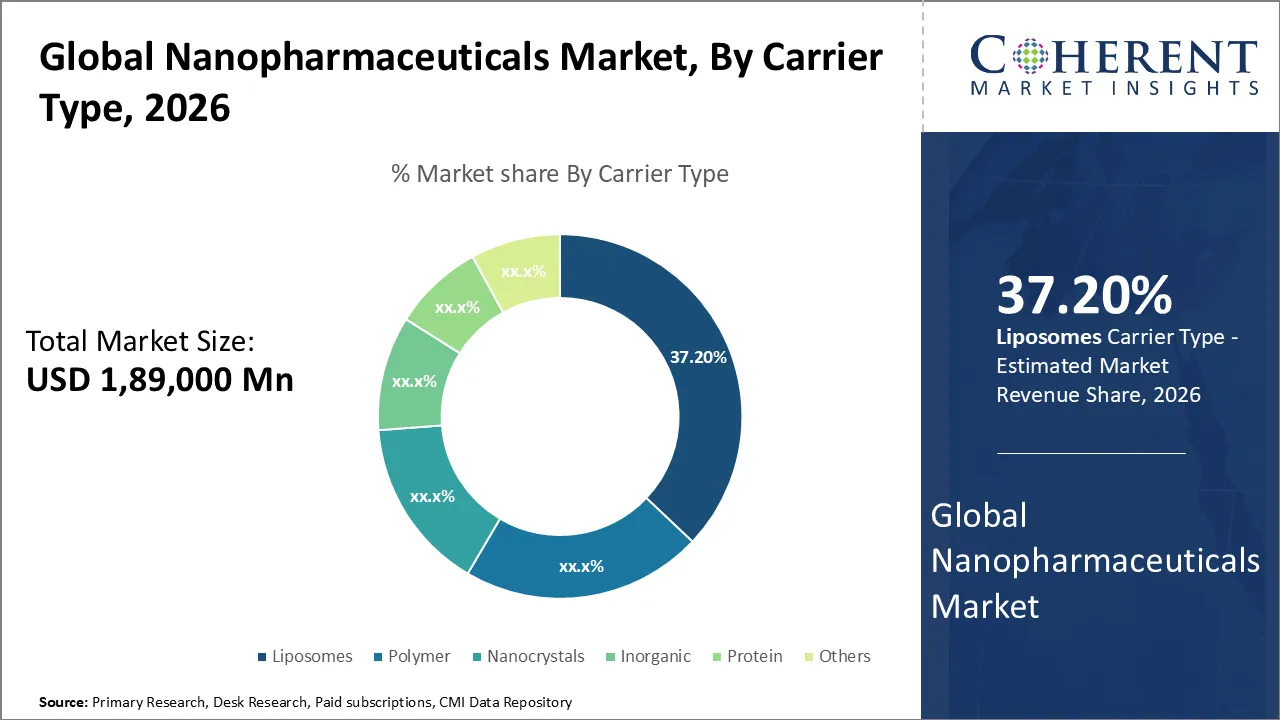
Nanopharmaceuticals Market Insights, By Carrier Type: Liposomes lead due to proven safety, biocompatibility, and widespread clinical adoption in drug delivery
In terms of carrier type, the liposomes segment is expected to hold 37.2% share in 2026, because they are safe, work well with both hydrophilic and hydrophobic drugs, and can hold both types of drugs. They are commonly used in cancer treatment to improve targeted delivery, lower toxicity, and improve treatment outcomes. Liposomes are going to remain the best type of carrier as they have been approved by the FDA and have been shown to work in clinical settings.
Nanopharmaceuticals Market Insights, By Application: Oncology dominates as nanopharmaceuticals revolutionize targeted cancer therapies with reduced side effects
In terms of application, the oncology segment is expected to lead the market with 47.8% share in 2026, driven by the strong need for targeted cancer treatments. Nanocarriers, such as liposomes and polymeric micelles, make it easier for drugs to get to the right place, reduce side effects, and increase the chances of survival for patients. Oncology is the biggest and most profitable application segment because of high cancer incidence globally and companies’ strong investment in research and development.
For instance, in January 2026, Triapine® combinations are being tested on neuroendocrine tumors, glioblastoma, and cervical cancer. Researchers are investigating into tetrathiomolybdate as a treatment for triple negative breast cancer. The goal of these new ideas is to help people live longer, make treatments less harmful, and give patients more options for treatment. This means that oncology is the company's main area of research and development.
Nanopharmaceuticals Market Insights, By Distribution Channel: Hospital pharmacies prevail since complex nanomedicines require specialized handling and monitored administration
In terms of distribution channel, the hospital segment is projected to account for 58.4% share of the market in 2026, because nanopharmaceuticals often need special handling, intravenous administration, and close patient monitoring. The majority of the time, hospitals provide complex medicines and advanced treatments. Hospital pharmacies will always be the main way to get drugs around the world as they have the right infrastructure, follow the rules, and work with cancer care.
For example, in December 2025, IIT Madras made a precise nanoinjection platform to make it easier for breast cancer drugs delivery. This new idea makes targeted therapy better, lowers side effects, and makes treatment more effective. This is mostly a big step forward in research, but it's also critical for hospitals because it will lead to better cancer care and better outcomes for patients in the future.
Regional Insights
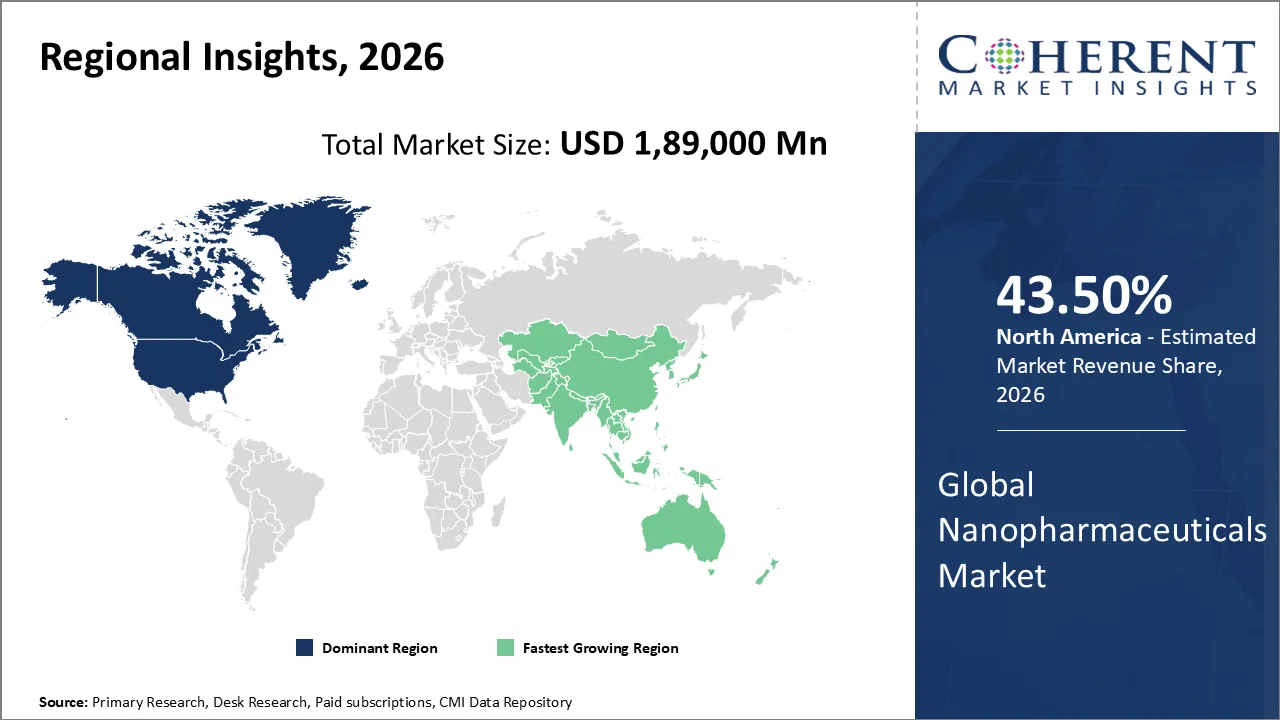
North America Nanopharmaceuticals Market Analysis & Trends
North America is expected to dominate the nanopharmaceuticals market with 43.5% share in 2026, on account of high R&D spending, high prevalence of cancer and chronic disease cases, rapid adoption of new drug delivery systems, and regulatory approvals that help. Established healthcare systems and top pharmaceutical companies drive commercialization, which leads to strong growth in regional markets.
For instance, in May 2025, The Commonwealth of Massachusetts and MassVentures provided Eascra Biotech, a U.S.-based nanomedicine startup, a $100,000 Stage I SBIR Targeted Technologies (START) grant. The grant helps them work on Janus Base Nanoparticles (JBNps), which are advanced non-lipid nanoparticles that can deliver drugs in a way that is better for your health.
Asia Pacific Nanopharmaceuticals Market Analysis & Trends
Asia Pacific is expected to exhibit the fastest growth, due to cancer rates are rising, healthcare infrastructure is growing, and the government is investing into biotechnology. Adoption is driven by more clinical trials, more pharmaceutical manufacturing hubs in China and India, and more patients becoming aware of the benefits. This makes the region a key growth engine.
For instance, in February 2025, Researchers at IASST in Guwahati, India, developed a nanotechnology-based system for delivering drugs to treat arthritis. The system uses nanoparticles to send methotrexate directly to inflamed joints. This makes targeting better, side effects less severe, and effectiveness higher. This new idea is an important step forward for precision nanomedicine for chronic inflammatory diseases in India.
Nanopharmaceuticals Market Outlook Country-Wise
The U.S. Nanopharmaceuticals Market Trends
In the US, the nanopharmaceuticals market is expected to expand in 2026 because of more cases of cancer and heart disease, more use of targeted drug delivery systems, and improvements in nanotechnology. Precision medicine projects, strong funding for research and development, and helpful regulatory frameworks all help growth even more, making oncology the most important application area.
For instance, in August 2025, Scientists at Washington University in St. Louis developed a nanoparticle system that uses ultrasound to guide drugs to the right place. This new idea makes targeting better, makes treatments more effective, and reduce side effects. This breakthrough is a big step forward in nanomedicine drug delivery, and it has promising uses for cancer and other complicated diseases.
China Nanopharmaceuticals Market Trends
By 2026, the Chinese nanopharmaceuticals market is expected to grow because rising cancer and heart disease, the government is putting resources into new healthcare technologies, and targeted drug delivery systems are becoming more popular. China is becoming a key center for market growth because it has better research and development facilities, more informed patients, and lower prices.
For example, in September 2025, METiS TechBio launched NanoForge in Beijing. It was the first AI-powered nano-delivery platform in the world. It uses quantum chemistry, molecular dynamics, and wet-lab screening to make lipid nanoparticles the best possible way to deliver drugs exactly. With a large LNP library, NanoForge makes oncology, mRNA therapies, and targeted treatments better. This makes APAC the leader in new ideas in nanomedicine around the world.
Market Report Scope
Nanopharmaceuticals Market Report Coverage
| Report Coverage | Details | ||
|---|---|---|---|
| Base Year: | 2025 | Market Size in 2026: | USD 1,89,000 Mn |
| Historical Data for: | 2020 To 2024 | Forecast Period: | 2026 To 2033 |
| Forecast Period 2026 to 2033 CAGR: | 22.1% | 2033 Value Projection: | USD 7,62,000 Mn |
| Geographies covered: |
| ||
| Segments covered: |
| ||
| Companies covered: | Abbott, GlaxoSmithKline plc., Eli Lilly and Company, Astrazeneca plc., Novavax, Inc., Stryker Corporation, OSI Pharmaceuticals, Kadmon Pharmaceuticals, Samyang Biopharm, Mitsubishi Tanabe Pharma Corporation, Kaken Pharmaceutical, Selecta Biosciences, Par Pharmaceutical, Cerulean Pharma Inc., Navidea Biopharmaceuticals, Inc., AbbVie Inc., AMAG Pharmaceuticals, Amgen Inc., Astellas Pharma Inc., Celgene Corporation, Gilead Sciences, Inc., JOHNSON & JOHNSON, Merck & Co., Inc., Novartis AG, Pfizer, Inc., Hoffmann-La Roche AG, Sanofi S.A, Shire Plc., and Teva Pharmaceuticals Industries Limited. | ||
| Growth Drivers: |
| ||
| Restraints & Challenges: |
| ||
Nanopharmaceuticals Market Driver
Rising Burden of Chronic Diseases
The global increase in cancer, heart disease, and neurological disorders is driving the need for better treatments. Nanopharmaceuticals enable targeted drug delivery, improving treatment effectiveness and reducing systemic toxicity. This precise method lowers side effects and makes patients more likely to follow their treatment plan, making nanomedicine more and more important in modern medicine. Oncology continues to be the most prominent application segment, making up a large part of the nanopharmaceuticals market, as targeted cancer therapies has dominated adoption around the world and are driving growth in both developed and emerging regions.
Advancements in Nanotechnology & Drug Delivery
Nanotechnology advancements have revolutionized drug delivery via liposomes, polymeric micelles, solid lipid nanoparticles, nanoemulsions, and microemulsions. These carriers make drugs more bioavailable, stable, and controllable, which leads to better therapeutic results. Nanotechnology is important because it lets drugs cross biological barriers like the blood-brain barrier, which opens up more treatment options for neurological diseases. This technological advancement is a significant driver of the increasing demand for nanopharmaceuticals, as healthcare professionals progressively utilize nanomedicine to tackle intricate conditions with enhanced accuracy and efficacy.
Nanopharmaceuticals Market Opportunity
Targeted Drug Delivery Systems
Nanopharmaceuticals' targeted drug delivery systems are a big step forward in cancer treatment. These systems send therapeutic agents only to cancerous cells, which protects healthy tissues, lowers side effects, and makes treatment more effective. This precise method makes patients more likely to follow through with their treatment and improves overall outcomes, which is why it is the preferred method in oncology. The nanopharmaceuticals market forecast claims that targeted delivery technologies will continue to be a key factor in adoption, helping to spread nanomedicine applications to more types of cancer.
Analyst Opinion (Expert Opinion)
The market for nanopharmaceuticals is expanding rapidly due to the growing integration of nanotechnology with drug development and delivery systems. Nanopharmaceuticals are particularly useful in the treatment of chronic diseases and precision medicine because they use nanoscale formulations, which are usually between 1 and 100 nanometers in size, to improve drug solubility, stability, bioavailability, and targeted delivery. Nanotechnology platforms like liposomes, polymeric micelles, and solid lipid nanoparticles are widely used by pharmaceutical innovators, as evidenced by recent industry analysis that reveals a significant percentage of new therapeutic formulations, including those in oncology.
The largest focus area, according to application trends, is cancer and tumor therapies, where nanopharmaceuticals improve the specificity and tolerability of chemotherapy in comparison to their conventional counterparts. Significant segments include the treatment of inflammation and autoimmune disorders, with several clinical studies showing improved results compared to conventional treatments.
With strong funding, a well-established biotech infrastructure, and active regulatory pathways for novel drug approvals, North America continues to lead the region in R&D investment and market allocation. Growing research initiatives in Europe and Asia-Pacific follow, especially in China and India, where academic-industry collaborations and nanopharmaceutical patent activity have significantly increased.
Technological developments, such as the incorporation of machine learning and artificial intelligence into the design of nanoparticles, are improving formulation accuracy and possibly reducing development times. The market will be positioned as a crucial part of the larger pharmaceutical innovation landscape if the emphasis on personalized therapeutics is maintained. This will sustain interest in nano-enabled drug platforms across various therapeutic areas.
Speak to the analyst
Want personalized insights?
Take the findings above to one of our principal consultants, or have the report rebuilt around the segments, geographies and competitors you actually track.
Recent Developments
- In September 2025, Scientists at Rice University made a hydrogel platform that allows for precise control of long-lasting, targeted drug delivery. It is made to be put near target tissues and slowly releases drugs over time, which lowers systemic side effects. It does not utilize nanoparticles, but it fits with the goals of nanomedicine and could be a good option for precise treatment of chronic conditions and cancer.
Market Segmentation
- By Carrier Type
- Liposomes
- Polymer
- Nanocrystals
- Inorganic
- Protein
- Others
- By Application
- Oncology
- Neurology
- Anti-inflammatory
- Anti-infective
- Cardiovascular
- Others
- By Distribution Channel
- Hospital Pharmacies
- Retail Pharmacies
- Online Pharmacies
- By Region
- North America
- U.S.
- Canada
- Latin America
- Brazil
- Argentina
- Mexico
- Rest of Latin America
- Europe
- Germany
- U.K.
- Spain
- France
- Italy
- Russia
- Rest of Europe
- Asia Pacific
- China
- India
- Japan
- Australia
- South Korea
- ASEAN
- Rest of Asia Pacific
- Middle East & Africa
- GCC Countries
- Israel
- Rest of Middle East & Africa
- North America
- Key Players
- Abbott
- GlaxoSmithKline plc.
- Eli Lilly and Company
- Astrazeneca plc.
- Novavax, Inc.
- Stryker Corporation
- OSI Pharmaceuticals
- Kadmon Pharmaceuticals
- Samyang Biopharm
- Mitsubishi Tanabe Pharma Corporation
- Kaken Pharmaceutical
- Selecta Biosciences
- Par Pharmaceutical
- Cerulean Pharma Inc.
- Navidea Biopharmaceuticals, Inc.
- AbbVie Inc.
- AMAG Pharmaceuticals
- Amgen Inc.
- Astellas Pharma Inc.
- Celgene Corporation
- Gilead Sciences, Inc.
- JOHNSON & JOHNSON
- Merck & Co., Inc.
- Novartis AG
- Pfizer, Inc.
- Hoffmann-La Roche AG
- Sanofi S.A
- Shire Plc.
- Teva Pharmaceuticals Industries Limited
Sources
Primary Research Interviews
- Nanopharmaceutical Drug Manufacturers
- Nanomedicine Formulation & Delivery Technology Providers
- Contract Development & Manufacturing Organizations (CDMOs)
- Clinical Research Scientists & Pharmacologists
- Regulatory Affairs & Drug Approval Consultants
- Others
Databases
- Bloomberg Terminal
- Thomson Reuters Eikon
- IQVIA Database
- GlobalData Healthcare
- S&P Global Market Intelligence
- Others
Magazines
- Pharmaceutical Technology Magazine
- Nature Nanotechnology Magazine
- Drug Development & Delivery Magazine
- Pharma Times
- Others
Journals
- International Journal of Nanomedicine
- Journal of Controlled Release
- Nanomedicine: Nanotechnology, Biology and Medicine
- Advanced Drug Delivery Reviews
- Others
Newspapers
- The Wall Street Journal
- Financial Times
- Reuters
- Bloomberg News
- Others
Associations
- Controlled Release Society (CRS)
- International Society for Nanomedicine
- American Association of Pharmaceutical Scientists (AAPS)
- European Technology Platform on Nanomedicine (ETPN)
- Others
Public Domain Sources
- U.S. Food and Drug Administration (FDA) – Nanotechnology Task Force
- National Institutes of Health (NIH)
- European Medicines Agency (EMA)
- World Health Organization (WHO)
- National Nanotechnology Initiative (NNI)
- Others
Proprietary Elements
- CMI Data Analytics Tool
- Proprietary CMI Existing Repository of Information for the Last 8 Years
Get access to 250+ pages report
Every segment, forecast, competitor profile and data table behind the analysis above — available for instant download.
- ESOMAR Member
- ISO 9001:2015 Certified
- D-U-N-S Registered
- GDPR & CCPA Compliant
Missing comfort of reading report in your local language? Find your preferred language:
Transform your Strategy with Exclusive Trending Reports
Frequently Asked Questions
The bio-engineered stent market is estimated to be valued at USD 1,89,000 Mn in 2026, and is expected to reach USD 7,62,000 Mn by 2033.
Major players operating in the global nanopharmaceuticals market include Abbott, GlaxoSmithKline plc., Eli Lilly and Company, Astrazeneca plc., Novavax, Inc., Stryker Corporation, OSI Pharmaceuticals, Kadmon Pharmaceuticals, Samyang Biopharm, JOHNSON & JOHNSON, Merck & Co., Inc., Novartis AG, Pfizer, Inc., Hoffmann-La Roche AG, Sanofi S.A, Shire Plc., and Teva Pharmaceuticals Industries Limited, among others.
High development costs & complex manufacturing is expected to hamper growth of the market over the forecast period.
Rising burden of chronic diseases and advancements in nanotechnology & drug delivery are expected to propel growth of the market over the forecast period.
The global nanopharmaceuticals market is estimated to exhibit a CAGR of 22.1% over the forecast period.
Among regions, North America is expected to hold dominant position in the global nanopharmaceuticals marketover the forecast period.