

Nigeria Neuropathic Pain Management Drugs Market Size and Share Analysis: 2026 - 2033
The Nigeria neuropathic pain management drugs market is estimated to be valued at USD 9.5 Mn in 2026 and expected to reach USD 11.8 Mn by 2033, witnessing a CAGR of 3.2% over the forecast period (2026-2033).
Key Takeaways
- Based on Drug Class, the anticonvulsants segment is expected to hold 47.3% share of the market in 2026.
- Based on Disease Condition, the diabetic neuropathy segment is expected to lead the market with 57.8% share in 2026.
- Based on Distribution Channel, the hospital pharmacies segment is projected to account for 52.4% share in 2026.
Market Overview
Neuropathic pain is caused by a lesion or disease of the somatosensory system, which includes peripheral fibers (Aβ, Aδ and C fibres), central neurons, and affects 7-10% of the population. Multiple causes of neuropathic pain have been identified and its prevalence is expected to rise due to aging global population, and increase in incidences of diabetes mellitus. The intricacy of neuropathic symptoms, poor results, and challenging treatment decisions contribute to the burden of chronic neuropathic pain.
Most importantly, people with neuropathic pain have a lower quality of life as a result of increased medicine prescriptions, frequent visits to health care providers, as well as morbidity from the pain and the instigating disease. Despite obstacles, advancement in understanding the pathophysiology of neuropathic pain is stimulating the development of innovative diagnostic tools and tailored therapies.
Current Events and their Impacts on the Nigeria Neuropathic Pain Management Drugs Market
Current Event | Description and its Impact |
Nigeria's Healthcare Infrastructure Development and Policy Reforms |
|
Economic Volatility and Currency Devaluation Pressures |
|
Is Nigeria’s neuropathic pain care hindered by limited specialists and rural reliance on generics?
Aspect | Data/Observation | Implication |
Specialist Care Availability | <30% of patients with chronic neuropathic pain receive specialist care | Majority rely on general practitioners, limiting advanced treatment options |
Urban Centers (Lagos, Abuja) | Higher access to advanced therapies (gabapentinoids, SNRIs, multidisciplinary clinics) | Better outcomes and broader drug choices in metropolitan areas |
Rural Regions | Heavy reliance on generic drugs (gabapentin, amitriptyline) due to affordability and limited supply | Treatment often less effective, with higher discontinuation rates |
Infrastructure | Fewer than 1 dedicated pain clinic per 5 million people | Severe shortage of specialized facilities |
Equity Gap | Geographic disparity between urban and rural access | Highlights urgent need for expanded specialist training and infrastructure |
- Current Industry Events of 2026
- Market Size Estimation
- Regional Breakdown
- Competitive Landscape
- Customer Intelligence
- Segmental Analysis
- Pricing Analysis
- Key Market Drivers, Challenges & Future Trends
- Customized Insights Section
Segmental Insights
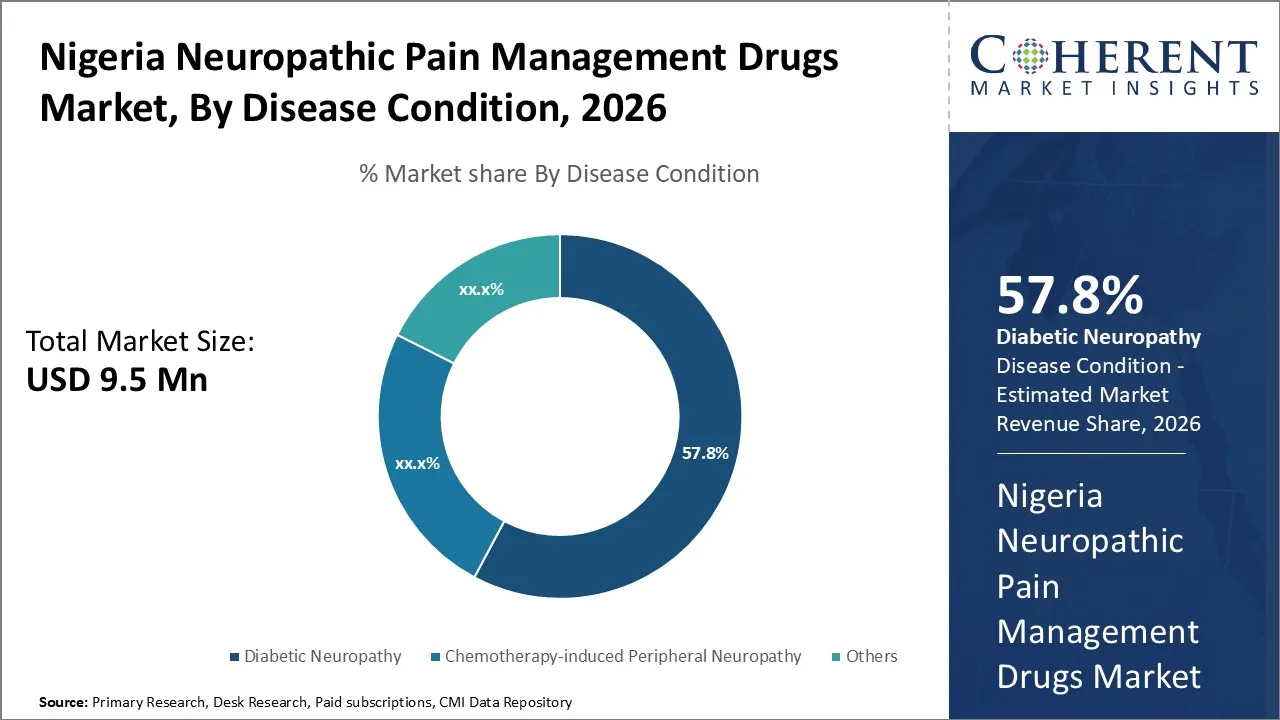
Nigeria Neuropathic Pain Management Drugs Market Insights, By Disease Condition - Diabetic neuropathy drives demand, reflecting Nigeria’s rising diabetes prevalence and high complication rates among patients
In terms of disease condition, the diabetic neuropathy segment is expected to lead the market with 57.8% share in 2026, because diabetes is becoming more common in Nigeria, with more than five million adults now having it. This group has largest share because almost 40% of diabetics have neuropathic problems. It shows how important it is for the whole country to have integrated diabetes management and strategic ways to control pain.
Nigeria Neuropathic Pain Management Drugs Market Insights, By Drug Class - Anticonvulsants dominate prescriptions in Nigeria due to affordability, availability, and proven pain relief effectiveness
In terms of drug class, the anticonvulsants segment is expected to hold 47.3% share of the market in 2026. Gabapentin and pregabalin are two examples of anticonvulsants that are often prescribed because they are affordable, easy to get, and proven to work well for neuropathic pain. They are used a lot in both cities and rural areas, making up almost half of all treatments. They are still the first-line treatment in Nigeria's clinical practice guidelines.
Nigeria Neuropathic Pain Management Drugs Market Insights, By Distribution Channel - Hospital pharmacies lead, ensuring centralized access to prescriptions and affordable generics across urban and rural regions
in terms of distribution channel, the hospital pharmacies segment is projected to account for 52.4% share in 2026. Hospital pharmacies are in charge of distribution and give out more than half of all neuropathic pain medications. Centralized hospital-based care makes sure that people can get prescriptions and specialists oversight, especially in big cities. Rural patients often rely on hospital networks for affordable generic drugs, which makes hospitals the main source of both advanced therapies and basic medications.
Market Report Scope
Nigeria Neuropathic Pain Management Drugs Market Report Coverage
| Report Coverage | Details | ||
|---|---|---|---|
| Base Year: | 2025 | Market Size in 2026: | USD 9.5 Mn |
| Historical Data for: | 2020 To 2024 | Forecast Period: | 2026 To 2033 |
| Forecast Period 2026 to 2033 CAGR: | 3.2% | 2033 Value Projection: | USD 11.8 Mn |
| Geographies covered: |
| ||
| Segments covered: |
| ||
| Companies covered: | Pfizer Inc., Novartis AG, GlaxoSmithKline Plc, and Biofemgroup Ltd. | ||
| Growth Drivers: |
| ||
| Restraints & Challenges: |
| ||
Nigeria Neuropathic Pain Management Drugs Market Driver
Increasing cancer treatments - chemotherapy-induced peripheral neuropathy
As more people in Nigeria get cancer treatment, more people are getting chemotherapy-induced peripheral neuropathy. This condition greatly affects the quality of life of patients, which increases the need for effective pain management solutions. The Nigeria Neuropathic Pain Management Drugs Market growth because more oncology services are available. This is because there is a need for specialized treatments that deal with nerve damage and chronic pain, which makes it easier for patients to continue treatment and stick with it.
Growing awareness and diagnosis rates - more patients seeking effective therapies
Neuropathic pain is becoming more well-known in Nigeria due to public health campaigns and better diagnostic tools. More patients are currently seeking for medical help, which has led to more prescriptions for anticonvulsants, antidepressants, and other drug classes. This trend is directly responsible for the Nigeria Neuropathic Pain Management Drugs demand. Increased awareness leads to fewer people not reporting their pain and better access to treatment, which strengthens the healthcare system as a whole and increases the use of drugs.
Nigeria Neuropathic Pain Management Drugs Market Opportunity
Expansion of oncology care- chemotherapy-induced neuropathy
The oncology field in Nigeria is growing, and more people are undergoing chemotherapy. This rise has led to more cases of peripheral neuropathy caused by chemotherapy, a painful condition that needs special drug treatments. Pharmaceutical companies see this as an opportunity to bring in new, better treatments. Due to this, the Nigeria Neuropathic Pain Management Drugs Market forecast shows that the market has a lot of room to grow, considering the urgent need for effective solutions that make patients more comfortable and help them stick to their cancer treatment plans.
Analyst Opinion (Expert Opinion)
- Neuropathic pain affects about 7–10% of the population in Nigeria, and diabetes-related neuropathy is responsible for about 40% of cases. The increasing number of people with diabetes and the aging population are two of the main reasons why people want pharmacological treatments.
- The way people get prescriptions shows that they are using gabapentinoids and antidepressants on a daily basis, which together make up more than 60% of treatment regimens. Access to advanced therapies is still limited, and costs are still a problem. This shows that there is a need for more affordable options.
Speak to the analyst
Want personalized insights?
Take the findings above to one of our principal consultants, or have the report rebuilt around the segments, geographies and competitors you actually track.
Market Segmentation
- By Drug Class
- Anticonvulsants
- Serotonin–norepinephrine Reuptake Inhibitors (SNRIs)
- Tricyclic Antidepressants
- Nonsteroidal Anti-inflammatory Drugs (NSAIDs)
- Others
- By Disease Condition
- Diabetic Neuropathy
- Chemotherapy-induced Peripheral Neuropathy
- Others
- By Distribution Channel
- Hospital Pharmacies
- Retail Pharmacies
- Online Pharmacies
- Key Players
- Pfizer Inc.
- Novartis AG
- GlaxoSmithKline Plc
- Biofemgroup Ltd.
Sources
Primary Research Interviews
- Neurologists & Pain Management Specialists (Nigeria)
- Anesthesiologists / Pain Clinics & Interventional Pain Physicians
- General Practitioners & Internal Medicine Physicians
- Hospital Pharmacists & Retail Chain Pharmacists
- Drug Distributors / Importers / Wholesalers
- HMOs / Payers & Reimbursement Stakeholders
- Regulatory / Policy Stakeholders (medicines access & pricing)
- Patient Advocacy Groups / Caregiver Networks
- Others
Databases
- IQVIA (sales / prescription intelligence, where applicable)
- GlobalData Healthcare / Pharma Intelligence
- EvaluatePharma
- Cortellis (Clarivate)
- Fitch Solutions (Country & Healthcare insights)
- WHO Global Health Observatory (GHO)
- World Bank Data
- NAFDAC (registered products / regulatory updates)
- ClinicalTrials.gov / WHO ICTRP (pipeline & trials)
- Others
Magazines
- Scrip (Informa)
- Pharmaceutical Technology
- Fierce Pharma
- PharmaTimes
- African Pharmaceutical Review
- Others
Journals
- Pain (IASP)
- The Journal of Pain
- Clinical Journal of Pain
- Journal of Pain Research
- Neurology
- The Lancet Neurology
- Cochrane Database of Systematic Reviews
- Others
Newspapers
- Reuters
- Bloomberg News
- Financial Times
- The Wall Street Journal
- The Guardian Nigeria
- Punch Newspapers (Nigeria)
- BusinessDay (Nigeria)
- Others
Associations
- International Association for the Study of Pain (IASP)
- Nigerian Medical Association (NMA)
- Pharmaceutical Society of Nigeria (PSN)
- Association of Community Pharmacists of Nigeria (ACPN)
- Neurological Society of Nigeria (NSN)
- West African College of Physicians (WACP)
- WHO (Nigeria / AFRO programs relevant to NCDs)
- Others
Public Domain Sources
- National Agency for Food and Drug Administration and Control (NAFDAC) – Nigeria
- Federal Ministry of Health & Social Welfare (Nigeria)
- National Health Insurance Authority (NHIA) – Nigeria
- Nigeria Centre for Disease Control (NCDC) – relevant health statistics (where applicable)
- WHO – Essential Medicines / NCD resources
- World Bank Open Data
- UN Comtrade (pharma trade flows, where relevant)
- Others
Proprietary Elements
- CMI Data Analytics Tool
- Proprietary CMI Existing Repository of Information for the Last 8 Years
Get access to 250+ pages report
Every segment, forecast, competitor profile and data table behind the analysis above — available for instant download.
- ESOMAR Member
- ISO 9001:2015 Certified
- D-U-N-S Registered
- GDPR & CCPA Compliant
Missing comfort of reading report in your local language? Find your preferred language:
Transform your Strategy with Exclusive Trending Reports
Frequently Asked Questions
The global Nigeria Neuropathic Pain Management Drugs Market size was valued at USD 9.5 Mn in 2026 and is expected to reach USD 11.8 Mn in 2033.
The increasing cancer treatments - chemotherapy-induced peripheral neuropathy and growing awareness and diagnosis rates - more patients seeking effective therapies are expected to drive the market growth over the forecast period.
Anticonvulsants segment is the leading drug class segment in the market.
Major factors hampering growth of the market include scarce local production of pain management drugs, and the risk of counterfeit drugs.
Major players operating in the market include Pfizer Inc., Novartis AG, GlaxoSmithKline Plc, and Biofemgroup Ltd.