

Nursing Care Services Market Size and Forecast — 2026-2033
Overview
Nursing care services provide special care to patients suffering from chronic diseases such as Parkinson’s disease, Alzheimer’s disease, patients who need care for injury, and who are ill and require continuous attendance. At the nursing care services centre, trained professionals provide care facilities such as dressing, personal hygiene, and timely medications. This industry provides patient nursing, rehabilitation services, and living accommodations to people with some disability or chronic disorders. These service centres also help the speech therapists and physical therapist by assisting them and monitoring interventional medications.
Nursing Care Services Market Size and Forecast – 2026 – 2033
The Nursing Care Services Market size is estimated to be valued at USD 180.73 billion in 2026 and is expected to reach USD 338.96 billion by 2033, exhibiting a compound annual growth rate (CAGR) of 9.4% from 2026 to 2033.
Key Takeaways
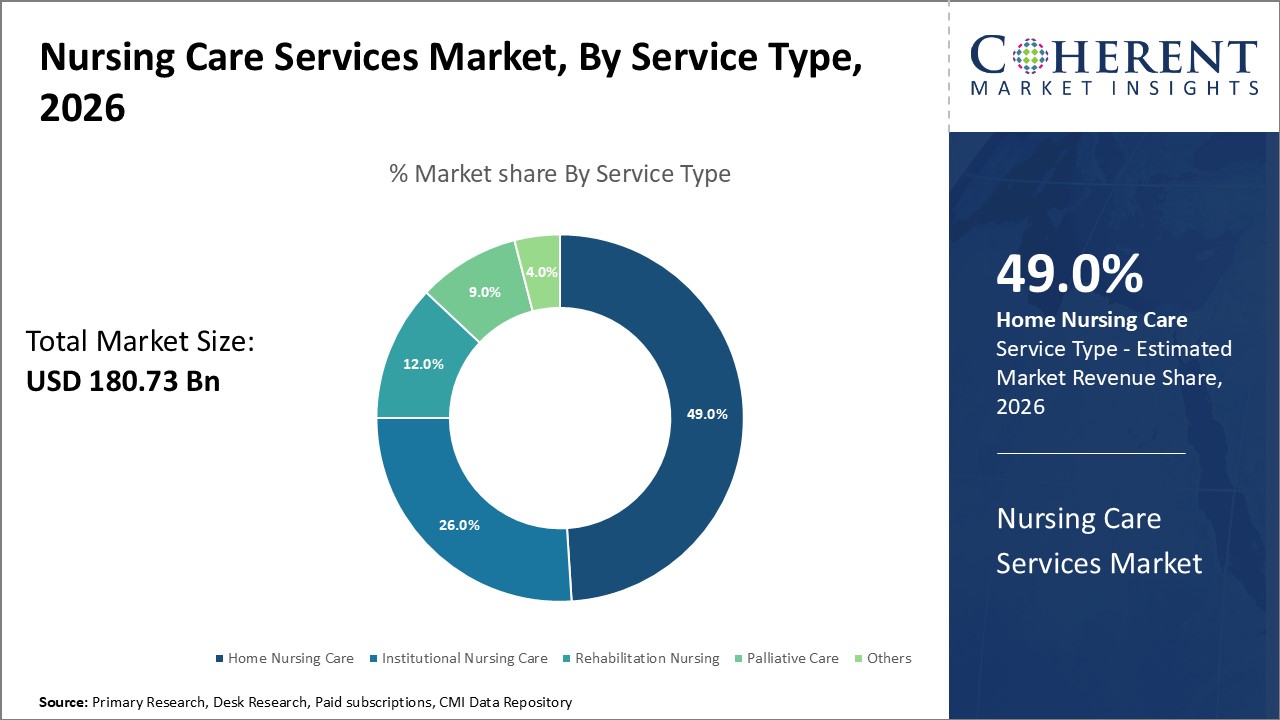
The home nursing care segment leads the market with nearly 49% market share, driven by growing patient preference for in-home treatment and technological advancements in remote care.
Homecare Settings is expected to dominate the target market growth, as it is driven by increasing demand for in-home clinical interventions and personalized care.
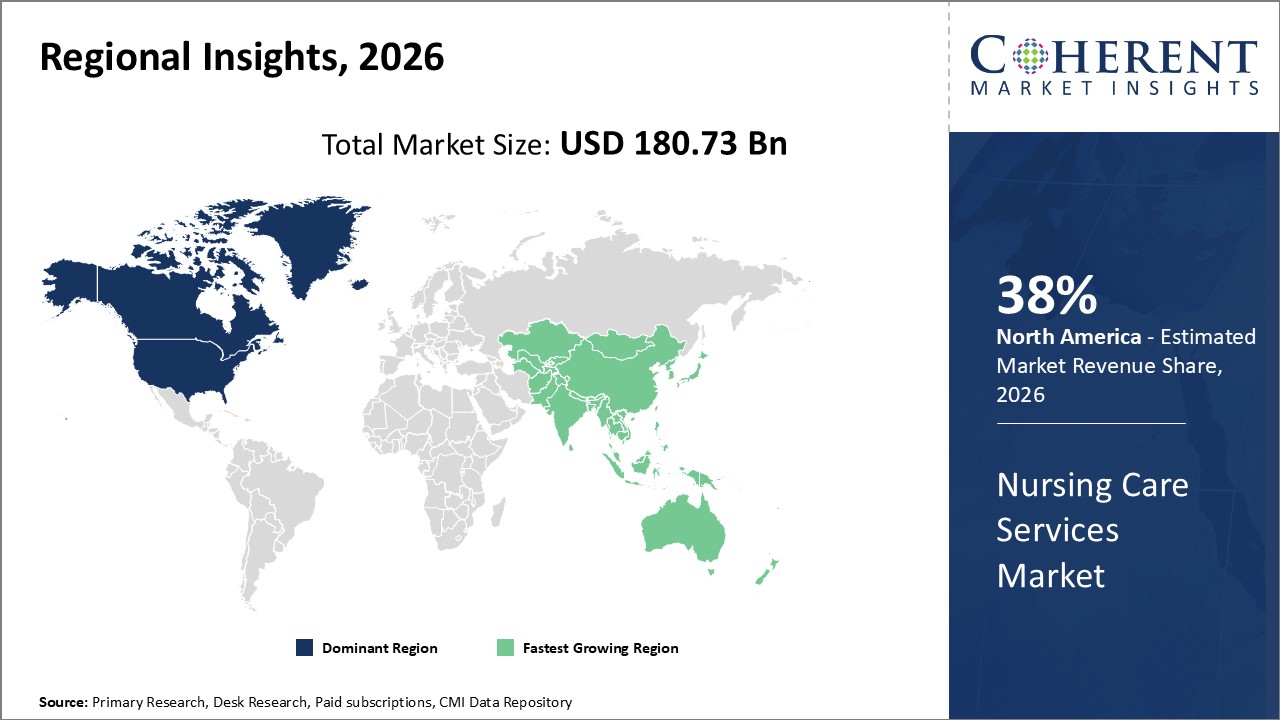
North America commands a dominant market share of approximately 38%, underpinned by robust healthcare infrastructure and government expenditure.
Meanwhile, Asia Pacific exhibits the fastest market growth, driven by increasing healthcare awareness and expanding elderly demographics, projected to grow at a CAGR above 11%. These trends provide a compelling outlook for market players aiming to optimize opportunities across diverse segments and geographies.
Nursing Care Services Market – Segmentation Analysis
Analysis of the Nursing Care Services Market, By Service Type
In terms of service type, the market is segmented into Home Nursing Care, Institutional Nursing Care, Rehabilitation Nursing, Palliative Care, and Others, among which Home Nursing Care dominates the market share of 49%. The dominance of home nursing care is primarily attributed to patient preference for receiving care in familiar environments coupled with advancements in telehealth services enabling remote health monitoring. This segment is witnessing accelerated growth supported by an escalating elderly population and chronic care patients opting for non-institutionalized settings.
Analysis of the Nursing Care Services Market, By Care Setting
The Nursing Care Services market by care setting is classified into Private Nursing Homes, Public Nursing Homes, Hospices, Homecare Settings, and Others, with Homecare Settings dominating the market share. The rapid decentralization of healthcare and patient inclination towards home-based care positions homecare settings as the key revenue driver. Private Nursing Homes command significant attention owing to upscale service offerings and enhanced amenities attracting premium segments.
Analysis of the Nursing Care Services Market, By End User
Within end-user segmentation, the market includes Elderly Patients, Chronic Disease Patients, Disabled Individuals, Post-operative Patients, and Others, where Elderly Patients dominate market share substantially. This dominance arises due to escalating aging populations globally requiring ongoing nursing support for age-related conditions.
Nursing Care Services Market Insights, By Geography
North America Nursing Care Services Market Analysis and Trends
Due to its advanced healthcare infrastructure, high healthcare spending, and advantageous reimbursement regulations, North America holds a significant 38% market share in the nursing care services industry. Market leaders like Encompass Health and Brookdale Senior Living have solidified their positions and are using technology and patient-centred care to drive expansion.
Asia Pacific Nursing Care Services Market Analysis and Trends
Growing older populations, better access to healthcare, and growing government initiatives in nations like China and India are driving the market's robust demand for nursing care services across emerging urban and rural areas, making Asia Pacific the fastest-growing region with a compound annual growth rate (CAGR) of over 11%.
Nursing Care Services Market Outlook for Key Countries
Analysis of the United States Market for Nursing Care Services and Its Trends
Despite healthcare spending expected to reach USD 4.3 trillion in 2025 and a growing demand for homecare options, the USA continues to play a significant role in the nursing care services market. Large-scale service networks and sophisticated telehealth-enabled nursing programs are the hallmarks of dominant companies like LHC Group and Amedisys. The need for ongoing nursing care is highlighted by the increased frequency of chronic illnesses, such as the 16% increase in diabetes cases in 2025. Additionally, the market is very profitable and competitive because to the expansion of access to nursing services brought about by favourable Medicare rules and federal financial improvements.
Analysis of the Japan Market for Nursing Care Services and Its Trends
Boasting more than 28% of the population over 65, Japan has one of the highest old population ratios in the world, which is driving the country's nursing care market's rapid expansion. Since 2023, the use of homecare services has increased by 20% as a result of government policies that gave priority to home nursing care. To combat labor shortages, major companies like Bupa Ltd. and regional service providers make significant investments in incorporating robotics and AI-assisted care delivery. Together with significant government subsidies, this technological adoption is reshaping Japan's nursing care services market into one that is highly innovative and growing.
Analyst Opinion
Rapid Expansion of Home Healthcare Services: Home nursing care is becoming the dominant model within the market, driven by patient preferences for in-home treatment and lower healthcare costs. In 2025, home nursing care accounted for approximately 49% of the overall market revenue, underlining a sustained shift towards decentralized healthcare delivery. For instance, the U.S. saw a 16% year-on-year increase in Medicare-funded home healthcare patients, validating supply-side growth potential.
Integration of Telehealth and Remote Monitoring Solutions: The increasing adoption of telehealth devices enables remote patient monitoring, thereby expanding the scope of nursing care services. Recent data from 2026 indicates a 39% increase in telehealth nursing consultations globally, significantly improving outcomes for chronic disease patients and reducing hospital readmissions by up to 26%.
Labor Market Challenges and Workforce Upskilling: The nursing care sector faces constraints due to workforce shortages and the need for specialized skills in geriatric and palliative care. In 2025, the U.S. reported a nursing vacancy rate of approximately 13%, underscoring the necessity for enhanced training programs and recruitment strategies to sustain market growth.
Increasing Healthcare Expenditure and Government Initiatives: National healthcare spending rose by 9.5% in 2025 globally, with several governments launching initiatives to support elderly care infrastructure. This demand-side dynamic plays a critical role in driving the market’s favorable growth trajectory, evidenced by policy reforms in countries like Japan and Germany that subsidize nursing care services.
- Current Industry Events of 2026
- Market Size Estimation
- Regional Breakdown
- Competitive Landscape
- Customer Intelligence
- Segmental Analysis
- Pricing Analysis
- Key Market Drivers, Challenges & Future Trends
- Customized Insights Section
Market Scope
| Report Coverage | Details | ||
|---|---|---|---|
| Base Year: | 2025 | Market Size in 2026: | USD 180.73 billion |
| Historical Data for: | 2020 To 2024 | Forecast Period: | 2026 To 2033 |
| Forecast Period 2026 to 2033 CAGR: | 9.4% | 2033 Value Projection: | USD 338.96 billion |
| Geographies covered: |
| ||
| Segments covered: |
| ||
| Companies covered: | LHC Group Inc., Amedisys Inc., Brookdale Senior Living, Encompass Health Corporation, Kindred Healthcare, Genesis Healthcare, Bupa Ltd., Atria Senior Living, Consulate Health Care, Interim HealthCare Inc. | ||
| Growth Drivers: |
| ||
Growth factors
The increasing geriatric population worldwide is a primary catalyst propelling the industry’s expansion, with the global elderly demographic projected to reach over 1.6 billion by 2050.
In tandem, rising chronic disease prevalence, including diabetes and cardiovascular conditions, necessitates specialized nursing care services, contributing to steady market growth.
Technological innovations, particularly remote monitoring systems and AI-powered care analytics, are optimizing service delivery, thus enhancing patient outcomes and operational efficiency.
Moreover, government funding and policy incentives supporting home-based care facilities reduce institutional care dependency, thereby significantly amplifying market revenue.
The integration of digital health solutions is another critical driver enabling scalable and cost-effective nursing care, demonstrated by a 24% increase in telehealth nursing consultations in 2025.
Nursing Care Services Market Development
- In March 2026, Emory University Hospital Midtown is the first Emory Healthcare hospital to deploy and test both new telehealth equipment and artificial intelligence (AI)-driven technology to assist nurses in caring for patients and preventing falls. Emory is working with VirtuSense Technologies, based in Illinois, to help nurses with everyday activities and monitoring using a combination of new hardware, software, telehealth, and artificial intelligence. This will allow nurses to concentrate more on active patient care. This strategic launch, which is referred to as "virtual nursing," includes new technology for remote nursing care that enables nurses to monitor, evaluate, and assist patients without being physically there.
Market Trends
The Nursing Care Services market demonstrates a prominent shift towards integrated care models combining healthcare and social services to enhance patient-centricity.
Innovations such as wearable medical devices and AI-enabled care coordination platforms have gained momentum, improving monitoring and responsiveness, including advancements in joint pain injections for targeted treatment.
Sustainable care practices are emerging, focusing on reducing inpatient stays and promoting homecare adoption, exemplified by a 19% increase in home nursing referrals across North America in 2025.
Additionally, personalized care plans driven by big data analytics contribute to improved care quality and patient satisfaction.
Furthermore, the incorporation of robotic assistance in nursing tasks, while nascent, gained traction in pilot programs in Japan and Germany, showing potential for operational efficiency gains in the near future.
Key Players
LHC Group Inc.
Amedisys Inc.
Brookdale Senior Living
Encompass Health Corporation
Kindred Healthcare
Genesis Healthcare
Bupa Ltd.
Atria Senior Living
Consulate Health Care
Interim HealthCare Inc.
Several market players have adopted strategic collaborations and acquisitions to enhance service portfolios and geographic presence. For example, LHC Group’s acquisition of a regional home health provider in 2025 expanded their patient base by 22%, while Amedisys implemented AI-driven workforce management tools that reduced operational costs by 14% in one year. Such competitive strategies not only consolidate market position but also accelerate business growth trajectories.
Future Prospects of the Nursing Care Services Market
The future outlook for the Nursing Care Services Market is highly positive, driven by several converging factors. The growing global geriatric population, coupled with the increasing prevalence of chronic diseases, continues to create strong demand for specialized nursing care. The shift toward home-based and personalized care models is expected to accelerate, supported by advancements in telehealth, remote monitoring, and digital healthcare technologies that enhance patient comfort and care efficiency.
Healthcare policies that promote community and home-based care will further support market growth. Additionally, innovations like AI-driven care management and increased investment in nursing workforce development aim to address challenges such as staffing shortages. Collaboration between private nursing providers, healthcare institutions, and technology firms is anticipated to foster integrated, patient-centered care ecosystems, positioning the market for sustained expansion and transformation in the coming years.
However, challenges including cost, regulatory variability, and workforce retention remain areas requiring strategic solutions to maintain positive momentum. Overall, the market is set for robust growth as healthcare systems worldwide adapt to demographic and technological trends.
Historical Analysis
The Nursing Care Services Market demonstrated steady growth over the past several years, supported by rising demand from an aging population and increasing prevalence of chronic diseases. In 2020, the market was estimated at approximately USD 1,076.8 million and was projected to grow at a compound annual growth rate (CAGR) of around 6.6% to reach about USD 1,414 million by 2026.
The market was shaped by increasing awareness of the need for efficient healthcare delivery, alongside challenges such as high healthcare costs and a shortage of skilled nursing professionals. From 2019 to 2025, the broader care services market, inclusive of nursing care, reached a valuation of over USD 50 billion, with expected growth continuing driven by factors like the shift towards home-based care and advancements in healthcare technology.
Key developments in the sector included expansion by companies such as Genesis HealthCare and Amana Healthcare launched specialized care units, plus investments in AI and automation to improve service efficiency. The private nursing services segment, valued at over USD 5 billion in 2025, grew with a CAGR close to 7.7%, reflecting increased demand for personalized, home-based healthcare solutions.
North America remained a leading regional market due to strong governmental support and advanced health infrastructure, while Asia Pacific was noted as the fastest-growing region. The market trends reflected a transformation towards patient-centric care models, supported by ongoing innovation and healthcare policy shifts.
Sources
Primary Research interviews:
Nursing home directors
Home healthcare providers
Registered nurses (RNs)
Databases:
Web of Science
ProQuest
MEDLINE
Magazines:
Nurse Leader
Modern Healthcare
Today’s Caregiver
Journals:
Journal of Advanced Nursing
- BMC Nursing
Journal of Gerontological Nursing
Newspapers:
The Washington Post (Health section)
The Hindu (Health section)
Times of India (Health section)
Associations:
International Council of Nurses (ICN)
National Association for Home Care & Hospice (NAHC)
Gerontological Advanced Practice Nurses Association (GAPNA)
Get access to 250+ pages report
Every segment, forecast, competitor profile and data table behind the analysis above — available for instant download.
- ESOMAR Member
- ISO 9001:2015 Certified
- D-U-N-S Registered
- GDPR & CCPA Compliant
Missing comfort of reading report in your local language? Find your preferred language:
Transform your Strategy with Exclusive Trending Reports
Frequently Asked Questions
The market is led by companies such as LHC Group Inc., Amedisys Inc., Brookdale Senior Living, and Encompass Health Corporation, which have significantly increased their market presence through acquisitions and digital innovation strategies.
The Nursing Care Services market size is projected to grow from USD 180.73 billion in 2026 to USD 338.96 billion by 2033, expanding at a CAGR of 9.4% during this period.
Elderly patient care represents the largest growth opportunity due to the burgeoning global aging population and increasing prevalence of age-related chronic diseases that require ongoing nursing care services.
There will be an increasing shift toward home nursing care supported by telehealth integration, personalized care plans, and AI-enabled monitoring systems, contributing to enhanced patient outcomes and cost efficiencies.
The competitive landscape is shaped by strategic mergers, technology adoption, and workforce challenges including shortages and skill gaps, which companies are addressing through training and innovative care models.
Companies emphasize expanding home healthcare service offerings, investing in digital health platforms, forging partnerships, and focusing on patient-centric care solutions to capture a larger market share and maximize business growth.