

Peptic Ulcer Drugs Market Analysis & Forecast: 2026-2033
Peptic Ulcer Drugs Market is estimated to be valued at USD 38.82 Bn in 2026 and is expected to reach USD 52.13 Bn in 2033, exhibiting a compound annual growth rate (CAGR) of 4.3% from 2026 to 2033.
Key Takeaways
- Based on the Product Type, the Proton Pump Inhibitors segment dominates the peptic ulcer drugs market share due to high efficiency in acid suppression.
- Based on the Disease Indication, the Duodenal Ulcer segment dominates the market due to the increased prevalence of Global ulcers.
- Based on the Distribution Channel, the Hospital Pharmacies segment dominates the market due to the availability of advanced treatment.
- On the basis of Region, North America dominates the Peptic Ulcer Drugs market with the largest share of 34.8% on account of the growing healthcare expenditure.
Market Overview
The growth of the Peptic Ulcer Drugs Market’s growth is fueled by the increasing prevalence of Helicobacter pylori infections, widespread NSAID usage, and aging population shifts towards medical therapies.
Current Events and Its Impact
Current Events | Description and its impact |
Technological Advances and Pharmaceutical Innovations |
|
Shifts in Patient Preferences and Physician Treatment Patterns |
|
End Use Application for Peptic Ulcer Drugs Market
- Hospitals: Used for acute treatment of bleeding ulcers, perforations, or severe pain requiring IV administration of drugs like PPIs for example pantoprazole. Hospitals prefer intravenous PPIs and H2-receptor antagonists for
- Retail Pharmacies: Long-term management of chronic ulcers, especially in patients with recurring H.pylori infection or NSAID-induced ulcers.
- Ambulatory Surgical Centers (ASCs): Short-stay procedures like endoscopy or biopsy in diagnosed ulcers and PPIs and prophylactic drugs used perioperatively.
- Speciality Clinics (Gastroenterology Practices): Specialized care for drug-resistant ulcers or patients with complications like Zollinger-Ellison syndrome, and chronic gastritis)
- Current Industry Events of 2026
- Market Size Estimation
- Regional Breakdown
- Competitive Landscape
- Customer Intelligence
- Segmental Analysis
- Pricing Analysis
- Key Market Drivers, Challenges & Future Trends
- Customized Insights Section
End-user Feedback and Unmet Needs in the Peptic Ulcer Drugs Market
End-user Feedback
- Slow Onset of Action: Patients often report relief from symptoms using PPIs or H2-receptor antagonists can take several days, leading to poor compliance during the initial phase.
- Lack of Personalized Treatment: Current therapy does not consider genetic variability, comorbidities, or lifestyle factors, which can affect treatment outcomes.
- Side Effects and Saftey: Common complaints include bloating, diarrhea, constipation, and long-term concerns about bone loss, kidney function, and increased
Unmet Needs
- Next-Gen Therapies for PPI-Resistant Ulcers: There is a need for new drug classes that target ulcer formation via non-acid-related mechanisms for example mucosal healing agents, and prostaglandin analogs with better safety.
- Personalized Ulcer Therapy Algorithms: Use of AI tools or diagnostic biomarkers to customize ulcer management based on risk, comorbidity, and microbial resistance profiles.
- Non-Oral Delivery Systems: Especially for patients with GI intolerance, nausea, or difficulty swallowing pills–patches, injectables, or ODT (orally disintegrating tablets) could improve adherence.
Segmental Insights
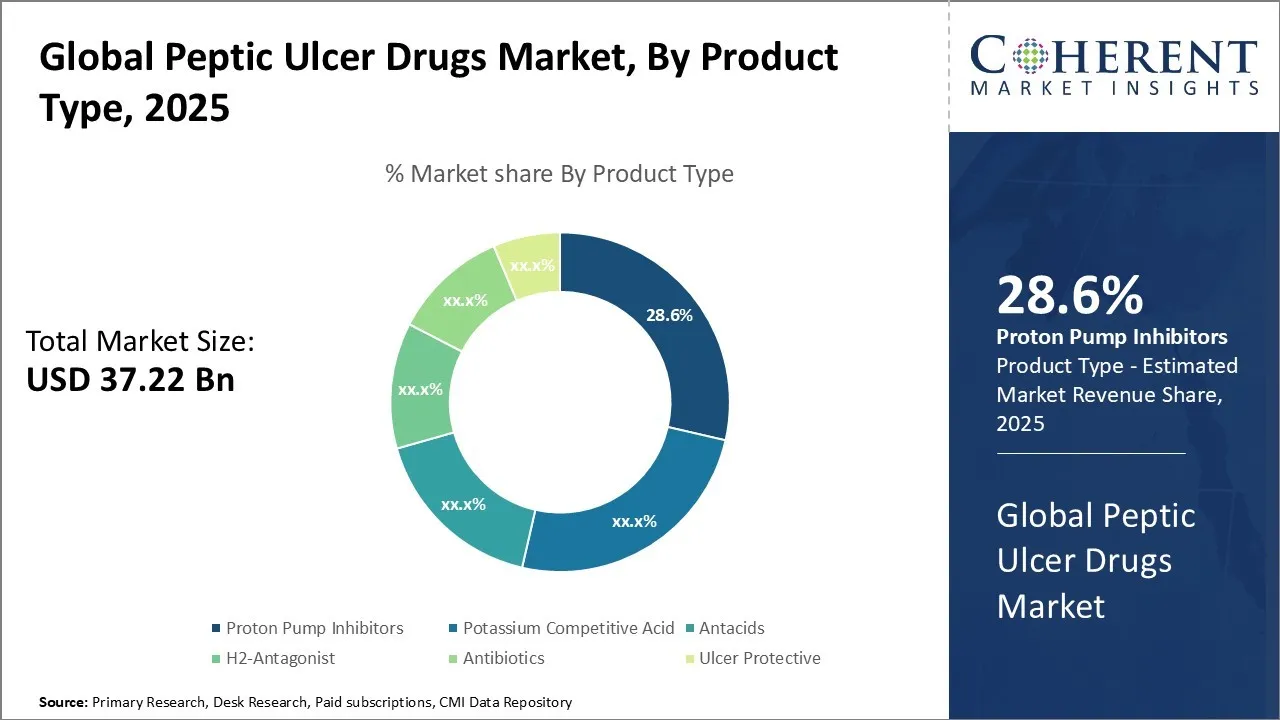
Peptic Ulcer Drugs Market Insights, by Product Type - The Proton Pump Inhibitors segment dominates the market due to High efficiency in acid suppression
Based on Product Type, the market is segmented into steroids, proton pump inhibitors, potassium-competitive acid blockers (p-cab), antacids, h2- antagonists, antibiotics, and ulcer protection. Out of which, the Proton Pump Inhibitors segment is expected to dominate the global peptic ulcer drugs market during the forecast period and this is attributed to an increase in the product launches by key market players. In June 2026, Eisai Co., Ltd. launched “Pariet® S,” the first proton pump inhibitor (PPI) approved as an over-the-counter (OTC) medicine in Japan, effective in relieving severe heartburn and stomach pain from acid reflux. It is now available at pharmacies and drugstores nationwide. This is further propelling the peptic ulcer drugs market share.
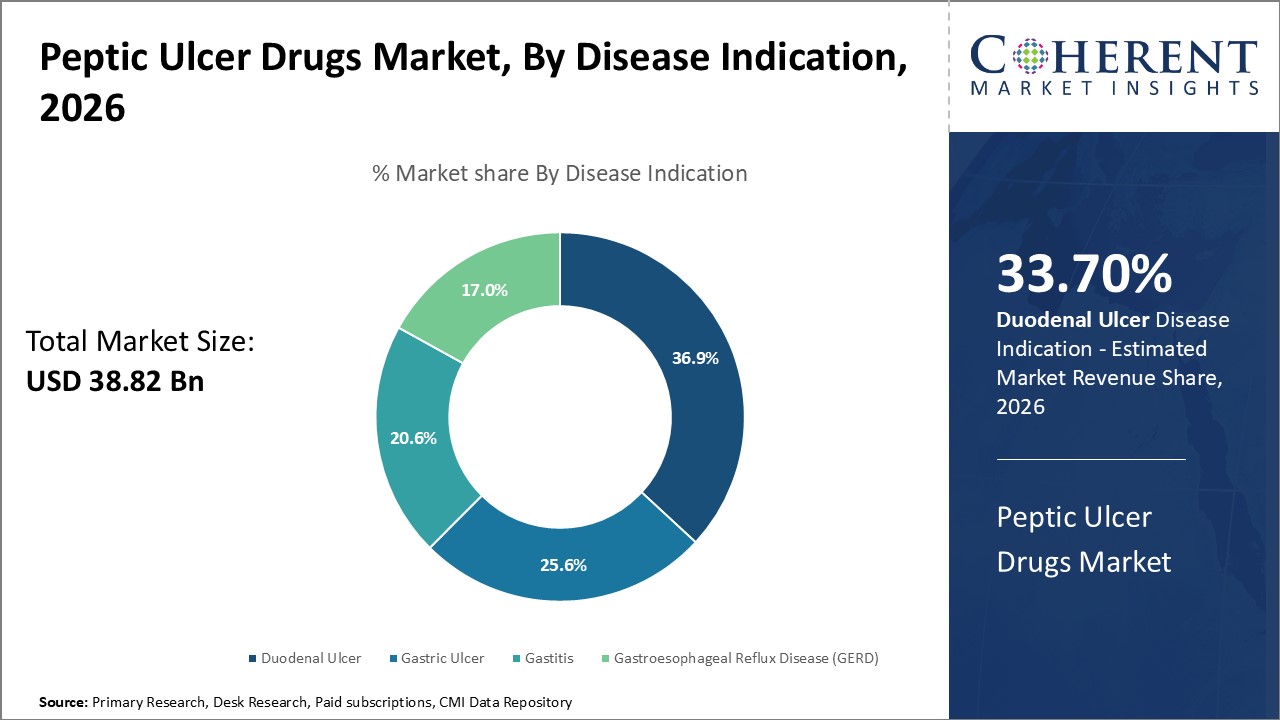
Peptic Ulcer Drugs Market Insights, by Disease Indication - The duodenal ulcer segment dominates the market due to Increased prevalence of Global ulcer
Based on Disease Indication, the market is segmented into gastritis, gastric ulcer, duodenal ulcer, and gastroesophageal reflux disease (GERD). Out of which, the duodenal ulcer segment is expected to dominate the global peptic ulcer drugs market during the forecast period and this is attributed to an increase in the global prevalence of gastric ulcer. For instance, Akums launched Combikit for Duodenal Ulcer where the Combikit is approved by the CDSCO for healing duodenal ulcers associated with Helicobacter pylori in patients with active or healed peptic ulcer.
Peptic Ulcer Drugs Market Insights, by Distribution Channel - The hospital pharmacies segment dominates the market due to the availability of advanced treatment.
Based on the Distribution Channel, the market is segmented into Hospital Pharmacies, Retail Pharmacies, and Online Pharmacies. Out of which, the hospital pharmacies segment is expected to dominate the market over the forecast period and this is attributed to an increase in the number of hospital pharmacies. For instance, Apollo HealthCo Ltd is expanding its pharmacy network in West Bengal, aiming to establish numerous new outlets across the state. Such initiatives are adding to the peptic ulcer drugs market demand. Apart from this, there is a growing penetration towards e-pharmacy, which is further acting as a major growth-inducing factor.
Regional Insights
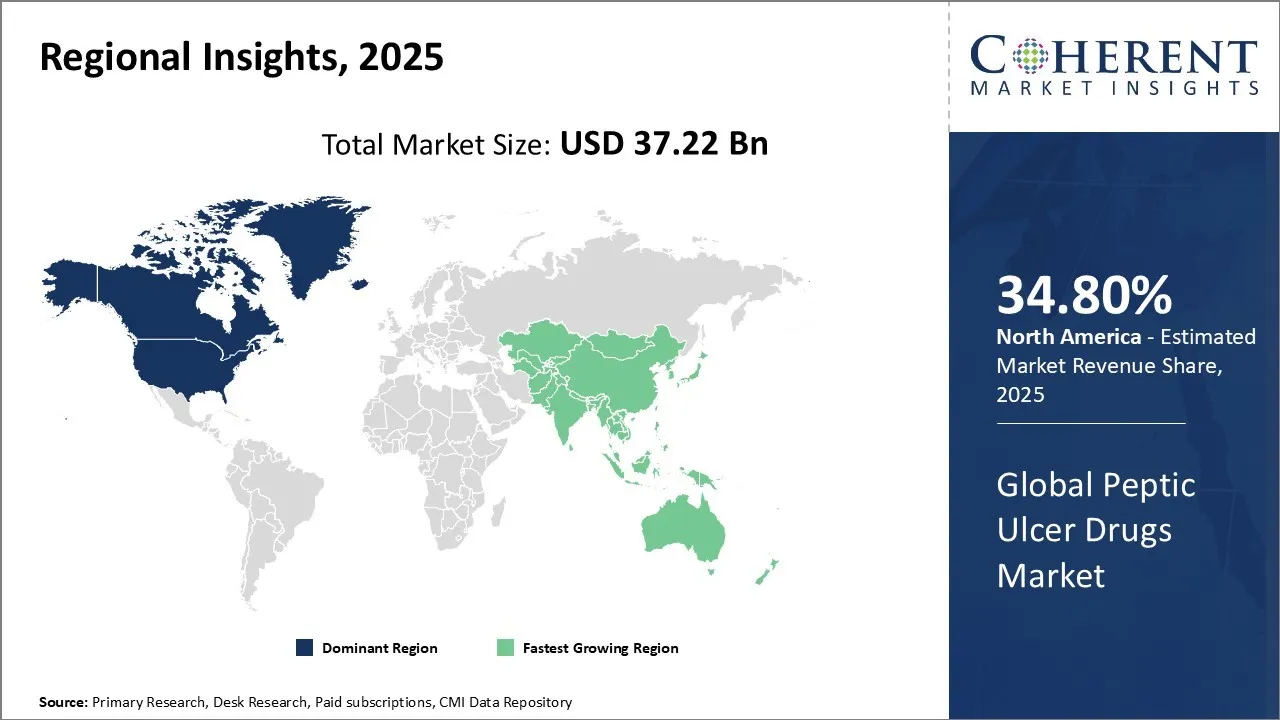
North America Peptic Ulcer Drugs Market Trends
Among all regions, North America is expected to dominate the global market with a share of 34.80% over the forecast period. This is attributed to North America holding a large market share and an increase in product approval by the regulatory bodies in this region. For instance, in June 2026, Zydus Lifesciences, a pharmaceutical company, announced that the company had received approval from the U.S. Food and Drug Administration (FDA) to market Famotidine tablets in the strengths of 20 mg and 40 mg. Famotidine is a histamine H2 receptor blocker. It works by reducing the amount of acid in the stomach.
Europe Peptic Ulcer Drugs Market Trends
The Europe peptic ulcer drugs market is growing steadily, driven by an increasing prevalence of peptic ulcers caused by NSAID use, and lifestyle factors. Advancements in drug formulations, especially proton pump inhibitors (PPIs) and H2 receptor antagonists, improve treatment efficacy and patient adherence. The rise of over-the-counter (OTC) availability for some ulcer medications also enhances accessibility, boosting market demand. Ranbaxy Laboratories announced the launch of generic esomeprazole tablets in 20 mg and 40 mg strengths for ulcer treatment in the United Kingdom.
United States Peptic Ulcer Drugs Market
The United States Peptic Ulcer Drug Market is seeing significant growth due to the increasing prevalence of H.pylori infections and widespread NSAID/aspirin use especially among older adults and the fueling demand, as these are the leading causes of ulcers in the U.S. population. For instance, Phathom Pharmaceuticals announced FDA Approval of Reformulated Vonoprazan Tablets for VOQUEZNA® TRIPLE PAK® (vonoprazan, amoxicillin, clarithromycin) and VOQUEZNA® DUAL PAK® for the Treatment of H. pylori Infection in Adults.
India Peptic Ulcer Drugs MarketTrends
The rise in the peptic ulcer drugs market in India is driven by the increasing prevalence of Helicobacter pylori infections and growing gastrointestinal complications due to changing dietary habits and stress. Expanding access to healthcare in rural areas and rising awareness about gastrointestinal disorders are further propelling demand. For, instance Dr. Reddy’s, in innovation with Takeda, launched Vonoprazan (VONO) in India, a potassium-competitive acid blocker (PCAB) for treating acid peptic disorders like reflux esophagitis.
Global Peptic Ulcer Drugs Market- Driver
Increasing prevalence of peptic ulcers
The increasing prevalence of peptic ulcers is a major factor boosting the growth of the global peptic ulcer drugs market over the forecast period. For instance, data published in April 2021, stated that in the U.S., peptic ulcer disease affects approximately 4.6 million people every year.
Increase in the research and development activities
An increase in the research and development activities by the key players in the market is expected to drive the growth of the market over the forecast period. For instance, on January 4, 2023, Tanta University, based in Egypt, initiated a clinical study titled ‘Diosmin as Adjuvant Therapy in Treatment of Non-bleeding Peptic Ulcer.’ The study is expected to be completed by June 2025.
Market Report Scope
Peptic Ulcer Drugs Market Report Coverage
| Report Coverage | Details | ||
|---|---|---|---|
| Base Year: | 2025 | Market Size in 2026: | USD 38.82 Bn |
| Historical Data for: | 2020 To 2024 | Forecast Period: | 2026 To 2033 |
| Forecast Period 2026 to 2033 CAGR: | 4.3% | 2033 Value Projection: | USD 52.13 Bn |
| Geographies covered: |
| ||
| Segments covered: |
| ||
| Companies covered: | Daewoong Pharmaceutical Co., Ltd, Takeda Pharmaceutical Co., Ltd., Pfizer Inc., AstraZeneca plc., RedHill Biopharma, Cadila Healthcare Ltd., Novitium Pharma LLC., Boehringer Ingelheim GmbH, Eisai Co. Ltd., Yuhan Corporation, GlaxoSmithKline plc. | ||
| Growth Drivers: |
| ||
| Restraints & Challenges: |
| ||
Global Peptic Ulcer Drugs Market Cross-Sectional Analysis
In the product type segment, the proton pump inhibitors segment held a dominant position in the Asia Pacific region due to the increasing adoption of inorganic growth strategy agreements by key market players. For instance, in March 2021, Daiichi Sankyo Co., Ltd., a pharmaceutical company, made an agreement to transfer the marketing and distribution rights for the proton pump inhibitor Nexium capsules 10 mg and 20 mg and Nexium granules for suspension 10 mg and 20 mg (esomeprazole magnesium) to AstraZeneca in Japan.
In the disease indication segment, the Gastric Ulcer segment held a dominant position in the North American region due to the increase in research and development activities by key market players. For instance, on June 9, 2020, Spital Limmattal Schlieren, a general and teaching hospital based in Switzerland, initiated a clinical study titled ‘Functional Changes in the Stomach and Esophagus After One Anastomosis Gastric Bypass- OAGB- BiFlux Trial.’ The study is estimated to be completed on May 28, 2028.
Global Peptic Ulcer Drugs Market: Key Developments
In April 2025, Sun Pharmaceutical Industries launched FEXUCLUE, a 40 mg potassium-competitive acid blocker (P-CAB), in India. Approved for treating adults with erosive esophagitis of all grades, FEXUCLUE contains Fexuprazan and targets acid-related disorders such as GERD and erosive esophagitis. It is also under investigation for preventing NSAID-induced peptic ulcers and gastritis.
In September 2024, Jeil Pharmaceutical unveiled Jaqbo, a new potassium-competitive acid blocker to enter peptic ulcer drug market.
In June 2024, Mankind Pharma & Takeda signed a non-executive patent license for vonoprazan in India. This enables Mankind to commercialize Takeda’s first-in-class P-CAB (potassium-competitive acid blocker) for duodenal and peptic ulcers.
In September 2024, Hk inno. N gained approvals in six Latin American countries for K-CAB, a new P-CAB targeting GERD and peptic ulcers for a new drug for gastroesophageal.
In September 2024, Jeil Pharmaceuticals launched Jaqbo(zastaprazan citrate) in South Korea, another P-CAB entering the gastric/peptic ulcer segment.
Analyst Opinion (Expert Opinion)
- Over-Reliance on PPIs in masking long-term safety concerns. Proton Pump inhibitors (PPIs) dominate the peptic ulcer market due to their strong efficacy in acid suppression, but long-term use has been increasingly linked to chronic kidney disease, vitamin B12 deficiency, and increased risk of CKD among chronic PPI users. A 2022 BMJ study involving over 190,000 patients found a 44% higher risk of CKD among chronic PPI users. Despite this, companies like Takeda (Dexilant) and Pfizer (Prevacid) continue to prioritize PPI lifecycle extensions rather than innovating on safer alternatives– indicating a short-term market strategy over patient-centric R&D.
- pylori resistance is outpacing drug development. Antibiotic resistance is severely undermining standard triple therapy for Helicobacter pylori-induced ulcers. WHO has classified H.pylori as a high-priority pathogen and recent studies in India and China show clarithromycin resistance rates exceeding 30%, rendering current regimens ineffective. Yet, only a handful of pharma companies like RedHill Biopharma are addressing this novel combination. This signals a glaring innovation gap and suggests that regulatory and investment frameworks are failing to incentivize development in antimicrobial-specific ulcer therapeutics.
- Neglected pipeline for NSAID-induced ulcer indicates misalignment with aging population trends. With increasing NSAID-induced ulcers are surging. However, drug innovation here remains stagnant. Misoprostol, despite proven gastroprotective efficacy, sees limited adoption due to poor tolerance and outdated formulation. This presents a commercially viable white space that remains largely ignored, highlighting strategic inertia across major players.
Speak to the analyst
Want personalized insights?
Take the findings above to one of our principal consultants, or have the report rebuilt around the segments, geographies and competitors you actually track.
Global Peptic Ulcer Drugs Market: Restraint
Side effects associated with peptic ulcer drugs
The major factors that can hamper the growth of the global peptic ulcer drugs market over the forecast period include side effects associated with the drugs used to treat peptic ulcers. Prolonged use of peptic ulcer drugs such as proton pump inhibitors and antibiotics may lead to an increased risk of hip bone fracture as the ability to absorb calcium and iron decreases. Other side effects include the risk of opportunistic infections with S. pneumonia and C. difficult, owing to diminished natural gut flora. Such a scenario is expected to hamper the growth of the global peptic ulcer drugs market.
Market Segmentation
- Global Peptic Ulcer Drugs Market, By Product Type (Revenue, USD Bn, 2021 - 2033)
- Proton Pump Inhibitors
- Potassium-Competitive Acid Blocker (P-CAB)
- Antacids
- H2- Antagonist
- Antibiotics
- Ulcer Protective
- Global Peptic Ulcer Drugs Market, By Disease Indication (Revenue, USD Bn, 2021 - 2033)
- Gastitis
- Gastric Ulcer
- Duodenal Ulcer
- Gastroesophageal Reflux Disease (GERD)
- Global Peptic Ulcer Drugs Market, By Distribution Channel (Revenue, USD Bn, 2021 - 2033)
- Hospital Pharmacies
- Retail Pharmacies
- Online Pharmacies
- Global Peptic Ulcer Drugs Market, By Region (Revenue, USD Bn, 2021 - 2033)
- North America
- U.S.
- Canada
- Latin America
- Brazil
- Argentina
- Mexico
- Rest of Latin America
- Europe
- Germany
- U.K.
- Spain
- France
- Italy
- Russia
- Rest of Europe
- Asia Pacific
- China
- India
- Japan
- Australia
- South Korea
- ASEAN
- Rest of Asia Pacific
- Middle East
- GCC Countries
- Israel
- Rest of Middle East
- Africa
- South Africa
- North Africa
- Central Africa
- North America
- Company Profiles
- Daewoong Pharmaceutical Co., Ltd
- Takeda Pharmaceutical Co., Ltd.
- Pfizer Inc.
- AstraZeneca plc.
- RedHill Biopharma
- Cadila Healthcare Ltd.
- Novitium Pharma LLC.
- Boehringer Ingelheim GmbH
- Eisai Co. Ltd.
- Yuhan Corporation
- GlaxoSmithKline plc.
Sources
Primary Research
Interviews from the following stakeholders
Stakeholders
- In-depth interviews with marketing managers, business development heads, plant operations managers, R&D directors, supply chain leaders, and procurement heads engaged in the manufacturing, regulatory approval, distribution, and clinical application of peptic ulcer drugs across healthcare facilities, pharmaceutical companies, and research organizations.
- Specific stakeholders gastroenterologists, hospital pharmacy managers, formulary decision-makers, clinical pharmacologists, regulatory affairs professionals, healthcare procurement officers, CRO executives, academic researchers, and therapeutic area experts in gastroenterology.
Databases
- Euromonitor International
- IBISWorld
- Mintel GNPD
Magazines
- PharmaVoice
- Drug Development & Delivery
- Pharmaceutical Executive
- Medical Marketing & Media (MM&M)
- BioPharm International
Journals
- The Lancet Gastroenterology & Hepatology
- American Journal of Gastroenterology
- Alimentary Pharmacology & Therapeutics
- Journal of Clinical Gastroenterology
- Gut (BMJ Journals)
Newspapers
- The Wall Street Journal – Health & Pharma Section
- Financial Times – Life Sciences & Healthcare Reports
- The New York Times – Health & Medicine
- Reuters – Healthcare and Pharmaceutical News
- The Economic Times – Pharma & Healthcare Insights
Associations
- American Gastroenterological Association (AGA)
- International Foundation for Gastrointestinal Disorders (IFFGD)
- European Crohn’s and Colitis Organisation (ECCO)
- U.S. Food and Drug Administration (FDA) – Drug Approval & Labeling Information
- European Medicines Agency (EMA) – Gastrointestinal Drug Assessments
Public Domain Sources
- World Health Organization (WHO) – Essential Medicines List and Guidelines
- National Institutes of Health (NIH) – Peptic Ulcer Research and Clinical Trials
- Centers for Medicare & Medicaid Services (CMS) – Drug Reimbursement and Coverage
- Eurostat – Pharmaceutical Production and Consumption Statistics
- Indian Council of Medical Research (ICMR) – Gastrointestinal Health Reports
Proprietary Elements
- Internal market modeling, drug lifecycle tracking, and field-level insight generation using the in-house analytics platform and historical repository of peptic ulcer drugs market intelligence, including pricing trends, regulatory timelines, regional treatment patterns, patient compliance data, and competitive benchmarking developed over the last 10 years.
*Definition: Peptic ulcers are open sores that develop on the inside lining of your stomach and the upper portion of your small intestine. The most common symptom of a peptic ulcer is stomach pain. Peptic ulcers include: Gastric ulcers that occur on the inside of the stomach.
Get access to 250+ pages report
Every segment, forecast, competitor profile and data table behind the analysis above — available for instant download.
- ESOMAR Member
- ISO 9001:2015 Certified
- D-U-N-S Registered
- GDPR & CCPA Compliant
Missing comfort of reading report in your local language? Find your preferred language:
Transform your Strategy with Exclusive Trending Reports
Frequently Asked Questions
The Peptic Ulcer Drugs Market is estimated to be valued at USD 38.82 Bn in 2026, and is expected to reach USD 52.13 Bn by 2033.
The CAGR of the Peptic Ulcer Drugs Market is projected to be 4.3% from 2026 to 2033.
The increasing prevalence of peptic ulcers and an increase in the research and development activities by the key players in the market are expected to drive the market growth.
Proton Pump Inhibitors is the leading drug class segment in the market.
The major factors that can hamper the growth of the market include side effects associated with peptic ulcer drugs.
Major players operating in the market Daewoong Pharmaceutical Co., Ltd, Takeda Pharmaceutical Co., Ltd., Pfizer Inc., AstraZeneca plc., RedHill Biopharma, Cadila Healthcare Ltd., Novitium Pharma LLC., Boehringer Ingelheim GmbH, Eisai Co. Ltd., Yuhan Corporation, GlaxoSmithKline plc.