

Pharmaceutical Lab Equipment Market Size and Trends: 2026-2033
The Pharmaceutical Lab Equipment Market is estimated to be valued at USD 12,500 Mn in 2026 and is expected to reach USD 17,900 Mn by 2033, growing at a compound annual growth The rate (CAGR) of 5% from 2026 to 2033.
Key Takeaways
- Based on Equipment, the Chromatography Devices segment is expected to lead the market with 33.50 % share in 2026, due to its critical role in compound separation and purity analysis.
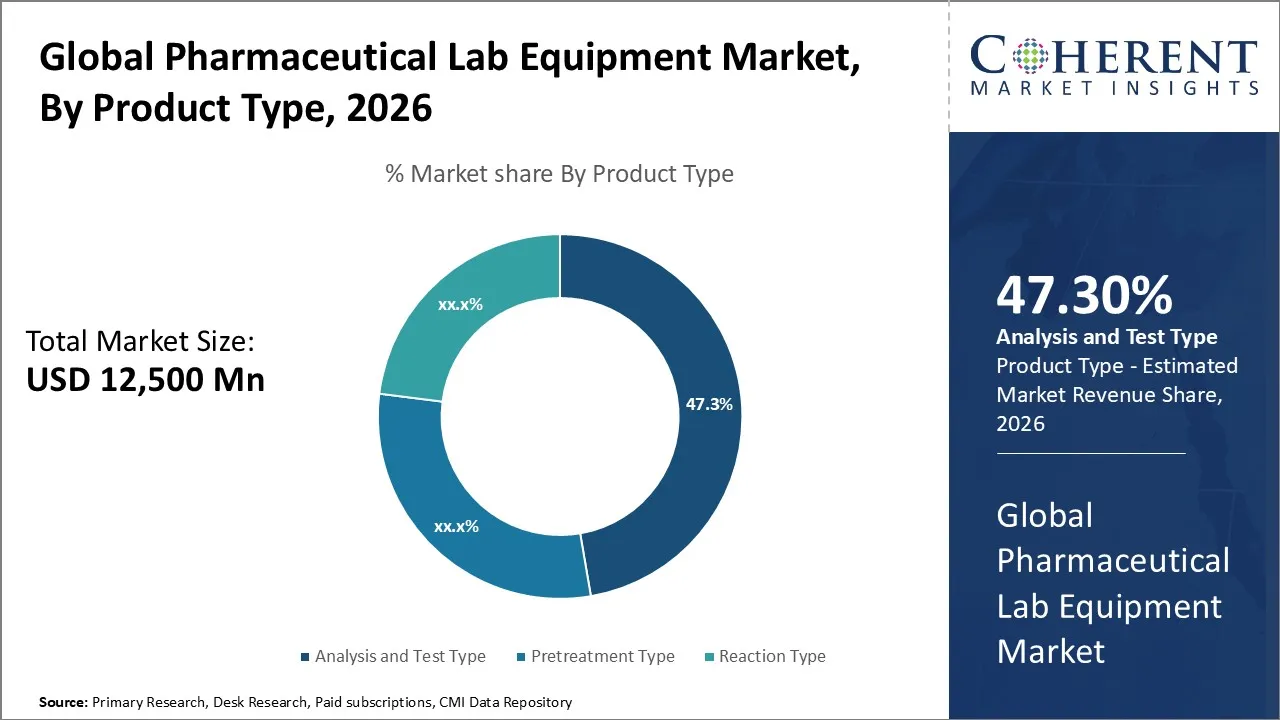
- Based on Product Type, the Analysis and Test Type segment is expected to hold 47.30 % share of the market in 2026 driven by its wide application in drug testing.
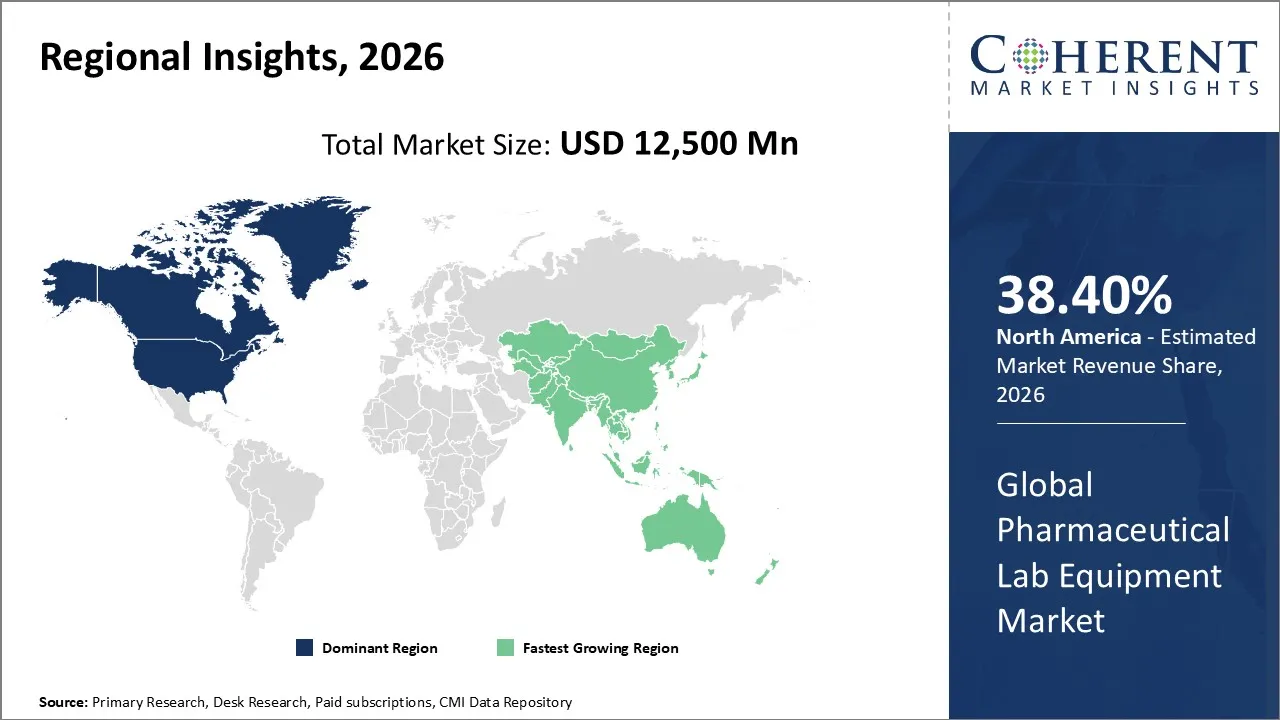
- Based on Region, North America is set to lead the market with 38.40 % share in 2026. While, Asia Pacific is anticipated to be the fastest growing region.
Market Overview
The pharmaceutical lab equipment market is advancing significantly driven by its critical role in enhancing analytical precision during complex drug discovery and high-throughput screening as well as the expansion of integrated digital laboratories. The increasing demand for high-acuity research environments and tightening regulatory safety standards, particularly regarding data integrity and contamination control along with GMP compliance, are expected to drive market growth over the forecast period.
Pharmaceutical analytical systems are high-precision solutions mainly categorized as chromatography, mass spectrometry, or automated liquid handling systems that deliver concentrated and error-free data to the research site. This allows scientists to distinguish between subtle molecular variations with a superior role in purity and potency verification. These instruments play a crucial role in modern healthcare sectors such as biopharmaceuticals and clinical pharmacology plus genomics owing to their ability to provide rapid and reproducible results while minimizing human error during prolonged experimental interventions.
The continuous innovation in automation efficiency and integrated sensor technology is reshaping the laboratory equipment industry. The demand for flexible and high performance systems is increasing in pharmaceutical giants and specialized clinics. These advancements have expanded the functional scope of laboratory hardware by enhancing sample throughput and ensuring compatibility with cleanroom airflow systems while enabling precise real-time environmental monitoring. The top players operating in the industry including Thermo Fisher Scientific and Agilent Technologies or Danaher are forming strategic acquisitions and launching AI integrated and cloud-connected platforms designed mainly for streamlined digital workflows and personalized therapeutic interventions.
Current Events and Its Impacts on the Pharmaceutical Lab Equipment Market
Current Event | Description and the Impact |
Technological Advancements and Innovation
|
|
Public Health and Pandemic Response
|
|
Environmental and Sustainability Initiatives
|
|
Segmental Insights
- Current Industry Events of 2026
- Market Size Estimation
- Regional Breakdown
- Competitive Landscape
- Customer Intelligence
- Segmental Analysis
- Pricing Analysis
- Key Market Drivers, Challenges & Future Trends
- Customized Insights Section
Pharmaceutical Lab Equipment Market Insights, By Product Type – Analysis and Test Type Leads Due its Wide Application in Drug Testing
In terms of product type, the analysis and test type segment contributes the highest share of 47.30% in the market in 2026 because it provides the critical analytical validation necessary throughout the drug lifecycle. The segment includes a wide array of instruments like spectrophotometers, dissolution testers, and thermal analyzers that perform stability testing and molecular characterization. The contract research organizations are propelling the demand for standardized testing equipment to ensure data integrity and compliance with international standards. In addition, the transition toward continual manufacturing requires real time analytical tools to monitor product quality. The growing use of personalized medicine and cell-based therapies is fueling sustained growth in advanced testing equipment for delicate samples.
For instance, in March 2025, Nelson Labs introduced rapid sterility testing to reduce incubation times. The company now conducts product-sterility testing using expedited microbiological procedures at two laboratory facilities in the US and one in Germany.
Pharmaceutical Lab Equipment Market Insights By, Equipment – Chromatography Devices Leads Due to its Critical Role in Compound Separation and Purity Analysis
In terms of equipment, the chromatography devices segment contributes the highest share of 33.50% in 2026 of the market. This is because they play an indispensable role in drug discovery and quality control. The pharmaceutical firms are increasingly focusing on complex biologics and biosimilars. This is driving the demand for high-resolution separation techniques like High performance liquid chromatography and gas chromatography. The systems detect impurities, protect the purity of active pharmaceutical ingredients, and ensure adherence to strict regulatory standards. The use of solvent-efficient green chromatography in conjunction with AI driven data analysis is assisting the segment’s continued market growth. Laboratories are implementing ultra-high-performance systems to speed up analysis times while improving sensitivity. These instruments continue to play a pivotal role in modern pharmaceutical research by facilitating high-throughput workflows and supporting intricate molecular separations.
For instance, in September 2025, Thermo Fisher Scientific has launched Chromeleon 7.4, a data system for chromatography and mass spectrometry (MS) that is designed to support enterprise-level operations and ensure regulatory compliance.
Regional Insights
North America Pharmaceutical Lab Equipment Market Analysis & Trends
North America has remained the dominant region with 38.40% in 2026 of the global Pharmaceutical Lab Equipment Market over the past decade. The growth is due to a robust ecosystem of leading pharmaceutical companies and a strong presence of research-intensive biotechnology firms. The substantial research investment and a sophisticated healthcare infrastructure encourage the early adoption of new technologies. Updated Quality Management System (QMS) regulations mandate that laboratories upgrade legacy hardware to maintain compliance with federal standards. The top global equipment manufacturers in the region facilitate the rapid adoption of cutting-edge technologies like cloud-connected lab ecosystems and automated robotics. These dynamics help North America preserve its status as a key hub for pharmaceutical innovation and advanced molecular imaging.
For instance, in November 2025, Waters Corporation, a manufacturer of laboratory equipment, has unveiled the Charged Aerosol Detector (CAD), designed for use with its chromatography data program, Empower. The CAD enables the detection of various analytes in pharmaceutical formulations.
Asia Pacific Pharmaceutical Lab Equipment Market Analysis & Trends
The Asia Pacific region has emerged as the fastest-growing market owing to the expanding pharmaceutical manufacturing infrastructure and research activities in the region. The government incentives promoting the reshoring and localization of active pharmaceutical ingredient production in China and India are significant contributors to this market growth. The high investments in healthcare infrastructure as well as the increasing demand for generic drugs are fueling the need for large-scale laboratory development. The region is also a global hub for biopharmaceutical contract research and attracts international firms due to competitive operational costs and a growing pool of skilled scientific talent. The fast digital transformation in laboratories, coupled with the integration of smart monitoring technologies, positions Asia Pacific as a primary engine of market evolution.
Pharmaceutical Lab Equipment Market Outlook Country-Wise
The US Pharmaceutical Lab Equipment Market Trends
The US is at the forefront of the market owing to a comprehensive research ecosystem that includes both established pharmaceutical firms and innovative biotechnology startups. The substantial investments in genomic research and personalized medicine are creating strong demand for high-precision analytical tools and automated liquid handling systems. In addition, strict adherence to updated regulatory frameworks is driving laboratories to replace legacy hardware with digitally integrated, regulation-compliant equipment. The rapid integration of AI-enabled data platforms with cloud-based monitoring systems allows facilities to optimize performance across operations. Together, these innovations strengthen the nation’s standing as a main center for pharmaceutical research and development.
For instance, in May 2025, Bruker Corporation introduced the timsOmni™ system, a revolutionary new timsTOF-based mass spectrometer. It is designed for use by clinical researchers, drug discovery scientists, and those conducting advanced quality control on biologics.
China Pharmaceutical Lab Equipment Market Trends
China is experiencing explosive growth as it shifts from being primarily a manufacturing hub to becoming a leading global center for drug innovation. The significant government funding supports the modernization of laboratory infrastructure and incentivizes the development of high-end domestic equipment. The surge in demand for biosimilars and therapies for chronic conditions necessitates both the expansion of high-throughput sequencing platforms and the deployment of intelligent bioreactors. In addition, the localization of active pharmaceutical ingredient production has fueled a surge in quality control testing. This rapid digital transformation positions China as a primary engine for intelligent and automated laboratory solutions.
Market Report Scope
Pharmaceutical Lab Equipment Market Report Coverage
| Report Coverage | Details | ||
|---|---|---|---|
| Base Year: | 2025 | Market Size in 2026: | USD 12,500 Mn |
| Historical Data for: | 2020 To 2024 | Forecast Period: | 2026 To 2033 |
| Forecast Period 2026 to 2033 CAGR: | 5% | 2033 Value Projection: | USD 17,900 Mn |
| Geographies covered: |
| ||
| Segments covered: |
| ||
| Companies covered: | GE Healthcare, Agilent Technologies, Waters, Danaher, Thermo Fisher Scientific, Bruker, Eppendorf, Millipore, Shimadzu, Perkin Elmer, Brand GmbH, Pace Analytical, and Telstar. | ||
| Growth Drivers: |
| ||
| Restraints & Challenges: |
| ||
Pharmaceutical Lab Equipment Market Drivers
Surging R&D investments
The global pharmaceutical lab equipment market is experiencing a substantial growth phase owing to the increasing focus on Research and development (R&D) activities. The transition toward personalized medicine and complex biology has created a demand for sophisticated laboratory tools, particularly for high-performance liquid chromatography and advanced imaging systems. The R&D investments are increasing, with firms prioritizing the development of new therapies for chronic diseases. This demand for innovation necessitates the integration of automated platforms and AI compatible hardware to accelerate testing cycles and improve accuracy. In addition, rigorous global regulatory mandates for data integrity are forcing laboratories to replace legacy systems with modern connected equipment. The ongoing strategic upgrade cycles ensure that the laboratory equipment sector sustains its critical contribution to the pharmaceutical industry's expansion over the forecast period.
Increasing number of research and development activities
The increasing number of research and development activities within the pharmaceutical industry is anticipated to create a high demand for pharmaceutical lab equipment. This demand is expected to drive the growth of the pharmaceutical lab equipment market throughout the forecast period. Additionally, key market players are concentrating on designing and manufacturing energy-efficient freezing and cooling systems. They are also pursuing acquisition strategies to broaden their product portfolios, which is likely to further enhance market growth.
Analyst Opinion (Expert Opinion)
- The pharmaceutical lab equipment market is experiencing sustained expansion, supported by rising investments in drug discovery, quality control, and regulatory-compliant laboratory infrastructure. Increasing complexity in pharmaceutical formulations and biologics development has intensified demand for high-precision analytical, processing, and testing equipment across research and manufacturing laboratories. Analytical instruments such as chromatography systems, spectroscopy tools, and automated sample preparation platforms account for a significant proportion of equipment installations, reflecting the industry’s emphasis on accuracy, reproducibility, and data integrity.
- Quality assurance requirements continue to play a critical role in shaping purchasing behavior, as pharmaceutical companies adopt advanced laboratory systems to meet stringent regulatory standards. Automation and digitalization are gaining traction, with a growing share of newly installed equipment featuring automated workflows, real-time monitoring, and integration with laboratory information management systems. Industry estimates indicate that automated and digitally enabled instruments now represent more than one-third of new laboratory equipment deployments globally.
- Regionally, North America remains a major hub for pharmaceutical laboratory equipment adoption due to a dense concentration of pharmaceutical and biotechnology research facilities. Europe maintains steady demand driven by established pharmaceutical manufacturing bases and research institutions. Asia Pacific is emerging as a high-growth region, supported by expanding pharmaceutical production capacity, increasing research investments, and the rapid development of contract research organizations. Overall, the market outlook remains positive, underpinned by technological advancements, regulatory compliance needs, and continuous pharmaceutical innovation.
Speak to the analyst
Want personalized insights?
Take the findings above to one of our principal consultants, or have the report rebuilt around the segments, geographies and competitors you actually track.
Pharmaceutical Lab Equipment Industry News
- In December 2025, Repligen Corporation introduced three new high-performance chromatography resins. These include the AVIPure® HiPer™ AAV9 affinity resin, the AVIPure® HiPer™ AAV8 affinity resin, and the HiPer™ QA anion exchange resin.
- In July 2025, MachineQ, a Comcast Company, seeks to digitize a traditionally paper-based process in the life sciences industry, marking an expansion of its lab asset management system. Pharmaceutical companies can now digitally track, manage, and display vital equipment data using the MQdisplay 4b, an e-ink display device.
- In April 2025, DDL has opened a new Good Manufacturing Practice (GMP) laboratory specifically for testing drug-device combination products. This expansion enhances DDL's capacity to deliver strict, legally compliant testing solutions to the pharmaceutical, biotech, and combination product industries.
- In April 2025, QIAGEN announced that it is proceeding with plans to launch three new sample preparation tools to enhance and expand its automated sample preparation portfolio.
Market Segmentation
- Equipment Insights (Revenue, USD Mn, 2026 - 2033)
- Spectroscopy Instrument
- Chromatography Devices
- Lab Automation Devices
- Immunoassay Analyzers
- Flow Cytometry Devices
- Microarray Devices
- Electrophoresis Equipment
- Others
- Product Type Insights (Revenue, USD Mn, 2026 - 2033)
- Pretreatment Type
- Reaction Type
- Analysis and Test Type
- Regional Insights (Revenue, USD Mn, 2026 - 2033)
- North America
- U.S.
- Canada
- Latin America
- Brazil
- Argentina
- Mexico
- Rest of Latin America
- Europe
- Germany
- U.K.
- France
- Italy
- Russia
- Rest of Europe
- Asia Pacific
- China
- India
- Japan
- Australia
- South Korea
- ASEAN
- Rest of Asia Pacific
- Middle East
- GCC
- Israel
- Rest of Middle East
- Africa
- North Africa
- Central Africa
- South Africa
- Key Players Insights
- GE Healthcare
- Agilent Technologies
- Waters
- Danaher
- Thermo Fisher Scientific
- Bruker
- Eppendorf
- Millipore
- Shimadzu
- Perkin Elmer
- Telstar
Sources
Primary Research Interviews
- Pharmaceutical Laboratory Equipment Manufacturers
- Analytical & Measurement Instrument Suppliers
- Contract Research Organizations (CROs)
- Pharmaceutical & Biotechnology R&D Managers
- Quality Control & Regulatory Affairs Specialists
- Others
Databases
- Bloomberg Terminal
- Thomson Reuters Eikon
- IHS Markit
- Euromonitor International
- S&P Global Market Intelligence
- Others
Magazines
- Pharmaceutical Technology
- Lab Manager Magazine
- Drug Discovery Today
- BioProcess International
- Chemical Engineering Magazine
- Others
Journals
- Journal of Pharmaceutical Sciences
- Analytical Chemistry
- Journal of Chromatography A
- Pharmaceutical Research
- International Journal of Pharmaceutics
- Others
Newspapers
- Financial Times
- The Wall Street Journal
- Reuters
- Bloomberg News
- Others
Associations
- International Society for Pharmaceutical Engineering (ISPE)
- Parenteral Drug Association (PDA)
- American Association of Pharmaceutical Scientists (AAPS)
- European Federation of Pharmaceutical Industries and Associations (EFPIA)
- International Federation of Pharmaceutical Manufacturers & Associations (IFPMA)
- Others
Public Domain Sources
- U.S. Food & Drug Administration (FDA)
- European Medicines Agency (EMA)
- World Health Organization (WHO)
- National Institutes of Health (NIH)
- U.S. Department of Health & Human Services (HHS)
- Others
Proprietary Elements
- CMI Data Analytics Tool
- Proprietary CMI Existing Repository of Information for the Last 8 Years Share
Definition: The Pharmaceutical Lab Equipment Market includes specialized instruments, apparatus, and automated systems that are crucial for drug delivery, development, and quality control. The sector includes analytical tools like chromatographs and spectrometers. It also encompasses general laboratory devices like centrifuges, incubators, and bioreactors. These technologies allow pharmaceutical firms, contract research organizations, and academic institutions to identify chemical compounds, ensure molecular purity, and validate product safety. The market also encompasses digitalization solutions like AI driven data platforms and cloud-connected monitoring systems that streamline laboratory workflows. The market forms a cornerstone of the global healthcare industry and life sciences advancement by supplying essential resources for stability testing and ensuring regulatory compliance.
Get access to 250+ pages report
Every segment, forecast, competitor profile and data table behind the analysis above — available for instant download.
- ESOMAR Member
- ISO 9001:2015 Certified
- D-U-N-S Registered
- GDPR & CCPA Compliant
Missing comfort of reading report in your local language? Find your preferred language:
Transform your Strategy with Exclusive Trending Reports
Frequently Asked Questions
The Pharmaceutical Lab Equipment Market is estimated to be valued at USD 12,500 Mn in 2026, and is expected to reach USD 17,900 Mn by 2033.
The CAGR of the Pharmaceutical Lab Equipment Market is projected to be 5% from 2026 to 2033
Surging R&D investments for drug discovery and high demand for biologic/cell therapy production are the major factors driving the growth of the Pharmaceutical Lab Equipment Market.
A shortage of skilled personnel for complex operations and stringent regulatory compliance are the major factors hampering the growth of the Pharmaceutical Lab Equipment Market.
In terms of equipment, the chromatography devices is estimated to dominate the market revenue share in 2026.
GE Healthcare, Agilent Technologies, Waters, Danaher, Thermo Fisher Scientific, Bruker, Eppendorf, Millipore, Shimadzu, Perkin Elmer, Brand GmbH, Pace Analytical, and Telstar are the major players.
North America is expected to lead the Pharmaceutical Lab Equipment Market in 2026.