

Medical Device Connectivity Market Analysis & Forecast: 2026-2033
Medical Device Connectivity Market is estimated to be valued at USD 6.98 Bn in 2026 and is expected to reach USD 35.19 Bn in 2033, exhibiting a compound annual growth rate (CAGR) of 26.0% from 2026 to 2033.
Key Takeaways
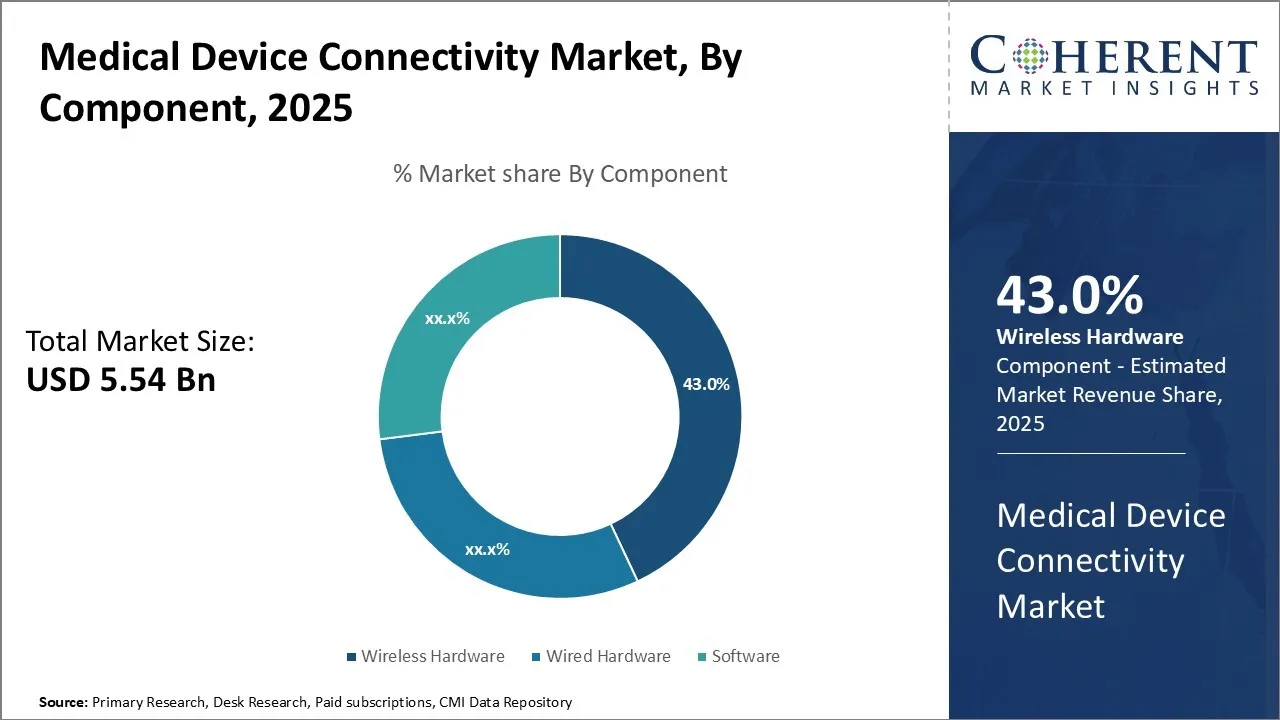
- By Component, The Wireless Hardware Sub-Segment is projected to lead the global medical device connectivity market with 44% shares in 2026.
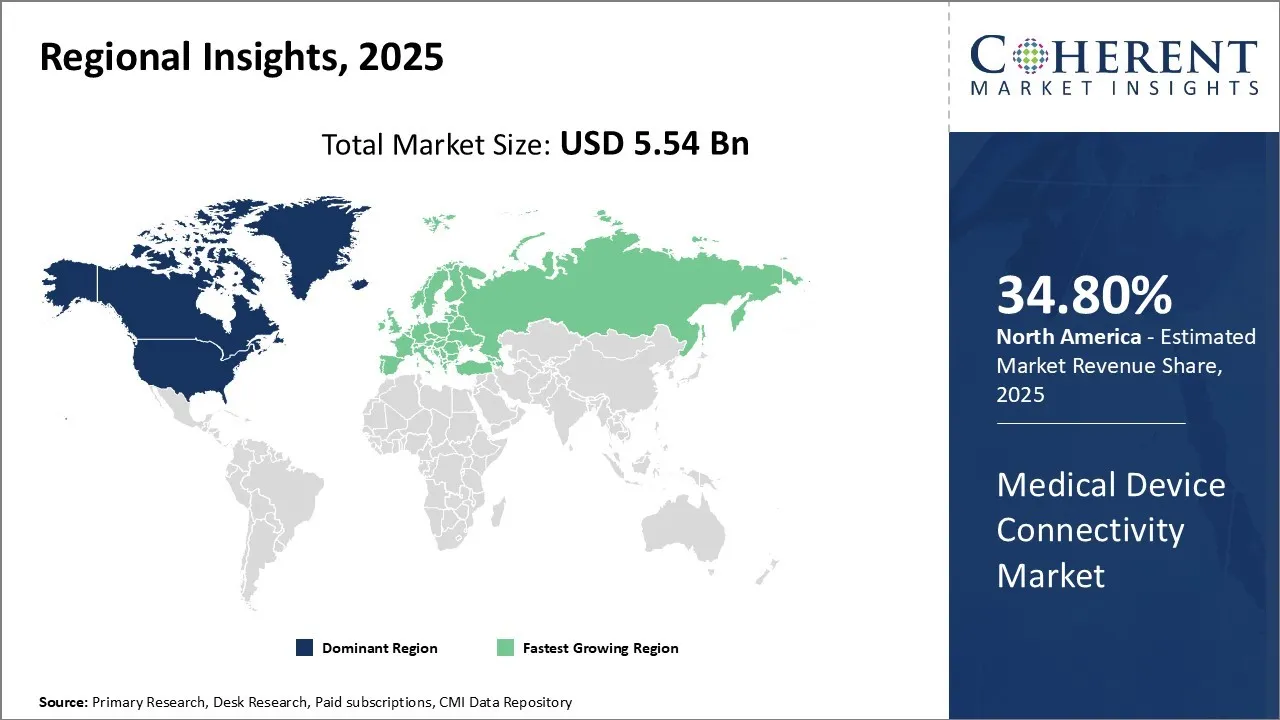
- By region, North America is expected to hold the largest market share of 34.8% in 2026.
Market Overview
The global medical device connectivity market growth can be driven by an increase in inorganic growth strategies such as acquisition by key market players. For instance, in January 2021, Koninklijke Philips N.V., a Netherland-based medical technology company, announced that it had acquired Capsule Technologies, Inc., a global provider of medical device integration, clinical surveillance, and patient monitoring for hospitals, to enter into patient monitoring devices market. Capsule’s Medical Device Information Platform - comprised of device integration, vital signs monitoring, and clinical surveillance services - connects almost all existing medical devices and EMRs in hospitals through a vendor-neutral system.
Current Events and Its Impact on the Global Medical Device Connectivity Market
Event | Description and Impact |
U.S.-China Technology Trade Relations and Semiconductor Supply Chain |
|
European Union Medical Device Regulation (MDR) and Cybersecurity Framework |
|
Rising Healthcare Cybersecurity Threats and Data Breaches |
|
Segmental Insights
- Current Industry Events of 2026
- Market Size Estimation
- Regional Breakdown
- Competitive Landscape
- Customer Intelligence
- Segmental Analysis
- Pricing Analysis
- Key Market Drivers, Challenges & Future Trends
- Customized Insights Section
Global Medical Device Connectivity Market Insights, By Component
The market is segmented into wired hardware, wireless hardware, and software. Out of which, the wireless hardware segment is expected to dominate the global medical device connectivity market with 44% share in 2026 and this is attributed to an increase in the product launches by key market players.
Global Medical Device Connectivity Market Insights, By End User
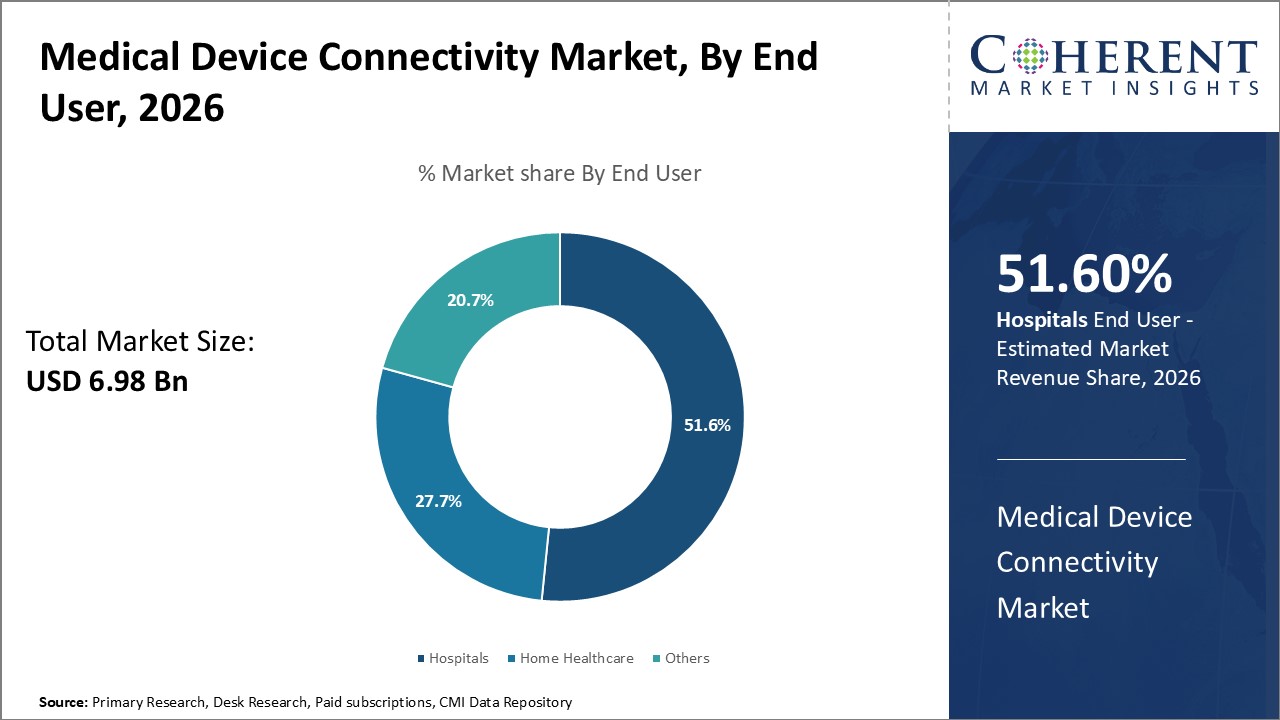
The market is segmented into hospitals, home healthcare, and others. Out of which, the hospital segment is expected to dominate the market over the forecast period and this is attributed to an increase in the number of hospitals globally.
Among all segmentation, the end user segment has the highest potential due to an increase in the number of hospitals. For instance, in 2022, according to the data published by American Hospital Association, there were 6,093 hospitals in the U. S. in 2020, and total admissions in all the U.S. hospitals were more than 33,356,853, in 2020.
Regional Insights
North America Medical Device Connectivity Market Analysis and Trends
North America is projected to maintain its dominant position in the global medical device connectivity market, holding approximately 34.80% of the market share over the forecast period. This leadership is driven by the presence of major industry players such as Medtronic, GE Healthcare, Cerner Corporation, and Koninklijke Philips N.V., who continue to invest in advanced connectivity solutions.
The region benefits from a robust healthcare infrastructure and high adoption rates of integrated medical devices, enabling efficient data exchange between systems. Ongoing technological innovations and a strong regulatory framework further support steady market growth across North America.
Asia Pacific Medical Device Connectivity Market Analysis and Trends
The Asia Pacific (APAC) region is expected to be the second-largest market for medical device connectivity during the forecast period. Growth is fueled by the rising prevalence of chronic diseases, particularly cancer, and increasing investments in healthcare digitization.
For instance, according to an article published in the National Library of Medicine (August 2026), more than 2.3 million breast cancer (BC) cases were diagnosed in the Asia Pacific region in 2020. Expanding hospital networks, government initiatives to modernize healthcare systems, and the growing adoption of advanced connected medical devices are key drivers of APAC’s market expansion.
Dominating Countries in the Medical Device Connectivity Market
United States Medical Device Connectivity Market Analysis and Trends
The United States leads the North American market with advanced healthcare IT infrastructure, widespread integration of connected medical devices, and strong support from regulatory bodies. Leading companies headquartered in the U.S. continue to drive innovation, ensuring a steady demand for medical device connectivity solutions.
China Medical Device Connectivity Market Analysis and Trends
China is a major growth engine for the Asia Pacific region, supported by large-scale healthcare investments, the rapid adoption of connected technologies, and a growing prevalence of chronic illnesses. Efforts to modernize healthcare data management systems further drive demand for connectivity solutions.
India Medical Device Connectivity Market Analysis and Trends
India’s market is expanding rapidly, driven by government-led healthcare digitization initiatives, increasing hospital infrastructure, and a rising patient population with chronic conditions. Local and international players are introducing cost-effective connectivity solutions to meet growing demand.
Japan Medical Device Connectivity Market Analysis and Trends
Japan benefits from a technologically advanced healthcare system and strong adoption of digital health technologies. The country’s aging population and increasing focus on home healthcare solutions also bolster the demand for medical device connectivity.
Market Report Scope
Medical Device Connectivity Market Report Coverage
| Report Coverage | Details | ||
|---|---|---|---|
| Base Year: | 2025 | Market Size in 2026: | USD 6.98 Bn |
| Historical Data for: | 2020 To 2024 | Forecast Period: | 2026 To 2033 |
| Forecast Period 2026 to 2033 CAGR: | 26.0% | 2033 Value Projection: | USD 35.19 Bn |
| Geographies covered: |
| ||
| Segments covered: |
| ||
| Companies covered: | Medtronic, GE Healthcare, Capsule Tech Inc., Cerner Corporation, Koninklijke Philips N.V., Digi International Inc., Cisco System Inc., Siemens Healthineers, Honeywell International Inc., Medshift, and Drägerwerk AG & Co. KGaA | ||
| Growth Drivers: |
| ||
| Restraints & Challenges: |
| ||
Global Medical Device Connectivity Market Cross-Sectional Analysis
In the end user segment, hospitals segment held a dominant position in the Asia Pacific region due to an increase in the number of hospitals in this region. For instance, according to an article published by Asian Hospital & Healthcare Management, in December 2022, there were more than 36,570 hospitals in China, in year 2021.
Global Medical Device Connectivity Market Restraint
- High cost associated with medical device connectivity setup
The major factors that can hamper the growth of the global medical device connectivity market over the forecast period include the high cost of medical device connectivity setup for small healthcare organizations. The cost of interoperability and connectivity solutions for various medical devices is significantly high.
Small-scale healthcare organizations need help to use internet connectivity to medical devices. This is mainly because of difficulties implementing multiple networks with health setups, wireless connectivity options, and the constant need to install subsequent security layers to prevent data breaches. The high price of this service is hampering the market growth. Key market players should focus on launching cost effective medical devices connectivity solution for small and medium scale organizations.
Global Medical Device Connectivity Market- Driver
- Increase in the prevalence of cancer
An increase in the prevalence of cancer which requires constant patient monitoring is expected to increase the demand for its early diagnosis and monitoring which in turn is expected to drive the global medical device connectivity market growth during the forecast period. For instance, according to data published by the American Cancer Society, in 2021, 1.9 Million new cancer cases were diagnosed in 2021 in the U.S. out of which 281,550 were breast cancer.
- An increase in product launches by key market players
Increasing product launches by key market players is expected to drive market growth over the forecast period. For instance, on April 27, 2023, Honeywell International Inc., a U.S.-based multinational conglomerate corporation, announced that they have launched a new real-time health monitoring system, which captures and records patients’ vital signs both within the hospital setting and remotely. It uses advanced sensing technology to monitor vital signs via a skin patch, which connects the data instantaneously to healthcare providers on mobile devices and an online dashboard.
Analyst Opinion (Expert Opinion)
- Enhanced integration of medical devices with hospital information systems is a pivotal supply-side driver. Hospitals are increasingly adopting advanced connectivity solutions that improve device interoperability, resulting in a 27% reduction in patient monitoring errors reported in 2024 across U.S. healthcare facilities. Such adoption directly influences the market size by driving device upgrade cycles and demand for connectivity solutions.
- From the demand perspective, the surge in remote patient monitoring (RPM) during and post-pandemic has solidified its position as a major use case. For instance, in 2025, RPM accounted for over 35% of installed connected devices globally, with a 30% year-on-year increase, underlining its critical role in market revenue.
- Pricing dynamics also reflect technological advancements, with wireless and cloud-enabled medical device interfaces experiencing price reductions by 12% in 2024, making these systems more accessible to emerging healthcare markets. This pricing trend positively impacts market growth potential and overall market share across diverse healthcare provider segments.
Speak to the analyst
Want personalized insights?
Take the findings above to one of our principal consultants, or have the report rebuilt around the segments, geographies and competitors you actually track.
Global Medical Device Connectivity Market: Key Developments
- In October 2025, BD (Becton, Dickinson and Company) launched the BD Incada™ Connected Care Platform, an AI-enabled, cloud-based system that unifies data from BD devices into a single intelligent ecosystem. The platform debuts with the next-generation BD Pyxis™ Pro Automated Medication Dispensing Solution, offering enterprise-wide connectivity and real-time, actionable insights.
- In January 2023, Senet, a provider of cloud-based software and services platforms for healthcare organizations, and Telli Health, a medical remote patient monitoring devices manufacturer, jointly announced that they have launched the first remote patient monitoring (RPM) hardware powered by LoRaWAN. This device will connect remote patients with their caregivers or physicians.
- In June 2021, Max Healthcare Institute Limited, an India-based multispecialty hospital chain, announced the launch of the technologically advanced Max MyHealth+ platform, a device-integrated patient monitoring platform for monitoring the vital sign of patients across the globe.
Market Segmentation
- Global Medical Device Connectivity Market, By Component (Revenue, USD Bn, 2021 - 2033)
- Wired hardware
- Wireless hardware
- Wi-Fi
- WMTS
- Bluetooth
- Software
- Global Medical Device Connectivity Market, By End User (Revenue, USD Bn, 2021 - 2033)
- Hospitals
- Home healthcare
- Others (Clinics, etc.)
- Global Medical Device Connectivity Market, By Region (Revenue, USD Bn, 2021 - 2033)
- North America
- U.S.
- Canada
- Latin America
- Brazil
- Mexico
- Argentina
- Rest of Latin America
- Europe
- Germany
- U.K.
- France
- Italy
- Spain
- Russia
- Rest of Europe
- Asia Pacific
- China
- India
- Japan
- Australia
- South Korea
- ASEAN
- Rest of Asia Pacific
- Middle East
- GCC
- Israel
- Rest of Middle East
- Africa
- South Africa
- Central Africa
- North Africa
- North America
- Company Profiles
- Medtronic
- GE Healthcare
- Capsule Tech Inc.
- Cerner Corporation
- Koninklijke Philips N.V.
- Digi International Inc.
- Cisco System Inc.
- Siemens Healthineers
- Honeywell International Inc.
- Medshift
- Drägerwerk AG & Co. KGaA
Sources
Primary Research Interviews
- Medical Device Manufacturers
- Healthcare IT Solution Providers
- Hospital IT Directors and CIOs
- Healthcare Technology Consultants
- Others
Databases
- Healthcare Information and Management Systems Society (HIMSS) Database
- Medical Device Database (FDA)
- Global Health Observatory (WHO)
- Healthcare Technology Market Intelligence Database
- Others
Magazines
- Healthcare IT News
- Medical Device & Diagnostic Industry (MD+DI)
- Healthcare Technology Report
- Modern Healthcare Technology
- Others
Journals
- Journal of Medical Internet Research (JMIR)
- IEEE Journal of Biomedical and Health Informatics
- International Journal of Medical Informatics
- Others
Newspapers
- Healthcare Finance News
- FierceHealthcare
- MedTech Breakthrough
- Healthcare IT Today
- Others
Associations
- Healthcare Information and Management Systems Society (HIMSS)
- Medical Device Manufacturers Association (MDMA)
- Healthcare Financial Management Association (HFMA)
- Association for the Advancement of Medical Instrumentation (AAMI)
- Others
Public Domain Sources
- U.S. Food and Drug Administration (FDA) Reports
- Centers for Medicare & Medicaid Services (CMS) Data
- World Health Organization (WHO) Publications
- National Institute of Standards and Technology (NIST) Guidelines
- Others
Proprietary Elements
- CMI Data Analytics Tool
- Proprietary CMI Existing Repository of information for last 8 years
Get access to 250+ pages report
Every segment, forecast, competitor profile and data table behind the analysis above — available for instant download.
- ESOMAR Member
- ISO 9001:2015 Certified
- D-U-N-S Registered
- GDPR & CCPA Compliant
Missing comfort of reading report in your local language? Find your preferred language:
Transform your Strategy with Exclusive Trending Reports
Frequently Asked Questions
The Medical Device Connectivity Market size is estimated to be valued at USD 6.98 Bn in 2026, and is expected to reach USD 35.19 Bn by 2033.
The CAGR of the global Market is projected to be 26.0% from 2026 to 2033.
Increasing prevalence of cancer and increase in the product launches by key market players are expected to drive the market growth.
Wireless hardware is the leading component segment in the market.
The major factors that can hamper the growth of the market include the high cost associated with medical device connectivity setup.
Major players operating in the market include Medtronic, GE Healthcare, Capsule Tech Inc., Cerner Corporation, Koninklijke Philips N.V., Digi International Inc., Cisco System Inc., Siemens Healthineers, Honeywell International Inc., Medshift, and Drägerwerk AG & Co. KGaA.
AI analyzes data from connected medical devices to enable predictive maintenance, automate workflows, detect anomalies, and improve clinical decision-making.