

Brazil Cardiac Pacemakers Market Analysis & Forecast 2026-2033
The Brazil cardiac pacemakers market is estimated to be valued at USD 341.6 Mn in 2026 and expected to reach USD 403.2 Mn by 2033, witnessing a CAGR of 2.4% over the forecast period (2026-2033).
Key Takeaways
- Based on Product Type, the implantable segment is expected to hold 87.2% share of the market in 2026.
- Based on Technology, the dual chamber segment is expected to lead 57.8% share of the market in 2026.
- Based on End User, the hospitals segment is projected to account for 72.4% share of the market in 2026.
Market Overview
A pacemaker is inserted in the chest to help manage the heartbeat of patient. It is used from preventing the heart from beating slowly. It requires surgical procedure to insert a pacemaker in the chest. Pacemaker is also known as cardiac pacing device. The pacemaker starts sending the electrical signals if the heartbeat is slow to correct the beat.
The new pacemakers have the sensors which detect the body motion or breathing rate and signals the device to increase the heart rate through the exercise, as per needed. Pacemaker has 2 parts: pulse generator and lead (electrodes). The pacemaker would stop functioning because of some electrical involvement, such as Cell phones, Security systems, medical equipment, and power-generating equipment.
Current Events and their Impacts on the Brazil Cardiac Pacemakers Market
Current Event | Description and its Impact |
Brazil's Healthcare System Transformation and SUS Expansion |
|
Technological Advancement in Cardiac Device Innovation |
|
Are Sao Paulo, Rio de Janeiro, and Brasilia Driving the Majority of Pacemaker Implants in Brazil?
City/Region | Estimated Share of National Pacemaker Implants | Key Drivers |
Sao Paulo | 35–40% | Dense hospital network, >60 accredited cardiology centers, largest pool of specialists |
Rio de Janeiro | 15–20% | Large teaching hospitals, specialized cardiac institutes, strong public-private mix |
Brasília (Federal District) | ~8–10% | Federal hospitals, referral centers, advanced cardiac care availability |
Other Regions | Remaining share (~30–40%) | Limited access, fewer specialized centers, patients often travel to urban hubs |
- Current Industry Events of 2026
- Market Size Estimation
- Regional Breakdown
- Competitive Landscape
- Customer Intelligence
- Segmental Analysis
- Pricing Analysis
- Key Market Drivers, Challenges & Future Trends
- Customized Insights Section
Segmental Insights
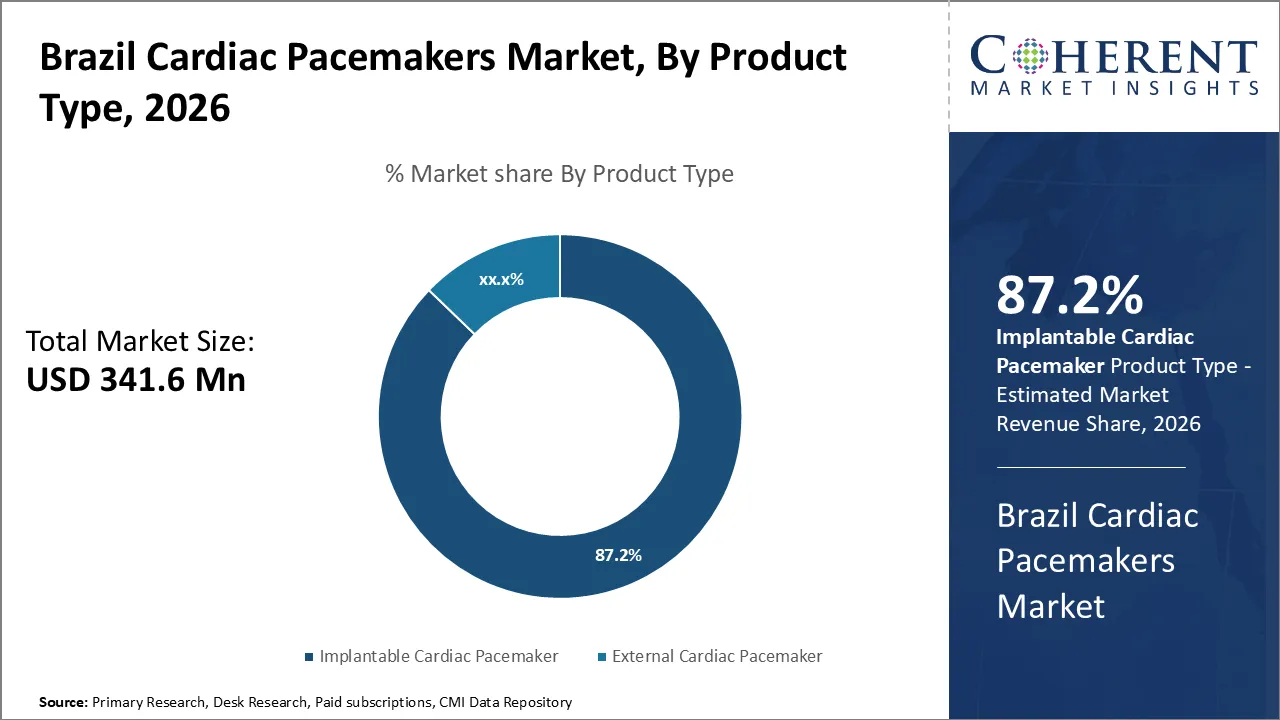
Brazil Cardiac Pacemakers Market Insights, By Product Type: Implantable cardiac pacemakers dominate as permanent, reliable solutions for chronic arrhythmia management
In terms of product type, the implantable segment is expected to hold 87.2% share of the market in 2026, because they give patients with chronic arrhythmias a permanent, reliable solution. Implantable are better than external devices as they provide long-term rhythm management, better patient quality of life, and better clinical outcomes. External devices are only used in emergencies. Their widespread adoption reflects strong physician preference and patient demand.
Brazil Cardiac Pacemakers Market Insights, By Technology: Dual chamber pacemakers lead with superior synchronization and improved patient outcomes across diverse conditions
In terms of technology, the dual chamber segment is expected to lead 57.8% share of the market in 2026, due to their ability to synchronize atrial and ventricles contractions, which makes the cardiac efficiency better and lowers the risk of problems compared to single-chamber devices. They are widely prescribed for conditions like atrioventricular block. Their large market share is due to their combination of advanced features, low price, and proven clinical benefits.
Brazil Cardiac Pacemakers Market Insights, By End User: Hospitals remain primary end users, offering surgical infrastructure, specialized staff, and comprehensive post-operative care
In terms of end user, the hospitals segment is projected to account for 72.4% share of the market in 2026, because they have the surgical facilities, trained staff, and ability to monitor patients after surgery that are needed for implantation procedures. Most pacemaker surgeries are performed in hospitals, where patients trust and the hospital reimbursements frameworks. This means that hospitals are the main places where people get devices and care for them.
Market Report Scope
Brazil Cardiac Pacemakers Market Report Coverage
| Report Coverage | Details | ||
|---|---|---|---|
| Base Year: | 2025 | Market Size in 2026: | USD 341.6 Mn |
| Historical Data for: | 2020 To 2024 | Forecast Period: | 2026 To 2033 |
| Forecast Period 2026 to 2033 CAGR: | 2.4% | 2033 Value Projection: | USD 403.2 Mn |
| Segments covered: |
| ||
| Companies covered: | BIOTRONIK SE & Co.KG, Medtronic plc., Boston Scientific Corporation, Abbott Laboratories, LivaNova plc., Osypka Medical GmbH, and MEDICO S.p.A. | ||
| Growth Drivers: |
| ||
| Restraints & Challenges: |
| ||
Brazil Cardiac Pacemakers Market Driver
Aging Population
The Brazil Cardiac Pacemakers Market share is being greatly affected by Brazil's demographic shift toward a larger elderly population. As people live longer, conditions that are more common with age, like arrhythmia, creating sustained as, and bradycardia, lead to more people needing pacemakers. Older adults often need advanced cardiac rhythm management demographic trend solutions, ensuring pacemakers are still an important part of Brazil's healthcare system. The growing number of seniors directly leads to higher adoption rates, which makes pacemakers a key part of treating heart disease.
Rising Cardiovascular Disease Burden
Hypertension, diabetes, and obesity are all on the rise because of changes in lifestyle and urbanization. All of these conditions can lead to heart disease. The rise in heart-related conditions in Brazil is causing a rise in the demand for pacemakers, as more people need devices to control abnormal heart rhythms. The rising number of people with cardiovascular disease not only increases the number of patients who need a pool, but it also speeds up the development of new pacemaker technologies. As a result, healthcare providers are putting cardiac rhythm management at the top of their list, which is driving steady growth in the Brazilian market.
Brazil Cardiac Pacemakers Market Opportunity
Expansion of Healthcare Infrastructure and Accessibility
Brazil's healthcare system is significantly expanding. There are now more than 3,000 hospitals and more specialized cardiac centers, which makes it easier for people to get advanced treatments. This is especially important for pacemaker implantation because it makes them available in semi-urban areas as well as major cities. increased investment into medical device infrastructure and training programs for cardiologists, which should lead to more procedures. These changes make it easier to create new ideas, which support the Brazil cardiac pacemakers market forecast with more patients using and adopting the product.
Analyst Opinion (Expert Opinion)
- There are more than 30 million people in Brazil that are 60 or older. This number is expected to almost double by 2050. This change in the population is directly related to more cases of bradycardia and arrhythmias, which need pacemaker implantation. Cardiovascular disease is prevalent, and it is responsible for more than 27% of all deaths in Brazil. This shows the importance of pacemakers are for treating heart rhythm problems.
- Brazil's healthcare system is quickly adopting new pacemaker technologies, such as MRI-compatible and dual-chamber devices. There are now more than 3,000 hospitals and more and more specialized cardiac centers, making it easier to get implantation procedures. increased investment into medical device infrastructure and training programs, which is helping to make modern pacemaker solutions work better for more patients and improve treatment outcomes.
Speak to the analyst
Want personalized insights?
Take the findings above to one of our principal consultants, or have the report rebuilt around the segments, geographies and competitors you actually track.
Market Segmentation
- By Product Type
- Implantable Cardiac Pacemaker
- External Cardiac Pacemaker
- By Technology
- Single Chamber Pacemaker
- Dual Chamber Pacemaker
- Biventricular Pacemaker
- By End Users
- Hospitals
- Cardiac Clinics
- Ambulatory Surgery Centers
- Key Players
- BIOTRONIK SE & Co.KG
- Medtronic plc.
- Boston Scientific Corporation
- Abbott Laboratories
- Ivanovo plc.
- Osyka Medical GmbH
- MEDICO S.p.A
Sources
Primary Research Interviews
- Cardiac pacemaker OEMs & regional subsidiaries (Brazil)
- CRM (Cardiac Rhythm Management) product managers & sales leaders
- Authorized distributors / channel partners (hospital & clinic supply)
- Electrophysiologists (EPs), cardiac surgeons & implanting cardiologists
- Cath lab managers / biomedical engineering heads (public & private hospitals)
- Group purchasing / procurement heads (hospital networks)
- Reimbursement & access experts (ANS/private payers; SUS pathway specialists)
- After-sales service providers (device follow-up, interrogation, remote monitoring)
- KOLs from cardiology societies & training centers
- Others
Databases
- Bloomberg Terminal
- Thomson Reuters Eikon
- IQVIA (where applicable)
- Fitch Solutions
- EvaluateMedTech (Evaluate)
- Import/export trade databases (UN Comtrade / national customs trade portals)
- Company annual reports / investor presentations / financial filings databases
- Others
Magazines
- EP Lab Digest
- Cardiac Rhythm News
- Cardiovascular Business
- MedTech Dive
- MDDI (Medical Device and Diagnostic Industry)
- MassDevice
- Others
Journals
- Heart Rhythm
- Europace
- Journal of the American College of Cardiology (JACC)
- Circulation
- Revista Brasileira de Cardiologia (Brazilian cardiology journals)
- Pacing and Clinical Electrophysiology (PACE)
- Brazilian Journal of Cardiovascular Surgery (BJCVS)
- Others
Newspapers
- Reuters
- Bloomberg News
- Financial Times
- The Wall Street Journal
- Valor Econômico (Brazil)
- Folha de S.Paulo (Brazil)
- O Globo (Brazil)
- Others
Associations
- Sociedade Brasileira de Cardiologia (SBC)
- Sociedade Brasileira de Arritmias Cardíacas (SOBRAC)
- Heart Rhythm Society (HRS)
- European Society of Cardiology (ESC)
- European Heart Rhythm Association (EHRA)
- Latin American Heart Rhythm Society (LAHRS)
- Advanced Medical Technology Association (AdvaMed)
- Associacao Brasileira da Indústria de Dispositivos Médicos (ABIMO)
- Others
Public Domain Sources
- ANVISA (Brazil National Health Surveillance Agency) – device registration & safety notices
- Ministério da Saúde (Brazil Ministry of Health) – SUS policies/programs
- DATASUS (Brazil Unified Health System information database)
- ANS (Agência Nacional de Saúde Suplementar) – private health coverage/reimbursement references
- IBGE (Brazilian Institute of Geography and Statistics) – demographics & epidemiology proxies
- WHO (World Health Organization) / PAHO (Pan American Health Organization)
- World Bank Open Data
- OECD health statistics (as applicable)
- Others
Proprietary Elements
- CMI Data Analytics Tool
- Proprietary CMI Existing Repository of Information for the Last 8 Years
- Internal primary interview transcripts & validated expert notes (anonymized)
- CMI pricing & tender-tracking repository (where available)
Get access to 250+ pages report
Every segment, forecast, competitor profile and data table behind the analysis above — available for instant download.
- ESOMAR Member
- ISO 9001:2015 Certified
- D-U-N-S Registered
- GDPR & CCPA Compliant
Missing comfort of reading report in your local language? Find your preferred language:
Transform your Strategy with Exclusive Trending Reports
Frequently Asked Questions
The global Brazil Cardiac Pacemakers Market size was valued at USD 341.6 Mn in 2026 and is expected to reach USD 403.2 Mn in 2033.
The aging population and rising cardiovascular disease burden are the major factors which are expected to drive the market growth over the forecast period.
Implantable Cardiac Pacemaker segment is expected to hold major market share over the forecast period, which are surgically implanted in the patient’s chest.
Major factors hampering growth of the market include infections associated with cardiac pacemaker implantation.
Major players operating in the market include BIOTRONIK SE & Co.KG, Medtronic plc., Boston Scientific Corporation, Abbott Laboratories, LivaNova plc., Osypka Medical GmbH, and MEDICO S.p.A.