Physical Security Information Management Market Analysis & Forecast: 2026-2033

The physical security information management market is anticipated to grow at a CAGR of 18.7% with USD 5,390 Mn in 2026 and is expected to reach USD 17,876 Mn in 2033. Rising security threats, smart city initiatives, AI and IoT adoption (USD1.6 trillion by 2025), and regulatory compliance are driving the Physical Security Information Management market.
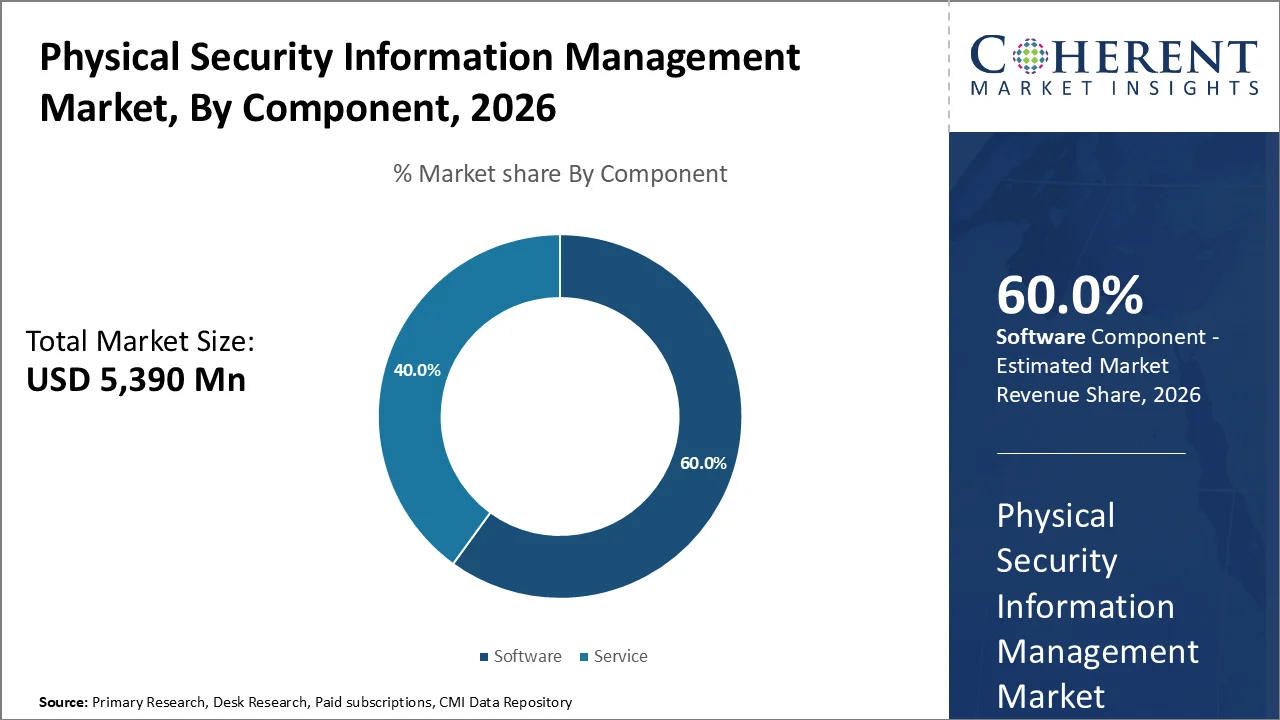
Software is projected to account for the largest share of component in 2026, representing approximately 60% of the total volume. The dominance of software in the PSIM market is associated with its role as the backbone for integrating disparate security systems, including video surveillance, access control, intrusion detection, as well as alarm systems, into a unified platform. This consolidation provides security operators with centralized situational awareness along with enhanced decision-making capabilities.
For example, in October 2025, Quest PSIM implemented software solutions in Qatar to enable integrated control room operations, demonstrating how PSIM software centralizes security management and enhances operational decision-making.
Off-the-Shelf software solutions, especially those available in both on-premise and cloud-based models, are particularly attractive because they offer organizations the ability to rapidly deploy established, well-tested platforms without the complexity of building from the ground up.
To learn more about this report, Request Free Sample
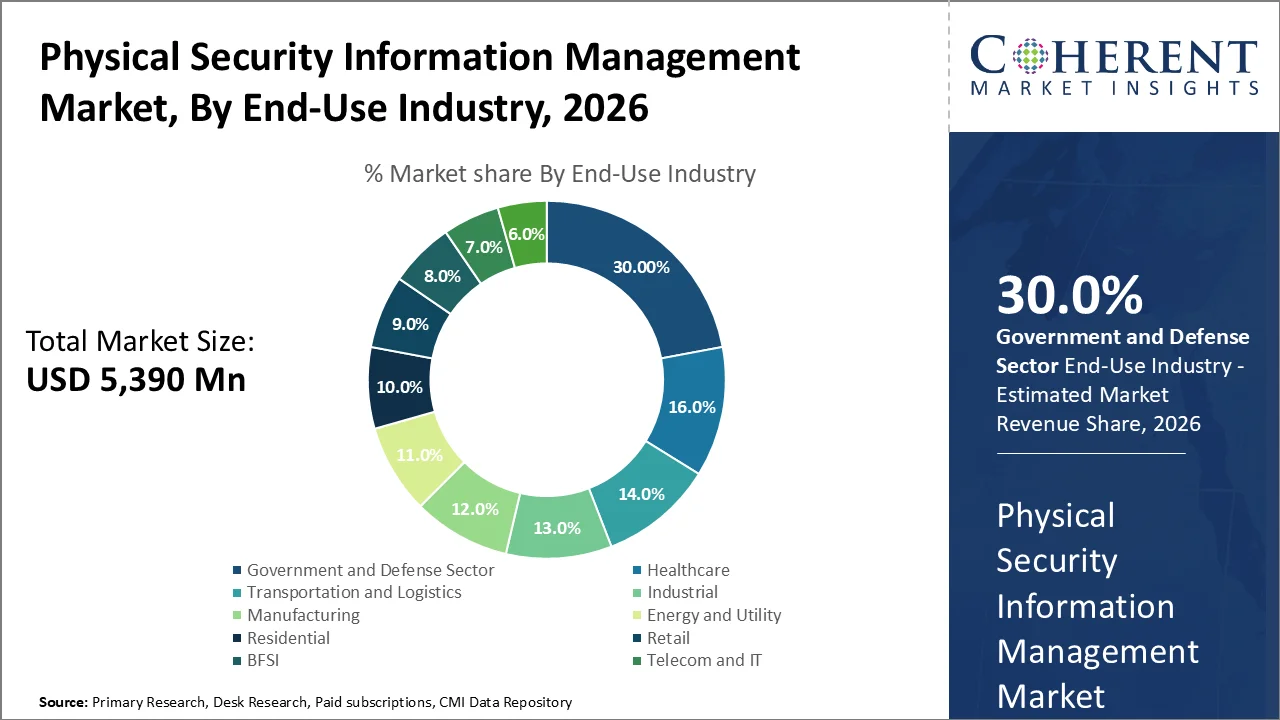
Based on end-user industry, Government and Defense Sector dominates the market, accounting for a significant 30% share in 2026, due to heightened emphasis on national security, counterterrorism, border surveillance, as well as critical infrastructure protection. Government authorities are investing heavily in integrated physical security solutions for real-time monitoring as well as rapid response. For example, Australia plans to increase defense spending by USD53 billion over the next decade amid intensifying global risks, showing the sector’s growing demand for PSIM platforms.
The U.S. Department of Homeland Security encourages using advanced PSIM systems to improve security monitoring and make it easier to manage complex networks across different agencies and areas.
Furthermore, NATO and the European Union have implemented extensive PSIM-based systems to protect major government buildings, military installations, and urban centers against evolving threats, which involve sophisticated intelligence and operational coordination capabilities.
PSIM platforms serve as middleware that unifies different security technologies, allowing both legacy and modern systems to work together seamlessly. They connect with tools like CCTV (IP and analog), access control, and intrusion detection systems, while also incorporating building automation systems to capture environmental data.
This integration has practical benefits: for example, cities like New York have combined multiple agencies’ security feeds into a single platform, advancing coordinated incident response. Similarly, enterprises experience fewer operational silos, faster response times, and a reduction in false alarms.
Artificial Intelligence (AI) and Machine Learning (ML) are now highly adopted in PSIM platforms for efficient security monitoring. They provide intelligent video analytics, behavior analysis, predictive threat detection, automated alert prioritization, etc., with capabilities like facial recognition, object detection, crowd analytics, and forecasting potential security breaches. In fact, 60% of organizations adopting AI-powered PSIM platforms have lowered investigation time by at least 25%, highlighting the measurable efficiency gains these technologies deliver.
Major adopters include IBM QRadar, which integrates AI to correlate cyber-physical security data, and Heathrow Airport, which uses AI-enabled PSIM for real-time threat detection and crowd management. These applications improve incident detection accuracy, allow proactive security responses, and reduce costs by automating routine monitoring tasks.
|
Current Event |
Description and its Impact |
|
EU Cybersecurity Certification for Critical Infrastructure (2025) |
|
|
U.S. Federal Funding for Smart City Security Projects (2025) |
|
Uncover macros and micros vetted on 75+ parameters: Get instant access to report
To learn more about this report, Request Free Sample
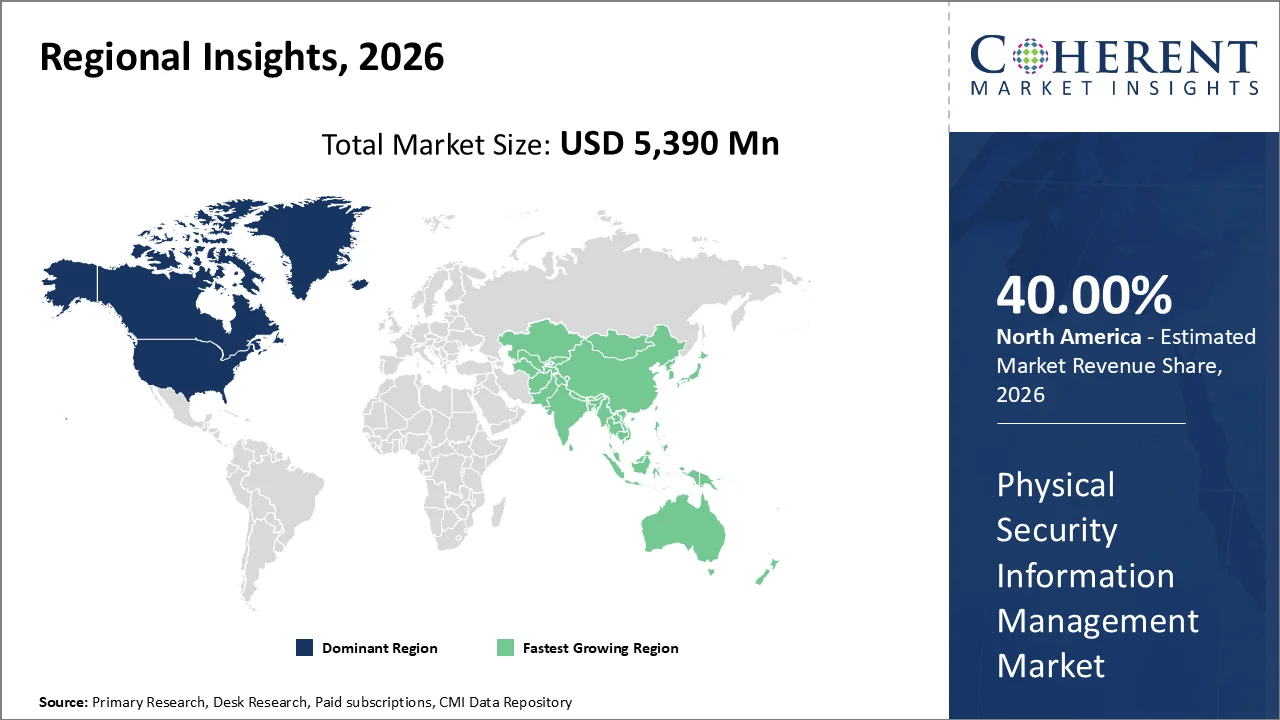
North America account 40% market share in 2026, driven by its strong technological infrastructure, early adoption of advanced security systems, as well as strict regulations on physical security for critical sectors. The region’s leadership in the Physical Security Information Management (PSIM) market reflects a mature security ecosystem, where organizations highly rely on integrated security platforms to handle advancing threats effectively. For example, the EPA proposed a USD19 million investment in cybersecurity for water systems, showing how regulatory initiatives are helping with critical infrastructure to adopt advanced, integrated security solutions.
Major corporations headquartered in North America, particularly in the United States, have been at the forefront of implementing comprehensive PSIM solutions to protect their assets, personnel, and intellectual property. The Department of Homeland Security's continuous emphasis on enhancing physical security measures across federal facilities has created a ripple effect, encouraging private sector adoption of sophisticated security information management systems.
The Asia-Pacific region is poised to be the fastest-growing region through 2026-2033, expanding at a CAGR of approximately 5.74%. Driven primarily by the rapid urbanization, surveillance initiatives by government authorities, as well as high security concerns stemming from geopolitical tensions along with rising industrialization. Countries like China, India, South Korea, Australia, etc., are experience major investments in smart infrastructure, which catalyzes PSIM deployment to integrate diverse security systems, video surveillance, access control, threat detection, as well as emergency response into a unified interface.
China invested over USD180 billion in smart city initiatives in 2024–2025, targeting heavily on integrated surveillance, public safety, as well as urban management systems. with projects focusing on integrating AI, big data, and cloud computing for urban management, public safety, and surveillance.
The United States, being home to a vast number of federal agencies, private corporations, and sprawling metropolitan areas, prioritizes integrated security management systems to effectively monitor, analyze, as well as respond to security threats.
For instance, the Department of Homeland Security (DHS) has highly invested in advanced PSIM technologies across various sectors such as transportation hubs, government facilities, energy sectors, etc., to improve situational awareness as well as response coordination.
Similarly, PalAmerican Security, with over 50 years of experience serving major computing clients in North America, builds customized security programs for high-risk, technical environments where uptime, reliability, as well as asset protection are paramount. Their coast-to-coast capabilities as well as locally engaged leadership make them a trusted provider for enterprises requiring stringent security standards and integrated management solutions.
Additionally, the integration of smart city initiatives in U.S. metropolitan areas like New York, Los Angeles, and Chicago bolsters demand for advanced PSIM platforms to manage vast networks of sensors as well as surveillance devices distributed across urban environments.
China’s rapid urbanization along with the ambitious "Smart City" initiatives across multiple provinces have been paramount in driving demand for advanced physical security systems. The National Development and Reform Commission (NDRC) of China has targets on enhancing urban management by integrating surveillance, security, as well as emergency response systems, which directly correlates with the deployment of PSIM platforms that consolidate data from various security devices into a unified interface.
For example, the city of Shenzhen, known as a forerunner in adopting cutting-edge technology, has adopted PSIM solutions to coordinate public safety across transport hubs, financial centers, and residential districts.
Some of the major key players in physical security information management are Mer, Inc., AxxonSoft, NEC Corporation, Genetec, Inc., CNL Software Ltd., Milestone Systems A/S, VidSys, Inc., S2 Security Corporation, Tyco International Ltd. (Proximex Corporation), videoNEXT Federal, Inc., NICE Systems Ltd., and Intergraph Corporation
| Report Coverage | Details | ||
|---|---|---|---|
| Base Year: | 2025 | Market Size in 2026: | USD 5,390 Mn |
| Historical Data for: | 2020 To 2024 | Forecast Period: | 2026 To 2033 |
| Forecast Period 2026 to 2033 CAGR: | 18.7% | 2033 Value Projection: | USD 17,876 Mn |
| Geographies covered: |
|
||
| Segments covered: |
|
||
| Companies covered: |
Mer, Inc., AxxonSoft, NEC Corporation, Genetec, Inc., CNL Software Ltd., Milestone Systems A/S, VidSys, Inc., S2 Security Corporation, Tyco International Ltd. (Proximex Corporation), videoNEXT Federal, Inc., NICE Systems Ltd., and Intergraph Corporation |
||
| Growth Drivers: |
|
||
| Restraints & Challenges: |
|
||
Uncover macros and micros vetted on 75+ parameters: Get instant access to report
Share
Share
Monica Shevgan has 9+ years of experience in market research and business consulting driving client-centric product delivery of the Information and Communication Technology (ICT) team, enhancing client experiences, and shaping business strategy for optimal outcomes. Passionate about client success.
Joining thousands of companies around the world committed to making the Excellent Business Solutions.
View All Our Clients