

Plastic Bag and Sack Market
Plastic Bag and Sack Market is estimated to be valued at USD 29.71 Bn in 2026 and is expected to reach USD 42.64 Bn in 2033, exhibiting a compound annual growth rate (CAGR) of 5.3% from 2026 to 2033.
Key Takeaways
- Based on Application, the Retail & Consumer Application segment is projected to account for 71% of the market share in 2026, driven by widespread application in packaging.
- Based on Product Type, the T-Shirt Bag segment is expected to hold a largest share of the global plastic bag and sack market due to its lightweight and economical factor.
- Based on Material Type, the Non-Biodegradable Material segment is projected to capture highest share in the market in 2026, owing to it widespread and convenience.
- Based on Region, Europe is projected to dominate the market in 2026 with a 35% share due to strong environmental regulation.
Market Overview
The global plastic bag and sack market is predominantly demanding due it’s the convenience, affordability and durability it offers. Another factor driving the market growth is its widespread application in various industries including retail, food packaging and agriculture. However, the rising environmental concerns and increasing regulation against plastic waste is restraining the market and shifting towards a sustainable alternative.
Current Events and Its Impact
Current Events | Description and its Impact |
Increasing global restrictions on single-use plastics |
|
Growing environmental awareness among consumers |
|
End User Feedback on Plastic Bags and Sacks
- Convenience and Portability
Users appreciate that plastic bags are lightweight and easy to carry. They can be quickly folded or stuffed into pockets or purses, making them highly convenient for spontaneous shopping trips or transporting items on the go. - Water Resistance and Protection
Users value plastic bags for their ability to protect groceries and other items from moisture. Whether it’s a sudden rain or leaking produce, plastic bags help keep contents dry and clean. - Weakness and Durability Issues
Many users report that plastic bags tear easily, especially when carrying heavy or sharp-edged items. This causes frustration and sometimes leads to accidental spills or dropped goods, highlighting durability as a key concern.
Unmet Needs for Plastic Bags and Sacks
- Environmentally Sustainable Alternatives
There is a strong need for plastic bags made from biodegradable or compostable materials that break down naturally without leaving toxic residues. Consumers want options that reduce pollution and protect ecosystems. - Enhanced Safety Features
There’s a need for bags designed to minimize suffocation hazards, especially for children. Clear labeling and warnings, along with safety-conscious design elements, would address these concerns and increase user confidence. - Accessible Recycling and Awareness Programs
Users need better infrastructure for collecting and recycling plastic bags, including convenient drop-off points and clearer instructions. Educational efforts would help consumers understand how to properly dispose of bags and support environmental efforts.
- Current Industry Events of 2026
- Market Size Estimation
- Regional Breakdown
- Competitive Landscape
- Customer Intelligence
- Segmental Analysis
- Pricing Analysis
- Key Market Drivers, Challenges & Future Trends
- Customized Insights Section
Segmental Insights
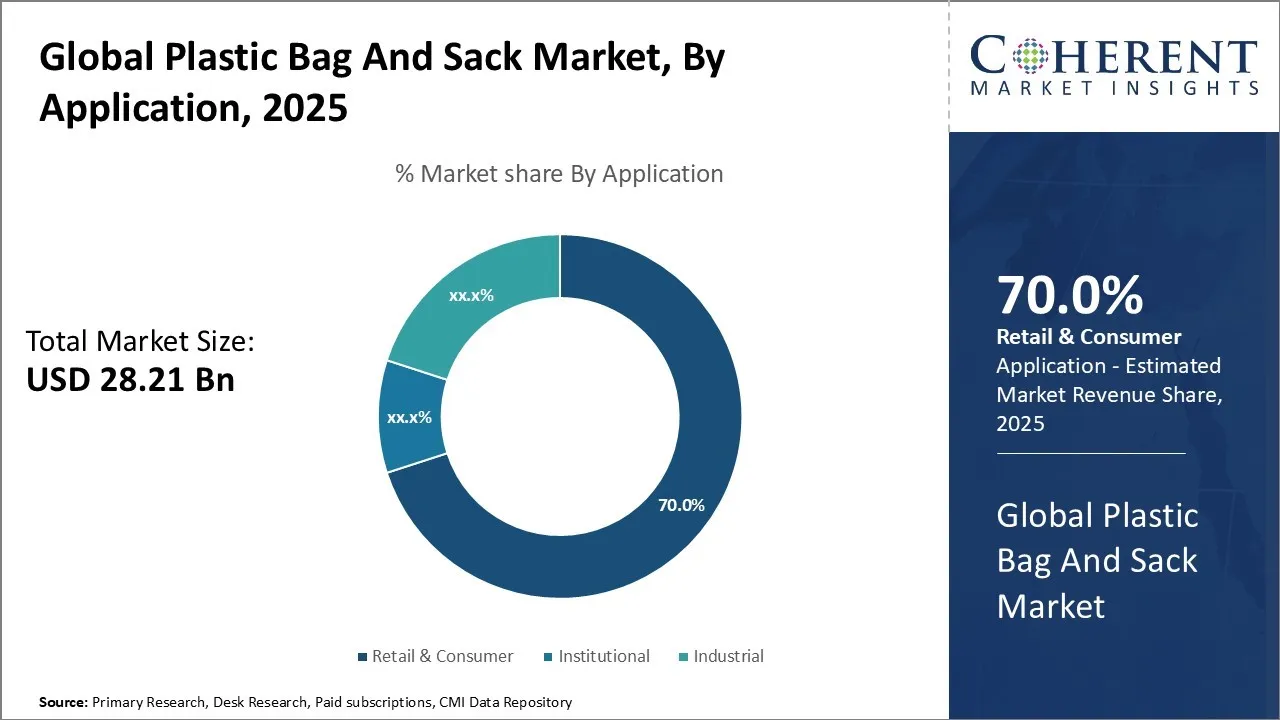
Plastic Bag and Sack Market Insights, By Application: Retail & Consumer Dominates the Overall Market Owing to Its Widespread Application in Packaging
The retail & consumer segment is expected to contribute 71% share of the market in 2026, owing to its widespread application in packaging. Plastic bags are low cost, durable and convenience which fuels the market further. For retail and consumer purpose they are practical and affordable way of packaging solution. Plastic bags are commonly used for carrying daily groceries from the store to vehicle and home throughout the developed world. In many countries including India, have replaced plastic bags with re-useable bags and containers in shopping.
Americans use more than 100 billion plastic bags each year which is more than 300 bags per person per year. This is further propelling the plastic bag and sack market demand.
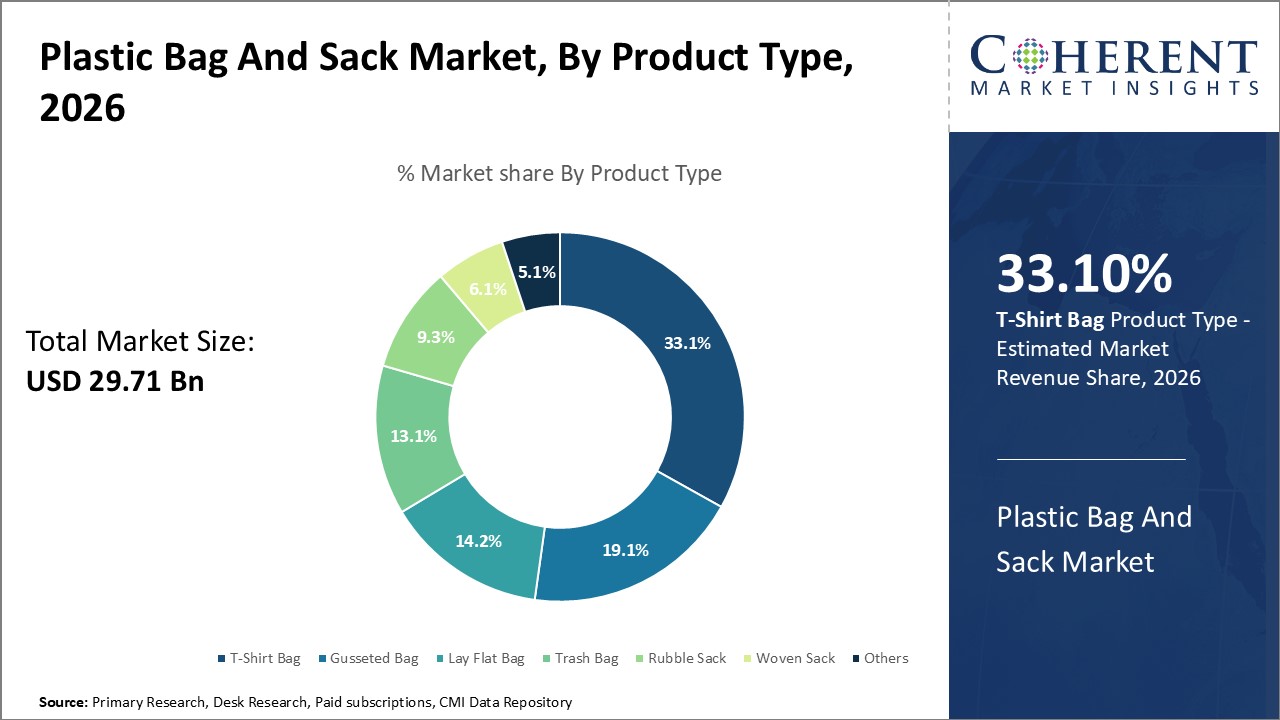
Plastic Bag and Sack Market Insights, By Product Type: T-Shirt Acquires the Largest Share Owing to Its Lightweight and Economical
The t-shirt bag segment is expected to contribute the highest share of the market in 2026, owing to its lightweight and economical factor. T-shirt bags are used to carry almost everything when commuting. The popularity of t-shirt bags is observed due to its reusable property. They are made from non-woven synthetic material, making then eco-friendly and sustainable bag option. It is commonly used in retail stores, grocery stores, carryout and takeout, promotional marketing, events and conventions, household storage and many more.
Plastic Bag and Sack Market Insights, By Material Type: Non-Biodegradable Material Dominates the Overall Market
The non-biodegradable material segment is expected to contribute the highest share of the global plastic bag and sack market in 2026, owing to its lower cost production. Non-biodegradable plastic bags are made from a material that will not decompose in the environment which includes plastics and paper. A plastic bag such as such as polyethylene (PE), polypropylene (PP), and polyethylene terephthalate (PET), are demanding due to their durability and longevity. It is estimated that non-biodegradable bags are present in massive quantity, approximately 500 billion to 1 trillion plastic bags are used annually.
Regional Insights
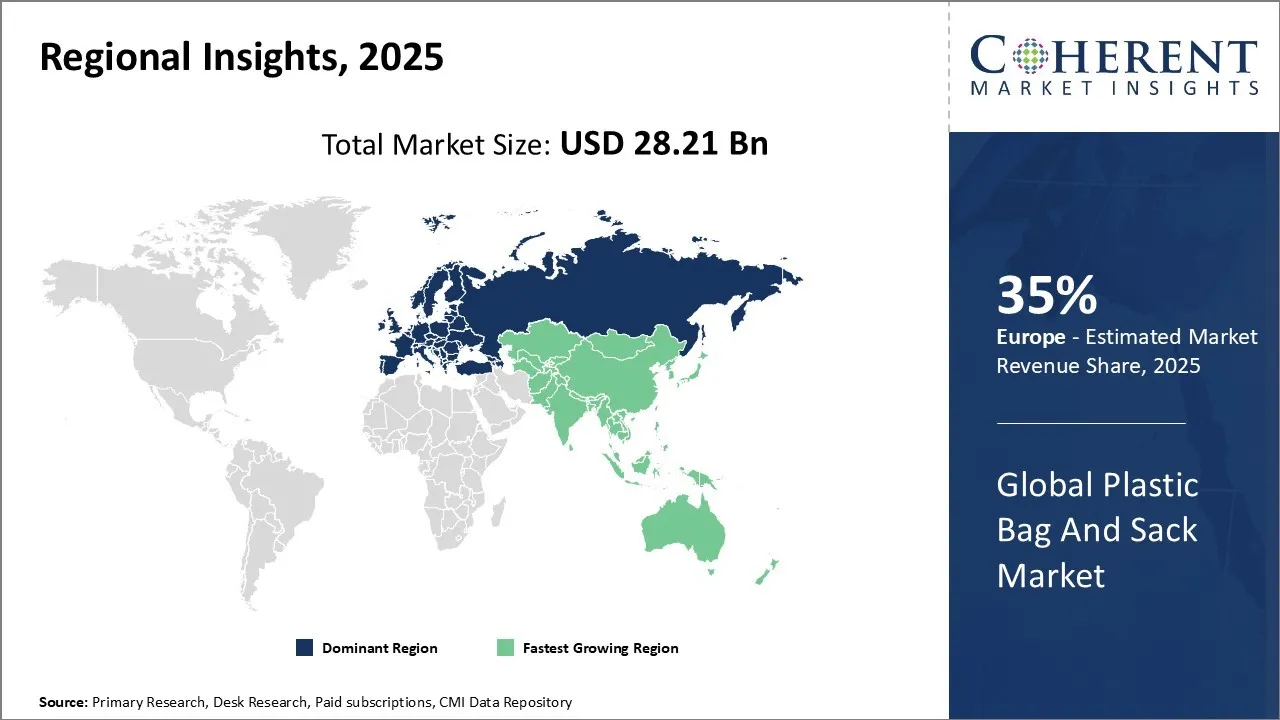
Europe Plastic Bag and Sack Market Analysis and Trends
Europe dominates the global plastic bag and sack market with a share of 35% in 2026 can be attributed to strong environmental regulation. Europe consumers prefer a low weight, resistance to degradation and ability to protect content from rain and water bags, and plastic bag and sack. The plastic companies’ revenue and sale production are aggressively superior to the paper or reusable bags. However, the EU state members have declared a limitation on plastic bags used each year. Governments have to make sure that each person uses no more than 90 lightweight plastic bags per year, reducing to 40 bags per year by the end of 2026.
Asia Pacific Plastic Bag and Sack Market Analysis and Trends
The Asia Pacific region is expected to exhibit the fastest growth in the global plastic bag and sack market in 2026. Asia Pacific is experiencing great growth due to rapid urbanization and industrialization. Along with that the market is fueled by the food and beverages industry, where consumers prefer using convenient, single-use packaging. According to the Korea Zero Waste Movement Network, South Korea consumer around 19 billion plastic bags annually and Thailand consumers roughly 200 billion, with on average one person using eight plastic bags in a day.
Plastic Bag and Sack Market Outlook Country-wise
China Plastic Bag and Sack Market Trends
China is the leading producer and polluter of plastic bags. China banned the import of plastic bags in 2018 and still its is the major contributor to global pollution due to domestic consumption and weak recycling system. The market is driven by large population, widespread use in supermarket and local market. Government policies in China are reducing plastic bags waste such as ultra-thin bags, have been implemented. Additionally, the growth is fueled by the growing e-commerce and food delivery industries.
Rwanda Plastic Bag and Sack Market Trends
Rwanda, a country in East Africa, is the first ever country to be plastic-free. Rwanda has implemented a comprehensive ban on plastic bags. The banned plastic bags include single-use plastic bags, bottles and other packaging with penalties for non-compliance. This initiative reflects on reducing litter and a cleaner environment. Presence of any plastic bags are confiscated at the airport or any entry point in Rwanda.
Plastic Bag and Sack Market Drivers
Declining prices of oil & gas around the globe
Declining prices of oil & gas around the globe are projected to drive the market growth of the plastic bag and sack. According to a report by the Energy Information Administration (EIA), the global crude oil inventory rose by around 500 barrels in 2022 that translated to 40% drop in oil prices from US$ 46 per barrel in 2021 to US$ 33 per barrel in 2022. Therefore, the declining price of oil & gas is encouraging manufacturer to use these raw materials for the production of plastic bags.
Growing focus of manufacturers to use plastic bags as a marketing platform for the brand is estimated to foster the market growth of plastic bag and sack during the forecast period. For example, printed plastic bags are providing excellent marketing tool to promote and create brand awareness, across various end use industries such as apparel, consumer products, food & beverage, bakery, and others. Therefore, using plastic bags as a form of brand promotion among various companies is expected to fuel the market growth of plastic bag and sack.
Plastic Bag and Sack Market Opportunities
The growing introduction of biodegradable plastic bags is expected to impact the plastic bag and sack market growth positively over the forecast period. For instance, LyondellBasell has joined forces with a Finland-based energy company to produce two forms of plastics made from renewable sources instead of fossil fuels. The company has partnered with Neste, an oil refiner, and producer of renewable diesel, to create a new bio-based polypropylene and low-density polyethylene products, two of the most common types of plastics.
Market Report Scope
Plastic Bag and Sack Market Report Coverage
| Report Coverage | Details | ||
|---|---|---|---|
| Base Year: | 2025 | Market Size in 2026: | USD 29.71 Bn |
| Historical Data for: | 2020 To 2024 | Forecast Period: | 2026 To 2033 |
| Forecast Period 2026 to 2033 CAGR: | 5.3% | 2033 Value Projection: | USD 42.64 Bn |
| Geographies covered: |
| ||
| Segments covered: |
| ||
| Companies covered: | Key players operating in global plastic bag and sack are AEP Industries Inc., Mondi Group, Berry Plastics Inc., Alpha T-shirt, Novolex, Ampac Holdings LLC, Bischof & Klein GmbH & Co. KG, Inteplast Group, Starlinger & Co Gesellschaft M.B.H, Da Nang Plastic Joint Stock Company, Hanoi Plastic Bag JSC, Goglio Group, Schur Flexibles Group | ||
| Growth Drivers: |
| ||
| Restraints & Challenges: |
| ||
Recent Developments
- In May 2025, the Navi Mumbai Municipal Corporation (NMMC), launched crackdown against single-use plastic. This has intensified its anti-plastic campaign. Under this initiative a strategic trap was laid and intercepted a small tempo found transporting banned single-use plastic bags. Authorities seized 50 kilograms of plastic bags and imposed a fine of Rs 5,000 on the offender.
- In May 2025, Don Don Donki, a Japan-based specialty store that offers Japanese products mainly food, is back to the market after 7 months of Japanese supermarket chain stopped offering them. Now, the new plastic bags are biodegradable and eco-friendly and cost shopper’s fiver cents each. They are design to break down naturally over time and reduce negative impact on the environments.
- In February 2025, Amcor collaborated with Australian bread manufacturer Tip Top bakeries to launch bread bags containing 30% recycled plastic, using certified mass balance approach.
- In January 2025, Siliguri Municipal Corporation (SMC) introduced a campaign against single-use plastic in Siliguri. This initiative for driven by the continues use of polythene bags. The SMC conduced a rais on three warehouses located in the Khalpara and Naya Bazar areas of Wards 08 and 09. In the operation, over 500 sacks of banned plastic were seized.
Analyst Opinion (Expert Opinion)
- Regulatory changes are reshaping the global plastic bag and sack market. For example, China has introduced stricter rules on the production and disposal of plastic bags. This is likely to reduce manufacturing capacity and increase compliance costs for producers, which could impact global supply and push up prices. Meanwhile, in Europe, a proposed EU-wide ban on single-use plastics could lead to a sharp drop in demand for plastic bags and sacks, limiting market growth across the region.
- Economic factors are also adding pressure to the industry. Fluctuating oil prices—since oil is a key raw material for plastic can drive up production costs. This squeezes profit margins and could lead to higher prices for plastic bags and sacks. Additionally, ongoing trade disputes and tariffs on plastic products are disrupting global supply chains, creating more price volatility and uncertainty in the market.
Market Segmentation
- Global Plastic Bag and Sack Market, By Application (Revenue, USD Bn, 2021 - 2033)
- Retail & Consumer
- Grocery Products
- Food & Beverage
- Clothing & Apparel
- Others
- Institutional
- Hospitality
- Hospital & Healthcare Facility
- Others
- Industrial
- Retail & Consumer
- Global Plastic Bag and Sack Market By Product Type (Revenue, USD Bn, 2021 - 2033)
- T-Shirt Bag
- Gusseted Bag
- Lay Flat Bag
- Trash Bag
- Rubble Sack
- Woven Sack
- Others
- Global Plastic Bag and Sack Market, By Material Type (Revenue, USD Bn, 2021 - 2033)
- Non-Bio-Degradable
- High-density polyethylene (HDPE)
- Low-density polyethylene (LDPE)
- Linear low-density polyethylene (LLDPE)
- Polypropylene (PP)
- Polystyrene (PS)
- Others
- Bio-Degradable
- Polylactic acid (PLA)
- Polyhydroxyalkanoates (PHA)
- Starch Blends
- Others
- Non-Bio-Degradable
- Global Plastic Bag and Sack Market, By Geography (Revenue, USD Bn, 2021 - 2033)
- North America
- U.S.
- Canada
- Europe
- U.K.
- Germany
- Italy
- France
- Spain
- Nordic
- Benelux
- Russia
- Poland
- Rest of Europe
- Asia Pacific
- China
- India
- Japan
- ASEAN
- Australia & New Zealand
- Rest of Asia Pacific
- Latin America
- Brazil
- Mexico
- Rest of Latin America
- Middle East & Africa
- GCC
- South Africa
- Rest of Middle East & Africa
- North America
- Company Profiles
- AEP Industries Inc.
- Mondi Group
- Berry Plastics Inc.
- Alpha T-shirt
- Novolex
- Ampac Holdings LLC
- Bischof & Klein GmbH & Co. KG
- Inteplast Group
- Starlinger & Co Gesellschaft M.B.H
- Da Nang Plastic Joint Stock Company
- Hanoi Plastic Bag JSC
- Goglio Group
- Schur Flexibles Group
Sources
Primary Research Interviews from the Following Stakeholders
Stakeholders:
- Interviews with plastic bag and sack manufacturers, polymer suppliers, packaging solution providers, sustainability officers, procurement managers, waste management authorities, and import/export managers across key global markets.
Specific Stakeholders
- Operations and supply chain managers at FMCG and retail conglomerates (e.g., Walmart, Big Bazaar, Tesco)
- Procurement heads at logistics and courier firms (e.g., FedEx, Blue Dart, DHL)
- Sustainability and compliance officers at foodservice chains (e.g., McDonald's, Subway, Domino's)
- Packaging innovation leads at e-commerce companies (e.g., Amazon, Flipkart)
- Municipal waste management officials and urban development authorities
- Materials engineers and R&D heads at polyethylene and bioplastic manufacturers
- Import/export heads at customs logistics hubs and ports
- Retail floor managers and store layout planners at hypermarkets and supermarkets
- Policy advisors and environmental officers at regulatory bodies and ministries
Databases
- UN Comtrade Database
- World Trade Organization (WTO) Trade Statistics
- U.S. Census Bureau – Foreign Trade Division
- Directorate General of Commercial Intelligence and Statistics (DGCIS), India
- Eurostat – International Trade Database
- Japan Customs and Tariff Bureau
- Korea Customs Service
- China Customs Statistics
- Brazil Foreign Trade Secretariat (SECEX)
- South African Revenue Service (SARS) Trade Data
Magazines
- Packaging World
- Plastics Technology
- Packaging Digest
- Flexible Packaging Magazine
- Sustainable Plastics
- Modern Plastics India
- Recycling Today
- Packaging South Asia
Journals
- Journal of Polymer Science
- Waste Management (Elsevier)
- Journal of Cleaner Production
- Journal of Applied Polymer Science
- Packaging Technology and Science
- Resources, Conservation & Recycling
- Journal of Environmental Management
- International Journal of Plastic Technologies
Newspapers
- The Economic Times – Industry & Manufacturing
- Business Standard – Plastics and Packaging Section
- Financial Times – Global Supply Chain & Materials Reports
- The Hindu Business Line – Sustainability and Packaging News
- Nikkei Asia – Materials and Chemicals
- South China Morning Post – Industry & Environment
- The Guardian – Plastics and Sustainability Coverage
Associations
- Plastindia Foundation
- All India Plastics Manufacturers’ Association (AIPMA)
- American Chemistry Council – Plastics Division
- European Bioplastics Association
- Flexible Packaging Association (FPA)
- Confederation of Indian Industry (CII) – Plastic Packaging
- British Plastics Federation (BPF)
- Japan Plastics Industry Federation
- Korea Packaging Center
- South African Plastics Recycling Organization (SAPRO)
Public Domain Sources
- Central Pollution Control Board (CPCB), India
- Ministry of Environment, Forest and Climate Change (MoEFCC), India
- U.S. Environmental Protection Agency (EPA) – Plastic Waste Reports
- European Environment Agency (EEA)
- Ministry of Economy, Trade and Industry (METI), Japan
- National Development and Reform Commission (NDRC), China
- Department for Environment, Food & Rural Affairs (DEFRA), UK
- Bureau of Indian Standards (BIS) – Packaging and Plastics Standards
- UN Environment Programme (UNEP) – Plastic Waste Initiatives
- NITI Aayog – Circular Economy and Plastics
Proprietary Elements
- CMI Data Analytics Tool, and Proprietary CMI Existing Repository of information for last 8 years
*Definition: A plastic bag and sack, are also referred to as polybag and is completely composed of thin plastic film. Plastic bag and sack is widely used across packaged industry for packaging packed food products, apparel, fresh produce, stationery, and other product. These bags are considerably transparent, offer flexibility and tear-resistance. Moreover, it also provides a superior moisture barrier property. Retail & consumer, food and beverage, institutional services, and other industrial applications are some of the major application areas of plastic bag and sack.
Get access to 250+ pages report
Every segment, forecast, competitor profile and data table behind the analysis above — available for instant download.
- ESOMAR Member
- ISO 9001:2015 Certified
- D-U-N-S Registered
- GDPR & CCPA Compliant
Missing comfort of reading report in your local language? Find your preferred language:
Transform your Strategy with Exclusive Trending Reports
Frequently Asked Questions
The Plastic Bag And Sack Market is estimated to be valued at USD 29.71 Bn in 2026, and is expected to reach USD 42.64 Bn by 2033.
The CAGR of the Plastic Bag And Sack Market is projected to be 5.3% from 2026 to 2033.
Key players operating in global plastic bag and sack are AEP Industries Inc., Mondi Group, Berry Plastics Inc., Alpha T-shirt, Novolex, Ampac Holdings LLC, Bischof & Klein GmbH & Co. KG, Inteplast Group, Starlinger & Co Gesellschaft M.B.H, Da Nang Plastic Joint Stock Company, Hanoi Plastic Bag JSC, Goglio Group, Schur Flexibles Group.
Government Taxation and extra charges can hamper the market growth.
Declining prices of oil & gas around the globe are the key factors driving growth of the market
The CAGR of the Plastic Bag And Sack Market is projected to be 5.3% from 2026 to 2033.
Europe region held the largest market share in the market.