

Microplate Readers Market Size and Forecast — 2026-2033
The Global Microplate Readers Market size is estimated to be valued at USD 952.3 million in 2026 and is expected to reach USD 1,590.2 million by 2033, exhibiting a compound annual growth rate (CAGR) of 7.6% from 2026 to 2033.
Overview
Microplate readers are analytical laboratory instruments used to detect biological, chemical, or physical events in samples arranged in microtiter plates. These devices measure absorbance, fluorescence, luminescence, or multiple detection modes across 96-, 384-, or 1536-well plates. Products vary from single-mode readers for routine assays to multimode systems integrated with automation platforms, robotics, and software for high-throughput screening. They are essential for ELISA, enzyme kinetics, protein and nucleic acid quantification, and drug discovery applications. Modern microplate readers include advanced optics, temperature control, and onboard data analysis, with touchscreen interfaces and cloud connectivity for laboratory integration.
Key Takeaways
The Multi-Mode Technology segment dominates market share, driven by its ability to support various assay types simultaneously, thus capturing over one-third of the market revenue in 2026.
Pharmaceutical and biotechnology companies remain the largest end-user segment, accounting for more than 41% of market revenue, owing to increased R&D spending and demand for faster drug screening.
North America holds a commanding market share exceeding 35%, attributed to advanced healthcare infrastructure and robust government support.
Asia Pacific registers the fastest growth, with a CAGR surpassing 9%, fueled by rising healthcare investments, expanding research institutions, and surging diagnostic requirements in countries like China and India.
Microplate Readers Market Segmentation Analysis
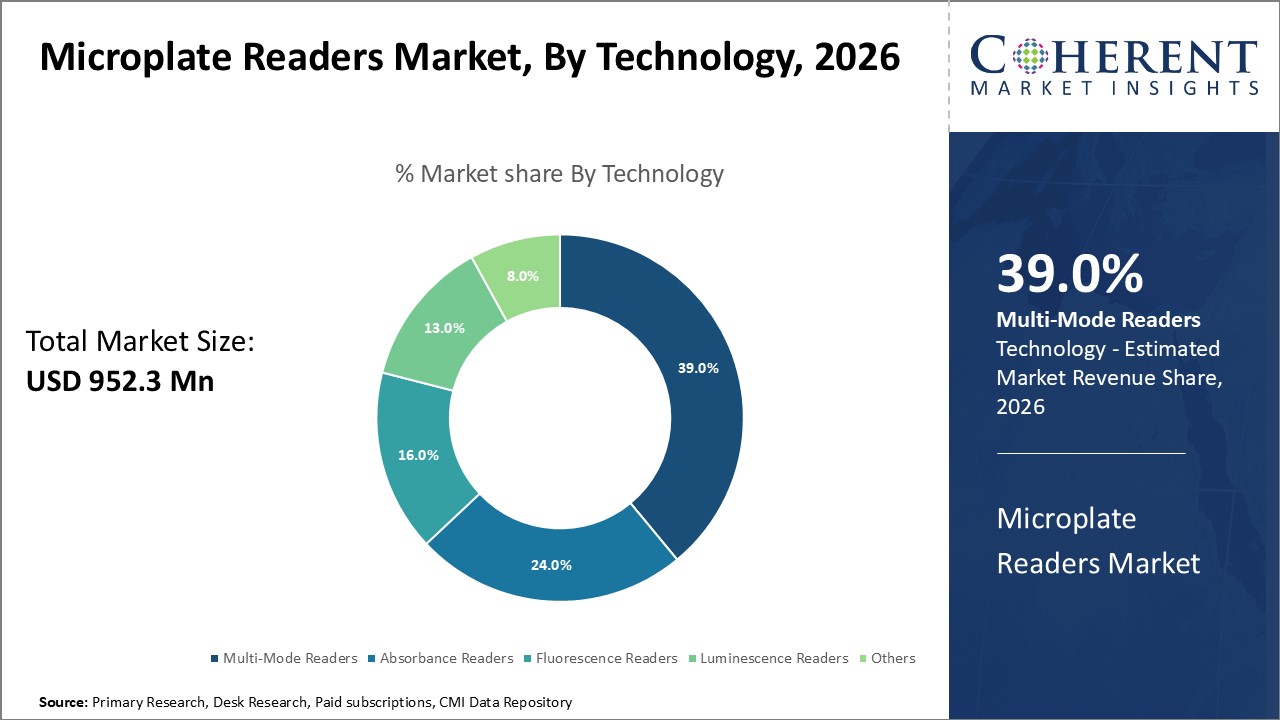
Microplate Readers Market Insights, By Technology
Multi-Mode Readers dominate the market share with 39% due to their multifunctionality, offering simultaneous absorbance, fluorescence, and luminescence detection, which significantly enhances laboratory throughput. This segment’s growth is propelled by pharmaceutical and biotech labs requiring versatile platforms for complex assays with high sensitivity and reproducibility. The fastest-growing subsegment is Luminescence Readers, benefiting from increasing biomarker and cell viability assays in clinical diagnostics, showing accelerated adoption driven by superior sensitivity and low background noise. Absorbance Readers mainly serve traditional ELISA and colorimetric assays, maintaining steady demand due to their foundational role in diagnostics.
Microplate Readers Market Insights, By Application
Drug Discovery dominates the market share since the majority of microplate readers are deployed in pharmaceutical R&D workflows for compound screening and mechanism-of-action studies, benefiting from technological innovations that improve assay sensitivity and throughput. The fastest-growing application is Diagnostics, spurred by rising demand for rapid infectious disease testing and personalized health assessments; recent advancements have enabled microplate readers to support multiplexed diagnostic panels efficiently. Genomics & Proteomics applications are steadily expanding as advanced readers facilitate nucleic acid quantification and protein interaction studies.
Microplate Readers Market Insights, By End User
Pharmaceutical and Biotechnology Companies hold the dominant market share, attributed to their heavy investment in drug discovery and high-throughput screening processes that necessitate advanced microplate readers. These companies prioritize multi-mode systems capable of multiplexed assay detection, driving significant market revenue. The fastest-growing subsegment is Academic & Research Institutes, fueled by increased grants and research funding, especially in genomics and proteomics studies worldwide.
Microplate Readers Market Trends
The Microplate Readers market trend in recent years emphasizes integration with advanced technologies such as artificial intelligence and microfluidics, enabling enhanced automation and precision in assay results.
For instance, in 2025, major pharmaceutical companies reported a 31% increase in screening efficiency after implementing AI-enabled microplate readers.
Additionally, portable and miniaturized reader designs are gaining momentum, particularly in decentralized diagnostic labs, as seen in increased sales in Latin America and the Middle East regions.
The shift toward cloud-based data solutions is transforming data management, improving collaboration across global research teams.
Microplate Readers Market Insights, By Geography
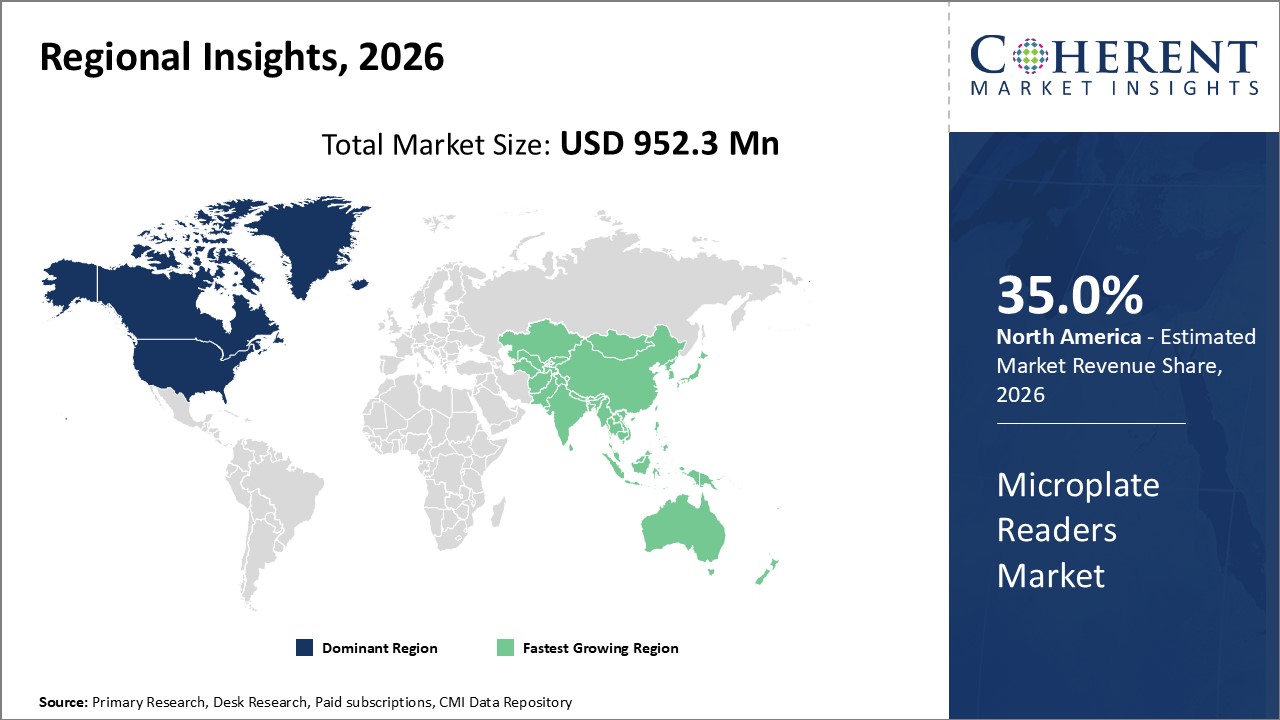
North America Microplate Readers Market Analysis and Trends
In North America, the dominance in the Microplate Readers market is driven by established pharmaceutical hubs, high R&D expenditure, and well-developed infrastructure. The region accounts for over 35% of the industry size, supported by federal funding initiatives and cutting-edge research institutions such as the NIH and leading universities. Notable companies like Agilent Technologies and Thermo Fisher Scientific maintain headquarters and production facilities here, further anchoring the market dominance.
Asia Pacific Microplate Readers Market Analysis and Trends
Meanwhile, the Asia Pacific exhibits the fastest growth with a CAGR exceeding 9%, propelled by rapid industrialization, increasing healthcare investments, and expanding biotech research centers in China and India. Government incentives and a growing patient population fuel the demand for advanced diagnostic solutions and microplate readers. Companies like BMG Labtech and Molecular Devices have capitalized on this growth by expanding regional operations and collaborations.
Microplate Readers Market Outlook for Key Countries
USA Microplate Readers Market Analysis and Trends
The USA’s microplate readers market remains a global leader, fueled by high pharmaceutical R&D investments, with over USD 180 billion allocated to R&D in 2025 alone. The presence of major industry players, coupled with innovation centers, facilitates the rapid adoption of next-generation devices. Initiatives favoring personalized medicine and regulatory approvals for new diagnostic assays have further supported market revenue and business growth strategies. The country also benefits from a mature supply chain ecosystem, ensuring steady production and export.
China Microplate Readers Market Analysis and Trends
China’s market growth is driven by increasing investments in biotechnology, with government policies supporting advanced research infrastructures and the development of indigenous manufacturers. In 2026, import records show a sharp 18% increase, reflecting the demand for sophisticated microplate readers for genomics and proteomics applications. Expansion of research facilities and favorable reimbursement frameworks also boost equipment demand, creating robust market dynamics and growth paths in the region.
Analyst Opinion
The surge in demand for Multi-Mode Microplate Readers is a key supply-side indicator impacting market share, with a reported 46% increase in adoption within pharmaceutical R&D labs during 2025 due to their versatility in fluorescence, luminescence, and absorbance detection methods. This multi-detection capability correlates to increased market revenue and is a crucial driver behind the industry size expansion.
On the demand side, emerging use cases in personalized medicine and molecular diagnostics are propelling imports of advanced microplate readers, particularly in the Asia Pacific, where laboratories are upgrading equipment for rapid biomarker screening. In 2026, import volumes for microplate readers into China surged by 18%, accentuating the market forecast of sustained regional growth.
Nano-scale indicators reflect the rising preference for compact, user-friendly microplate readers designed for point-of-care testing in decentralized labs. In 2025, product launches tailored for ease of use and quicker assay turnaround captured over 26% of new customer acquisitions, signifying evolving market dynamics in the microplate readers segment.
Pricing trends indicate a steady reduction in component costs by 6-8% annually, enhancing affordability and encouraging market penetration in price-sensitive regions such as Latin America and the Middle East. This trend directly contributes to a broader market scope and supports business growth among emerging market players.
- Current Industry Events of 2026
- Market Size Estimation
- Regional Breakdown
- Competitive Landscape
- Customer Intelligence
- Segmental Analysis
- Pricing Analysis
- Key Market Drivers, Challenges & Future Trends
- Customized Insights Section
Market Scope
| Report Coverage | Details | ||
|---|---|---|---|
| Base Year: | 2025 | Market Size in 2026: | USD 952.3 million |
| Historical Data for: | 2020 To 2024 | Forecast Period: | 2026 To 2033 |
| Forecast Period 2026 to 2033 CAGR: | 7.6% | 2033 Value Projection: | USD 1,590.2 million |
| Geographies covered: |
| ||
| Segments covered: |
| ||
| Companies covered: | Agilent Technologies, BioTek Instruments (now part of Agilent), Tecan Group Ltd., Thermo Fisher Scientific Inc., Analytik Jena AG, Beckman Coulter (Beckman Coulter Life Sciences), Bio-Rad Laboratories, Inc., Promega Corporation, FLUOstar Optima (BMG Labtech), Hidex Oy, Berthold Technologies GmbH. | ||
| Growth Drivers: |
| ||
Microplate Readers Market Growth Factors
The surge in pharmaceutical R&D investments continues to be a predominant market driver, with drug discovery processes increasingly reliant on high-throughput screening technologies; globally, R&D expenditure grew by 10% in 2025, favoring microplate reader adoption. The rising prevalence of chronic diseases demanding rapid biomarker testing fuels diagnostic applications, driving growth in hospital and laboratory end-user segments. Furthermore, technological advancements in multi-mode microplate readers, combining fluorescence, luminescence, and absorbance detection, expand the market scope by enabling versatile assay types with improved sensitivity and data accuracy. Lastly, growing government initiatives promoting life sciences and personalized medicine, especially in the Asia Pacific and North America, act as positive market dynamics facilitators, fostering market growth strategies overall.
Microplate Readers Market Development
In July 2026, Molecular Devices launched its next-generation microplate readers, the SpectraMax® iD3s and SpectraMax® iD5e, designed for multi-omics research and advanced cellular assays. The new systems feature tunable monochromator optics, dual injectors, hybrid detection modes (absorbance, fluorescence, luminescence, TRF, FP), and live-cell environmental control (CO₂/O₂). The iD3s targets more routine workflows while the iD5e supports complex applications like TR-FRET and Western blot quantification.
In September 2026, Cerillo introduced its new multi-wavelength absorbance microplate reader, the Rayo, set to debut at the Analytica USA 2026 (September 10-12, Columbus, Ohio). The Rayo platform supports multiple wavelengths (405 nm, 450 nm, 590 nm, and 740 nm) and both endpoint and real-time kinetic measurements for ELISA, protein quantification, and growth-curve assays. Its ultra-compact, automation-ready design enables deployment in incubators, anaerobic chambers, or liquid-handling systems.
Key Players
Leading companies of the market include:
Agilent Technologies
BioTek Instruments (now part of Agilent)
Tecan Group Ltd.
Thermo Fisher Scientific Inc.
Analytik Jena AG
Beckman Coulter (Beckman Coulter Life Sciences)
Bio-Rad Laboratories, Inc.
Promega Corporation
FLUOstar Optima (BMG Labtech)
Hidex Oy
Berthold Technologies GmbH
Several market companies have actively pursued growth strategies, including product innovation and mergers & acquisitions to capture market share. For example, Agilent Technologies' acquisition of BioTek in late 2022 significantly expanded its microplate reader portfolio, resulting in a 21% increase in market revenue in 2023. Likewise, Thermo Fisher Scientific’s launch of ultra-sensitive luminescence microplate readers in 2025 improved detection limits for diagnostics applications, allowing for enhanced business growth and client retention.
Microplate Readers Market Future Outlook
In the coming years, the Microplate Readers Market is expected to continue its upward trajectory due to the integration of AI-driven assay analytics, miniaturization, and increased throughput requirements in drug discovery and genomics. Emerging trends such as single-cell analysis, multiplex detection, and the growth of CRO and academic collaborations will open new avenues for adoption. The introduction of cloud-connected readers with enhanced data visualization capabilities will redefine assay reproducibility and result accuracy, leading to consistent mid- to high-single-digit growth over the next decade.
Microplate Readers Market Historical Analysis
The Microplate Readers Market has witnessed steady technological advancement since the early 2000s, becoming a key enabler of modern biochemical, pharmaceutical, and clinical diagnostics research. Initially limited to single-mode absorbance readers, the market expanded significantly with the development of multimode systems that could perform fluorescence, luminescence, and time-resolved measurements. The growth of life science R&D, high-throughput screening, and drug discovery in the biotechnology sector during the 2010s created strong demand for these instruments. The market also benefited from the rise of automation and digital laboratory ecosystems, which integrated microplate readers with robotic handling systems and data management software for seamless assay workflows.
Sources
Primary Research Interviews:
Laboratory Managers
Biotech Scientists
Clinical Research Coordinators
Automation Specialists
Pharmaceutical R&D Heads
Databases:
PubMed
Scopus
ClinicalTrials.gov
GlobalData Life Science Instruments Reports
Magazines:
Lab Manager
BioTechniques
The Scientist
Laboratory Equipment
Journals:
Analytical Biochemistry
Journal of Laboratory Automation
Nature Methods
Assay and Drug Development Technologies
Newspapers:
The Wall Street Journal (Science & Health)
Financial Times (Technology)
The Hindu (Science)
The Times of India (Health & Tech)
Associations:
American Association for Clinical Chemistry (AACC)
Society for Laboratory Automation and Screening (SLAS)
International Society for Analytical Cytology
Get access to 250+ pages report
Every segment, forecast, competitor profile and data table behind the analysis above — available for instant download.
- ESOMAR Member
- ISO 9001:2015 Certified
- D-U-N-S Registered
- GDPR & CCPA Compliant
Missing comfort of reading report in your local language? Find your preferred language:
Transform your Strategy with Exclusive Trending Reports
Frequently Asked Questions
The market is led by companies such as Agilent Technologies, Tecan Group, Thermo Fisher Scientific, and Molecular Devices, which have strong product portfolios and active innovation pipelines.
The market size is estimated at USD 952.3 million in 2026 and projected to grow to USD 1,590.2 million by 2033, exhibiting a CAGR of 7.6% during this period.
Pharmaceutical and biotechnology companies represent the largest growth opportunity due to increased investments in high-throughput screening and drug discovery applications.
Emerging trends include AI integration for data analytics, miniaturized portable devices for point-of-care testing, and cloud-based data management, enhancing collaborative research.
The competitive landscape is dynamic, with companies focusing on innovation, strategic acquisitions, and expanding multi-mode technologies. Key challenges include pricing pressures and technological complexity for end-users.
Leading players adopt strategies such as mergers & acquisitions, product line expansions, and partnerships with research institutes to enhance market penetration and address diverse customer needs.