

Anti-nuclear Antibody Testing Market Size and Forecast – 2026 to 2033
The Anti-nuclear Antibody Testing Market is estimated to be valued at USD 6.70 Bn in 2026 and is expected to reach USD 9.2 Bn by 2033, exhibiting a compound annual growth rate (CAGR) of 14.2% from 2026 to 2033.
Key Takeaways
- By Product Type, Reagents & Assay Kits hold the largest market share of 24.3% in 2026 owing to its rising prevalence of autoimmune diseases.
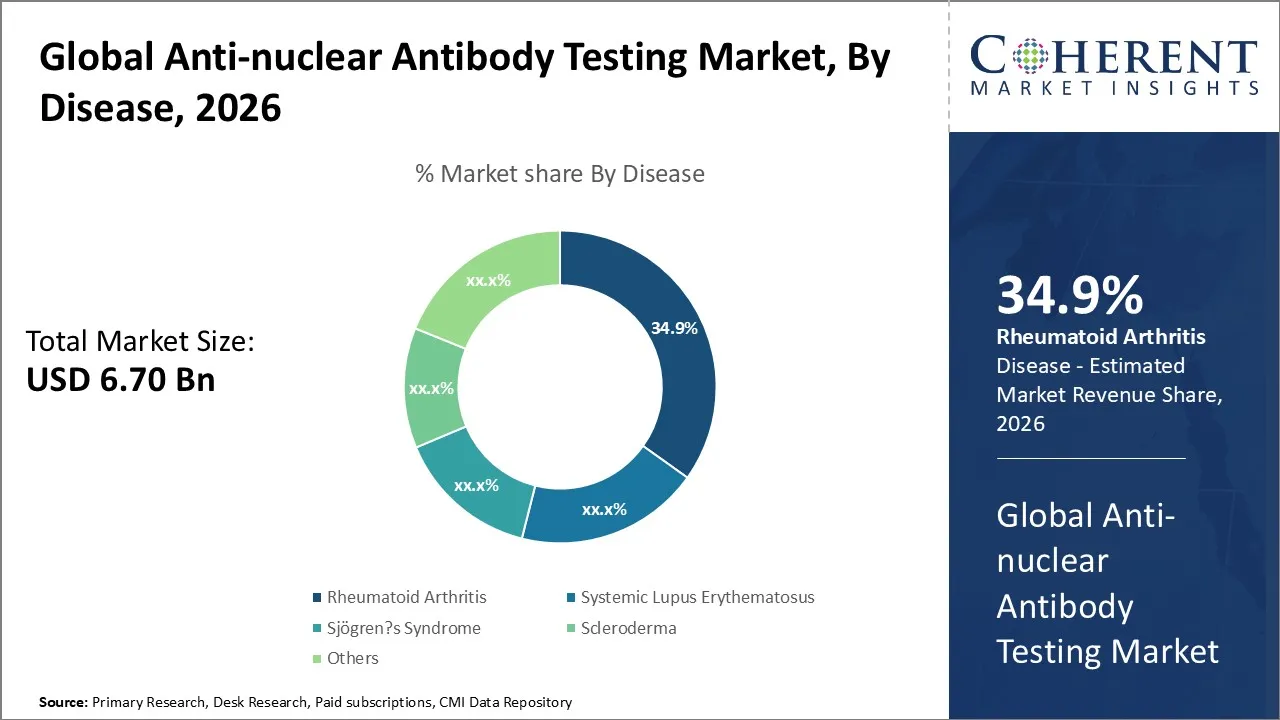
- By Disease, Rheumatoid Arthritis expected to hold largest market share of 33.6% in 2026 owing to its high and growing prevalence of rheumatoid arthritis.
- By Technique, Multiplex Assay acquired the prominent market share of 37.7% in 2026 owing to the simultaneous detection of multiple autoantibodies.
- By End User, Hospital and clinics hold the largest market share of 33.3% in 2026 owing to the high patient volume & clinical need for autoimmune diagnosis.
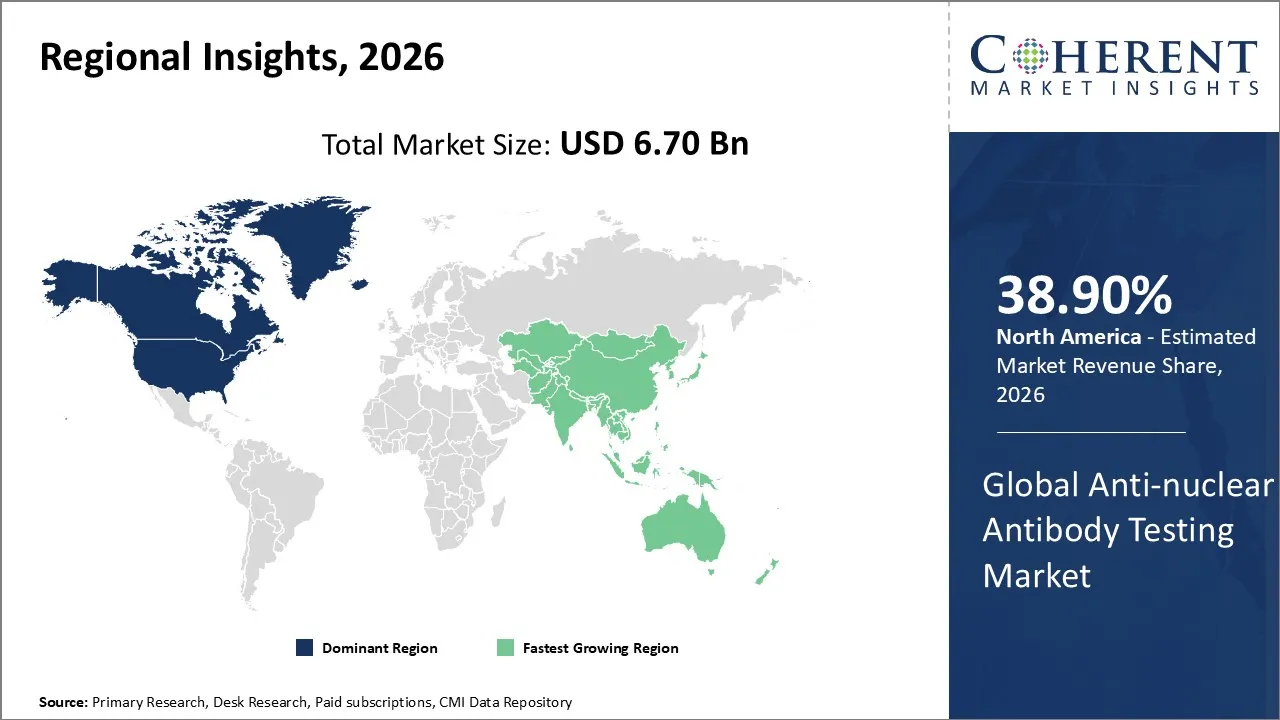
- By Region, North America dominates the overall market with an estimated share of 38.9% in 2026 high prevalence of autoimmune diseases.
Market Overview
The Anti‑nuclear Antibody (ANA) Testing Market is rapidly evolving as the in vitro diagnostics industry responds to the rising prevalence of autoimmune diseases such as lupus, rheumatoid arthritis, and Sjögren’s syndrome. Healthcare providers are increasingly aware of the importance of early diagnosis, while laboratories and hospitals adopt advanced assay technologies, including multiplex and automated platforms, to meet growing demand. Manufacturers supply reagents and assay kits as the primary consumables, with North America and Europe driving the market through well-established healthcare systems and widespread use of advanced testing methods.
Current Events and Its Impact on the Anti-nuclear Antibody Testing Market
Current Events | Description and its impact |
Geopolitical Developments in Healthcare Regulations |
|
Technological Innovations and Integration of AI in Diagnostics |
|
Macroeconomic Factors Influencing Healthcare Spending |
|
Segmental Insights
- Current Industry Events of 2026
- Market Size Estimation
- Regional Breakdown
- Competitive Landscape
- Customer Intelligence
- Segmental Analysis
- Pricing Analysis
- Key Market Drivers, Challenges & Future Trends
- Customized Insights Section
Anti-nuclear Antibody Testing Market Insights, By Disease - Rheumatoid Arthritis contribute the highest share of the market owing to its overlap with other autoimmune conditions
Rheumatoid Arthritis expected to hold largest market share of 34.6% in 2026. Rheumatoid arthritis drives the Anti‑nuclear Antibody (ANA) Testing Market as clinicians rely on ANA tests to diagnose and monitor disease progression. Because RA patients often exhibit overlapping autoimmune symptoms, healthcare providers perform broader antibody screenings to differentiate it from conditions like lupus and Sjögren’s syndrome. Emphasizing early detection and personalized treatment, hospitals and laboratories conduct regular testing, while advanced assay technologies deliver faster and more accurate results, reinforcing the widespread adoption of ANA tests in managing rheumatoid arthritis. For instance, in July 2025, Agilus Diagnostics, in partnership with Sebia, has launched the anti-MCV antibody test in India to support early rheumatoid arthritis diagnosis, especially in patients negative for anti-CCP and rheumatoid factor.
Anti-nuclear Antibody Testing Market Insights, By Product Type - Reagents & Assay Kits contribute the highest share of the market owing to its laboratory automation and standardization
Reagents & Assay Kits hold the largest market share of 24.3% in 2026. Reagents and assay kits drive the Anti‑nuclear Antibody (ANA) Testing Market as laboratories and hospitals depend on these consumables for accurate and efficient autoimmune disease diagnostics. Clinics use ready-to-use kits and high-quality reagents to test conditions like lupus and rheumatoid arthritis effectively. Advances in multiplex assays and automated platforms improve test reliability and streamline workflows, while the continuous demand for consumables in routine screening and patient monitoring sustains steady growth throughout clinical and diagnostic environments. For instance, in November 2024, Becton, Dickinson, and Company (BD) announced the commercial launch of the BD OMICS-One XT WTA Assay, its first robotics-compatible, high-throughput reagent kit.
Anti-nuclear Antibody Testing Market Insights, By Technique - Multiplex Assay contribute the highest share of the market owing to its higher throughput and workflow efficiency
Multiplex Assay acquired the prominent market share of 37.7% in 2026. Multiplex assays drive growth in the Anti‑nuclear Antibody (ANA) Testing Market by allowing laboratories to detect multiple autoantibodies from a single sample, saving time and resources. Hospitals and clinics adopt these assays to streamline workflows, minimize sample requirements, and enhance diagnostic accuracy for complex autoimmune diseases. By integrating with automated, high-throughput platforms, labs boost efficiency, while clinicians use the comprehensive results to make faster, informed decisions. The combination of speed, accuracy, and convenience is increasing the preference for multiplex assays in ANA testing. For instance, in July 2025, Leica Biosystems unveiled ChromoPlex III Triple Detection RUO, a chromogenic multiplex immunohistochemistry system designed to simplify assay setup and minimize variability.
Regional Insights
North America Anti-nuclear Antibody Testing Market Trends
North America dominates the overall market with an estimated share of 38.90% in 2026. North America drives the Anti‑nuclear Antibody (ANA) Testing Market through its advanced healthcare infrastructure and strong adoption of innovative diagnostic technologies. Hospitals and reference laboratories implement automated and multiplex platforms to increase testing speed and accuracy. Clinicians’ growing awareness of autoimmune diseases, along with well-established reimbursement systems, encourages routine ANA screening. Major diagnostic companies and ongoing research initiatives continuously develop new products, shaping market trends that focus on efficiency, accuracy, and broader access to ANA testing throughout the region. For instance, Organon & Co. and Samsung Bioepis have launched HADLIMA™ (adalimumab-bwwd), a Humira biosimilar, in the U.S., offering both high- and low-concentration options for seamless patient care.
Asia Pacific Anti-nuclear Antibody Testing Market Trends
The Asia Pacific region is expanding the Anti‑nuclear Antibody (ANA) Testing Market by improving healthcare infrastructure and increasing awareness of autoimmune diseases. Hospitals and diagnostic laboratories adopt modern assay technologies, including automated and multiplex platforms, to boost testing efficiency and accuracy. Governments implement initiatives, rising healthcare spending supports advanced diagnostics, and greater access encourages routine ANA screening. Local manufacturers and international collaborations increase product availability, actively driving the region toward more comprehensive and timely autoimmune testing. In July 2025, Agilus Diagnostics, with Sebia, launched the Anti-MCV antibody test in India to improve early rheumatoid arthritis detection, particularly in patients negative for anti-CCP and rheumatoid factor.
United States Anti-nuclear Antibody Testing Market Trends
The United States drives the Anti‑nuclear Antibody (ANA) Testing Market through its well-established healthcare system and widespread use of advanced diagnostic technologies. Hospitals and clinical laboratories adopt automated and multiplex platforms to improve testing accuracy and reduce turnaround times. Physicians’ growing awareness of autoimmune diseases, supported by insurance coverage and reimbursement policies, encourages routine ANA screening. Leading diagnostic companies conduct active research and development, introducing innovative tests, expanding availability, and reinforcing the country’s role as a central hub for comprehensive autoimmune diagnostics.
China Anti-nuclear Antibody Testing Market Trends
China is actively expanding the Anti‑nuclear Antibody (ANA) Testing Market by modernizing healthcare infrastructure and increasing awareness of autoimmune diseases. Hospitals and diagnostic laboratories adopt automated and multiplex assay technologies to boost testing speed, accuracy, and efficiency. Government initiatives and rising healthcare investment broaden access to diagnostic services, encouraging routine ANA screening. Local manufacturers collaborate with international diagnostic companies to increase product availability and drive innovation, positioning the country to deliver more comprehensive, timely, and reliable autoimmune disease diagnostics across both urban and emerging areas.
End-user Feedback and Unmet Needs in the Anti-nuclear Antibody Testing Market
- Demand for Faster and More Accurate Results: Clinicians and laboratories report the need for quicker ANA test results without compromising accuracy. Traditional methods like indirect immunofluorescence are time-consuming and labor-intensive. End users seek automated or multiplex platforms that reduce turnaround time, minimize manual errors, and deliver reliable results to support timely diagnosis and treatment decisions.
- Standardization Across Laboratories: End users express concern over inconsistent results across different labs due to varying assay protocols and interpretation methods. There is a growing demand for standardized reagents, kits, and reporting systems that provide reproducible and comparable results, ensuring better confidence in clinical decisions and reducing diagnostic variability in autoimmune disease testing.
- Broader Autoantibody Coverage in Panels: Healthcare providers often encounter patients with complex autoimmune profiles requiring multiple antibody screenings. End users indicate the need for expanded ANA test panels capable of detecting a wider range of autoantibodies in a single assay. This would reduce repeated sampling, lower costs, and enhance comprehensive autoimmune diagnostics.
Anti-nuclear Antibody Testing Market Trend
Shift Towards Multiplex and High-Throughput Assays
The ANA testing market is moving toward multiplex and high-throughput platforms, allowing simultaneous detection of multiple autoantibodies from a single sample. Laboratories adopt these technologies to increase efficiency, reduce sample volume, and minimize turnaround times. Clinicians benefit from comprehensive profiles that support accurate diagnosis of complex autoimmune disorders. This trend reflects the growing demand for faster, reliable, and integrated testing solutions that streamline workflows while providing detailed immunological insights for personalized patient care.
Adoption of Automated and Digital Platforms
Automation and digital integration are reshaping ANA testing practices. Laboratories implement automated immunoassay analyzers and AI-assisted interpretation tools to enhance precision and reduce human error. Digital platforms facilitate result management, data tracking, and integration with hospital information systems. This trend addresses clinician and technician demands for faster, reproducible, and standardized results, supporting efficient workflow management and consistent clinical decision-making across hospitals, reference laboratories, and specialized diagnostic centers.
Anti-nuclear Antibody Testing Market Opportunity
Integration with Automated and Digital Platforms
There is a strong opportunity to integrate ANA testing with automated analyzers and digital reporting systems. This allows laboratories to streamline workflows, reduce manual errors, and provide clinicians with faster, more reliable results. Manufacturers can develop assay kits compatible with high-throughput and AI-assisted platforms, catering to hospitals and large diagnostic networks seeking standardized, scalable, and technologically advanced testing solutions, reinforcing efficiency and clinical accuracy.
Market Report Scope
Anti-nuclear Antibody Testing Market Report Coverage
| Report Coverage | Details | ||
|---|---|---|---|
| Base Year: | 2025 | Market Size in 2026: | USD 6.70 Bn |
| Historical Data for: | 2020 To 2024 | Forecast Period: | 2026 To 2033 |
| Forecast Period 2026 to 2033 CAGR: | 14.2% | 2033 Value Projection: | USD 9.2 Bn |
| Geographies covered: |
| ||
| Segments covered: |
| ||
| Companies covered: | F. Hoffmann-La Roche Ltd., ERBA Diagnostics, Zeus Scientific, Inc., Alere Inc., Bio-Rad Laboratories, Inc., Becton Dickinson and Company, Antibodies, Inc., EUROIMMUN AG, Immuno Concepts, Inova Diagnostics, Thermo Fisher Scientific, Inc., and Trinity Biotech plc. | ||
| Growth Drivers: |
| ||
| Restraints & Challenges: |
| ||
Anti-nuclear Antibody Testing Market News
- In November 2025, LifeLabs Ontario announced to transition to a fully automated indirect immunofluorescence platform for Anti-Nuclear Antibody (ANA) testing, as part of ongoing initiatives to enhance service quality.
Analyst Opinion (Expert Opinion)
- The current trajectory of the Anti‑nuclear Antibody (ANA) Testing market reflects a structural evolution from a largely manual, specialized diagnostic niche into a more automated, integrated pillar of autoimmune disease diagnostics. This transition is not merely incremental; multiple independent analyses underscore a substantive shift towards high‑throughput multiplex platforms, AI‑augmented interpretation tools, and reflex testing workflows that improve diagnostic precision and reduce subjective variability — a swing away from the historically labor‑intensive immunofluorescence assays that dominated clinical practice.
- From a clinical perspective, ANA testing is increasingly entrenched in routine autoimmune panels rather than a second‑line confirmatory test. Its application in conditions such as systemic lupus erythematosus, rheumatoid arthritis, and Sjögren’s syndrome continues to expand, largely because early detection has demonstrable impacts on therapeutic decisions and patient management. Adoption is further amplified by educational campaigns and rising clinician awareness, particularly in regions where autoimmune disease diagnosis historically lagged.
- However, structural impediments remain. The requirement for skilled personnel in traditional IFA interpretation persists as a bottleneck in both developed and emerging markets, even as AI‑assisted tools aim to mitigate this constraint. Additionally, fragmented regulatory environments and the need for globally consistent performance standards continue to temper uniform adoption. The reality is that advances in diagnostic technology are outpacing harmonized clinical implementation, a gap that may constrain near‑term standardization despite clear performance benefits.
- On a macro level, the broadening use of ANA testing as both a screening and monitoring tool signals maturation of the segment. It is no longer confined to specialist centers; instead, it is becoming a mainstay in hospital labs, reference centers, and integrated care pathways. This shift reflects a deeper clinical understanding of autoimmunity’s prevalence and complexity during disease progression, reinforcing the notion that ANA testing is transitioning from a niche assay to a central component in autoimmune disease management frameworks.
Speak to the analyst
Want personalized insights?
Take the findings above to one of our principal consultants, or have the report rebuilt around the segments, geographies and competitors you actually track.
Market Segmentation
- By Product
- Reagents & Assay Kits
- Systems & Software
- Services
- By Disease
- Rheumatoid Arthritis
- Systemic Lupus Erythematosus
- Sjögren’s Syndrome
- Scleroderma
- Other Diseases
- By Technique
- ELISA
- Multiplex Assay
- Immunofluorescence Assay
- By End Users
- Hospitals and Clinics
- Diagnostic Laboratories
- Others
- By Regional Insights
- North America
- U.S.
- Canada
- Latin America
- Brazil
- Argentina
- Mexico
- Rest of Latin America
- Europe
- Germany
- U.K.
- Spain
- France
- Italy
- Russia
- Rest of Europe
- Asia Pacific
- China
- India
- Japan
- Australia
- South Korea
- ASEAN
- Rest of Asia Pacific
- Middle East
- GCC Countries
- Israel
- Rest of Middle East
- Africa
- South Africa
- North Africa
- Central Africa
- North America
- Key Players Insights
- Hoffmann-La Roche Ltd.
- ERBA Diagnostics
- Zeus Scientific, Inc.
- Alere Inc.
- Bio-Rad Laboratories, Inc.
- Becton Dickinson and Company
- Antibodies, Inc.
- EUROIMMUN AG
- Immuno Concepts
- Inova Diagnostics
- Thermo Fisher Scientific, Inc.
- Trinity Biotech plc.
Sources
Primary Research interviews
- Pathologists and clinical laboratory directors
- Immunologists and rheumatologists
- Laboratory technicians specializing in autoimmune testing
- Hospital laboratory procurement managers
- Representatives from diagnostic kit manufacturers
Databases:
- PubMed
- Scopus
- Web of Science
- ClinicalTrials.gov
- WHO Global Health Observatory
Magazines
- The Scientist
- Laboratory Equipment
- MedTech Outlook
- Autoimmunity News
Journals
- Journal of Autoimmunity
- Clinical and Experimental Rheumatology
- Lupus
- Autoimmunity Reviews
- Arthritis & Rheumatology
Newspapers
- The New York Times – Health Section
- The Guardian – Science Section
- Washington Post – Health & Science
Associations
- American College of Rheumatology (ACR)
- European League Against Rheumatism (EULAR)
- Autoimmune Diseases Association
- Clinical Laboratory Management Association (CLMA)
Public Domain sources
- U.S. Food and Drug Administration (FDA) databases
- Centers for Disease Control and Prevention (CDC) reports
- National Institutes of Health (NIH) publications
- World Health Organization (WHO) reports
Proprietary Elements
- CMI Data Analytics Tool
- Proprietary CMI Existing Repository of information for last 8 years
Get access to 250+ pages report
Every segment, forecast, competitor profile and data table behind the analysis above — available for instant download.
- ESOMAR Member
- ISO 9001:2015 Certified
- D-U-N-S Registered
- GDPR & CCPA Compliant
Missing comfort of reading report in your local language? Find your preferred language:
Transform your Strategy with Exclusive Trending Reports
Frequently Asked Questions
The Anti-nuclear Antibody Testing Market is estimated to be valued at USD 6.70 Bn in 2026 and is expected to reach USD 9.2 Bn by 2033.
The CAGR of the Anti-nuclear Antibody Testing Market is projected to be 14.2% from 2026 to 2033.
The market is increasingly shifting toward automated, high-throughput platforms and AI-assisted interpretation, which reduce manual variability in immunofluorescence assays.
Key challenges include the need for skilled personnel for traditional IFA interpretation, fragmented regulatory standards, and the high cost of automated platforms.
Automation and AI are expected to reshape workflow efficiency and interpretive accuracy.