

Optometry Equipment Market Size and Trends - 2026 to 2033
The Optometry Equipment Market is estimated to be valued at USD 5.17 Bn in 2026 and is expected to reach USD 7.92 Bn by 2033, growing at a compound annual growth rate (CAGR) of 6.3% from 2026 to 2033.
Key Takeaways
- Based on Product Type, the OCT Scanners segment is expected to lead the market with 27.10% share in 2026, driven by demand for high‑resolution, non‑invasive imaging and increasing prevalence of retinal and glaucoma conditions.
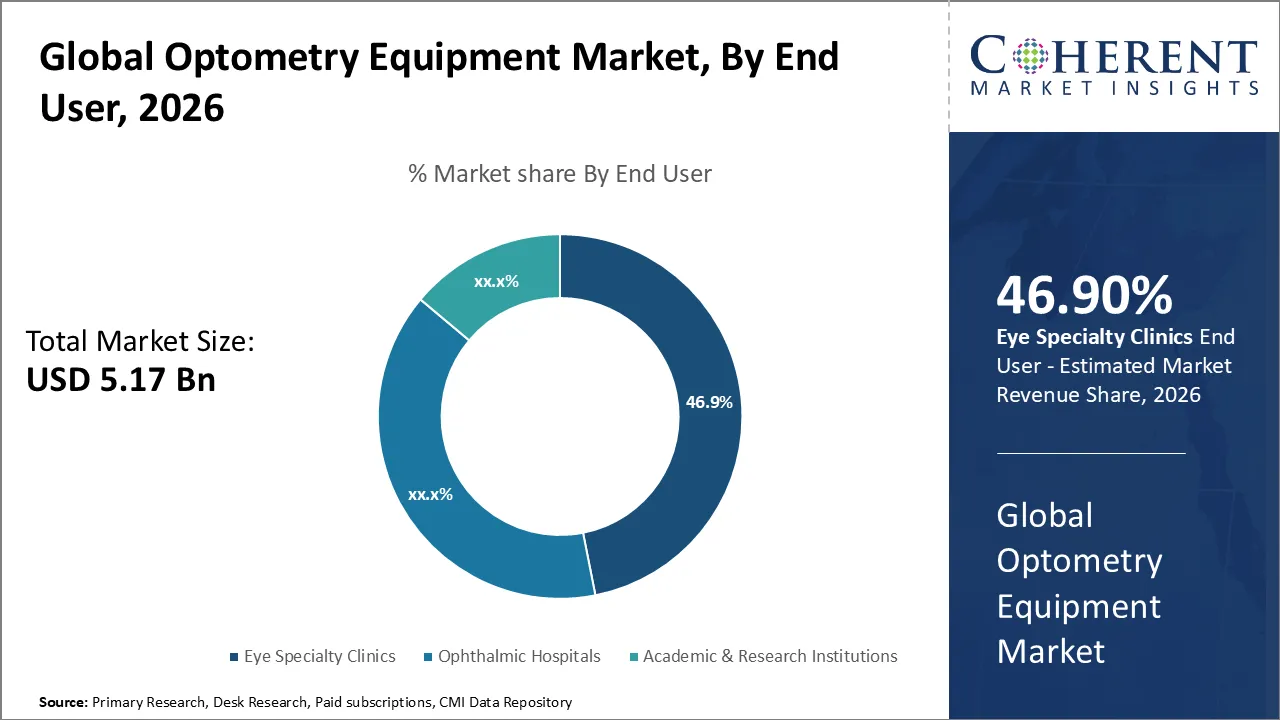
- Based on End User, the Eye Specialty Clinics segment is expected to lead the market with 46.90% share in 2026, driven by broader adoption of diagnostics and patient preference for specialized care centers.
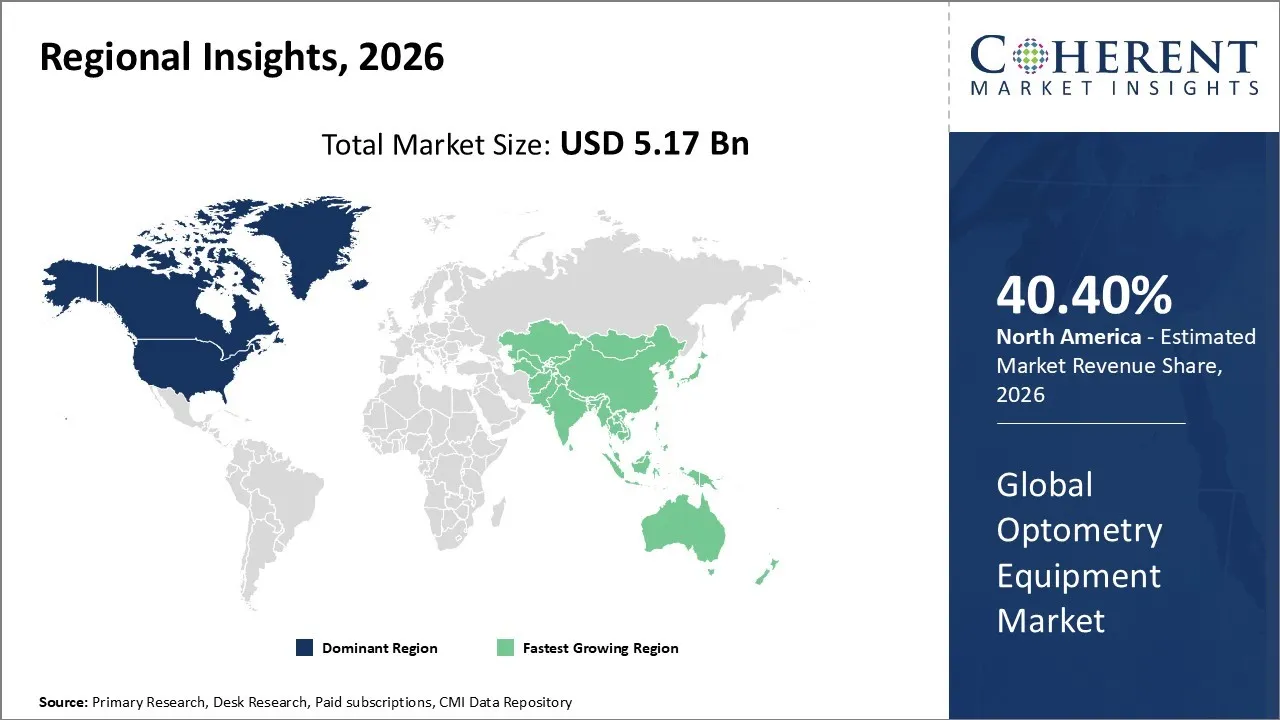
- Based on Region, North America is set to lead the market with 40.40% share in 2026. While, Asia Pacific is anticipated to be the fastest growing region.
Market Overview
The optometry equipment market is advancing significantly with the rising applications in advanced imaging and personalized vision care. Moreover, expanding geriatric populations, increasing prevalence of chronic eye diseases, and tightening regulatory standards are expected to drive market growth over the forecast period.
Refractive errors and retinal disorders are the primary conditions requiring precise diagnostic intervention. Comprehensive eye examinations are a standard analytical necessity in clinical, hospital, and retail optical settings. Optometry devices are used for both qualitative and quantitative analysis of ocular health, which helps accurately characterize conditions such as glaucoma, cataracts, and diabetic retinopathy.
The optometry equipment industry is currently experiencing a revolutionary era, driven by several advancing technological factors, the adoption of sophisticated AI-driven detection systems, and high demand for specific biochemical analyses in various settings, including specialized eye clinics, public hospitals, and teleoptometry platforms. These developments have spread the capabilities of diagnostic and surgical instruments and enhanced their efficiency and sensitivity, as well as automation, marking a transformative phase in the market. The top firms like Carl Zeiss Meditec and Alcon are currently redefining the standards of precision through the integration of digital health ecosystems and 3D imaging.
Current Events and Its Impacts on the Optometry Equipment Market
Current Event | Description and the Impact |
Technological Advancements in Vision Care |
|
Demographic and Public Health Trends |
|
Geopolitical and Market Expansion Factors |
|
Segmental Insights
- Current Industry Events of 2026
- Market Size Estimation
- Regional Breakdown
- Competitive Landscape
- Customer Intelligence
- Segmental Analysis
- Pricing Analysis
- Key Market Drivers, Challenges & Future Trends
- Customized Insights Section
Optometry Equipment Market Insights, By Product Type – OCT Scanners Leads Due to Increasing Prevalence of Retinal and Glaucoma Conditions
In terms of product type, the OCT scanners segment is projected to account for the largest share of 27.10% of the market in 2026. The growth is owing to the increasing worldwide prevalence of chronic ocular diseases like glaucoma, diabetic retinopathy, and macular degeneration (AMD). OCT technology employs light waves to capture cross-sectional images of the retina, thereby enabling practitioners to visualize individual tissue layers with micron-level precision.
The incorporation of Artificial Intelligence (AI) and automated analytics is also constituting to the segment's growth. The modern scanners from leading firms like Topcon Healthcare and Heidelberg Engineering are now equipped with software capable of automatically detecting fluid, measuring thickness, and comparing scans against extensive normative databases. This functionality reduces chair time and minimizes human error, rendering these devices essential in high-volume clinical environments.
For instance, in February 2026, BOC Instruments unveiled a novel optical coherence tomography (OCT) system named the AutoFusion. This innovative device integrates OCT imaging with a fundus camera into a single unit.
Optometry Equipment Market Insights By, End User – Eye Specialty Clinics Leads Due to Patient Preference for Specialized Care Centers
In terms of end user, the eye specialty clinics segment contributes the highest share of 46.90% in 2026 of the market. The growth is owing to the increasing complexity of ophthalmic procedures and the global move toward specialized outpatient care. As patient volumes for chronic conditions like glaucoma, cataracts, and diabetic retinopathy continue to rise, these clinics offer a more focused and efficient alternative to traditional large-scale hospitals. Specialty clinics have the capability to treat a larger number of patients and make better use of costly technology like Optical Coherence Tomography (OCT) scanners and advanced laser systems. These technologies may not be fully utilized in general hospitals, as specialty clinics concentrate solely on vision care.
A trend toward private equity investment and consolidation also fuels this segment's leadership. Independent practices are merging into large-scale specialty networks across major nations like the US and China. This consolidation provides the necessary capital to equip multiple exam lanes with synchronized, high-end diagnostic suites from manufacturers like Carl Zeiss Meditec and Alcon. In addition, patients prefer specialty clinics due to their perceived expertise, shorter wait times, and the availability of the latest non-invasive diagnostic tools.
Regional Insights
North America Optometry Equipment Market Analysis & Trends
North America has consistently been the leading region in the global optometry equipment market and holds a 40.40% share in 2026 throughout the forecast period. The growth is owing to a state-of-the-art healthcare system and the growing prevalence of age-related eye conditions like cataracts and glaucoma. The region is experiencing a technological transformation as traditional diagnostic tools are being replaced by AI-driven platforms. The cutting-edge imaging systems like Optical Coherence Tomography (OCT) allow for earlier and more accurate disease detection.
The market is mainly driven by the US, where high per-capita healthcare spending and favorable reimbursement policies through Medicare and private insurers are encouraging practitioners to invest in state-of-the-art automated refractors and tonometers. The rise of tele-optometry and cloud-based Electronic Health Record (EHR) systems is simplifying patient workflows and broadening access to specialized care in rural areas. The market continues to expand as manufacturers like Alcon and Johnson & Johnson Vision focus on developing connected diagnostic ecosystems.
For instance, in October 2025, VEO Ophthalmics partnered with PeriVision to introduce the VisionOne VR Visual Field platform in the US. This collaboration introduces PeriVision's patented AI visual field-testing algorithm (SORS) to clinicians in the US, with the company based in Switzerland.
Asia Pacific Optometry Equipment Market Analysis & Trends
The Asia Pacific optometry equipment market is the world’s fastest growing region. The growth is owing to a massive patient base and the rise of the myopia epidemic in East and Southeast Asia. The region is undergoing a rapid modernization of its healthcare infrastructure. The countries like China and India are spending in cutting-edge diagnostic tools like optical coherence tomography (OCT) and automated refractometers. Their goal is to address surging rates of diabetic retinopathy and age-related macular degeneration. The market benefits from a unique dual-dynamic.
The global firms like Nidek and Topcon provide high-end imaging systems for urban specialty hospitals. The local manufacturers are developing cost-effective, portable devices tailored for rural screening programs. In addition, the integration of AI-enabled retinal screening and tele-ophthalmology is becoming crucial for increasing access to eye care in remote geographical areas.
Optometry Equipment Market Outlook Country-Wise
The US Optometry Equipment Market Trends
The US leads the market owing to an aging population and a rising prevalence of chronic conditions like glaucoma and macular degeneration. The country has a strong healthcare infrastructure characterized by high per-capita expenditures and well-established reimbursement systems. This enables practitioners to swiftly adopt cutting-edge and high-cost technologies. A defining trend is the digitalization of the exam lane, where practices are shifting toward integrated, AI-enhanced diagnostic suites and Optical Coherence Tomography (OCT) as the standard of care. This evolution is also supported by a move toward Ambulatory Surgical Centers (ASCs) and large-scale corporate vision chains, which possess the capital to invest in premium equipment from leaders like Johnson & Johnson Vision and Bausch + Lomb. In addition, the surge in Tele-optometry and cloud-based Electronic Health Record (EHR) systems is reshaping how care is delivered. This ensures that despite high equipment costs, the US remains at the forefront of non-invasive diagnostic innovation and predictive vision analytics.
For instance, in February 2025, Alcon introduced the Voyager DSLT, the first and only Direct Selective Laser Trabeculoplasty device (DSLT), in the US. The Voyager DSLT is strategically positioned to enhance the adoption of laser treatment as a first-line therapy, thereby increasing its accessibility for a larger number of patients.
China Optometry Equipment Market Trends
China is rapidly emerging as the fastest-growing market for Optometry Equipment. This growth is owing to the highest prevalence of juvenile myopia and a fast-aging population. This massive patient base has made China a critical hub for advanced diagnostic technologies, with demand specifically increasing for Optical Coherence Tomography (OCT) scanners and automated refractors.
The market is currently undergoing a structural transformation under the Healthy China 2030 initiative, which has stimulated massive government procurement of ophthalmic devices for public health centers and intensified the focus on early disease screening. While premium segments are still influenced by global leaders like Carl Zeiss Meditec and Topcon, there is a significant trend toward import substitution, where local innovators such as Eyebright Medical are gaining substantial market share in the mid-range diagnostic sector. Furthermore, the integration of AI-driven retinal imaging is becoming a cornerstone of the market, allowing the country to overcome a shortage of specialized ophthalmologists by providing automated diagnostics in expanding private eye-care chains across Tier-II and Tier-III cities.
Market Report Scope
Optometry Equipment Market Report Coverage
| Report Coverage | Details | ||
|---|---|---|---|
| Base Year: | 2025 | Market Size in 2026: | USD 5.17 Bn |
| Historical Data for: | 2020 To 2024 | Forecast Period: | 2026 To 2033 |
| Forecast Period 2026 to 2033 CAGR: | 6.3% | 2033 Value Projection: | USD 7.92 Bn |
| Geographies covered: |
| ||
| Segments covered: |
| ||
| Companies covered: | Canon Inc., Carl Zeiss AG, Escalon Services, Inc., Essilor International S.A., Haag-Streit AG, Heidelberg Engineering GmbH, Heine Optotechnik GmbH & Co. KG, Luneau Technology Group, NIDEK CO., LTD., Novartis International AG, and Topcon Corporation | ||
| Growth Drivers: |
| ||
| Restraints & Challenges: |
| ||
Optometry Equipment Market Drivers
Rising incidence of age-related eye diseases
The optometry equipment market is experiencing growth owing to the increasing number of age-related eye diseases among the aging population worldwide. Chronic disorders such as cataracts, glaucoma, and age-related macular degeneration (AMD) are becoming more common as people live longer, increasing the need for regular and detailed eye check-ups. This trend is creating steady demand for better imaging and screening solutions like Optical Coherence Tomography (OCT) and digital fundus cameras, which support early detection and continuous monitoring that are important for protecting vision in older adults. In addition, the use of AI powered diagnostic tools and less invasive surgical systems is making clinical processes more efficient to handle the increasing number of patients. Therefore, healthcare providers are continuing to invest in accurate and reliable optometry equipment to meet the complex vision requirements of the elderly population, reinforcing its position as the key factor driving market expansion.
For instance, in October 2025, Y.ora Vision, Inc. has announced a licensing agreement with the Singapore Eye Research Institute (SERI) and Eyexora Global to develop a minimally invasive surgical device aimed at treating mild-to-severe open-angle glaucoma.
Analyst Opinion (Expert Opinion)
The Optometry Equipment Market is experiencing steady growth driven by increasing demand for advanced diagnostic and vision assessment technologies across clinical and retail settings. Industry reports indicate consistent expansion in equipment utilization, supported by demographic trends and technological advancements. Globally, billions of individuals live with vision impairment or related disorders, creating substantial demand for devices used in routine examinations and specialized diagnostics.
Key product segments include optical coherence tomography (OCT) systems, fundus imaging devices, autorefractors, and slit lamps, which together account for the majority of clinical adoption. These instruments are critical in detecting conditions such as glaucoma, diabetic retinopathy, and age-related macular degeneration, making them essential in both hospitals and private practices.
Regionally, North America dominates in terms of adoption due to advanced healthcare infrastructure, high awareness, and widespread clinical utilization, while Asia-Pacific is emerging rapidly owing to expanding healthcare access, rising middle-class spending, and increasing investments in modern eye care technology.
Innovation remains a primary growth driver, with AI-assisted imaging, portable diagnostic solutions, and integrated data workflows enhancing both accuracy and efficiency. The market is also shaped by rising demand from tele-optometry services and multi-specialty eye care clinics, which continue to broaden access. Collectively, these factors indicate a sustained, data-supported growth trajectory for the optometry equipment sector.
Speak to the analyst
Want personalized insights?
Take the findings above to one of our principal consultants, or have the report rebuilt around the segments, geographies and competitors you actually track.
Optometry Equipment Industry News
- In September 2025, OpZira™, Inc. introduced OpZira, which is committed to providing innovative technologies aimed at improving the detection and monitoring of ocular disease. This initiative empowers clinicians by providing them with cutting-edge diagnostic tools.
- In September 2025, PPG has introduced its PPG HI-GARD® Non-Methanol hard coating, specifically designed for 1.5 standard index ophthalmic lenses. This innovative formula serves as a direct replacement for traditional methanol-based coatings, enabling prescription lens manufacturers to comply with new regulations regarding methanol use while maintaining the necessary durability.
- In July 2025, Bühler India has introduced its new Compact Coating System (CCS). This innovative system is specifically engineered for applying anti-reflective (AR) coatings to ophthalmic lenses.
- In May 2025, Lumenis has introduced a new device called OptiLIFT. This device is designed to tone the muscles around the eyes to address issues such as lower eyelid laxity and impaired blinking.
Market Segmentation
- Product Type Insights (Revenue, USD Bn, 2026 - 2033)
- Retinoscopes
- OCT Scanners
- Corneal Topography Systems
- Visual Field Analyzers
- Ophthalmic Ultrasound Systems
- Fundus Cameras
- Autorefractors and Keratometers
- Ophthalmoscopes
- Optical Biometry Systems
- Specular Microscopes
- Wavefront Aberrometers
- Other Equipment Types
- Accessories
- End User Insights (Revenue, USD Bn, 2026 - 2033)
- Eye Specialty Clinics
- Ophthalmic Hospitals
- Academic and Research Institutions
- Regional Insights (Revenue, USD Bn, 2026 - 2033)
- North America
- U.S.
- Canada
- Latin America
- Brazil
- Argentina
- Mexico
- Rest of Latin America
- Europe
- Germany
- U.K.
- France
- Italy
- Russia
- Rest of Europe
- Asia Pacific
- China
- India
- Japan
- Australia
- South Korea
- ASEAN
- Rest of Asia Pacific
- Middle East
- GCC
- Israel
- Rest of Middle East
- Africa
- North Africa
- Central Africa
- South Africa
- Key Players Insights
- Canon Inc.
- Carl Zeiss AG
- Escalon Services, Inc.
- Essilor International S.A.
- Haag-Streit AG
- Heidelberg Engineering GmbH
- Heine Optotechnik GmbH & Co. KG
- Luneau Technology Group
- NIDEK CO., LTD.
- Novartis International AG
- Topcon Corporation
Sources
Primary Research Interviews
- Optometry Equipment Manufacturers
- Eye Care Clinics & Hospitals
- Ophthalmologists & Optometrists
- Optical Lab Equipment Providers
- Vision Care Technology Consultants
- Others
Databases
- Bloomberg Terminal
- Thomson Reuters Eikon
- Others
Magazines
- Optometry Times
- Review of Optometry
- Ophthalmology Times
- Vision Monday
- Optician Magazine
- Others
Journals
- Journal of Optometry
- Ophthalmic & Physiological Optics
- Investigative Ophthalmology & Visual Science
- Clinical & Experimental Optometry
- Journal of Ophthalmology
- Others
Newspapers
- Financial Times
- The Wall Street Journal
- Reuters
- Bloomberg News
- Others
Associations
- American Optometric Association (AOA)
- World Council of Optometry (WCO)
- International Council of Ophthalmology (ICO)
- European Society of Ophthalmology (SOE)
- Others
Public Domain Sources
- U.S. National Eye Institute (NEI)
- World Health Organization (WHO) – Vision & Eye Health
- European Commission – Health & Consumer Directorate
- World Bank Open Data
- National Institutes of Health (NIH)
- Others
Proprietary Elements
- CMI Data Analytics Tool
- Proprietary CMI Existing Repository of Information for the Last 8 Years
Definition: The Optometry Equipment Market refers to the specialized global sector focused on the design, production, and sale of medical tools used to evaluate and manage eye health. The market includes a diverse range of equipment, such as diagnostic tools like phoropters and slit lamps, as well as cutting-edge imaging systems like Optical Coherence Tomography (OCT) scanners. The industry is driven by the increasing global prevalence of vision issues like myopia and age-related macular degeneration. In addition, the incorporation of digital health technologi9es and automated screening tools is rapidly transforming the landscape. The market plays a critical role in the early detection and treatment of eye diseases, thereby ultimately improving long-term patient vision outcomes.
Get access to 250+ pages report
Every segment, forecast, competitor profile and data table behind the analysis above — available for instant download.
- ESOMAR Member
- ISO 9001:2015 Certified
- D-U-N-S Registered
- GDPR & CCPA Compliant
Missing comfort of reading report in your local language? Find your preferred language:
Transform your Strategy with Exclusive Trending Reports
Frequently Asked Questions
The Optometry Equipment Market is estimated to be valued at USD 5.17 Bn in 2026, and is expected to reach USD 7.92 Bn by 2033.
The CAGR of the Optometry Equipment Market is projected to be 6.3% from 2026 to 2033.
Factors such as increasing incidences of eye disease and vision loss have led to introduction of new technologies and rising prevalence of eye disease are some of the major factors that are driving the growth of the Optometry Equipment Market.
The high cost of optometry equipment products is one of the major factors that are hampering the growth of the Optometry Equipment Market.
In terms of product type, the OCT scanners segment is estimated t dominate the market revenue share in 2026.
Canon Inc., Carl Zeiss AG, Escalon Services, Inc., Essilor International S.A., Haag-Streit AG, Heidelberg Engineering GmbH, Heine Optotechnik GmbH & Co. KG, Luneau Technology Group, NIDEK CO., LTD., Novartis International AG, and Topcon Corporation are the major players.
North America is expected to lead the Optometry Equipment Market in 2026.