

Polyimide Films Market Analysis & Forecast: 2026-2033
Polyimide Films Market is estimated to be valued at USD 1,713.70 Bn in 2026 and is expected to reach USD 2,769.88 Bn in 2033, exhibiting a compound annual growth rate (CAGR) of 7.1% from 2026 to 2033.
Key Takeaways
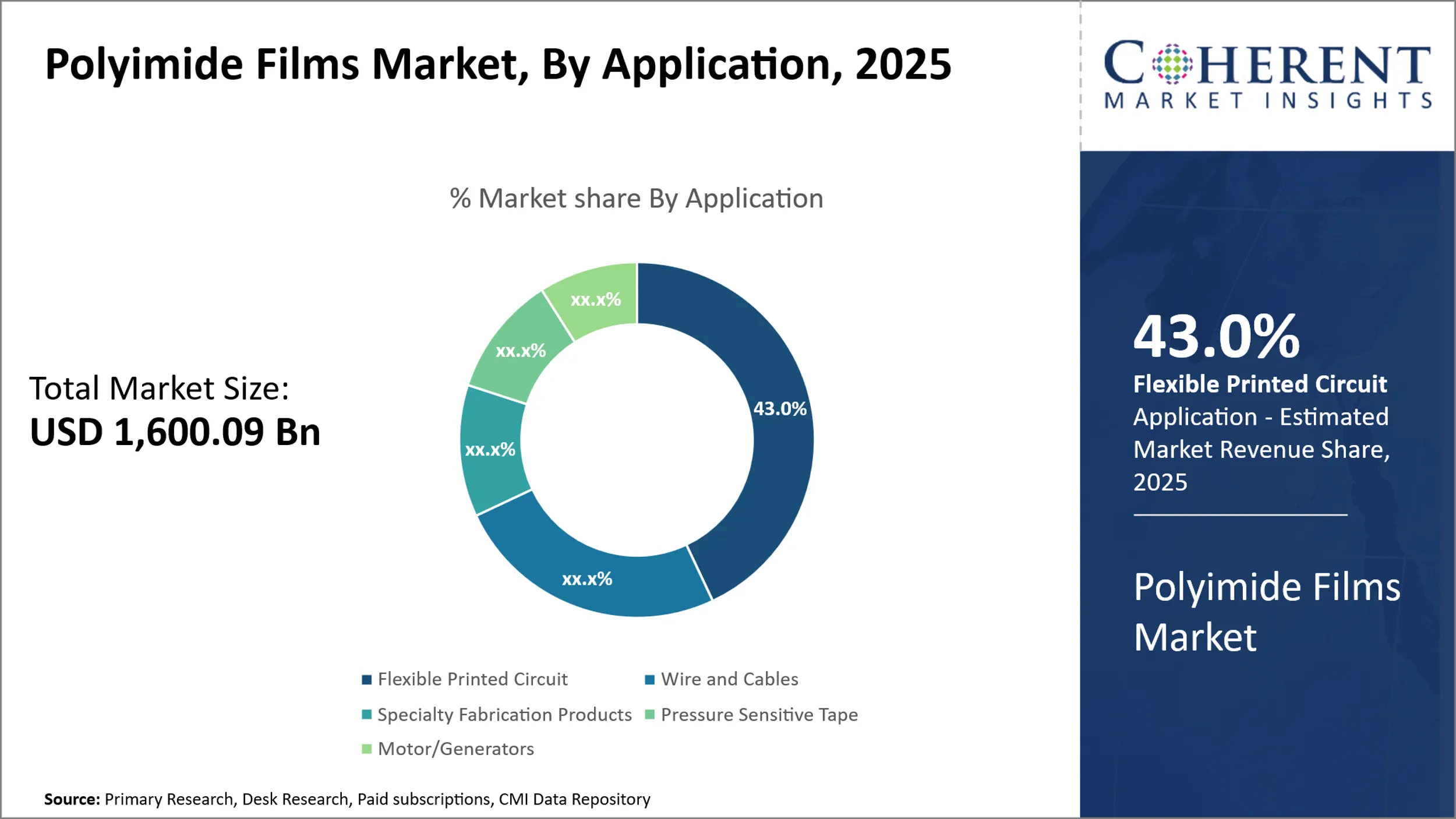
- By Application, the Flexible Printed Circuit (FPC) segment is projected to dominate the global polyimide films market in 2026, accounting for the largest value share of 44%.
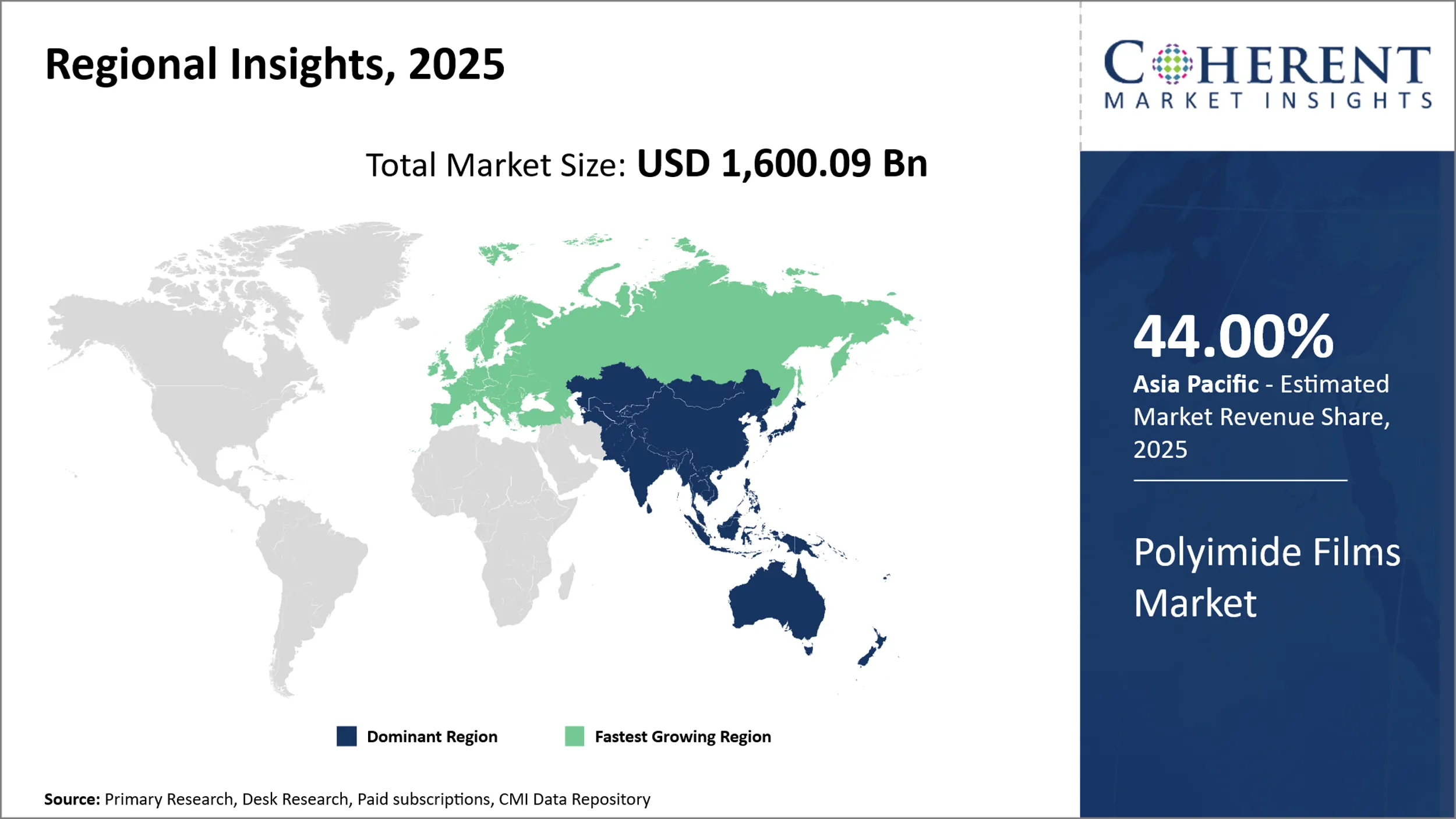
- By Region, Asia Pacific is anticipated to lead the global polyimide films market in 2026, holding an estimated 44% share of total market.
Market Overview
The growth of polyimide films market stems from their peripherals uses in the electronics industry with flexible screens, smartphones, and smart wearables. Polyimide films possess exceptional thermal stability and electrical insulation, making them indispensable in advanced electronics. For example, in 2023, DuPont expanded the production of Kapton® polyimide films to serve flexible printed circuit board fabricators in Asia. The polyimide films market is undoubtedly being stimulated by the surge of consumer electronics and 5G infrastructure.
Current Events and Its Impact on the Polyimide Films Market
Event | Description and Impact |
China-Taiwan Geopolitical Tensions and Semiconductor Supply Chain Disruptions |
|
Global Electric Vehicle Market Expansion and Battery Technology Advancement |
|
5G Infrastructure Rollout and Flexible Electronics Revolution |
|
Segmental Insights
- Current Industry Events of 2026
- Market Size Estimation
- Regional Breakdown
- Competitive Landscape
- Customer Intelligence
- Segmental Analysis
- Pricing Analysis
- Key Market Drivers, Challenges & Future Trends
- Customized Insights Section
Global Flexible Printed Circuit Market Insights, By Application
In terms of application, the flexible printed circuit (FPC) segment is poised to dominate the market by 2026, accounting for the largest value share of 44%. This dominance is driven by the increasing demand for compact, lightweight, and high-performance electronic components across various industries such as consumer electronics, automotive, and medical devices.
FPCs offer superior design flexibility, high reliability in complex circuit integration, and excellent heat dissipation, making them ideal for next-generation devices. Their ability to withstand dynamic flexing conditions also supports widespread adoption in wearable technology and foldable smartphones, sustaining robust market demand.
The wire and cable segment is also expected to witness steady growth, supported by the rising deployment of high-speed connectivity infrastructure and expanding use in telecommunications and data centers. The segment benefits from ongoing advancements in cable materials and design, which enhance durability and signal transmission efficiency.
Moreover, as industries transition toward automation and smart systems, wire and cable applications are evolving to support more sophisticated electrical and data networks, creating additional growth avenues.
Regional Insights
Asia Pacific Polyimide Films Market Analysis and Trends
Asia Pacific is projected to dominate the global polyimide films market in 2026, accounting for an estimated 44.00% share of the total market volume. This leadership position is largely attributed to the region’s accelerating demand for consumer electronics, advancements in digital infrastructure, and increasing adoption of flexible electronic components across key economies.
Countries such as China, Japan, South Korea, and Taiwan are driving the region’s growth, supported by robust investments in electronics manufacturing, semiconductors, and display technologies. The growing popularity of compact and flexible devices—including smartphones, foldable displays, wearable electronics, and sensors—is significantly boosting the consumption of high-performance polyimide films.
Asia Pacific’s strong manufacturing ecosystem, competitive labor costs, and integration into global electronics supply chains further enhance its position in the market. Additionally, government initiatives to promote domestic electronics production and digital transformation amplify demand across industrial, automotive, and telecommunications applications.
Europe Polyimide Films Market Analysis and Trends
Europe is expected to witness strong growth in the polyimide films market over the forecast period, driven by technological innovation, regulatory emphasis on sustainable materials, and rising demand in the automotive and energy sectors. The region remains a key contributor to global market dynamics, supported by the presence of several leading manufacturers and R&D-focused enterprises.
The increasing production of electric vehicles (EVs) across countries such as Germany, France, and the Netherlands is generating demand for thermal management and insulation materials, where polyimide films play a critical role. Moreover, the push toward digitalization and renewable energy infrastructure is creating new applications for polyimide films in flexible electronics, solar panels, and high-temperature insulation systems.
Europe’s market environment is also marked by high competition, with active mergers, acquisitions, and strategic partnerships shaping industry dynamics. These factors, along with a well-established industrial base and focus on innovation, position Europe as a high-potential region for future market expansion.
Dominating Countries in the Asia Pacific Polyimide Films Market
China Polyimide Films Market Analysis and Trends
China leads the Asia Pacific polyimide films market due to its dominant position in the global electronics manufacturing landscape. The country is witnessing increasing demand for smartphones, displays, and flexible printed circuits. Government initiatives promoting local semiconductor and display production are further fueling demand. Domestic producers are scaling up capacity and partnering with international players to enhance product quality and export potential.
Japan Polyimide Films Market Analysis and Trends
Japan plays a crucial role in the regional polyimide films market, known for its innovation in advanced materials and precision manufacturing. Japanese companies are key suppliers of high-performance polyimide films for applications in aerospace, automotive, and consumer electronics. The country’s emphasis on miniaturized, lightweight electronic components continues to drive research and adoption of polyimide-based solutions.
South Korea Polyimide Films Market Analysis and Trends
South Korea’s polyimide films market is driven by its leadership in semiconductor and display panel production. Major tech companies in the country are advancing the use of polyimide films in OLED displays, flexible screens, and 5G infrastructure. Government support for next-generation electronic materials and continued investment in R&D position South Korea as a hub for polyimide innovation and manufacturing.
Taiwan Polyimide Films Market Analysis and Trends
Taiwan contributes significantly to the Asia Pacific polyimide films market, backed by its robust semiconductor and electronics assembly industries. As a global leader in integrated circuit (IC) packaging and printed circuit board (PCB) production, Taiwan has a consistent need for thermally stable and electrically insulating polyimide films. Strong ties with global electronics brands and a thriving export market further elevate the country's role in regional growth.
Market Report Scope
Polyimide Films Market Report Coverage
| Report Coverage | Details | ||
|---|---|---|---|
| Base Year: | 2025 | Market Size in 2026: | USD 1,713.70 Bn |
| Historical Data for: | 2020 To 2024 | Forecast Period: | 2026 To 2033 |
| Forecast Period 2026 to 2033 CAGR: | 7.1% | 2033 Value Projection: | USD 2,769.88 Bn |
| Geographies covered: |
| ||
| Segments covered: |
| ||
| Companies covered: | Arakawa Chemicals Industries Ltd, Du Pont-Toray Co. Ltd, DuPont, Flexcon Company Inc., IST Corporation, Kaneka Corporation, Liyang Huajing Electronic Material Co. Ltd, Saint-Gobain Performance Plastics, Shinmax Technology Ltd, PI Advanced Materials Co. Ltd, Suzhou Kying Industrial Materials Co. Ltd, Taimide Tech Inc., Tianjin Hengji International Trade Co. Ltd, UBE Industries Ltd, Yunda Electronic Materials Co. Ltd, and Zhejiang Hecheng Electric Technology Co. Ltd. | ||
| Growth Drivers: |
| ||
| Restraints & Challenges: |
| ||
Global Polyimide Films Market: Drivers
- Rising demand from the electronic industry
The growing demand from the electronic industry is primarily fueling the growth of the global polyimide films market. Polyimide films are widely used for flexible printed circuits. Flexible printed circuits offer high-temperature resistance and lightweight properties. These products are used in a wide variety of applications such as digital cameras, electronic displays, and portable computers.
- Increasing demand for the aerospace industry
Increasing applications in the aerospace industry are again projected to foster the global polyimide films market growth. The growing delivery of commercial aircraft is propelling the growth of the market. According to Boeing Commercial Market Outlook 2020-2039, 43,110 aircraft are expected to be delivered during 2020-2039 globally. Out of this, 2,430 units are regional flight deliveries, 32,270 units are single aisle, 7,480 units are wide-body aircraft, and 930 units are freighter deliveries.
Global Polyimide Films Market: Opportunity
- Rapid adoption of hybrid and electric vehicles
The growing adoption of hybrid and electric vehicles is projected to provide promising market growth opportunities for key players over the forecast period. According to Electric Vehicle (EV) volumes by 2030, the global electric vehicle stock (excluding two- and three-wheelers) may reach nearly 140 million vehicles, accounting for 7% of the global vehicle fleet. It is projected that 30% of all vehicles, except two-wheelers, may be electric by 2030.
- Rising demand for flexible printed circuits
The increasing demand for flexible printed circuits, particularly in the automotive industry, is expected to present lucrative market growth opportunities. The market is also expected to benefit from the increased use of electronic gadgets and healthcare wearable devices.
Global Polyimide Films Market: Trends
- Increasing use of electronic devices
The rising trend of using electronic devices due to the growing penetration of the internet and disposable income of consumers is expected to increase the demand for digital isolators, which isolate digital signals. This ongoing trend is projected to boost the market growth of polyimide films.
Analyst Opinion ( Expert Opinion)
- The market is experiencing strong growth, primarily driven by rising demand in electronics and aerospace, where thermal stability and electrical insulation are critical.
- The surge in flexible electronics—including smartphones, wearables, and tablets—is a key driver, as polyimide films enable high-performance and temperature-resistant designs.
- Electric vehicle (EV) proliferation is accelerating demand for polyimide films in battery insulation and motor components, due to their superior thermal management capabilities.
- High production costs and the complexity of manufacturing processes remain key barriers, particularly for price-sensitive sectors.
- Technical limitations and limited availability of specialized film grades create supply chain challenges, restraining broader market adoption.
- Asia-Pacific leads the global market, bolstered by China’s electronics dominance, Japan’s advanced material technologies, and strong semiconductor activity in South Korea.
- Emerging demand in 5G infrastructure, renewable energy, aerospace, and medical devices presents significant long-term growth opportunities.
- Ongoing R&D in new formulations and performance enhancements is expected to expand the market's addressable applications and promote sustainable expansion.
Speak to the analyst
Want personalized insights?
Take the findings above to one of our principal consultants, or have the report rebuilt around the segments, geographies and competitors you actually track.
Global Polyimide Films Market: Key Developments
- In November 2021, Kaneka Corporation declared an increase in the sales price of polyimide films, reflecting an increase in the cost of raw materials and transportation, resulting in a 15% increase in the price per square meter for shipping on and subsequent to January 1, 2022.
- In January 2022, DuPont completed an expansion project at its Interconnect Solutions production site in Circleville, Ohio, U.S. The US$ 250 million investment will help DuPont meet the rising global demand for Kapton polyimide.
- In November 2021, Kaneka Corporation announced a change in the polyimide film sales price in response to increase raw material and transportation costs.
- In February 2022, PI Advanced Materials, a South Korea-based manufacturer of the majority of the polyimide films used to package electric vehicle batteries and other Information Technology (IT) components, was reportedly put up for sale in a deal worth more than US$ 1 trillion
Market Segmentation
- Global Polyimide Films Market, By Application (Revenue, USD Bn, 2021 - 2033)
- Flexible Printed Circuit
- Specialty Fabricated Product
- Pressure Sensitive Tape
- Wire and Cable
- Motor/Generator
- Global Polyimide Films Market, By End-User Industry (Revenue, USD Bn, 2021 - 2033)
- Electronics
- Automotive
- Aerospace
- Labelling
- Other End-user Industries
- Global Polyimide Films Market, Geography
- North America
- U.S.
- Canada
- Latin America
- Brazil
- Argentina
- Mexico
- Rest of Latin America
- Europe
- Germany
- U.K.
- Spain
- France
- Italy
- Russia
- Rest of Europe
- Asia Pacific
- China
- India
- Japan
- Australia
- South Korea
- ASEAN
- Rest of Asia Pacific
- Middle East
- GCC Countries
- Israel
- Rest of Middle East
- Africa
- South Africa
- North Africa
- Central Africa
- North America
- Company Profiles
- Arakawa Chemicals Industries Ltd.
- Du Pont-Toray Co. Ltd.
- DuPont
- Flexcon Company Inc.
- IST Corporation
- Kaneka Corporation
- Liyang Huajing Electronic Material Co. Ltd.
- Saint-Gobain Performance Plastics
- Shinmax Technology Ltd.
- PI Advanced Materials Co. Ltd.
- Suzhou Kying Industrial Materials Co. Ltd.
- Taimide Tech Inc.
- Tianjin Hengji International Trade Co. Ltd.
- UBE Industries Ltd.
- Yunda Electronic Materials Co. Ltd.
- Zhejiang Hecheng Electric Technology Co. Ltd.
Sources
Primary Research Interviews
- Polyimide film manufacturers and suppliers
- Electronics and aerospace industry end-users
- Raw material suppliers and chemical distributors
- Technology developers and R&D specialists
- Others
Databases
- Plastics Industry Database
- Others
Magazines
- Plastics Engineering Magazine
- Advanced Materials & Processes
- Electronics Packaging Magazine
- Aerospace Manufacturing Magazine
- Flexible Packaging Magazine
- Others
Journals
- Journal of Applied Polymer Science
- Polymer International
- High Performance Polymers Journal
- Others
Newspapers
- Chemical Week
- Plastics News
- Electronics Weekly
- Aerospace Daily & Defense Report
- Asian Chemical News
- Others
Associations
- Society of Plastics Engineers (SPE)
- American Chemistry Council (ACC)
- Flexible Packaging Association (FPA)
- International Association of Electronics Recyclers (IAER)
- Others
Public Domain Sources
- U.S. Patent and Trademark Office (USPTO)
- European Patent Office (EPO)
- Company annual reports and SEC filings
- Government statistical databases
- Others
Proprietary Elements
- CMI Data Analytics Tool
- Proprietary CMI Existing Repository of information for last 8 years
Get access to 250+ pages report
Every segment, forecast, competitor profile and data table behind the analysis above — available for instant download.
- ESOMAR Member
- ISO 9001:2015 Certified
- D-U-N-S Registered
- GDPR & CCPA Compliant
Missing comfort of reading report in your local language? Find your preferred language:
Transform your Strategy with Exclusive Trending Reports
Frequently Asked Questions
The Polyimide Films Market size is estimated to be valued at USD 1,713.70 Bn in 2026, and is expected to reach USD 2,769.88 Bn by 2033.
The global polyimide films market is estimated to surpass USD 2,769.88 Bn in 2033, exhibiting a CAGR of 7.1% between 2026 and 2033.
The rising demand from the electronic industry and increasing demand from the aerospace industry are projected to drive the market’s growth.
The CAGR of the global Market is projected to be 7.1% from 2026 to 2033.
The key companies operating in the market are Arakawa Chemicals Industries Ltd, Du Pont-Toray Co. Ltd, DuPont, Flexcon Company Inc., IST Corporation, Kaneka Corporation, Liyang Huajing Electronic Material Co. Ltd, Saint-Gobain Performance Plastics, Shinmax Technology Ltd, PI Advanced Materials Co. Ltd, Suzhou Kying Industrial Materials Co. Ltd, Taimide Tech Inc., Tianjin Hengji International Trade Co. Ltd, UBE Industries Ltd, Yunda Electronic Materials Co. Ltd, and Zhejiang Hecheng Electric Technology Co. Ltd.
Low production of vehicles in the automotive industry may hinder the market growth.
Asia-Pacific is expected to lead the market, driven by strong electronics manufacturing in countries like China, Japan, and South Korea.