

Polyvinylidene Fluoride Market Size and Trends
The Polyvinylidene Fluoride Market share is estimated to be valued at USD 1,407.5 Mn in 2026 and is expected to reach USD 2,885.5 Mn by 2033, growing at a compound annual growth rate (CAGR) of 10.8% from 2026 to 2033.
Key Takeaways
- Based on application, the membrane segment is expected to hold the largest market share at 42.7%, driven by its robust and durable properties.
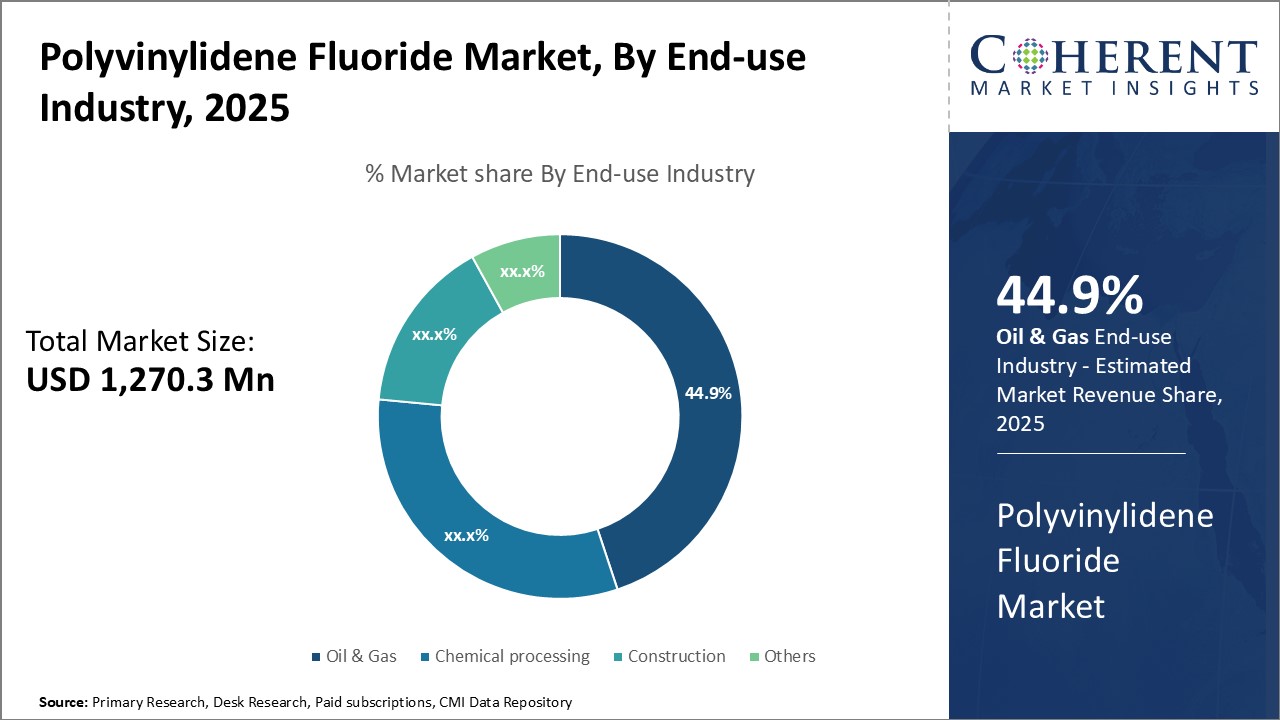
- Based on end use industry, the oil & gas segment dominates the market, accounting for an estimated 45.9% in 2026, as it is an ideal material for manufacturing pipes, casing and linings.
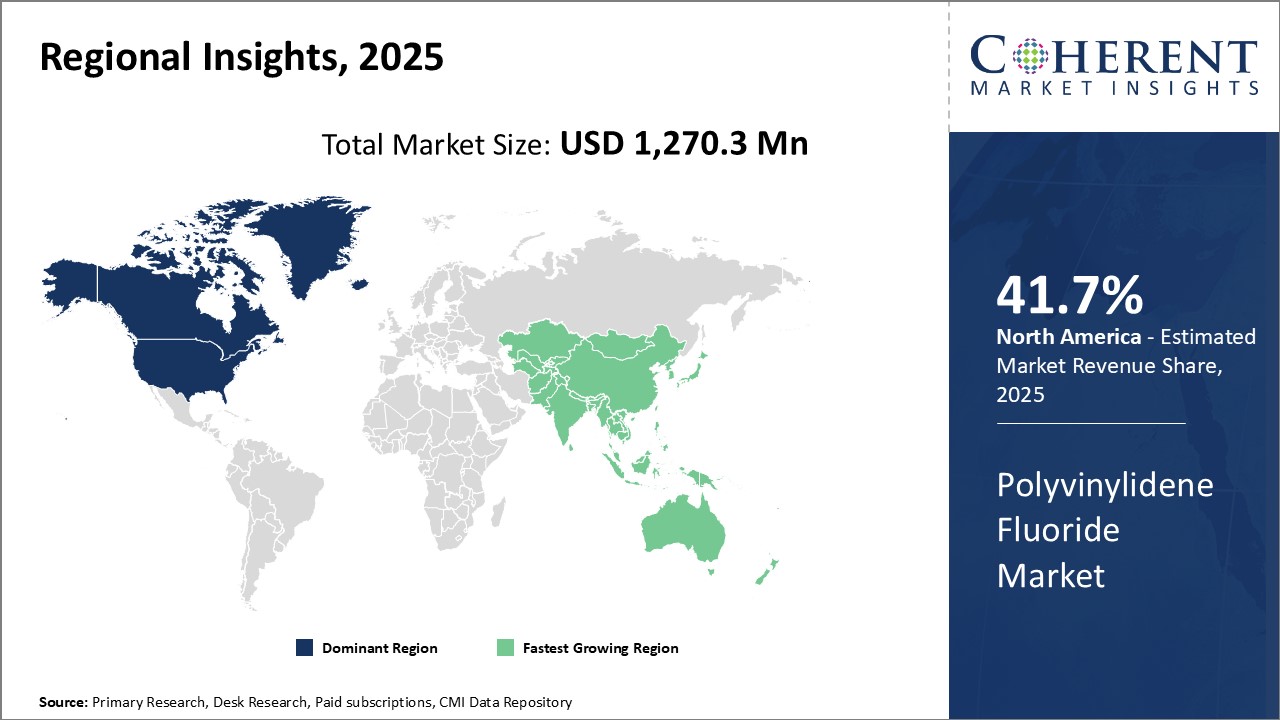
- Based on region, North America is expected to lead the market, holding a share of 41.7% in 2026. While, Asia Pacific is anticipated to be the fastest growing region during the forecast period.
Market Overview
The demand for polyvinylidene fluoride market demand is expected to grow owing to its increasing usage in various end-use industries. PVDF finds extensive applications in coatings, lithium-ion battery, and semiconductor industries due to its excellent mechanical, thermal, and chemical resistance properties. Growth in the electric vehicle industry is also driving the demand for advanced batteries using polyvinylidene fluoride membranes as separator, thus supplementing the polyvinylidene fluoride market demand. Furthermore, rapid industrialization and infrastructure development activities especially in the Asia Pacific region have been increasing the consumption of PVDF.
Current Events and their Impacts on Polyvinylidene Fluoride Market
Current Events | Description and its Impact |
Capacity Expansions in Key Regions |
|
Raw Material Supply Chain Volatility |
|
Import Export Analysis
India imported a total of 139 shipments of Polyvinylidene Fluoride (PVDF) during the twelve-month period from October 2023 to September 2024 (TTM). These imports originated from 29 foreign exporters and were distributed among 22 Indian buyers, indicating a well-diversified supply chain.
Focusing on recent monthly trends, India imported 7 shipments of PVDF in September 2024 alone. This monthly figure reflects a year-on-year growth of 17% compared to September 2023, highlighting a potential rebound or seasonal uptick in imports.
- Current Industry Events of 2026
- Market Size Estimation
- Regional Breakdown
- Competitive Landscape
- Customer Intelligence
- Segmental Analysis
- Pricing Analysis
- Key Market Drivers, Challenges & Future Trends
- Customized Insights Section
Segmental Analysis
Polyvinylidene Fluoride Market Insights, By End-use Industry
Oil & Gas Acquires the Largest Share Owing to its Drilling and Production Application
In terms of end-use industry, oil & gas contributes the highest share of 45.9% of the market driven by extensive PVDF use in various drilling and production applications. PVDF exhibits strong corrosion resistance against harsh alkalis and acids encountered in the oil & gas industry. This makes it an ideal material for manufacturing pipes, casings, and linings used in drilling and extraction processes. It is extensively used as an internal lining for steel pipes and casings to resist corrosion under extreme downhole conditions of high pressure and temperature during drilling. PVDF lining prevents direct contact between corrosive fluids and the base metal, thus enhancing the operational life of pipes. PVDF membrane finds increasing preference in various gas and liquid separation applications in the upstream and downstream sectors. Its reliable performance in separating hydrocarbons from water and separating gas from liquids has boosted its use in offshore separation systems. The non-stick property of PVDF makes it suitable for manufacturing flexible hoses used in transfer of produced fluids from wells and transportation through pipelines.
For instance, Arkema has reaffirmed the pivotal role of Kynar® PVDF in offshore oil and gas production, where the fluoropolymer’s extreme chemical resistance, thermal stability, and mechanical durability are essential. In challenging environments, PVDF is used in choke and kill line liners, flexible flowlines and risers, umbilicals, and downhole wire and cables, offering over 30-year performance in corrosive saltwater and under fluctuating temperatures.
-market-by-application.webp "Polyvinylidene Fluoride (PVDF) Market, By Application")
Polyvinylidene Fluoride Market Insights, By Application
Membrane Segment Dominates the Overall Market
In terms of application, membrane segment contributes the highest share of 42.7% of the market owing to its widespread use and demand. Membrane has emerged as the dominant application segment within the Polyvinylidene Fluoride (PVDF) market owing to its robust and durable properties that make it suitable for a variety of end-use industries. The non-reactive and corrosion resistant attributes of PVDF allow it to form highly effective membranes for gas and liquid separation applications. The excellent chemical and thermal resistance of PVDF-based membranes make them an important material for filtration processes across industries such as water & wastewater treatment and food & beverage. PVDF membranes are extensively used in ultrafiltration and microfiltration systems for industrial and municipal water treatment. Their reliability in withstanding harsh processing conditions and chemicals give them an advantage over conventional membrane materials. The non-toxic and biocompatible nature of PVDF also widens its usage in membrane-based medical devices. Membranes manufactured from PVDF are gaining popularity in gas separation for industrial gas production owing to their high permeability and selectivity. Their resistance to acids, bases and solvents has boosted the demand for PVDF membranes in sensor applications as well.
In April 2025, A new mixed-matrix membrane, blending Polyvinylidene Fluoride (PVDF) with eco-synthesized ZnO-nanoclay, demonstrated remarkable improvements in antifouling and mechanical performance, offering a promising solution for wastewater treatment and ultrafiltration. Compared to standard PVDF membranes, the advanced composite showed 99.9% inhibition of microbial fouling at 3% loading and a 16% higher water flux at 1 wt.%, while tensile strength increased five-fold.
Regional Insights
North America Polyvinylidene Fluoride Market Analysis & Trends
North America has been the dominant region in the global PVDF market for several years with 41.7% of the market share. Major PVDF producers, such as Arkema and Kureha America, have established a strong manufacturing presence with production plants located across the U.S. and Canada. This ensures the easy availability of PVDF to the growing industries in the region such as pharmaceutical, lithium-ion batteries, and membrane manufacturing. The region's mature end-use industries and large technical know-how also significantly contribute to PVDF consumption.
In February 2026, Specialty chemicals giant Arkema has announced a USD 20 million investment to expand production capacity of polyvinylidene fluoride (PVDF) by approximately 15% at its Calvert City facility. The expansion is scheduled for completion by mid‑2026 and aims to meet growing regional demand from lithium-ion battery, semiconductor, energy storage, and cable industries.
Asia Pacific Polyvinylidene Fluoride Market Analysis & Trends
The Asia Pacific region has emerged as the fastest-growing market for PVDF globally. China has become a global manufacturing hub for various industrial applications of PVDF such as coatings, films, and membranes. This is majorly attributed to the rapid industrialization and expansion of end-use industries that employ PVDF, such as water and wastewater treatment, automotive, and electronics. The availability of technical skills and low input costs for PVDF production in China have attracted various global manufacturers to invest in local PVDF plants. This has improved indigenous supply and reduced China's import dependence on North America and Europe.
In November 2024, the Mumbai Metropolitan Region (MMR) set national benchmarks in sewage treatment, deploying India’s largest membrane bioreactor (MBR) plants supported by Veolia Water Technologies & Solutions South Asia. The 500 MLD Worli and 360 MLD Bandra STPs feature Veolia’s ZeeWeed MBR technology, with additional tertiary filtration plants in Navi Mumbai under the AMRUT initiative. Veolia also introduced the upgraded ZW1500 XT PVDF hollow-fiber membrane at IFAT 2024, enhancing filtration capacity and footprint efficiency. ZW1500XT brings in with higher membrane surface area of 120 square meters with new generation PVDF hollow fiber membranes, higher fouling resistance and hydrophilicity feature.
Polyvinylidene Fluoride Market Outlook Country-wise
The United States Polyvinylidene Fluoride Market Trends
The U.S. market of polyvinylidene fluoride is characterized by its versatility, strong piezoelectric properties, and applications in various industries, including electronics, chemical processing, energy, and healthcare. The polymer is used in diverse applications, from electrical insulation and sensors to battery separators and medical devices. For instance, in October 2023, U.S. Steel and DuPont launched COASTALUME™, North America’s first GALVALUME® steel specifically engineered and guaranteed for coastal environments. This innovative product combines U.S. Steel’s strong, self-healing GALVALUME® with DuPont’s Tedlar® PVF film, providing enhanced protection against saltwater corrosion, UV damage, cracking, and impact. This is further propelling the polyvinylidene fluoride market demand.
India Polyvinylidene Fluoride Market Trends
India market for polyvinylidene fluoride is experiencing rapid growth, driven by the country’s growing industrialization, expanding automotive sector, and increasing electronics manufacturing capabilities, which drive demand for this versatile polymer. Key players in the Indian PVDF market include companies like Arkema India Pvt. For instance, India is among the top 10 PVDF importing countries, accounting for 62 shipments in recent import records, behind major buyers such as Russia, the U.S., and Vietnam.
Market Concentration and Competitive Landscape
Recent Development
- In May 2025, Advanced materials firm Syensqo signed multi‑year contracts worth over €150 million to supply its battery‑grade Solef® PVDF to major automotive OEMs and lithium‑ion battery manufacturers.
- In May 2025, Avient Corporation launched Colorant Chromatics™ PVDF Processing Aids, specifically formulated to enhance the melt-extrusion process for polyvinylidene fluoride (PVDF) resins. The new additives improve lubricity, prevent die build-up, and eliminate melt fracture, commonly known as “sharkskin”on extruded products.
Market Report Scope
Polyvinylidene Fluoride Market Report Coverage
| Report Coverage | Details | ||
|---|---|---|---|
| Base Year: | 2025 | Market Size in 2026: | USD 1,407.5 Mn |
| Historical Data for: | 2020 To 2024 | Forecast Period: | 2026 To 2033 |
| Forecast Period 2026 to 2033 CAGR: | 10.8% | 2033 Value Projection: | USD 2,885.5 Mn |
| Geographies covered: |
| ||
| Segments covered: |
| ||
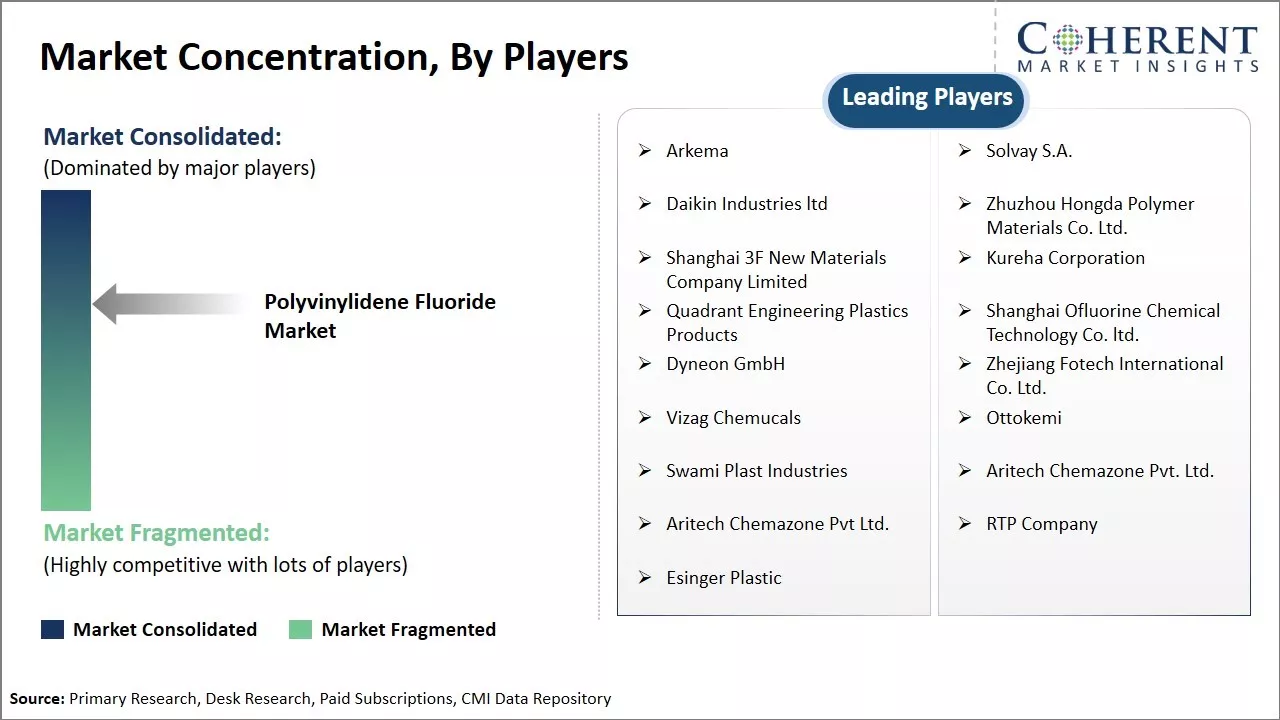
| Companies covered: | Arkema, Solvay S.A., Daikin Industries ltd, Zhuzhou Hongda Polymer Materials Co. Ltd., Shanghai 3F New Materials Company Limited, Kureha Corporation, Quadrant Engineering Plastics Products, Shanghai Ofluorine Chemical Technology Co. ltd., Dyneon GmbH, Zhejiang Fotech International Co. Ltd., Vizag Chemucals, Ottokemi, Swami Plast Industries, Aritech Chemazone Pvt. Ltd., Aritech Chemazone Pvt Ltd., RTP Company, and Esinger Plastic | ||
| Growth Drivers: |
| ||
| Restraints & Challenges: |
| ||
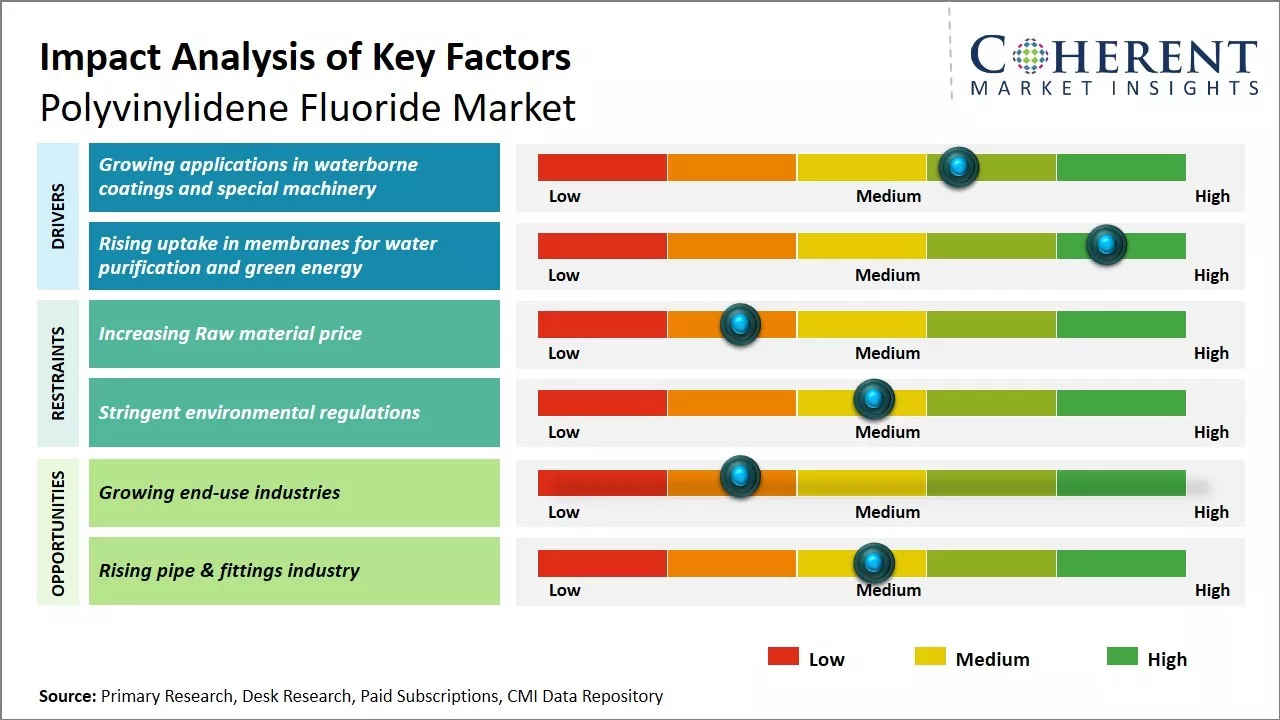
Polyvinylidene Fluoride Market Driver
Growing applications in waterborne coatings and special machinery
Polyvinylidene fluoride or PVDF finds wide usage in specialty coatings applications owing to its resistance properties against weathering, chemicals, and corrosion. PVDF coatings are increasingly utilized for their durable performance in waterborne architectural and industrial coatings. Their effectiveness in preventing corrosion has boosted their adoption in coatings for metal structures, bridges, and marine vessels that face harsh weather and sea conditions on a regular basis. Furthermore, PVDF emerges as a material of choice for coating specialized machinery exposed to chemicals, high temperatures, and friction in industries such as the oil & gas, pharmaceutical, and semiconductor manufacturing industries. Its high thermal stability allows PVDF coatings to protect sensitive components and parts against fluctuations in temperatures and other stresses. The development of advanced machinery operating under extreme factory environments thus drives the need for non-reactive, long-lasting protective coatings using PVDF. With steady investments into infrastructure and expansion of process industry facilities worldwide, the market for specialty coatings employing PVDF is likely to observe periodical rise going forward.
Rising uptake in membranes for water purification and green energy
Apart from use in protective coatings, a crucial driver for the PVDF market growth has been its extensive use in filtration membrane technology for water treatment and green energy generation purposes. PVDF membranes have gained widespread recognition due to their strong chemical resistance, mechanical strength and efficient separation capabilities. Their non-reactive nature prevents fouling and scaling, allowing long service lifetimes. As a consequence, PVDF membranes are extensively used for microfiltration and ultrafiltration in water and wastewater treatment plants globally.
Along with industrial usage, rising fresh water demands propel its adoption in household water purifiers as well. For instance, the global fresh water demand will outstrip supply by 40% by 2030. PVDF membranes have also emerged as popular separation mediums in the chlor-alkali industry and fuel cells.
Polyvinylidene Fluoride Market Opportunities
Growing end-use industries
Growing end-use industries such as automotive, construction, and electronics are driving significant demand for PVDF globally. Its excellent mechanical, chemical, and electrical properties make it suitable for use in lithium-ion batteries, which are seeing increased demand. Moreover, expanding operations in emerging markets and research into developing new high-performance PVDF grades could further boost market revenues over the coming years. This trend highlights a positive polyvinylidene fluoride market forecast, with expectations for sustained growth driven by innovation and widening application scope across various industrial sectors.
Analyst Opinion (Expert Opinion)
The Polyvinylidene Fluoride (PVDF) market value is not just evolving, it is pivoting sharply toward strategic realignment, driven primarily by two sectors: electric vehicles (EVs) and next-gen semiconductor fabs. Any player not deeply embedded in these verticals’ risks losing relevance in the next five years.
Moreover, PVDF’s role as a critical binder and separator coating in lithium-ion batteries is no longer a secondary opportunity—it is the primary battlefield. As of Q1 2025, over 60% of global PVDF demand by volume stems from energy storage applications, particularly lithium iron phosphate (LFP) and nickel-manganese-cobalt (NMC) chemistries. What’s more compelling is that automakers themselves—like Ford and Stellantis—are vertically integrating into battery component manufacturing, with several joint ventures specifically requesting PVDF suppliers with capabilities in high molecular weight and high crystallinity polymers. Solvay and Kureha have already secured multi-year battery-grade PVDF contracts with North American gigafactories, while smaller players are being squeezed out due to their inability to scale or meet purity benchmarks.
Furthermore, semiconductors are creating a “purity-first” PVDF submarket. Leading fabs such as TSMC and Intel have increased specifications for ultra-pure PVDF in high-purity piping and filtration membranes. This is not just a matter of chemical resistance; PVDF's dielectric properties and minimal leaching in aggressive solvents make it indispensable in cleanroom infrastructure. In fact, PVDF is now outperforming traditional fluoropolymers like PTFE and FEP in semiconductor cleanroom applications due to its mechanical strength and ease of processing. The shift toward 3nm and smaller nodes has forced fabs to requalify polymer components, and PVDF is emerging as a winner.
However, the challenge lies in raw material shortage—especially the availability of high-purity VDF monomer. China currently controls over 75% of VDF production capacity, and recent environmental clampdowns in Jiangsu and Shandong provinces have already led to 10–12% cost spikes quarter-on-quarter. Without diversified sourcing or downstream integration, Western PVDF processors are exposed to strategic risk.
Additionally, the assumption that PVDF will be displaced by cheaper polyolefin-based alternatives in coatings or membranes is deeply flawed. Case in point: PVDF-based membranes in water ultrafiltration and hydrogen purification continue to show superior long-term flux retention compared to PES or PP membranes, with up to 45% better resistance to biofouling and chlorine degradation, according to 2024 ASTM test panels.
Speak to the analyst
Want personalized insights?
Take the findings above to one of our principal consultants, or have the report rebuilt around the segments, geographies and competitors you actually track.
Market Segmentation
- By Application (Revenue, USD Mn, 2021 - 2033)
- Coatings
- Pipes
- Sheets
- Tubes
- Films
- Membranes
- Cables
- Others
- By End-use Industry (Revenue, USD Mn, 2021 - 2033)
- Oil & Gas
- Chemical processing
- Construction
- Others
- Regional Insights (Revenue, USD Mn, 2021 - 2033)
- North America
- U.S.
- Canada
- Latin America
- Brazil
- Argentina
- Mexico
- Rest of Latin America
- Europe
- Germany
- U.K.
- Spain
- France
- Italy
- Russia
- Rest of Europe
- Asia Pacific
- China
- India
- Japan
- Australia
- South Korea
- ASEAN
- Rest of Asia Pacific
- Middle East
- GCC Countries
- Israel
- Rest of Middle East
- Africa
- South Africa
- North Africa
- Central Africa
- North America
- Company Profiles
- Arkema
- Solvay S.A.
- Daikin Industries ltd
- Zhuzhou Hongda Polymer Materials Co. Ltd.
- Shanghai 3F New Materials Company Limited
- Kureha Corporation
- Quadrant Engineering Plastics Products
- Shanghai Ofluorine Chemical Technology Co. ltd.
- Dyneon GmbH
- Zhejiang Fotech International Co. Ltd.
- Vizag Chemucals
- Ottokemi
- Swami Plast Industries
- Aritech Chemazone Pvt. Ltd.
- Aritech Chemazone Pvt Ltd.
- RTP Company
- Esinger Plastic
Sources
Primary Research Interviews from the following stakeholders:
Stakeholders:
- Interviews with fluoropolymer processors, battery material suppliers, piping system manufacturers, chemical handling equipment producers, and procurement heads across leading global markets.
Databases:
- UN Comtrade Database
- World Trade Organization (WTO) Trade Statistics
- International Energy Agency (IEA) – Battery Materials Outlook
- Bureau of Economic Analysis (U.S.)
- Eurostat
- China Customs Statistics
- India Ministry of Chemicals and Fertilizers – Polymer Data Division
- Japan External Trade Organization (JETRO)
- Korea Customs Service Data Portal
Magazines:
- Specialty Chemicals Magazine
- Chemical Engineering World
- Battery Materials Review
- Wire & Cable India
- Membrane Technology Newsletter
- Modern Plastics India
- Plastic News Global
Journals:
- Journal of Fluorine Chemistry
- Polymer Degradation and Stability (Elsevier)
- Journal of Membrane Science
- Electrochimica Acta
- Journal of Power Sources
- Journal of Applied Polymer Science
Newspapers:
- The Economic Times – Chemicals & Advanced Materials
- Financial Times – Global Manufacturing
- The Hindu Business Line – Chemicals & Energy
- South China Morning Post – Materials & Tech
- Nikkei Asia – Batteries and Electronics Materials
- Business Standard – Industrial Manufacturing
Associations:
- American Chemical Society – Division of Polymer Chemistry
- Fluoropolymers Division – Plastics Europe
- Society of Plastics Engineers (SPE) – High Performance Polymers Group
- International Battery Materials Association
- Indian Plastics Institute (IPI)
- Confederation of Indian Industry (CII) – Chemical and Materials Division
- Asia Plastics Forum (APF)
Public Domain Sources:
- Ministry of Chemicals and Petrochemicals (India)
- U.S. Environmental Protection Agency (EPA) – Fluoropolymer Materials Reports
- Ministry of Economy, Trade and Industry (METI), Japan – Advanced Materials Division
- U.S. International Trade Commission (USITC)
- NITI Aayog – Battery Materials and Clean Energy Reports
- India Investment Grid – Chemicals & Advanced Materials Sector
- EU REACH Regulation Portal – Fluorinated Compounds Data
- Reserve Bank of India (RBI) – Industrial Inputs and Materials Analysis
Proprietary Elements:
- CMI Data Analytics Tool, and Proprietary CMI Existing Repository of information for last 8 years
*Definition: The Polyvinylidene Fluoride Market involves the production and sale of polyvinylidene fluoride polymer, commonly known as PVDF. PVDF is a highly non-reactive thermoplastic fluoropolymer resin that has an outstanding combination of properties including weatherability, chemical resistance, radiation resistance and fire resistance. It finds major applications in coatings, lithium-ion battery separators and piezoelectric applications. The global PVDF market has been growing steadily due to the increasing.
Get access to 250+ pages report
Every segment, forecast, competitor profile and data table behind the analysis above — available for instant download.
- ESOMAR Member
- ISO 9001:2015 Certified
- D-U-N-S Registered
- GDPR & CCPA Compliant
Missing comfort of reading report in your local language? Find your preferred language:
Transform your Strategy with Exclusive Trending Reports
Frequently Asked Questions
The Polyvinylidene Fluoride Market is estimated to be valued at USD 1,407.5 Mn in 2026, and is expected to reach USD 2,885.5 Mn by 2033.
The CAGR of the Polyvinylidene Fluoride Market is projected to be 10.8% from 2026 to 2033.
Growing applications in waterborne coatings and special machinery and rising uptake in membranes for water purification and green energy are the major factor driving the growth of the Polyvinylidene Fluoride Market.
Increasing raw material prices and stringent environmental regulations are the major factors hampering the growth of the Polyvinylidene Fluoride Market.
In terms of end-use Industry, oil & gas is estimated to dominate the market revenue share in 2026.
Arkema, Solvay S.A., Daikin Industries ltd, Zhuzhou Hongda Polymer Materials Co. Ltd., Shanghai 3F New Materials Company Limited, Kureha Corporation, Quadrant Engineering Plastics Products, Shanghai Ofluorine Chemical Technology Co. ltd., Dyneon GmbH, Zhejiang Fotech International Co. Ltd., Vizag Chemicals, Ottokemi, Swami Plast Industries, Aritech Chemazone Pvt. Ltd., Aritech Chemazone Pvt Ltd., RTP Company, and Esinger Plastic are the major players operating in the market.
North America is expected to lead the Polyvinylidene Fluoride Market.