

Preclinical Isolated Organ Perfusion System Market Size and Share Analysis - 2026 To 2033
The Preclinical Isolated Organ Perfusion System Market is anticipated to grow at a CAGR of 4.1% with USD 566.8 Mn in 2026 and is expected to reach USD 754.0 Mn in 2033. The Preclinical Isolated Organ Perfusion System Market is gaining adoption as pharma and CROs seek organ-specific, human-relevant models for toxicity, pharmacology, and efficacy screening. In 2026, U.S.FDA reported that over 90% of drugs safe in animals fail in humans and listed organ-on-chip/NAM platforms in its April 2026 animal-testing reduction update. EMA’s March 2026 draft qualification opinion on virtual control groups further supports regulatory acceptance of alternative preclinical methods across medicine development.
Key Takeaways
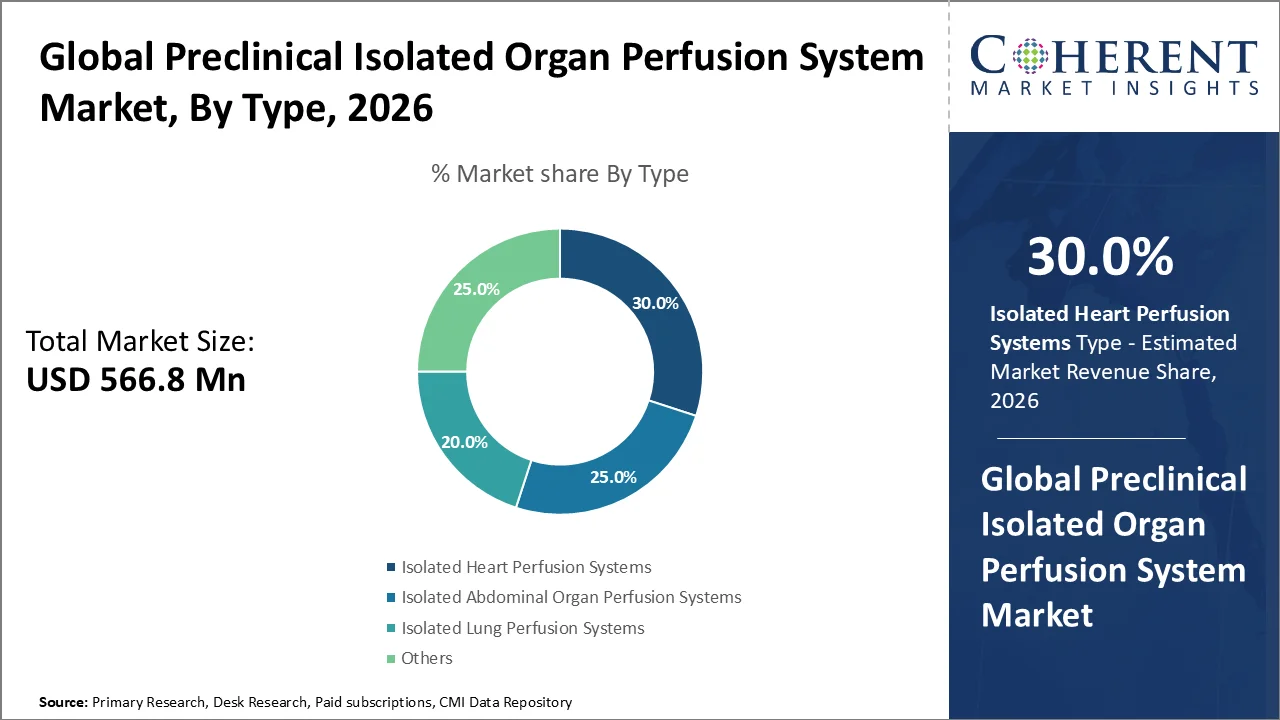
- Isolated Heart Perfusion Systems is expected to account the largest share of 30.0% in 2026, because cardiac safety pharmacology is a priority in drug screening, enabling ex-vivo assessment of contractility, arrhythmia, ischemia-reperfusion injury, and cardiotoxicity before clinical trials. FDA’s 2026 NAM/nonclinical page states ex-vivo, in-vitro, and in-silico models may support cardiovascular risk assessment, while AHA’s 2026 update reported 130.6 Mn U.S. adults with CVD, reinforcing strong segment adoption. Furthermore, in 2026, U.S. Food and Drug Administration’s NAM page notes ex vivo, in vitro, and in silico models can evaluate proarrhythmic risk, while AHA’s 2026 Statistics Update reported 130.6 Mn U.S. adults, or 48.9%, had cardiovascular disease during 2021–2023, strengthening adoption by pharma and CRO researchers.
Source: U.S.FDA; AHA
- Industrial laboratories and CROs will dominate with 60.0% in 2026, because they provide GLP-compliant infrastructure, validated assay teams, faster turnaround, and outsourced pharmacology/toxicology capacity for pharma pipelines. For instance, in 2026, according to the U.S. FDA’s NAM page stated that over 90% of drugs safe in animals fail in humans, supporting human-relevant ex-vivo testing; U.S.FDA’s 2026-published CDER page reported 46 novel drug approvals for 2025, reflecting continued nonclinical testing demand.
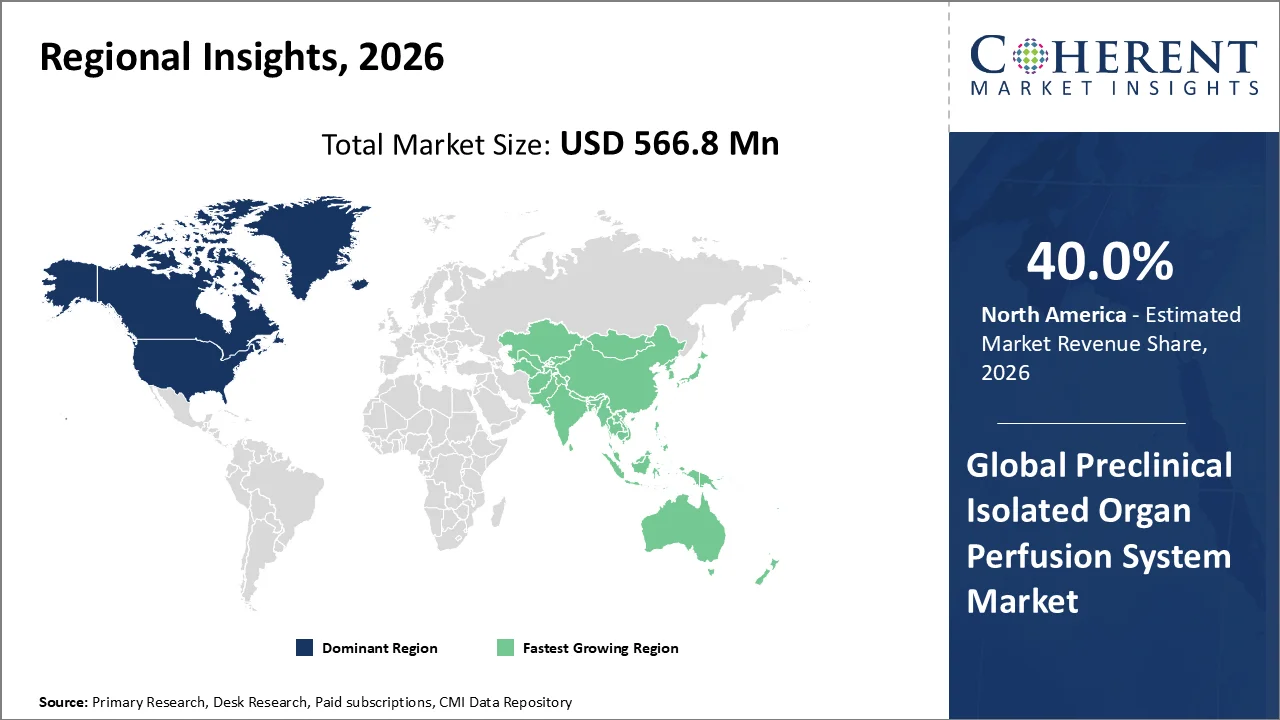
- North America is expected to acquire the dominant share of 40.0% in 2026, attributed to U.S. pharma, biotech, CRO, academic, and NIH-funded laboratories have strong nonclinical infrastructure for isolated organ pharmacology and toxicology testing. NIH’s 2026-published budget document cites a USD 46.5 billion FY 2026 enacted program level, strengthening biomedical research capacity. Furthermore, in April 2026, according to the data published by the U.S.FDA’s NAM update states over 90% of animal-safe drugs fail in humans, encouraging U.S. adoption of human-relevant ex-vivo perfusion models before clinical trials across drug developers and CROs region-wide.
Segmental Insights
Why is Isolated Heart Perfusion Systems Acquiring the Largest Market Share?
Isolated Heart Perfusion Systems is projected to account for the largest share of preclinical isolated organ perfusion system market in 2026, representing approximately 30.0% of the total volume. Isolated Heart Perfusion Systems dominate the Preclinical Isolated Organ Perfusion System Market because cardiac safety is a critical nonclinical checkpoint, and these systems enable controlled ex-vivo assessment of heart contractility, coronary flow, arrhythmia risk, ischemia-reperfusion injury, and cardiotoxicity before human trials. In U.S. FDA’s 2026-published CDER NAM page states that ex-vivo, in-vitro, in-silico, and in-vivo models can be used together to evaluate the proarrhythmic risk of QT-prolonging pharmaceuticals in humans. In addition, the American Heart Association’s 2026-published heart disease and Stroke Statistics Update reported 130.6 million U.S. adults, or 48.9%, had some form of CVD during 2021–2023, while CVD caused 915,973 U.S. deaths in 2023. The same 2026 source stated coronary heart disease accounted for 38.2% of CVD deaths, strengthening demand for heart-focused perfusion platforms.
Source: U.S.FDA; American Heart Association
- Current Industry Events of 2026
- Market Size Estimation
- Regional Breakdown
- Competitive Landscape
- Customer Intelligence
- Segmental Analysis
- Pricing Analysis
- Key Market Drivers, Challenges & Future Trends
- Customized Insights Section
Industrial Laboratories and CROs holds the Largest Market Share
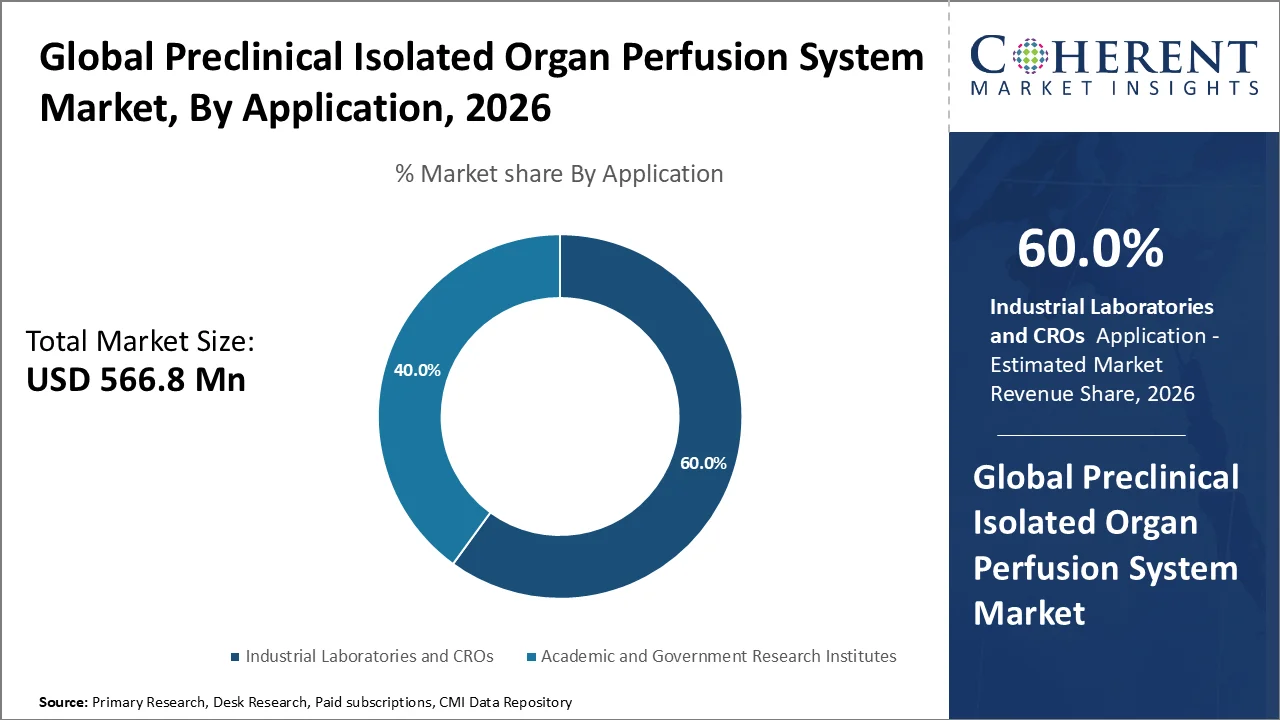
Based on application, industrial laboratories and CROs dominate the market, accounting for a significant 60.0% share in 2026, because pharma sponsors increasingly outsource complex GLP toxicology, pharmacology, cardiac safety, organ viability, and ischemia-reperfusion studies to facilities with validated protocols, trained assay teams, and faster study execution. For instance, in March 2026, U.S. FDA’s published draft guidance encouraged New Approach Methodologies in drug development, supporting human-relevant nonclinical platforms such as ex-vivo organ testing. FDA’s April 2026-published NAM update stated that over 90% of drugs safe in animals fail in humans, increasing demand for predictive organ-level testing before clinical trials. Further, in 2026, FDA’s current approval page reported 46 CDER novel drug approvals in 2025, showing continued drug-development throughput requiring nonclinical testing support. ClinicalTrials.gov also listed 582,418 registered studies as of April 28, 2026, including 18,588 added in 2026, reinforcing CRO demand for preclinical validation services.
Market Driver
Rising Cases of Organ Transplantation
Increasing cases of organ transplantation has driven the preclinical isolated organ perfusion system market growth over the forecast period. Rising organ transplantation drives the Preclinical Isolated Organ Perfusion System Market because more transplant activity increases the need to test organ viability, ischemia-reperfusion injury, preservation solutions, perfusion temperatures, and drug-induced organ damage before clinical use. For instance, in January 2026, in the U.S., United Network for Organ Sharing (UNOS) reported that more than 49,000 organ transplants were performed in 2025, while over 90,000 people were still waiting for kidney transplants, showing continued pressure to improve organ utilization and outcomes. The 2026-published Global Observatory on Donation and Transplantation report recorded 173,727 solid organ transplants worldwide in 2024, a 2% increase over 2023, with 47,180 deceased donors and donation after circulatory death accounting for 28% of deceased donation activity. Additionally, in January 2026, U.S. Centers for Medicare & Medicaid Services stated that medically complex organs need better placement and utilization, supporting preclinical perfusion studies that help assess marginal organs and preservation technologies.
Source: UNOS; Transplant Observatory; U.S. Centers for Medicare & Medicaid Services
Increasing Incidence of Chronic Diseases
Increasing incidence of chronic diseases has increased the demand for the preclinical isolated organ perfusion system and drive the growth of the market size over the forecast period. Rising chronic disease incidence drives demand for preclinical isolated organ perfusion systems because drug developers need organ-specific functional models to study heart, lung, liver, kidney, and vascular injury linked with long-duration diseases before human trials. For instance, in April 2026, according to the data published by the CDC’s “About Chronic Diseases,” states that three in four U.S. adults have at least one chronic condition, over half have two or more, and adults aged 65+ exceed 90% chronic-condition prevalence; it also links chronic diseases with USD 4.9 trillion in annual U.S. healthcare costs. Furthermore, in April 2026, according to the U.S. FDA’s NAM states that over 90% of drugs safe in animals fail in humans and highlights human-relevant methods, including organ-on-chip and in-vitro platforms, to improve toxicity and pharmacodynamic prediction. This supports wider use of isolated organ perfusion by pharma, CROs, and academic labs for chronic disease drug screening.
Ongoing Research and Development of Perfusion Systems
Increasing ongoing research and development of perfusion systems has created significant opportunity for the growth of the global preclinical isolated organ perfusion system market over the forecast period. Ongoing R&D in perfusion systems is expected to drive the Preclinical Isolated Organ Perfusion System Market because newer platforms help researchers maintain isolated organs under controlled oxygenation, temperature, pressure, and flow conditions, enabling better study of drug toxicity, ischemia-reperfusion injury, organ preservation, and functional recovery before human trials. For instance, in March 2026, U.S.FDA’s published draft guidance encouraged scientifically valid alternatives to animal testing, while FDA’s April 2026-published update stated that over 90% of drugs clearing animal studies do not receive FDA approval, supporting greater use of human-relevant ex-vivo systems. In addition, NHS Blood and Transplant’s March 2026-published update opened the first of 15 pilot assessment and recovery centres using machine perfusion and projected up to 750 extra transplants annually, showing strong real-world momentum for perfusion innovation.
Current Events and Their Impact on the Preclinical Isolated Organ Perfusion System Market
Current Event | Description and its Impact |
Regulatory Shift Supporting Innovation |
|
Rising Government Initiatives |
|
HRSA OPTN Modernization and Transplant Data Services Launch |
|
NIH FY 2026 SBIR/STTR Funding for Biomedical R&D |
|
Preclinical Isolated Organ Perfusion System Market Trends
- Shift Toward Human-Relevant NAM-Based Testing - The market is shifting toward New Approach Methodologies (NAMs) because pharma companies need better human-relevant tools before clinical trials. FDA’s 2026-published draft guidance stated that drug developers can validate NAMs for use instead of animal testing, supporting ex-vivo organ models, in-vitro systems, and computational approaches for safer and faster drug development.
- Rising Use of Machine Perfusion for Organ Viability Assessment - Perfusion technology is increasingly used to assess whether donated organs are functional and safe before transplantation, creating spillover demand for preclinical organ perfusion research. NHS Blood and Transplant’s 2026-published update stated that its ARC pilot uses machine perfusion to assess organ function and could support wider use of organs that may otherwise be declined.
- Stronger Transplant Oversight and Organ Utilization Policies - Government focus on improving organ use is strengthening interest in perfusion-based testing. CMS’s 2026-published proposed rule stated that more than 100,000 Americans were waiting for organ transplants, one person is added every 8 minutes, and 17 people die daily while waiting, supporting tools that improve organ viability and reduce discard risk.
- Growing Demand from Pharma Pipelines and CRO Testing - Isolated heart perfusion systems are gaining attention because cardiovascular safety is a major drug-development checkpoint. The American Heart Association’s 2026-published update reported 130.6 million U.S. adults, or 48.9%, had cardiovascular disease during 2021–2023, strengthening demand for ex-vivo cardiac models assessing arrhythmia, contractility, coronary flow, and ischemia-reperfusion injury.
- Integration of Data, AI, and Sensor-Based Functional Readouts - The market is moving toward data-rich perfusion systems with real-time monitoring of pressure, flow, oxygenation, biomarkers, and organ function. FDA’s 2026-published update stated it qualified the first AI-based drug development tool, while HRSA’s 2026-published OPTN modernization update launched Transplant Data Services to improve transplant data collection, management, and sharing.
Regional Insights
North America dominates owing to Advanced Healthcare Infrastructure
North America account 40.0% market share in 2026, because the U.S. has a strong base of pharma, biotech, CROs, transplant centers, academic hospitals, and federally funded biomedical laboratories using ex-vivo organ models for toxicology, pharmacology, cardiac safety, and organ preservation research. In 2026, NIH’s published FY 2027 budget document shows a USD 46.5 billion FY 2026 enacted program level, supporting advanced biomedical and translational research infrastructure. In April 2026, FDA’s published NAM update stated that over 90% of drugs safe in animals fail in humans, encouraging adoption of human-relevant ex-vivo testing platforms. FDA’s 2026-current novel drug approval page reported 46 CDER novel drug approvals in 2025, sustaining demand for preclinical validation. Additionally, in January 2026, UNOS also reported that the U.S. performed 49,064 organ transplants in 2025, strengthening perfusion-based organ research needs.
Asia Pacific Preclinical Isolated Organ Perfusion System Market Trends
The Asia-Pacific region is poised to be as the fastest-growing region through 2026-2033, owing to the region combines a large chronic-disease burden, rising transplant demand, expanding pharma/CRO activity, and government-backed regulatory modernization. For instance, according to the WHO’s 2026-published South-East Asia NCD report stated that NCDs caused 55% of all deaths, accounting for 9.5 million deaths, with 50% occurring prematurely, increasing the need for organ-specific drug safety and toxicity models. In India, the Ministry of Health reported in 2026 that 20,019 organ transplants were performed in 2025, while the transplant waitlist stood at 89,839 as of March 3, 2026, supporting demand for organ preservation and viability research. China’s NMPA also revised drug administration regulations in 2026 to strengthen clinical trial management and accelerated drug review pathways, encouraging preclinical testing infrastructure. These factors support faster adoption across Asia Pacific research centers.
Growing Research & Development and advanced biomedical infrastructure is accelerating the Preclinical Isolated Organ Perfusion System Market Demand in United States
The U.S. is the dominant country in the North America Preclinical Isolated Organ Perfusion System Market because it has the strongest combination of FDA-led regulatory support, pharma/CRO testing demand, transplant research needs, and advanced biomedical infrastructure. For instance, in April 2026, U.S.FDA’s published NAM update stated that over 90% of drugs safe in animals fail in humans, encouraging adoption of human-relevant ex-vivo and organ-level testing platforms. In U.S. FDA’s 2026-current novel drug approval page reported 46 CDER novel drug approvals in 2025, reflecting continuous demand for nonclinical safety and efficacy validation. Additionally, HRSA’s April 2026-published transplant modernization update stated that more than 100,000 U.S. patients were waiting for lifesaving organ transplants and 170 million people were registered organ donors, supporting organ preservation and viability research. ClinicalTrials.gov also listed 582,418 registered studies as of April 28, 2026, reinforcing strong U.S.-led clinical and preclinical research activity.
China Preclinical Isolated Organ Perfusion System Market Trends
China is the dominant country in the Asia Pacific Preclinical Isolated Organ Perfusion System Market due to its large pharma R&D base, expanding CRO ecosystem, strong transplant activity, and rising demand for organ-specific drug safety testing. For instance, in 2026 NMPA’s published drug regulation update strengthened clinical trial management and introduced accelerated review pathways, supporting faster drug development and greater need for preclinical validation platforms. China also recorded 4,900 registered drug clinical trials in 2024, up 13.9%, as reported by NMPA/CDE in 2025, creating strong demand for toxicology, pharmacology, and organ-function studies. In transplant activity, GODT data showed China completed 24,684 organ transplants in 2024, the highest in Asia Pacific, while China Daily’s 2026-published update reported over 7.3 million registered organ donation volunteers and more than 197,000 donated organs by end-2025. These factors support wider adoption of heart, liver, kidney, and lung perfusion systems.
Who are the Major Companies in Preclinical Isolated Organ Perfusion System Market
Some of the major key players in Preclinical Isolated Organ Perfusion System Market are World Precision Instruments Inc., Radnoti LLC, MDE GmbH, Harvard Bioscience Inc., emka TECHNOLOGIES S.A.S., Danish Myo Technology AS, ADInstruments Pty Ltd. and Experimetria Ltd.
Key News
- In January 2026, Bridge to Life Ltd., a global organ preservation and perfusion technology company, received U.S. FDA De Novo clearance for its VitaSmart Hypothermic Oxygenated Perfusion (HOPE) System. The FDA De Novo database lists the device under DEN250009, with a decision date of January 15, 2026, and classifies it as a hypothermic machine perfusion system and accessories for orthotopic liver transplant. This clearance created a regulated U.S. pathway for transplant centers to use VitaSmart for oxygenated donor-liver perfusion after static cold storage and before transplantation
- In April 2026, Bridge to Life Ltd., a global organ preservation and perfusion technology company, revealed that the Bridge to HOPE pivotal trial had been published in JAMA Surgery, strengthening clinical validation for the VitaSmart HOPE System. The trial enrolled 219 recipients across 15 U.S. transplant centers and evaluated end-ischemic hypothermic oxygenated perfusion through the portal vein in high-risk donor livers, including DBD and DCD grafts. The company stated that the trial supported FDA’s De Novo determination and showed improved early graft function with a strong safety profile.
Market Report Scope
Preclinical Isolated Organ Perfusion System Market Report Coverage
| Report Coverage | Details | ||
|---|---|---|---|
| Base Year: | 2025 | Market Size in 2026: | USD 566.8 Mn |
| Historical Data for: | 2020 To 2024 | Forecast Period: | 2026 To 2033 |
| Forecast Period 2026 to 2033 CAGR: | 4.1% | 2033 Value Projection: | USD 754.0 Mn |
| Geographies covered: |
| ||
| Segments covered: |
| ||
| Companies covered: | World Precision Instruments Inc., Radnoti LLC, MDE GmbH, Harvard Bioscience Inc., emka TECHNOLOGIES S.A.S., Danish Myo Technology AS, ADInstruments Pty Ltd. and Experimetria Ltd. | ||
Analyst Opinion
- The Preclinical Isolated Organ Perfusion System Market is moving from a niche academic research tool toward a more strategic preclinical testing platform, mainly because regulators are pushing drug developers toward more human-relevant evidence. FDA’s 2026-published NAM update stated that over 90% of drugs that appear safe in animals fail to receive FDA approval, mostly due to human safety or efficacy gaps. This creates a strong case for ex-vivo isolated organ perfusion systems, as they allow direct functional assessment of heart, lung, liver, kidney, and abdominal organs under controlled flow, oxygenation, pressure, and temperature conditions before clinical trials.
Source: U.S. FDA (U.S. Food and Drug Administration)
- The market is also being supported by the rising pressure to improve organ utilization and transplant outcomes. In January 2026, UNOS reported that the U.S. crossed 49,000 organ transplants in 2025, including 27,573 kidney transplants, while more than 90,000 Americans were still waiting for a kidney transplant. Similarly, NHS Blood and Transplant’s March 2026 programme opened the first of 15 pilot Assessment and Recovery Centres, where machine perfusion is used to assess donated organs, with the potential to enable up to 750 additional transplants per year. These developments show that perfusion technology is becoming central to organ viability assessment.
Source: UNOS; NHS Blood and Transplant (UNOS)
- Industrial laboratories and CROs are expected to remain key adopters because the drug-development pipeline needs faster, reproducible, and organ-specific safety testing. FDA’s 2026-current novel drug approval page reported 46 CDER novel drug approvals in 2025, while FDA’s 2025 approval report noted that 33 of the 46 approvals, or 72%, used one or more expedited development or review programmes. This shows that drug developers are under pressure to generate stronger early-stage safety and efficacy data. Isolated organ perfusion systems support this need by offering measurable readouts such as cardiac contractility, coronary flow, renal clearance, liver metabolism, vascular response, and ischemia-reperfusion injury.
- Regionally, North America is expected to remain dominant, while Asia Pacific is likely to show faster adoption. NIH’s March 2026 fiscal policy notice stated that NIH received US$ 47.5 billion in FY 2026 programme-level funding, supporting biomedical research infrastructure in the U.S. At the same time, Asia Pacific is gaining momentum due to chronic disease and transplant burden. WHO’s 2026-published South-East Asia NCD report stated that NCDs caused 55% of all deaths, equal to 9.5 million deaths, while India’s Ministry of Health reported 20,019 organ transplants in 2025 and a waitlist of 89,839 as of March 2026.
Source: NIH; WHO; India Ministry of Health and Family Welfare
Speak to the analyst
Want personalized insights?
Take the findings above to one of our principal consultants, or have the report rebuilt around the segments, geographies and competitors you actually track.
Market Segmentation
- By Type (Revenue, USD Mn, 2021-2033)
- Isolated Heart Perfusion Systems
- Isolated Abdominal Organ Perfusion Systems
- Isolated Lung Perfusion Systems
- Others
- By Application (Revenue, USD Mn, 2021-2033)
- Industrial Laboratories and CROs
- Academic and Government Research Institutes
- By Region (Revenue, USD Mn, 2021-2033)
- North America
- U.S.
- Canada
- Latin America
- Brazil
- Mexico
- Argentina
- Rest of Latin America
- Europe
- Germany
- U.K.
- France
- Italy
- Spain
- Russia
- Rest of Europe
- Asia Pacific
- China
- India
- Japan
- Australia
- South Korea
- ASEAN
- Rest of Asia Pacific
- Middle East
- GCC
- Israel
- Rest of Middle East
- Africa
- South Africa
- Central Africa
- North Africa
- North America
Sources
Primary Research Interviews
- Interviews with preclinical scientists and toxicology heads to understand adoption in drug safety and organ-function testing.
- Insights from CROs and GLP lab managers on study demand, validation needs, and turnaround time.
- Discussions with manufacturers and product engineers on system design, sensor integration, and organ-specific platforms.
- Conversations with transplant researchers and academic labs on organ preservation and viability testing.
Databases
- FDA Medical Device Databases
- NIH RePORTER
- PubMed / NCBI
- European Medicines Agency (EMA) Database
- ClinicalTrials.gov
- Global Observatory on Donation and Transplantation (GODT)
Magazines
- Medical Device Network
- Genetic Engineering & Biotechnology News
- BioProcess International
- Nature Biotechnology News
- The Medicine Maker
- Drug Discovery World
Journals
- Transplantation Journal
- American Journal of Transplantation
- Journal of Surgical Research
- Frontiers in Physiology
- Cardiovascular Drugs and Therapy
- Journal of Pharmacological and Toxicological Methods
Newspapers
- The Wall Street Journal – Healthcare Section
- The New York Times – Health Section
- Financial Times – Healthcare & Life Sciences
- The Guardian – Science & Health
- Reuters Health News
- STAT News
Associations
- American Society of Transplant Surgeons (ASTS)
- The Transplantation Society (TTS)
- International Society for Heart and Lung Transplantation (ISHLT)
- American Society of Transplantation (AST)
- European Society for Organ Transplantation (ESOT)
- Society of Toxicology (SOT)
Public Domain Sources
- U.S. Food and Drug Administration (FDA)
- NHS Blood and Transplant (NHSBT)
- National Institutes of Health (NIH)
- NHS Blood and Transplant (NHSBT)
- World Health Organization (WHO)
- Health Resources and Services Administration (HRSA)
- Centers for Medicare & Medicaid Services (CMS)
- Company annual reports, press releases, investor presentations, and product brochures from key players.
Proprietary Elements
- CMI Data Analytics Tool
- Proprietary CMI Existing Repository of information for last 10 years
Get access to 250+ pages report
Every segment, forecast, competitor profile and data table behind the analysis above — available for instant download.
- ESOMAR Member
- ISO 9001:2015 Certified
- D-U-N-S Registered
- GDPR & CCPA Compliant
Missing comfort of reading report in your local language? Find your preferred language:
Transform your Strategy with Exclusive Trending Reports
Frequently Asked Questions
The Preclinical Isolated Organ Perfusion System Market is expected to reach USD 754.0 Mn in 2033.
Major players operating in the global Preclinical Isolated Organ Perfusion System Market include World Precision Instruments Inc., Radnoti LLC, MDE GmbH, Harvard Bioscience Inc., emka TECHNOLOGIES S.A.S., Danish Myo Technology AS, ADInstruments Pty Ltd. and Experimetria Ltd.
Rising cases of organ transplantation and increasing incidence of chronic diseases are the key factors driving the growth of the preclinical isolated organ perfusion system market.
The Preclinical Isolated Organ Perfusion System Market is anticipated to grow at a CAGR of 4.1% between 2026 and 2033.
Among regions, North America is expected to account for a largest market share in the global Preclinical Isolated Organ Perfusion System Market over the forecast period.
It is a laboratory system used to keep an isolated organ functional outside the body under controlled flow, oxygenation, pressure, and temperature conditions. It helps researchers study drug response, toxicity, ischemia-reperfusion injury, organ viability, and physiological function before clinical trials.
The heart is widely studied because cardiac safety is a major nonclinical requirement in drug development. Isolated heart perfusion systems help assess contractility, coronary flow, heart rate, arrhythmia risk, ischemia-reperfusion injury, and cardiotoxicity under controlled ex-vivo conditions.