

Prosthetic Legs Market Size and Forecast — 2026 - 2033
The Global Prosthetic Legs Market size is estimated to be valued at USD 2.8 billion in 2026 and is expected to reach USD 5.1 billion by 2033, exhibiting a compound annual growth rate (CAGR) of 8.5% from 2026 to 2033.
Overview
Prosthetic legs are artificial limbs designed to replace a missing leg and restore mobility, balance, and independence for individuals who have experienced limb loss due to injury, illness, or congenital conditions. Modern prosthetic legs are made from lightweight, durable materials such as carbon fiber and titanium, and they can include advanced components like microprocessor-controlled knees and energy-storing feet. These devices are custom-fitted to each user to ensure comfort and proper function. Rehabilitation and physical therapy play an important role in helping users adapt to their prosthesis. With technological advancements, prosthetic legs continue to improve in performance, comfort, and natural movement.
Key Takeaways
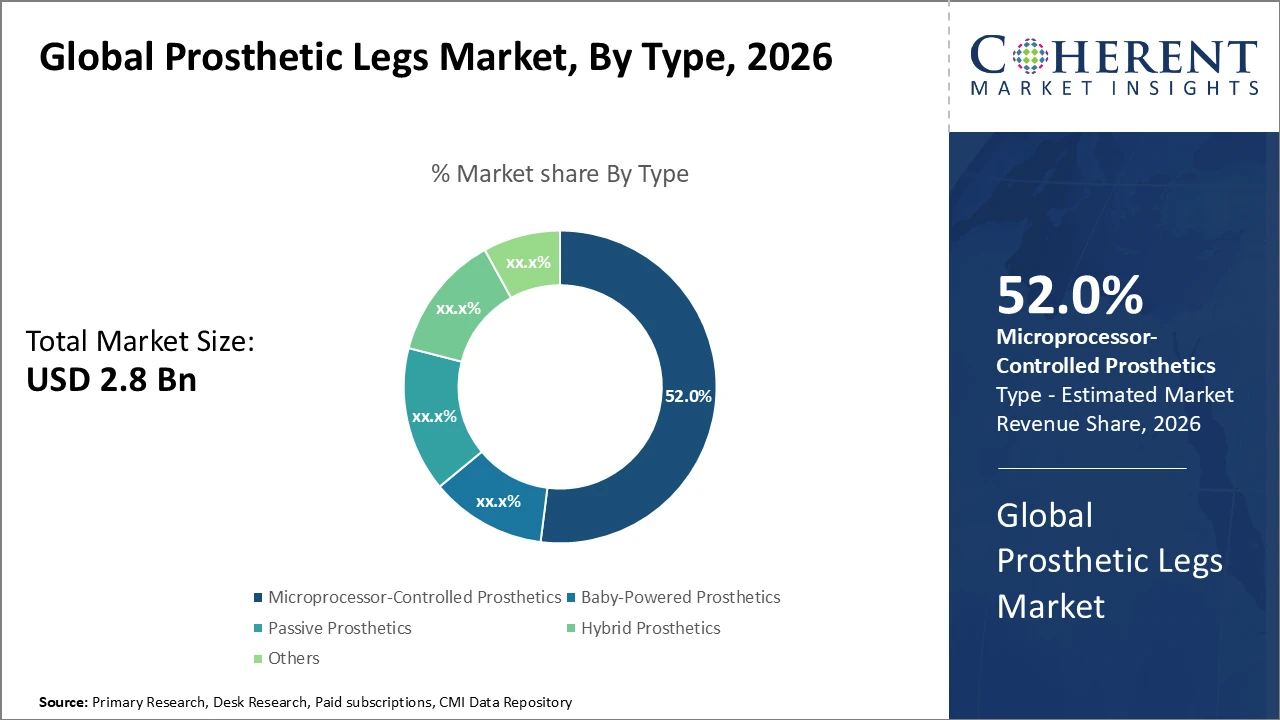
Microprocessor-controlled prosthetics dominate the market with over 52% share, driven by superior functionality and patient preference for adaptive technology.
The below-knee segment holds 60% of the industry share, largely due to the increasing prevalence of below-knee amputations from diabetes and related conditions.
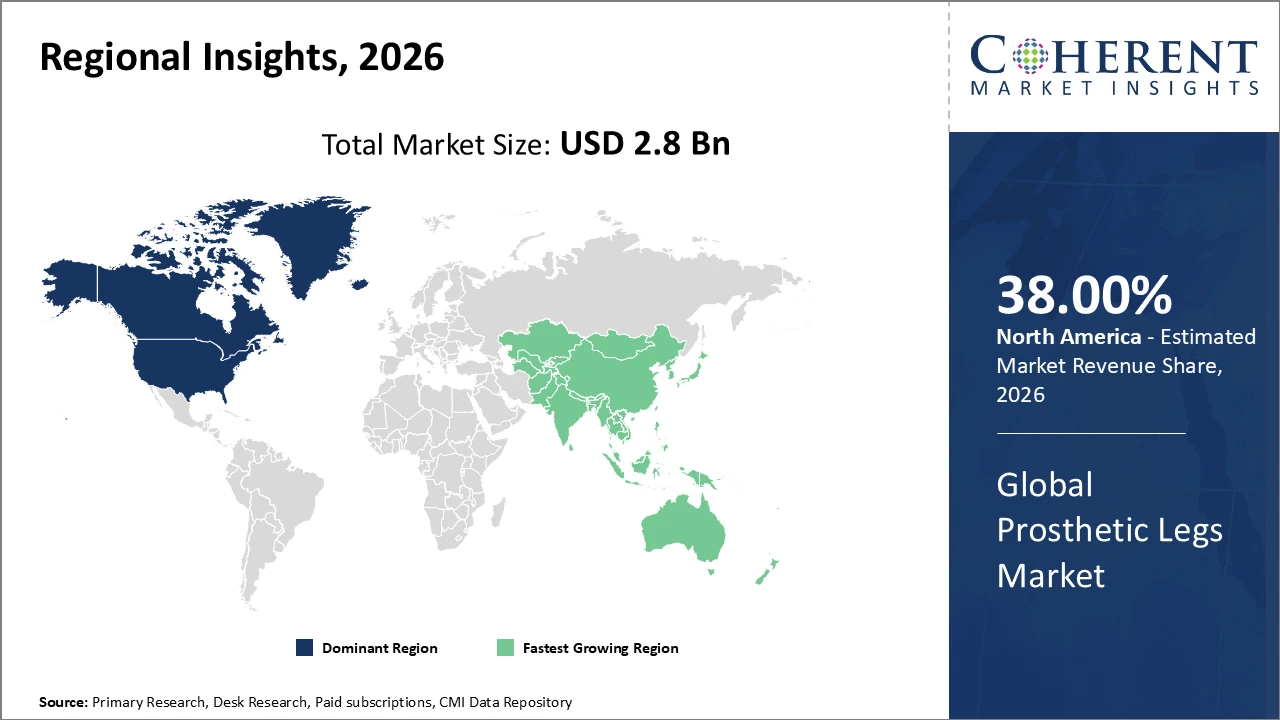
North America leads the market, accounting for approximately 38% of prosthetic legs revenue, supported by advanced healthcare infrastructure and a strong reimbursement environment.
Asia Pacific shows the fastest growth, with a CAGR above 10%, fueled by rising amputation cases, improving healthcare services, and the expansion of orthotic and prosthetic manufacturing hubs.
Prosthetic Legs Market Segmentation Analysis
Prosthetic Legs Market Insights, By Type
Microprocessor-controlled prosthetics dominate the market, representing over 52% of the share due to their ability to provide smoother gait patterns and real-time adaptability. These advanced devices incorporate sensor technologies that enhance balance and reduce fall risk, with a 2025 clinical trial reporting a 30% decrease in accident rates. Rising consumer demand for improved functionality and comfort continues to drive this segment. Body-powered prosthetics occupy a secondary position, favored in cost-sensitive regions for their mechanical simplicity and reliability. Passive prosthetics primarily address cosmetic needs, while hybrid prosthetics, combining microprocessor and body-powered features, are growing at 12% in 2026 as a cost-effective mid-tier solution.
Prosthetic Legs Market Insights, By Amputation Level
The Below Knee segment dominates the prosthetic legs market, holding approximately 60% of the share, driven by the high prevalence of below-knee amputations caused by diabetes and peripheral arterial disease worldwide. Its simpler design compared to above-knee prosthetics allows faster patient adaptation and wider applicability. The above-knee segment, although more technologically advanced, continues to grow steadily due to increasing military and trauma-related amputations from battlefield injuries and vehicular accidents reported in 2024. Highly specialized hip disarticulation and hemipelvectomy prosthetics serve smaller patient populations, but innovations in socket design have enhanced comfort, ensuring each subsegment meets specific clinical needs and maintains consistent demand.
Prosthetic Legs Market Insights, By End-User
Hospitals and clinics hold the largest share of the prosthetic legs market at 58%, owing to their central role in surgical procedures and immediate post-amputation rehabilitation. Their access to advanced prosthetic fitting services and multidisciplinary patient care reinforces their market dominance. Rehabilitation centers are capturing a growing portion of the market due to increasing demand for long-term mobility training and prosthetic adjustments. Home care settings, utilizing tele-rehabilitation and remote fitting technologies, are emerging as convenient alternatives, particularly in regions with limited healthcare access. Specialty centers cater to niche needs, complementing the broader care ecosystem and supporting overall market growth.
Prosthetic Legs Market Trends
The Prosthetic Legs market is increasingly defined by technological integration, especially AI and microprocessor-controlled systems, enhancing mobility and comfort.
In 2025, Ottobock introduced an AI-based prosthetic solution that significantly improved user gait and reduced adaptation periods by 20%.
Adoption of microprocessor-controlled prosthetics continues to rise, driven by patient demand for adaptive and high-performance devices.
Growing awareness of advanced prosthetic benefits among patients and healthcare providers is accelerating market uptake.
Expansion of telemedicine and remote fitting services post-pandemic supports accessibility, particularly in underserved and remote regions.
Prosthetic Legs Market Insights, By Geography
North America Prosthetic Legs Market Analysis and Trends
North America dominates the Prosthetic Legs market, accounting for around 38% of the global share, driven by advanced healthcare infrastructure, robust government reimbursement programs, and high patient awareness. The region benefits from the presence of leading market players, including Ottobock, 3M, and Össur, which invest heavily in R&D and innovative prosthetic solutions. Strong hospital networks and established rehabilitation services further support adoption. Additionally, favorable insurance coverage and supportive policies for amputees enhance accessibility, solidifying North America’s position as the leading regional market.
Asia Pacific Prosthetic Legs Market Analysis and Trends
The Asia Pacific region is experiencing the fastest growth in the Prosthetic Legs market, with a CAGR exceeding 10%, driven by rising amputation rates and increasing healthcare accessibility. Expanding manufacturing capabilities in countries such as China and India are enabling greater availability of advanced prosthetic solutions. Government initiatives, infrastructure development, and growing awareness of rehabilitative care further support adoption. These combined factors create a favorable environment for market expansion, attracting investment from leading global companies and fostering sustained business growth across the region.
Prosthetic Legs Market Outlook for Key Countries
USA Prosthetic Legs Market Analysis and Trends
The USA remains a key market for prosthetic legs, supported by high healthcare expenditure and targeted veteran care programs. Government initiatives through the Department of Veterans Affairs, coupled with rising diabetes-related amputations, drove a 17% increase in demand in 2025. Leading companies such as Össur and Freedom Innovations have expanded R&D operations in the U.S., integrating AI-enabled prosthetic technologies that enhance mobility and patient outcomes. Advanced healthcare infrastructure, favorable reimbursement policies, and a competitive market ecosystem further bolster adoption, positioning the U.S. as a critical hub for innovation and sustained growth in the global prosthetic legs market.
Germany Prosthetic Legs Market Analysis and Trends
Germany is a leading European market for prosthetic legs, supported by a sophisticated healthcare system and reimbursement policies covering up to 70% of costs. In 2026, the country saw a 15% rise in prosthetic legs market revenue, driven by increasing diabetic amputations and growing demand for elderly healthcare solutions. Local manufacturers have partnered with global companies to introduce microprocessor-controlled prosthetics specifically designed for elderly patients, enhancing mobility and comfort. These collaborations align with broader industry trends toward personalized care and advanced prosthetic technologies. Germany’s strong infrastructure, skilled workforce, and supportive policies continue to underpin steady market growth and innovation.
Analyst Opinion
Advancements in material science are expanding the Prosthetic Legs market, with lightweight carbon fiber composites reducing device weight by up to 30%, enhancing patient comfort. In 2025, production capacity using these materials increased by 20%, resulting in a 15% revenue boost in North America.
Pricing dynamics show gradual declines due to economies of scale and wider adoption in emerging markets; mid-level prosthetic legs’ average costs fell by 10% in 2024, aided by competitive local manufacturing in Asia Pacific, improving accessibility and market share in low-to-middle income countries.
Diverse use cases—including trauma rehabilitation, diabetes-related amputations, and military applications—drive complex demand. In 2026, demand for vascular disease-related prosthetics grew 12%, while military-grade prosthetics rose 18%, supported by defense healthcare budgets in the U.S. and Middle East.
Supply chain resilience has strengthened post-pandemic, stabilizing revenue streams. Strategic raw material sourcing and increased inventory buffers reduced lead times by 25% in 2025, ensuring consistent availability and supporting overall market growth.
- Current Industry Events of 2026
- Market Size Estimation
- Regional Breakdown
- Competitive Landscape
- Customer Intelligence
- Segmental Analysis
- Pricing Analysis
- Key Market Drivers, Challenges & Future Trends
- Customized Insights Section
Market Scope
| Report Coverage | Details | ||
|---|---|---|---|
| Base Year: | 2025 | Market Size in 2026: | USD 2.8 billion |
| Historical Data for: | 2020 To 2024 | Forecast Period: | 2026 To 2033 |
| Forecast Period 2026 to 2033 CAGR: | 8.5% | 2033 Value Projection: | USD 5.1 billion |
| Geographies covered: |
| ||
| Segments covered: |
| ||
| Companies covered: | Ottobock, Ossur, Hanger, Inc., Proteor, Endolite, Medi, Bidex, Ossur HF, LimaCorporate, Steeper Group | ||
| Growth Drivers: |
| ||
Prosthetic Legs Market Growth Factors
Technological innovations remain the primary growth driver for the Prosthetic Legs market, with next-generation devices incorporating real-time data analytics to improve patient mobility. For instance, adaptive microprocessor-controlled prosthetics launched in 2024 reduced fall incidents by 30%, boosting adoption rates. Rising prevalence of chronic diseases such as diabetes and peripheral arterial disease further propels demand, as over 15 million amputees globally require prosthetic solutions, with diabetic amputations increasing by 11% in 2025. Government initiatives and reimbursement policies, particularly in North America and Europe, enhance affordability, exemplified by Germany’s 2026 subsidies covering up to 70% of costs. Greater awareness and acceptance among elderly and veteran populations, including a 19% rise in demand following U.S. Veterans Affairs benefit enhancements in 2024, further strengthen market growth.
Prosthetic Legs Market Development
In August 2025, a partnership between the Government of Guyana, the High Commission of India, and the CARICOM Secretariat, led by Kalpataru Projects International Limited, will expand access to prosthetic limbs for Guyanese amputees. So far, 35 amputees have received prosthetics, with 50 more set to benefit. At the launch of the India-CARICOM Prosthetic Limbs Camp at the Ptolemy Reid Rehabilitation Centre, Health Minister Dr. Frank Anthony highlighted that recipients will receive the Jaipur Foot, an affordable, rubber-based prosthetic leg developed in India.
Key Players
Leading Companies of the Market
Ottobock
Ossur
Hanger, Inc.
Proteor
Endolite
Ossur HF
Medi
Bidex
LimaCorporate
Steeper Group
Competitive strategies in the Prosthetic Legs market have centered on focused R&D and strategic market expansion. Companies like Ottobock invested heavily in enhancing microprocessor controls and integrating AI for adaptive walking patterns, resulting in a 22% increase in customer satisfaction in 2025. Meanwhile, Blatchford pursued aggressive entry into emerging markets through joint ventures with local orthopedic centers, successfully expanding its presence and increasing market share by 14% in Asia Pacific in 2026. These approaches highlight how innovation and strategic partnerships are driving growth, improving patient outcomes, and strengthening competitive positioning in the global prosthetic legs market.
Prosthetic Legs Market Future Outlook
The Prosthetic Legs Market is poised for significant growth, driven by rising incidences of diabetes, vascular diseases, and traumatic amputations, alongside increasing global awareness of advanced mobility solutions. Technological innovations, including AI-integrated microprocessor prosthetics, lightweight carbon fiber composites, and bionic systems, are enhancing gait stability, comfort, and patient outcomes. Expansion in emerging markets, supported by government initiatives and improved healthcare infrastructure, will further accelerate adoption. Additionally, developments in tele-rehabilitation, personalized prosthetics, and cost-effective production techniques are expected to broaden accessibility. Overall, the market outlook remains strong, with sustained growth fueled by innovation, rising demand, and global healthcare improvements.
Prosthetic Legs Market Historical Analysis
The Prosthetic Legs Market has witnessed steady growth over the past decade, driven by rising incidences of amputations from diabetes, trauma, and vascular diseases. Early market adoption centered on mechanical and body-powered prosthetics, providing basic mobility solutions. Over time, advancements in materials, such as lightweight carbon fiber and titanium, improved comfort and durability, while microprocessor-controlled and bionic prosthetics enabled enhanced gait and adaptive motion. North America and Europe historically dominated the market due to advanced healthcare infrastructure, reimbursement policies, and high patient awareness, while Asia Pacific emerged as a high-growth region with expanding healthcare access and manufacturing capabilities.
Sources
Primary Research Interviews:
Prosthetic leg manufacturers and suppliers
Hospitals, rehabilitation centers, and clinics
Orthopedic surgeons and prosthetists
Biomedical engineers and R&D specialists
Magazines:
O&P Almanac (Orthotics & Prosthetics Magazine)
Rehab Management
Prosthetics and Orthotics International News
Mobility & Rehabilitation Technology
Journals:
Prosthetics and Orthotics International
Journal of Rehabilitation Research and Development
Medical Engineering & Physics
Journal of Biomechanics
Disability and Rehabilitation: Assistive Technology
Newspapers:
Financial Times – Healthcare & Medical Devices
The Wall Street Journal – Medical Technology
Reuters – Healthcare & Prosthetics Markets
Bloomberg – Medical Devices & Rehabilitation
Nikkei Asia – Healthcare Innovations
Associations:
American Orthotic & Prosthetic Association (AOPA)
International Society for Prosthetics and Orthotics (ISPO)
European Prosthetic & Orthotic Association (EPOA)
World Confederation for Physical Therapy (WCPT)
Get access to 250+ pages report
Every segment, forecast, competitor profile and data table behind the analysis above — available for instant download.
- ESOMAR Member
- ISO 9001:2015 Certified
- D-U-N-S Registered
- GDPR & CCPA Compliant
Missing comfort of reading report in your local language? Find your preferred language:
Transform your Strategy with Exclusive Trending Reports
Frequently Asked Questions
Leading companies include Ottobock, Össur, Bidex, Hanger, Inc., and Medi, which collectively capture a majority of the market by investing in R&D and expanding their geographic presence.
The global prosthetic legs market is projected to reach USD 5.1 billion by 2033, reflecting strong growth driven by rising demand, technological innovation, and increasing adoption of advanced prosthetic solutions.
Hospitals and clinics represent the largest segment due to their central role in post-amputation rehabilitation and prosthetic fitting, significantly influencing overall market revenue.
Trends will focus on AI integration, sustainable materials, tele-rehabilitation solutions, and data-driven prosthetic technologies, improving adoption, mobility outcomes, and patient engagement.
The market is highly competitive, with key players emphasizing innovation and geographic expansion. Challenges include price sensitivity in emerging markets, supply chain fluctuations, and regulatory compliance.
Common strategies include partnerships with healthcare providers, regional manufacturing expansions, customized prosthetic solutions, and strengthening after-sales support and patient training services.