

Red Raspberry Seed Oil Market Size and Forecast – 2026 to 2033
The Red Raspberry Seed Oil Market is anticipated to grow at a CAGR of 3.4% with USD 6.2 Bn in 2026 and is expected to reach USD 8.4 Bn in 2033. Rising demand for natural & organic products, High nutritional & functional benefits and Growing cosmetics & skincare industry.
Key Takeaways
- By Product, Organic Raspberry Oil hold the largest market share of 38.8% in 2026 owing to its strong shift toward natural & organic products. For example, it is widely used in face serums, anti-aging creams, and lip balms because it contains vitamins A & E and antioxidants that support skin regeneration and reduce inflammation.
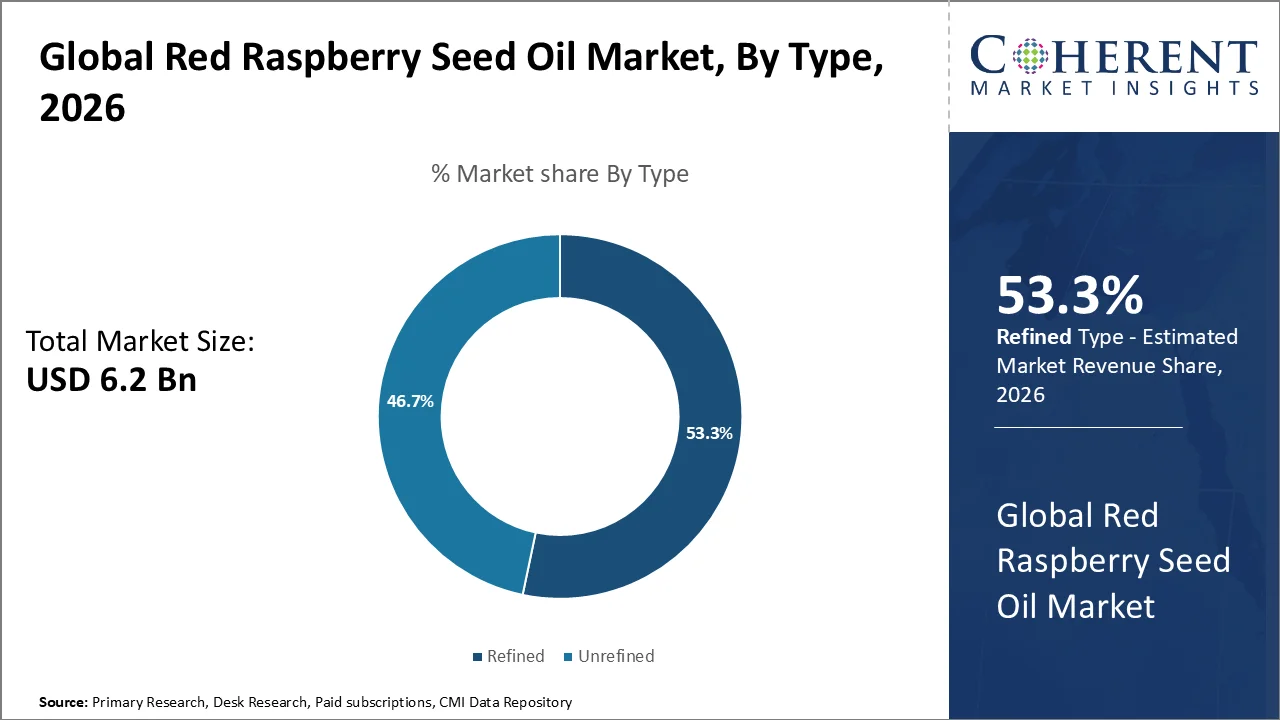
- By Type, Refined expected to hold largest market share of 53.3% in 2026 owing to its high demand from food & beverage industry. It is commonly used in processed foods, salad dressings, and cosmetic formulations, as refining improves shelf life and removes impurities, making it suitable for industrial applications.
- By End User, Food Industry acquired the prominent market share of 43.9% in 2026 owing to the rising demand for functional foods. Raspberry seed oil contains up to ~80% polyunsaturated fatty acids, making it valuable for heart-health-oriented products.
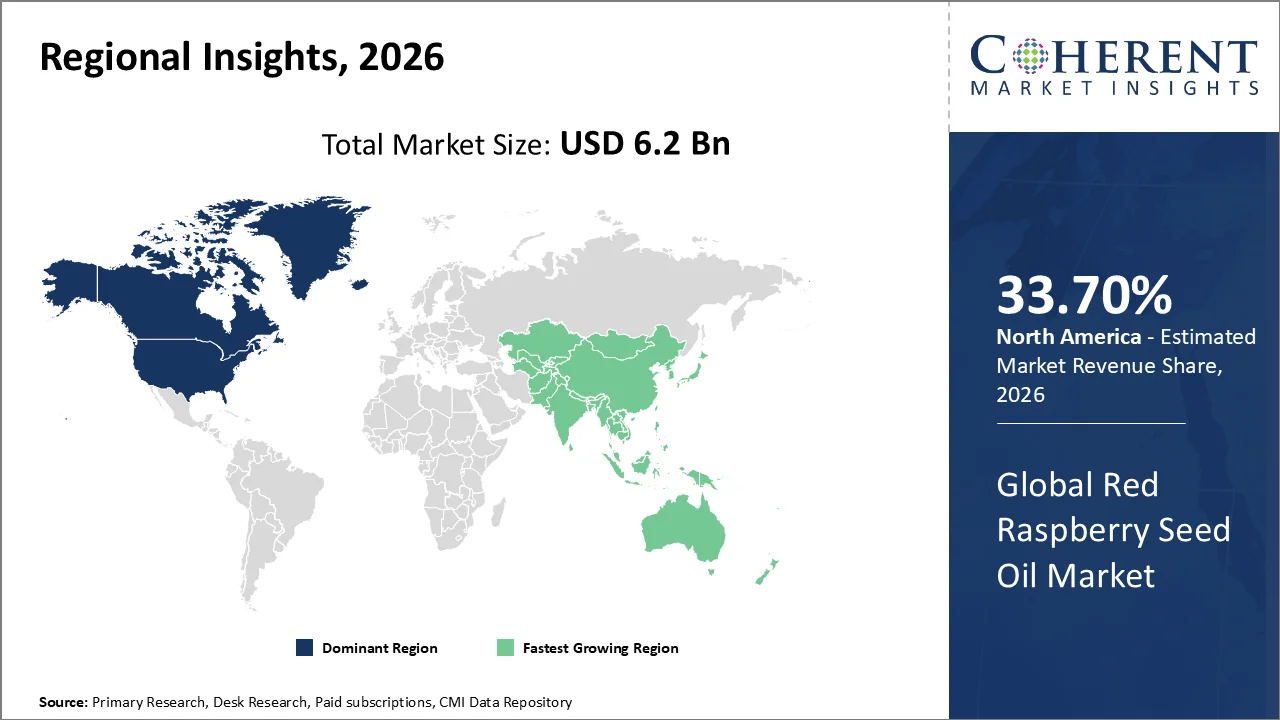
- By Region, North America is expected to acquire the dominant share of 33.7% in 2026 owing to its well-established cosmetics & personal care industry. For instance, raspberry seed oil is frequently incorporated into natural skincare brands, sunscreens, shampoos, and lotions, driven by consumer preference for plant-based beauty products.
Current Events and Their Impact on the Red Raspberry Seed Oil Market
Current Event | Description and its Impact |
EU Cosmetics Regulation Amendments (2025–2026) |
|
Stricter EU “Natural Ingredient” Verification Rules (2026) |
|
Segmental Insights
- Current Industry Events of 2026
- Market Size Estimation
- Regional Breakdown
- Competitive Landscape
- Customer Intelligence
- Segmental Analysis
- Pricing Analysis
- Key Market Drivers, Challenges & Future Trends
- Customized Insights Section
Refined holds the Largest Market Share
Refined expected to hold largest market share of 53.3% in 2026 owing to its Cost-effectiveness for bulk applications. Neutral color, odor, and taste make refined red raspberry seed oil suitable for large-scale food and cosmetic formulations, driving its market growth. Improved stability and longer shelf life support its use in industrial applications and global distribution. Manufacturers prefer it for its cost efficiency and consistent quality. Its compatibility with processed foods and personal care products, along with the presence of essential fatty acids, further strengthens its demand across multiple industries.
Why is Organic Raspberry Oil Acquiring the Largest Market Share?
Organic Raspberry Oil hold the largest market share of 38.8% in 2026. Rising consumer preference for natural, chemical-free ingredients and growing demand for clean-label products drive the growth of organic raspberry oil in the red raspberry seed oil market. Its rich content of antioxidants, essential fatty acids, and vitamins supports its application in skincare, nutraceuticals, and wellness products.
Increasing awareness of sustainable sourcing and eco-friendly options further boosts adoption. Moreover, premium positioning and strong appeal in high-end cosmetics and health-focused formulations significantly contribute to market demand. For instance, in April 2026, Baby Forest expanded its kids’ range with Surya Kawach SPF 30 Baby Sunscreen, a plant-based formula that protects delicate skin from UVA/UVB rays while hydrating it with seabuckthorn, carrot seed, red raspberry seed, and aloe vera.
Food Industry acquired the prominent market share
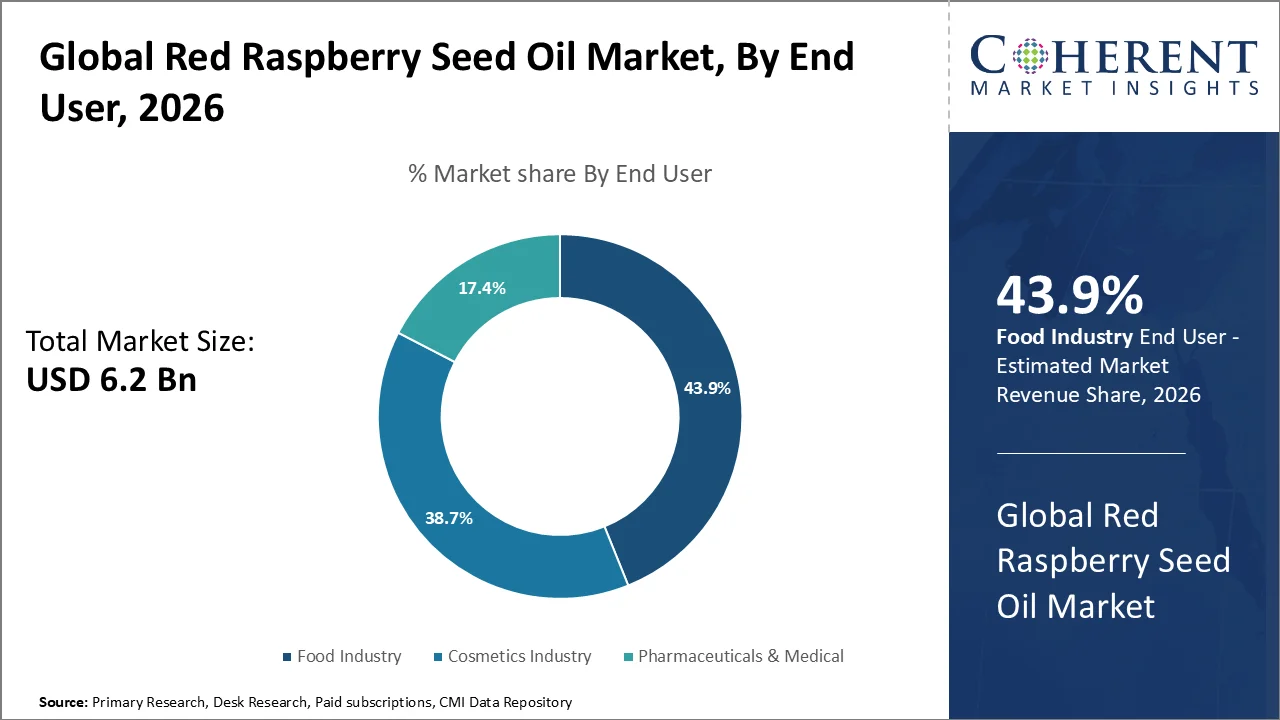
Food Industry acquired the prominent market share of 43.9% in 2026 owing to the Application in dietary supplements and nutraceuticals. Growing demand for functional and health-focused foods drives the food industry segment in the red raspberry seed oil market. Manufacturers use the oil because it contains omega fatty acids, antioxidants, and vitamins that support overall wellness. Increasing consumer preference for clean-label and natural ingredients further promotes its use in processed and premium food products. Its mild flavor and nutritional benefits make it suitable for various applications, including dressings, bakery items, and dietary supplements across the industry. For instance, in August 2025, Mike’s Mighty Good launched its Chicken Bone Broth Ramen Cup, a seed oil–free instant ramen made with antibiotic-free chicken, real bone broth, and organic noodles, offering a convenient, high-protein option with premium ingredients.
Red Raspberry Seed Oil Market Trends
- Rising demand for clean-label, natural, and minimally processed ingredients strengthens the adoption of red raspberry seed oil across cosmetics, food, and nutraceutical applications, driven by increasing consumer awareness of plant-based wellness solutions.
- Growing preference for organic and sustainable personal care products is driving the use of botanical oils rich in bioactives. Red raspberry seed oil contains ~80–85% essential fatty acids (omega-3 and omega-6) and high levels of vitamin E (tocopherols), supporting its use in anti-aging, moisturizing, and sun-care formulations.
- Expanding applications in functional foods and dietary supplements are supporting market growth. Raspberry seed oil is composed of ~52–60% linoleic acid and ~10–30% alpha-linolenic acid, both linked to cardiovascular and skin health benefits, aligning with rising demand for heart-health-focused ingredients.
- Increasing use in premium cosmetic formulations, including serums, creams, and carrier oils, boosts demand due to its lightweight texture, mild aroma, and compatibility with active ingredients in high-performance beauty products.
- Rising awareness of environmental sustainability and by-product utilization is promoting raspberry seed oil extraction from fruit waste. Studies indicate that raspberry processing generates up to ~10–15% seed waste, which can be repurposed for oil extraction, supporting circular economy practices and reducing overall food waste.
Regional Insights
North America dominates owing to High consumer awareness & spending power
North America is expected to acquire the dominant share of 33.70% in 2026. Strong demand for natural and organic ingredients drives the North America red raspberry seed oil market, and a well-established cosmetics and personal care industry supports this growth. Consumers increasingly prefer clean-label, plant-based products that offer antioxidant and skin-nourishing benefits. Rising health awareness and high spending capacity further boost adoption across skincare, nutraceuticals, and functional foods. Advanced distribution networks and a strong e-commerce presence improve product availability. Innovation in premium formulations and sustainable sourcing practices further strengthen market growth across the region. For instance, PepsiCo launched a new Rockstar Energy drink infused with hemp seed oil, combining caffeine, B vitamins, spearmint, and lemon balm in a sugar- and calorie-free formula available in Blueberry, Passionfruit, and Raspberry Cucumber flavors.
Asia Pacific Red Raspberry Seed Oil Market Trends
Rapid urbanization and rising disposable incomes drive the Asia Pacific red raspberry seed oil market, and they increase demand for premium personal care and wellness products. Consumers show growing awareness of natural and plant-based ingredients, which supports adoption in skincare and nutraceutical applications. Expanding cosmetics manufacturing and e-commerce platforms improve product accessibility across emerging economies. Additionally, increasing focus on health, beauty, and sustainable products encourages consumers to shift toward botanical oils rich in antioxidants and essential fatty acids, strengthening regional market growth.
United States Red Raspberry Seed Oil Market Trends
Strong demand for natural and organic personal care products drives the United States red raspberry seed oil market, and a highly developed cosmetics and wellness industry supports this growth. Consumers actively seek clean-label, plant-based ingredients with antioxidant and anti-aging benefits. Rising awareness of skin health and preventive wellness further boosts adoption across skincare, nutraceuticals, and functional foods. Advanced R&D activities, strong retail and e-commerce networks, and high disposable income levels also significantly contribute to market growth across the country. For instance, Bono USA launched its first line of Italian pasta sauces in seven varieties, bringing authentic Italian flavors to the U.S. market and reinforcing its focus on high-quality products.
Japan Red Raspberry Seed Oil Market Trends
Rising focus on skin health, longevity, and preventive wellness further supports market growth, especially as over 29% of Japan’s population is aged 65 and above, increasing demand for anti-aging and functional skincare solutions. Advanced product innovation and strong distribution networks also contribute to market expansion.
Who are the Major Companies in Red Raspberry Seed Oil Industry
Some of the major key players in Red Raspberry Seed Oil are Botanic Innovations, Sweet Essentials, Healing Hollow Essential Oil, Naissance, Sheabutter Cottage, PureNature, Kari Gran, Majestic Mountain Sage, and The Apothecary in Inglewood.
Key News
- In May 2025, Glossier launched a new Lip Glaze featuring KATSEYE, blending nine botanical oils, apricot and raspberry seed oils for hydration and plumping, and liquid shea butter for lightweight nourishment.
Market Report Scope
Red Raspberry Seed Oil Market Report Coverage
| Report Coverage | Details | ||
|---|---|---|---|
| Base Year: | 2025 | Market Size in 2026: | USD 6.2 Bn |
| Historical Data for: | 2020 To 2024 | Forecast Period: | 2026 To 2033 |
| Forecast Period 2026 to 2033 CAGR: | 3.4% | 2033 Value Projection: | USD 8.4 Bn |
| Geographies covered: |
| ||
| Segments covered: |
| ||
| Companies covered: | Botanic Innovations, Sweet Essentials, Healing Hollow Essential Oil, Naissance, Sheabutter Cottage, PureNature, Kari Gran, Majestic Mountain Sage, and The Apothecary in Inglewood. | ||
Analyst Opinion
- Demand for red raspberry seed oil is being disproportionately shaped by “functional cosmetic positioning” rather than true ingredient necessity. Industry formulation data consistently shows that linoleic acid makes up ~50–65% of its fatty acid profile, which is chemically similar to far cheaper carrier oils like grapeseed and sunflower oil. Yet it continues to be marketed as a “premium bioactive oil” largely due to its antioxidant narrative rather than formulation superiority.
- The so-called “natural UV protection” claim has been overstated in commercial usage. While in-vitro studies have reported SPF-equivalent values in controlled lab conditions, independent cosmetic chemistry reviews consistently note that red raspberry seed oil’s actual SPF contribution in finished formulations is negligible compared to regulated UV filters. Despite this, it is still frequently positioned in niche SPF products as a marketing differentiator rather than a functional UV agent.
- Supply dynamics are structurally constrained, not demand-driven. Red raspberry seed oil is a by-product of raspberry seed waste from juice and jam processing, and cold-press yields are typically very low (often cited in industry extraction ranges of ~10–15% oil from seed mass). This inherently limits scalability and explains why it is disproportionately concentrated in high-margin skincare SKUs rather than mass-market formulations.
- Adoption is being driven more by “clean beauty signalling” than measurable clinical differentiation. In comparative cosmetic formulation studies, antioxidant activity (polyphenols, tocopherols) is not unique versus alternatives like rosehip or argan oil, yet it is repeatedly selected in premium indie skincare lines because it allows brands to claim “edible-grade, seed-derived, upcycled antioxidant oil” positioning. This branding effect, rather than performance superiority, is what sustains its demand trajectory in professional formulation circles.
Speak to the analyst
Want personalized insights?
Take the findings above to one of our principal consultants, or have the report rebuilt around the segments, geographies and competitors you actually track.
Market Segmentation
- By Product
- Organic Raspberry Oil
- Black Raspberry Oil
- Red Raspberry Oil
- Others (Non-organic Raspberry Oil)
- By Type
- Refined
- Unrefined
- By End User
- Food Industry
- Cosmetics Industry
- Pharmaceuticals & Medical
- By Region
- North America
- U.S.
- Canada
- Latin America
- Brazil
- Mexico
- Argentina
- Rest of Latin America
- Europe
- Germany
- U.K.
- France
- Italy
- Spain
- Russia
- Rest of Europe
- Asia Pacific
- China
- India
- Japan
- Australia
- South Korea
- ASEAN
- Rest of Asia Pacific
- Middle East
- GCC
- Israel
- Rest of Middle East
- Africa
- South Africa
- Central Africa
- North Africa
- North America
Sources
Primary Research Interviews
- Cosmetic formulators and R&D professionals in personal care companies
- Procurement managers from natural ingredient suppliers
- Organic skincare brand owners and product development teams
- Aromatherapy and essential oil distributors and wholesalers
- Dermatologists and skincare specialists using botanical oils
Databases
- PubMed Central (biomedical and dermatological studies)
- ScienceDirect (peer-reviewed natural product chemistry papers)
- Google Scholar (academic research on seed oils and fatty acid composition)
- USDA FoodData Central (nutritional and composition data)
- European Food Safety Authority (EFSA) database
- Cosmetic Ingredient Review (CIR) reports
Magazines
- Cosmetics & Toiletries Magazine
- Natural Products Insider
- Organic Spa Magazine
- Perfumer & Flavorist Magazine
- Global Cosmetic Industry (GCI) Magazine
Journals
- Journal of Cosmetic Science
- Industrial Crops and Products
- Phytotherapy Research
- Journal of Agricultural and Food Chemistry
- International Journal of Cosmetic Science
Newspapers:
- The Guardian (health and sustainability sections)
- The New York Times (wellness and consumer trends)
- The Economic Times (India – FMCG and natural products coverage)
- Financial Times (consumer goods and beauty industry trends)
- The Hindu Business Line
Associations
- Personal Care Products Council (PCPC)
- International Federation of Societies of Cosmetic Chemists (IFSCC)
- Soil Association (organic certification body)
- American Herbal Products Association (AHPA)
- European Natural and Organic Cosmetics Association (COSMOS-standard organization)
Public Domain Sources
- World Health Organization (WHO) publications on natural ingredients
- Food and Agriculture Organization (FAO) reports
- National Center for Biotechnology Information (NCBI)
- Government agricultural extension reports
- Open-access university research repositories
Proprietary Elements
- CMI Data Analytics Tool
- Proprietary CMI Existing Repository of information for last 8 years
Get access to 250+ pages report
Every segment, forecast, competitor profile and data table behind the analysis above — available for instant download.
- ESOMAR Member
- ISO 9001:2015 Certified
- D-U-N-S Registered
- GDPR & CCPA Compliant
Missing comfort of reading report in your local language? Find your preferred language:
Transform your Strategy with Exclusive Trending Reports
Frequently Asked Questions
The Red Raspberry Seed Oil Market is anticipated to grow at a CAGR of 3.4% with USD 6.2 Bn in 2026 and is expected to reach USD 8.4 Bn in 2033.
Demand is primarily driven by marketing-driven “natural active” positioning rather than functional necessity.
In real-world formulations, its contribution is negligible. While some in-vitro studies have reported SPF-like behavior under controlled lab conditions, cosmetic chemists consistently emphasize that it cannot replace regulated UV filters.
The cost is structurally driven by low extraction efficiency. Since it is typically a by-product of raspberry processing waste streams, oil yield per unit biomass is limited (industry extraction estimates often fall around low double-digit percentages from seed mass).
It is concentrated in premium indie skincare, niche SPF blends, and “clean beauty” formulations.
Current trajectory suggests continued marketing-driven demand. Unless new extraction technologies significantly reduce cost or new clinical data demonstrates distinct dermatological benefits, it is unlikely to transition from niche positioning into mainstream functional formulation use.