

Apple Fiber Market Size and Share Analysis - 2026 To 2033
The global apple fiber market size is expected to reach USD 1.52 Bn in 2026 and is projected to grow at a CAGR of 7.0% during the forecast period (2026-2033), surpassing USD 2.44 Bn by 2033. This can be attributed to increasing demand for clean-label and natural food ingredients and the rising consumer focus on digestive health and high-fiber diets. 30% of global food and beverage launches featured a clean label claim in the past year. No additives or preservatives lead with 14% penetration. Australasia displays the highest penetration, with 49% launches having clean label claims in the past year, ahead of North America and Europe. The penetration in Asia has increased by 3% over the past year, with a smaller rise in Africa and the Middle East.
Key Takeaways from the Apple Fiber Market Report
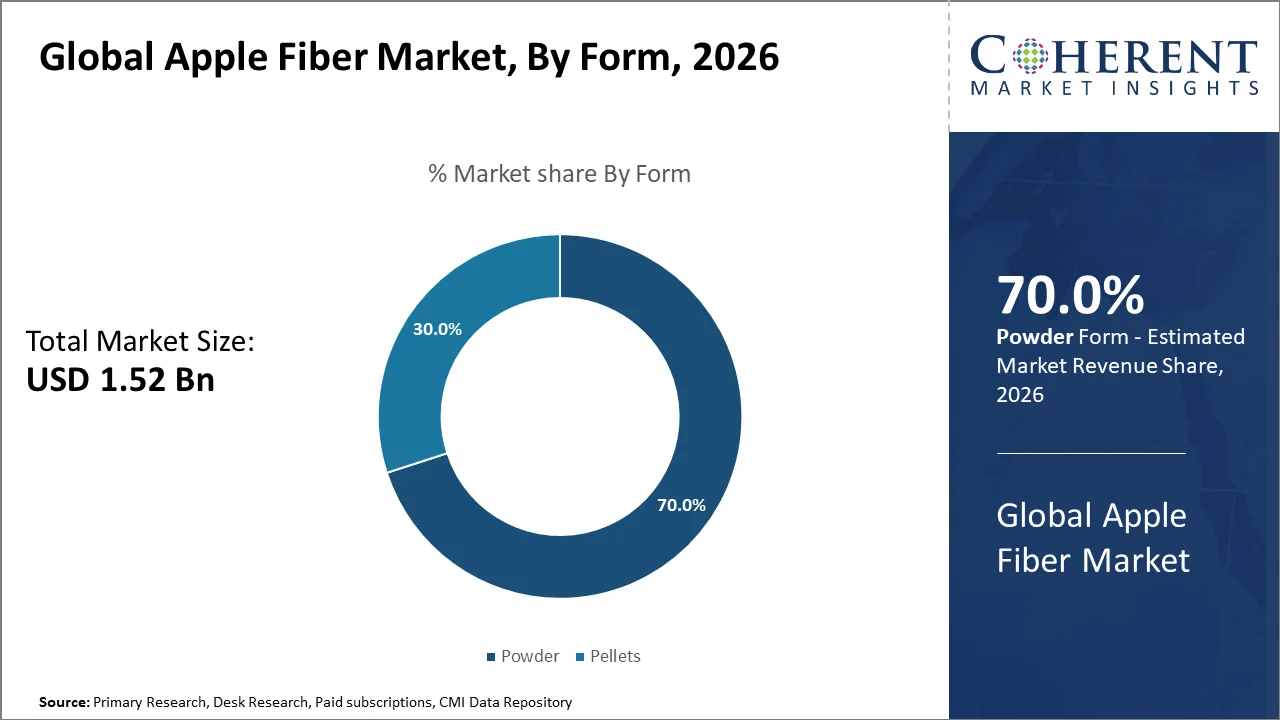
- Apple fiber powder is projected to lead the market with a share of 70% in 2026 because it is easy to blend into food, beverages, dietary supplements, and bakery products. For example, a peer-reviewed study found that apple pomace powder can replace up to 25% of wheat flour in cakes while increasing dietary fiber to 14.2%.
- Dietary supplements are slated to account for the largest market share of 33.8% in 2026 because apple fiber is increasingly used in digestive health supplements and functional nutrition products. Among U.S. adults aged 20 and older, 57.6% used dietary supplements, with higher usage among women (63.8%).
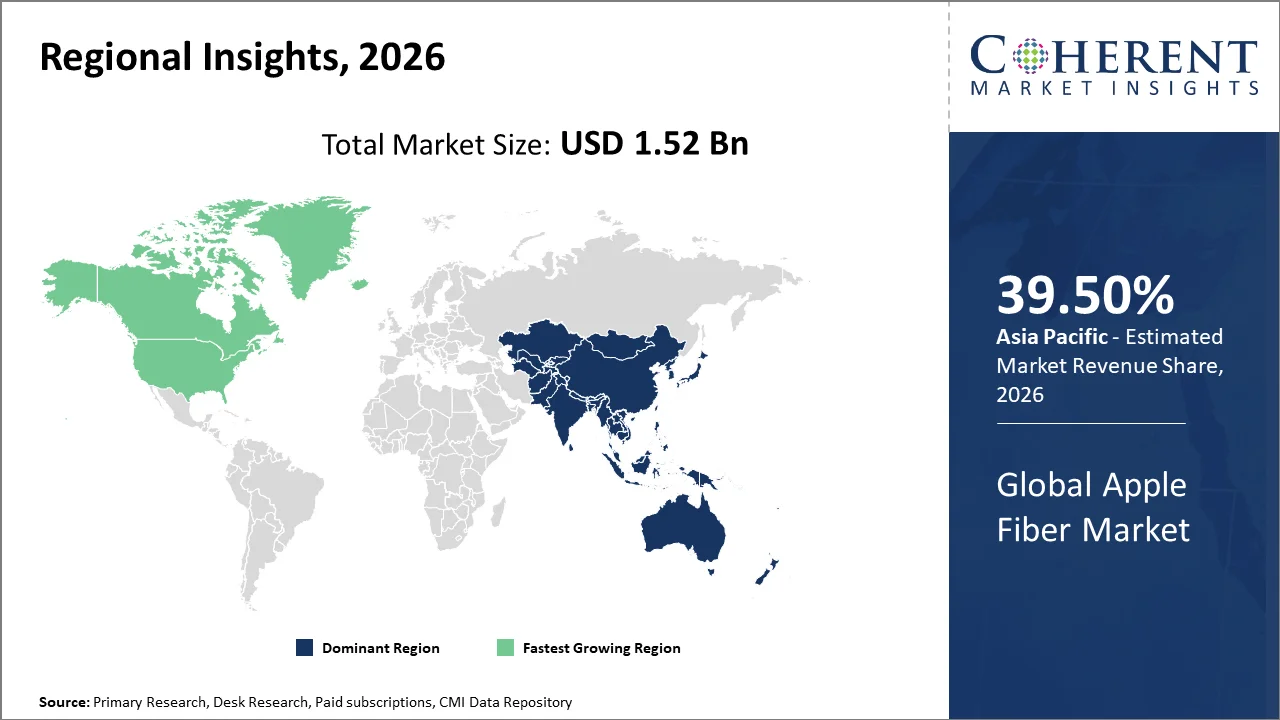
- Asia Pacific is expected to dominate the global apple fiber industry with a share of 39.5% in 2026 because of expanding food processing industries, growing health awareness, increasing bakery production, and abundant apple processing in China and India. For example, USDA estimates China's apple production at 47 million metric tons in 2025/26, providing abundant raw material for apple fiber production.
Apple Fiber Market Overview
The global apple fiber market is projected to grow steadily during the forecast period. This growth is driven by the increasing use of apple fiber in bakery products, beverages, dietary supplements, and functional foods. Rising consumer demand for natural and clean-label ingredients, greater awareness of the health benefits of dietary fiber, and the expansion of the food processing industry are also supporting the growth of the apple fiber market.
Apple fiber products are produced from apple pomace, the solid residue generated during apple juice and cider processing. During the pressing process, juice is separated from apple flesh and skin, leaving behind fiber-rich apple solids that are dried and milled into a uniform powder. Apple fiber is a natural source of soluble and insoluble dietary fibers, including pectin, cellulose, and hemicellulose, which support its use in functional food and beverage applications.
Organic apple fiber typically contains a significant amount of dietary fiber, making it suitable for improving fiber content and texture in various food products. The global availability of diverse apple cultivars, with more than 7,500 varieties developed through cultivation and breeding, supports the continuous supply of apple-based ingredients. Some widely recognized apple varieties include Ambrosia, Golden Russet, Junami, and Red Astrachan.
Apple fiber supports digestive health, weight management, and overall wellness due to its high dietary fiber and antioxidant content. Increasing consumer focus on healthy diets, gut health, and functional food ingredients is driving demand for apple fiber-based products.
Increasing numbers of cases of obesity and overweight around the globe create more needs for foods high in fiber content and thus encourage healthy eating habits. Trends of global obesity from the reports of WHO reveal that the number of obese people exceeds one Bn across the world.
Increasing popularity of plant-based diets is expected to boost the apple fiber market value in the coming years. There is a growing consumer preference for vegan and plant-based foods across the world. This is driving demand for fruit-derived functional ingredients such as apple fiber, which offers natural fiber enrichment without animal-derived additives.
Segmental Insights
Which is the Most Widely Used Form of Apple Fiber?
Demand Remains High for Apple Fiber Powder in the Market
By form, Apple fiber powder is set to lead the global market, accounting for a revenue share of 70% in 2026. This dominance is attributable to its excellent water-binding capacity, long shelf life, and ease of incorporation into a wide range of food and beverage formulations.
Powdered apple fiber is widely used in bakery products, meat products, dairy alternatives, beverages, nutritional supplements, and functional foods to improve texture, stabilize formulations as well as increase dietary fiber content. Its compatibility with automated food processing systems, consistent quality, and cost-effectiveness also support it adoption among manufacturers.
For example, a 2024 study published in Scientific Reports found that apple pomace powder has a water absorption capacity of 3.35 g/g, compared with 1.01 g/g for wheat flour. This high water-binding capacity helps improve texture and moisture retention in bakery and processed foods, supporting the growing use of apple fiber powder in food applications.
Rising consumer demand for clean-label, high-fiber, and plant-based products is also fueling sales of apple fiber powders. Similarly, expanding use of apple fiber powder in dietary supplements, sports nutrition products, and gluten-free food formulations is expected to boost segment growth during the forecast period.
- Current Industry Events of 2026
- Market Size Estimation
- Regional Breakdown
- Competitive Landscape
- Customer Intelligence
- Segmental Analysis
- Pricing Analysis
- Key Market Drivers, Challenges & Future Trends
- Customized Insights Section
Which Application Holds the Largest Apple Fiber Market Share?
Dietary Supplements Segment to Hold Over One-Third Share in 2026
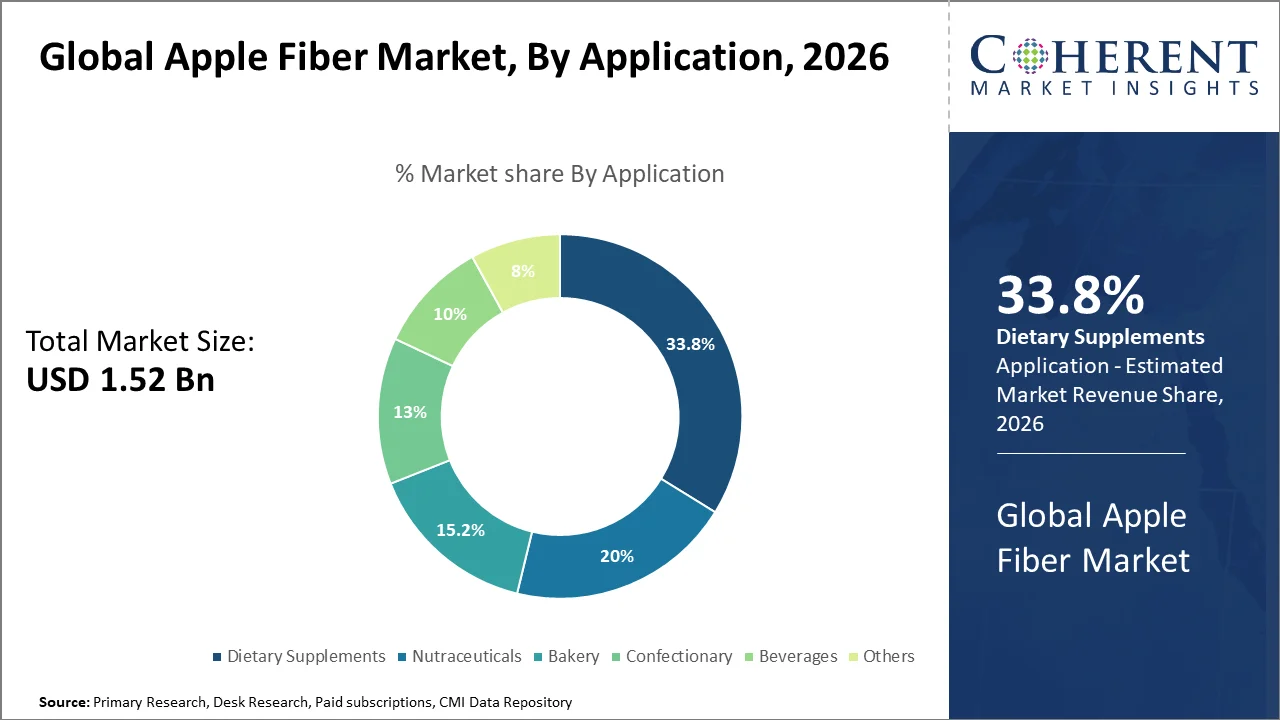
Based on application, dietary supplements are projected to account for the largest market share of 33.8% in 2026. This is mostly due to growing consumer preference for natural fiber ingredients that support digestive health, weight management, and overall wellness. According to Campbell County Health, apples support gut health.
Apple fiber is widely used in dietary supplements because of its high soluble and insoluble fiber content. It helps improve gut health, promote regular bowel movement as well as enhance satiety. Rising awareness of preventive healthcare and increasing demand for clean-label and plant-based nutritional products are also slated to drive adoption of apple fiber in dietary supplement formulations during the forthcoming period.
For example, the 2024 IFIC Food & Health Survey found that 36% of consumers seek digestive or gut health benefits from foods, beverages, and nutrients. This growing interest in digestive wellness is supporting demand for natural fiber ingredients such as apple fiber in dietary supplement formulations.
Apple Fiber Market Growth Drivers
Rising Demand for Digestive Health Products
Increasing demand for digestive health products is perhaps a major factor driving growth of apple fiber market. Consumers in the contemporary world are increasingly choosing high-fiber foods and dietary supplements to support gut health, weight management, and overall wellness. Apple fiber is gaining popularity because it is a natural source of dietary fiber and pectin. It is being increasingly used in functional foods, beverages, and dietary supplements.
Apple Fiber Market Opportunities
Expansion of Functional Food and Beverage Applications
Apple fiber is increasingly used in breads, cereals, nutrition bars, dairy alternatives, smoothies, and plant-based foods due to its ability to improve texture, moisture retention, and fiber content. It also helps manufacturers develop reduced-fat and reduced-sugar products while maintaining product quality. Thus, growing demand for functional foods and beverages is expected to create lucrative growth opportunities for the apple fiber market during the forecast period.
Apple Fiber Market Trends
Rising Demand for Organic Apple Fiber
Increasing demand for organic food products is a key trend shaping the apple fiber market. Modern consumers prefer organic and minimally processed food ingredients due to rising health and environmental awareness. This, in turn, is encouraging manufacturers to expand their organic apple fiber product portfolios.
For example, the PwC Voice of the Consumer Survey 2025 study, which involved 21,000 consumers from 28 countries, revealed that 73% of consumers are ready to pay extra for the environment sustainability of their food products. Moreover, according to the results of the study, 29% of consumers switch their food brands due to their health benefits.
Current Events and Their Impact on the Apple Fiber Market
Current Event | Description and its Impact |
WHO Promotes Higher Fiber Intake (2025–2026) |
|
Rising Demand for Clean-Label Foods |
|
Regional Insights
Asia Pacific Remains ate the Epicenter of Apple Fiber Market Growth
Asia Pacific is projected to lead the global apple fiber market during the forecast period, holding a share of 39.5% in 2026. This is mostly due to abundant apple production, rapid growth of the food processing industry, increasing health awareness, and rising demand for natural functional ingredients in food and beverages.
Strong apple production is one of the biggest factors driving Asia Pacific apple fiber market. Large apple harvests provide a steady supply of apple pomace, the main raw material used to produce apple fiber. According to the USDA, China is expected to produce about 47 million metric tons of apples in the 2025/26 season, making it the world's largest apple producer. This supports large-scale apple fiber production as well as helps meet growing demand from food manufacturers across the region.
Rising Preference for High-Fiber Foods Spurring Growth in North America
North America is expected to account for more than 28% of the global apple fiber market in 2026. This growth is mostly due to rising demand for clean-label and high-fiber foods, increasing consumer focus on digestive health, and rising use of natural ingredients in bakery, snacks, and dietary supplements.
Growing demand for high-fiber foods is playing a key role in boosting North America apple fiber market growth. Consumers across nations like the United States and Canada are increasingly choosing foods that improve digestive health and overall wellness. This, in turn, is expected to fuel demand for apple fibers during the forthcoming period.
According to the This trend is encouraging food manufacturers to use natural ingredients such as apple fiber in bakery products, snacks, and dietary supplements, leading to steady market demand.
Apple Fiber Market Outlook – Country-wise
China Apple Fiber Market Forecast
China’s apple fiber market is poised to register strong growth during the assessment period. This can be attributed to the country's large apple production, abundant availability of apple pomace from juice processing as well as rising demand for clean-label and functional food ingredients and rapid expansion of the bakery, dairy, and dietary supplement industries. Growing consumer awareness of digestive health and increasing investments in food ingredient manufacturing are also expected to support market growth.
U.S. Apple Fiber Market Trends
The United States is expected to remain a key market for apple fibers during the forecast period. This is mainly due to rising consumer demand for high-fiber and plant-based foods, increasing use of natural ingredients in clean-label product formulations, and rising adoption of apple fiber in meat alternatives, bakery products, and nutritional supplements. The presence of leading food manufacturers, ongoing product innovation, and growing emphasis on sustainable utilization of fruit processing by-products are also supporting market expansion.
Who are the Major Companies in the Apple Fiber Market?
Some of the major players in apple fiber market are CFF GmbH & Co. KG, J. RETTENMAIER & SOHNE GmbH + Co KG, Pestell Minerals & Ingredients Inc., Marshall Ingredients, Herbafood Ingredients GmbH, and Mayer Brothers.
Key Strategies Adopted by Industry Players
Leading manufacturers of apple fiber products are adopting various organic and inorganic strategies to boost their revenue as well as gain a competitive edge in the industry. These include new product launches, partnerships, distribution agreements, collaborations, mergers, and acquisitions.
- In September 2025, Herbafood Ingredients GmbH expanded its apple fiber portfolio with the launch of Herbacel® AQ® AFB-200 and AFB-250 functional apple fibers. The new fibers offer improved water-binding and swelling properties for applications such as meat alternatives, bakery products, and confectionery.
- In March 2025, Herbstreith & Fox expanded the commercialization of Herbafood’s apple and citrus fibers through its Italian subsidiary, Herbstreith & Fox Italy. The move strengthened the company’s distribution activities for fruit-based fiber ingredients in the Italian market.
Market Report Scope
Apple Fiber Market Report Coverage
| Report Coverage | Details | ||
|---|---|---|---|
| Base Year: | 2025 | Market Size in 2026: | USD 1.52 Bn |
| Historical Data for: | 2020 To 2024 | Forecast Period: | 2026 To 2033 |
| Forecast Period 2026 to 2033 CAGR: | 7.0% | 2033 Value Projection: | USD 2.44 Bn |
| Geographies covered: |
| ||
| Segments covered: |
| ||
| Companies covered: | CFF GmbH & Co. KG, J. RETTENMAIER & SOHNE GmbH + Co KG, Pestell Minerals & Ingredients Inc, Marshall Ingredients, Herbafood Ingredients GmbH, and Mayer Brothers. | ||
| Growth Drivers: |
| ||
| Restraints & Challenges: |
| ||
Analyst Opinion (Expert Opinion)
- Apple fiber is benefiting from the growing focus on digestive health. More consumers in the contemporary world are choosing fiber-rich ingredients for supplements, functional foods, and beverages, increasing demand for apple fiber.
- Food manufacturers are using apple fiber as a natural clean-label ingredient to improve texture, moisture retention as well as fiber content. This supports wider adoption across bakery, dairy, and plant-based food products.
- Increasing fiber consumption will help the market grow. According to the World Health Organization (WHO), individuals aged 10 and older should have daily intake of at least 25 grams of dietary fiber, which would result in the increased use of fiber-based ingredients such as apple fiber in foods consumed by consumers on an everyday basis.
Speak to the analyst
Want personalized insights?
Take the findings above to one of our principal consultants, or have the report rebuilt around the segments, geographies and competitors you actually track.
Market Segmentation
- By Form Insights ( Revenue, USD Bn, 2021 - 2033)
- Powder
- Pallets
- By Cultivation Type Insights ( Revenue, USD Bn, 2021 - 2033)
- Organic Apples
- Conventionally Raised Apples
- By Application Insights ( Revenue, USD Bn, 2021 - 2033)
- Dietary Supplements
- Nutraceuticals
- Bakery
- Confectionary
- Beverages
- Others
- By Distribution Channel Insights ( Revenue, USD Bn, 2021 - 2033)
- Hypermarket
- Supermarket
- Convenience Stores
- Online Stores
- Others
- By Region Insights ( Revenue, USD Bn, 2021 - 2033)
- North America
- U.S.
- Canada
- Latin America
- Brazil
- Argentina
- Mexico
- Rest of Latin America
- Europe
- Germany
- U.K.
- Spain
- France
- Italy
- Russia
- Rest of Europe
- Asia Pacific
- China
- India
- Japan
- Australia
- South Korea
- ASEAN
- Rest of Asia Pacific
- Middle East
- GCC Countries
- Israel
- Rest of Middle East
- Africa
- North Africa
- South Africa
- Central Africa
Sources
Primary Research interviews
- CEOs
- Product Managers
- R&D Directors
- Procurement Managers
- Food Scientists
- Ingredient Suppliers
- Dietary Supplement Manufacturers
- Food & Beverage Manufacturers
- Distributors
- Industry Experts
Databases
- FAOSTAT
- Eurostat
- USDA FoodData Central
- UN Comtrade Database
- World Bank Open Data
Magazines
- Food Technology Magazine
- Food Business News
- Nutraceuticals World
- Food Ingredients First
- Prepared Foods
Journals
- Journal of Food Science
- Food Chemistry
- Journal of Functional Foods
- International Journal of Food Science & Technology
- Foods
Newspapers
- The Wall Street Journal
- Financial Times
- The New York Times
- The Guardian
- The Economic Times
Associations
- Institute of Food Technologists (IFT)
- International Food Information Council (IFIC)
- European Food Information Council (EUFIC)
- International Association for Cereal Science and Technology (ICC)
- American Society for Nutrition (ASN)
Public Domain sources
- U.S. Department of Agriculture (USDA)
- U.S. Food and Drug Administration (FDA)
- European Food Safety Authority (EFSA)
- World Health Organization (WHO)
- Food and Agriculture Organization (FAO)
- European Commission
- Statistics Canada
Proprietary Elements
- CMI Data Analytics Tool
- Proprietary CMI Existing Repository of information for last 10 years
Get access to 250+ pages report
Every segment, forecast, competitor profile and data table behind the analysis above — available for instant download.
- ESOMAR Member
- ISO 9001:2015 Certified
- D-U-N-S Registered
- GDPR & CCPA Compliant
Missing comfort of reading report in your local language? Find your preferred language:
Transform your Strategy with Exclusive Trending Reports
Frequently Asked Questions
The global market is estimated to be valued at USD 1.52 Bn in 2026.
The global Apple Fiber Market value is expected to reach USD 2.44 Bn by 2033.
The global market is poised to exhibit a CAGR of 7.0% from 2026 to 2033.
Apple fiber powder is projected to lead the market with a share of 70% in 2026.
Some major companies in the Apple Fiber Market include CFF GmbH & Co. KG, J. RETTENMAIER & SOHNE GmbH + Co KG, Pestell Minerals & Ingredients Inc, Marshall Ingredients, Herbafood Ingredients GmbH, and Mayer Brothers.
Asia Pacific, with a 39.5% share in 2026, is set to lead the market during the forecast period.