

Apple Concentrate Market Size and Trends - 2026 to 2033
The Apple Concentrate Market is estimated to be valued at USD 3.4 Bn in 2026 and is expected to reach USD 4.86 Bn by 2033, growing at a compound annual growth The rate (CAGR) of 5.2% from 2026 to 2033.
Key Takeaways
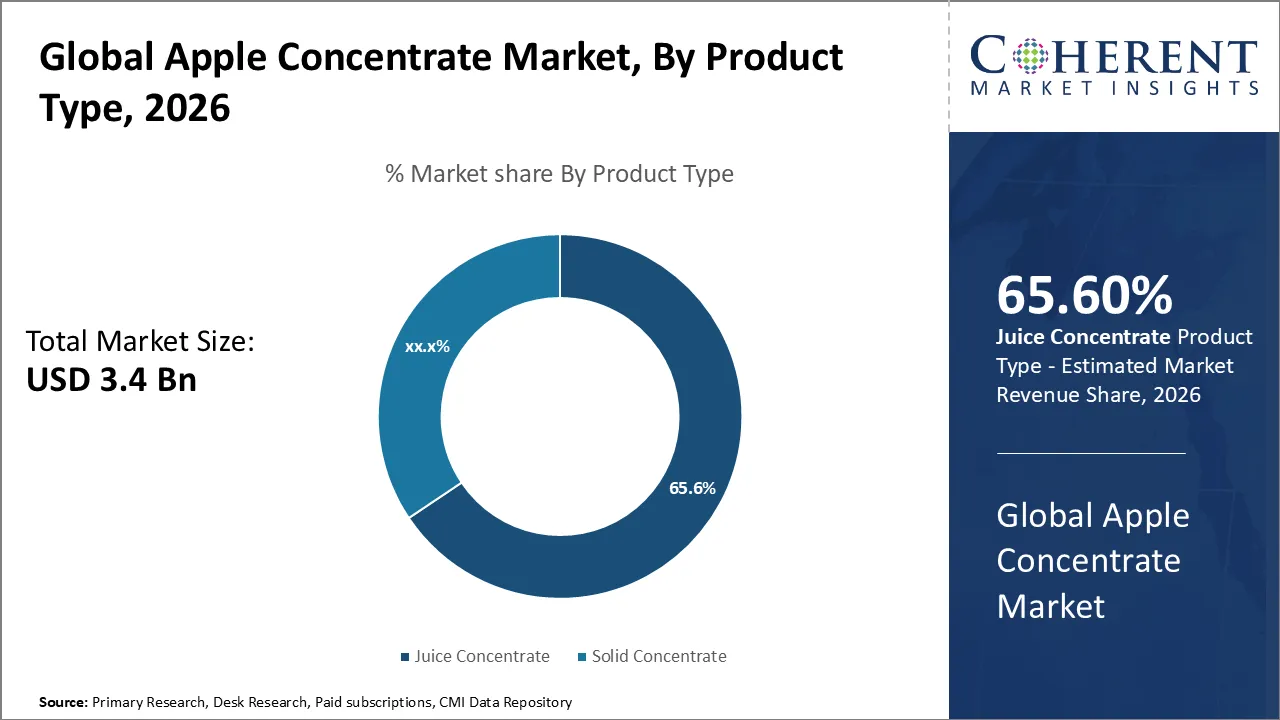
- Based on Product Type, the Juice Concentrate segment is expected to lead the market with 65.60% share in 2026, due its extensive use in large‑scale beverage manufacturing and reconstituted juice production.
- Based on Application, the Beverages segment is expected to hold 60.40% share of the market in 2026 reflecting the dominant role of apple concentrate in global beverage formulations.
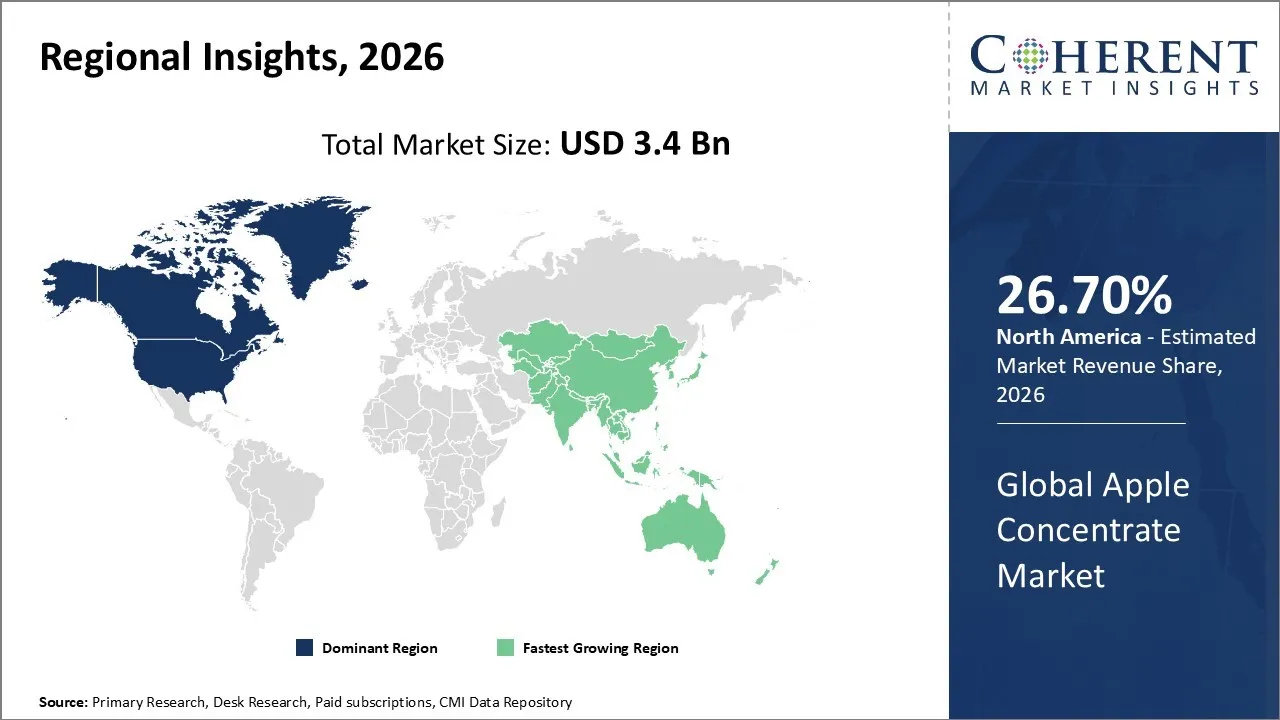
- Based on Region, North America is set to lead the market with 26.70% share in 2026. While, Asia Pacific is anticipated to be the fastest growing region.
Market Overview
The apple concentrate market is advancing significantly with rising applications in beverage formulation and natural food processing. Moreover, expanding consumer demand research for organic ingredients and tightening regulatory standards for clean label products are expected to drive market growth over the forecast period. Apple concentrates are the reduced-nutrient-sense derivatives of fresh fruit. Dehydration is a widely used processing technique in the beverage, bakery, and confectionary industries. Apple concentrates are used for sweetening and flavoring a variety of products. This helps in the effective replacement of refined sugar and artificial additives.
The apple concentrate industry is entering a new era driven by advancing production factors, the adoption of advanced evaporation and filtration systems, along with high demand for fruit-based solutions in industries such as functional beverages, dairy, infant nutrition, and snacks. These developments have improved the capabilities of apple concentrates and enhanced their shelf stability, solubility, and cost savings. This marks a transformative phase in the market.
Current Events and their Impacts on the Apple Concentrate Market
Current Event | Description and the Impact |
Technological Innovations in Apple Concentrate Production |
|
Health and Wellness Consumer Trends |
|
European Union Regulatory Changes |
|
Segmental Insights
- Current Industry Events of 2026
- Market Size Estimation
- Regional Breakdown
- Competitive Landscape
- Customer Intelligence
- Segmental Analysis
- Pricing Analysis
- Key Market Drivers, Challenges & Future Trends
- Customized Insights Section
Apple Concentrate Market Insights, By Product Type – Juice Concentrate Leads Due to Use in Large ‑ scale Beverage Manufacturing
In terms of product type, the juice concentrate segment contributes the highest share of 65.60% in 2026 of the apple concentrate market. The growth is because it offers exceptional stability and ease of transport. This segment is primarily categorized into clarified, cloudy, and deionized varieties to meet diverse manufacturing needs. Clarified concentrates are the most prevalent type because they provide a transparent appearance and versatile blending capabilities. In contrast, cloudy versions are gaining traction within the premium market since they retain more natural fruit solids and fiber. The shift toward organic processing is a significant trend that reflects a collective move away from synthetic additives. As a nutrient-dense alternative to fresh fruit, these concentrates serve as a vital raw material for global food manufacturers today.
Regional Insights
North America Apple Concentrate Market Analysis & Trends
North America has remained the dominant region with 26.70% in 2026 of the global Apple Concentrate Market over the past decade. This is because of the well-established beverage industry and consumer preference. The dominance is because of the shift from chemical sweeteners to natural sweeteners, where apple concentrate is recognized as a convenient ingredient. In the US and Canada, consumer awareness about health is increasing the demand for organic forms of apple concentrate used in functional juices and premium bakery products. The region boasts a highly developed infrastructure, like advanced processing technologies and robust supply chain networks that ensure consistent quality. In addition, the presence of major global food corporations is fostering continual product innovation. These companies keep the region at the forefront of high-value applications such as low-sugar formulations. Consequently, North America remains the primary benchmark for quality standards and market maturity.
Asia Pacific Apple Concentrate Market Analysis & Trends
The Asia Pacific region is the fastest-growing market for apple concentrates because of rapid urbanization and the expansion of a middle class with evolving dietary preferences. Countries such as China and India are transforming from major apple producers into significant consumers of value-added products like ready-to-drink juices and fruit-flavored snacks. The busy urban lifestyles are resulting in a growing preference for portable, health-focused beverages over traditional carbonated sodas. In addition, the proliferation of modern retail outlets and e-commerce platforms has drastically improved product accessibility for millions of people. With ongoing investments in local processing facilities, the region is rapidly narrowing the gap with traditional Western market leaders.
In October 2024, the Himachal Pradesh Horticultural Produce Marketing and Processing Corporation (HPMC) achieved a record production of 1,545 metric tonnes (MT) of apple juice concentrate across its three processing plants this year.
Apple Concentrate Market Outlook Country-Wise
The US Apple Concentrate Market Trends
The US represents one of the largest and most stable markets for apple concentrate due to high consumer demand for fruit-based beverages. North America maintains a substantial share of the global industry because established juice processors and innovative beverage startups are widely present across the country. Market trends in 2026 highlight a significant move toward organic and clean-label formulations as shoppers actively avoid synthetic additives and refined sugars. While the domestic supply remains steady in regions like Washington and New York, the industry relies heavily on imports to satisfy the basic requirements of the beverage and bakery sectors. This reliance has led to a focus on sustainable sourcing and transparent supply chains to ensure long-term stability.
China Apple Concentrate Market Trends
China acts as a global powerhouse in the apple concentrate sector because it makes nearly half of the world’s total apple supply. This dominance is owing to a strong processing system in the Shaanxi and Shandong provinces. The country once focused on large-scale exports to Western markets, but it is now shifting toward domestic consumption. This shift comes from a growing middle class that prefers healthy, convenient ready-to-drink beverages and natural food ingredients. The Chinese processors are investing heavily in modern extraction technologies to improve quality and meet international safety standards. As a result, China remains the main supplier while also becoming a major consumer market for these products.
China exported a remarkable 536,100 tons of concentrated apple juice in 2024, according to Freshco Industry Ltd. This was a huge increase of 99.43% from 2023 to 2024.
Market Report Scope
Apple Concentrate Market Report Coverage
| Report Coverage | Details | ||
|---|---|---|---|
| Base Year: | 2025 | Market Size in 2026: | USD 3.4 Bn |
| Historical Data for: | 2020 To 2024 | Forecast Period: | 2026 To 2033 |
| Forecast Period 2026 to 2033 CAGR: | 5.2% | 2033 Value Projection: | USD 4.86 Bn |
| Geographies covered: |
| ||
| Segments covered: |
| ||
| Companies covered: | Agrana Juice Gmbh, Tree Top Inc, Döhler GMBH, Shaanxi Hengtong Fruit Juice & Beverage Group Co Ltd, China Huiyuan Juice Group Ltd, Britvic Plc, Welch Foods Inc, Rauch Fruchtsäfte Gmbh & Co Og, Hermann Pfanner Getränke GmbH, and Cobell Ltd. | ||
| Growth Drivers: |
| ||
| Restraints & Challenges: |
| ||
Apple Concentrate Market Drivers
Increasing interest in natural and clean-label sweeteners
The rising demand for natural and clean-label sweeteners acts as a primary driver of growth in the apple concentrate market. As consumers reject high fructose corn syrup and synthetic additives, food manufacturers are reformulating products to feature recognizable fruit-based ingredients. Apple concentrate is an ideal solution due to its natural sugars and functional properties. This allows it to act as both the sweetener and a bulking agent in bakery, dairy, and confectionary items.
Furthermore, the surge in products labeled as organic or containing no added sugar has propelled apple concentrate into the spotlight as a premium alternative that maintains a healthy image. This trend is particularly strong in the infant nutrition and functional beverage sectors, where clarity is essential. Consequently, the market is evolving into a more advanced landscape of high-purity, deionized, and organic-certified concentrates.
Analyst Opinion (Expert Opinion)
The Apple Concentrate Market demonstrates steady expansion supported by measurable production volumes, trade flows, and diversified end-use integration. Global apple production consistently exceeds 85 million metric tons annually, providing a stable raw material base for concentrate processing. Standard industrial specifications of 65–75 °Brix remain widely adopted, ensuring consistency in international trade and compatibility across beverage and food manufacturing applications.
International trade data reflects strong cross-border movement, with export volumes of apple juice concentrate reaching several hundred thousand tons annually. Major importing regions continue to depend on large-scale processing hubs, particularly in Asia and Eastern Europe, reinforcing the market’s globalized supply chain structure. Europe’s apple harvest regularly surpasses 11 million metric tons, sustaining both domestic processing and export activity.
Product segmentation indicates that clarified concentrates account for more than half of overall utilization, primarily driven by demand from juice and cider manufacturers. Powdered concentrate formats, containing 90–95 percent solids, offer improved shelf life and logistics efficiency, reducing transport weight and storage costs. The beverage industry represents the dominant end-use sector, consuming a significant proportion of global concentrate output.
Overall, production scale, trade standardization, and diversified application across beverages, bakery, dairy, and confectionery industries position the market as structurally stable with sustained industrial demand.
Speak to the analyst
Want personalized insights?
Take the findings above to one of our principal consultants, or have the report rebuilt around the segments, geographies and competitors you actually track.
Apple Concentrate Industry News
- In September 2025, GNT has introduced a new line of plant-based EXBERRY® concentrates that allow manufacturers to create clean-label brown shades in low-pH soft drinks. EXBERRY® Shade Autumn Brown features carrot concentrate along with caramelized sugar syrup, while EXBERRY® Shade Golden Brown also incorporates apple concentrate.
Market Segmentation
- Product Type Insights (Revenue, USD Bn, 2026 - 2033)
- Juice Concentrate
- Solid Concentrate
- Application Insights (Revenue, USD Bn, 2026 - 2033)
- Food
- Beverages
- Cosmetics
- Pharmaceutical
- Flavors
- Others
- Regional Insights (Revenue, USD Bn, 2026 - 2033)
- North America
- U.S.
- Canada
- Latin America
- Brazil
- Argentina
- Mexico
- Rest of Latin America
- Europe
- Germany
- U.K.
- France
- Italy
- Russia
- Rest of Europe
- Asia Pacific
- China
- India
- Japan
- Australia
- South Korea
- ASEAN
- Rest of Asia Pacific
- Middle East
- GCC
- Israel
- Rest of Middle East
- Africa
- North Africa
- Central Africa
- South Africa
- Key Players Insights
- Agrana Juice Gmbh
- Tree Top Inc.
- Döhler GMBH
- Shaanxi Hengtong Fruit Juice & Beverage Group Co Ltd
- China Huiyuan Juice Group Ltd
- Britvic Plc.
- Welch Foods Inc
- Rauch Fruchtsäfte Gmbh & Co og
- Fujian Hermann Pfanner Getranke GmbH
- Cobell Ltd.
Sources
Primary Research Interviews
- Apple Concentrate Manufacturers
- Fruit Processing & Juice Concentrate Producers
- Beverage & Soft Drink Manufacturers
- Food & Bakery Product Developers
- Flavors & Ingredients Suppliers
- Supply Chain & Cold Storage Operators
- Others
Databases
- Bloomberg Terminal
- Thomson Reuters Eikon
- IHS Markit
- Others
Magazines
- Food Business News
- Beverage Industry Magazine
- Food Processing Magazine
- The Grocer
- FoodNavigator
- Others
Journals
- Journal of Food Science
- Food Chemistry
- Journal of Agricultural and Food Chemistry
- LWT – Food Science and Technology
- Trends in Food Science & Technology
- Others
Newspapers
- Financial Times
- The Wall Street Journal
- Reuters
- Bloomberg News
- The Economic Times
- Others
Associations
- International Fruit and Vegetable Juice Association (IFU)
- AIJN – European Fruit Juice Association
- U.S. Apple Association
- Food and Agriculture Organization (FAO)
- International Federation of Fruit Juice Producers
- Others
Public Domain Sources
- U.S. Department of Agriculture (USDA)
- Food and Agriculture Organization (FAO)
- European Commission – Agriculture and Rural Development
- World Bank Open Data
- APEDA (Agricultural and Processed Food Products Export Development Authority, India)
- Others
Proprietary Elements
- CMI Data Analytics Tool
- Proprietary CMI Existing Repository of Information for the Last 8 Years
Definition: The Apple Concentrate Market refers to the global industrial sector involved in the production, processing, and distribution of apple juice that has been reduced to a dense, shelf-stable form. This product is created by extracting a significant portion of the water content from fresh apples, thereby resulting in a liquid or powder that is easier to transport and store than fresh fruit. The industry serves as a primary supplier for the food and beverage industry, where the concentrate is used as a foundational ingredient for juices, ciders, and soft drinks. In addition, it is utilized in the bakery, confectionary, and dairy sectors as a natural, clean-label sweetener that offers a healthier alternative to refined sugars. The market continues to grow due to rising consumer demand for organic ingredients and the growing popularity of functional fruit-based beverages.
Get access to 250+ pages report
Every segment, forecast, competitor profile and data table behind the analysis above — available for instant download.
- ESOMAR Member
- ISO 9001:2015 Certified
- D-U-N-S Registered
- GDPR & CCPA Compliant
Missing comfort of reading report in your local language? Find your preferred language:
Transform your Strategy with Exclusive Trending Reports
Frequently Asked Questions
The Apple Concentrate Market is estimated to be valued at USD 3.4 Bn in 2026, and is expected to reach USD 4.86 Bn by 2033.
The CAGR of the Apple Concentrate Market is projected to be 5.2% from 2026 to 2033.
The increasing launches of apple concentrated-based food product, coupled with rising demand for apple concentrate from the food and beverage industry are some of the major factors driving the growth of the Apple Concentrate Market.
Limited access to raw materials is one of the major factors hampering the growth of the Apple Concentrate Market.
In terms of product type, the juice concentrate segment is estimated to dominate the market revenue share in 2026.
Agrana Juice Gmbh, Tree Top Inc, Döhler GMBH, Shaanxi Hengtong Fruit Juice & Beverage Group Co Ltd, China Huiyuan Juice Group Ltd, Britvic Plc, Welch Foods Inc, Rauch Fruchtsäfte Gmbh & Co Og, Hermann Pfanner Getränke GmbH, and Cobell Ltd are the major players.
North America is expected to lead the Apple Concentrate Market in 2026.