

rHu Albumin Market Size and Forecast: 2026 - 2033
The rHu Albumin Market is estimated to be valued at USD 87.6 Bn in 2026 and is expected to reach USD 277.8 Bn by 2033, exhibiting a compound annual growth rate (CAGR) of 13.6% from 2026 to 2033.
Key Takeaways
- By Source, Oryza Sativa hold the largest market share of 42.2% in 2026 owing to the growing demand for animal-free biopharmaceutical ingredients.
- By Application, Stem Cell Therapy expected to hold largest market share of 38.8% in 2026 owing to its rapid growth of stem cell research.
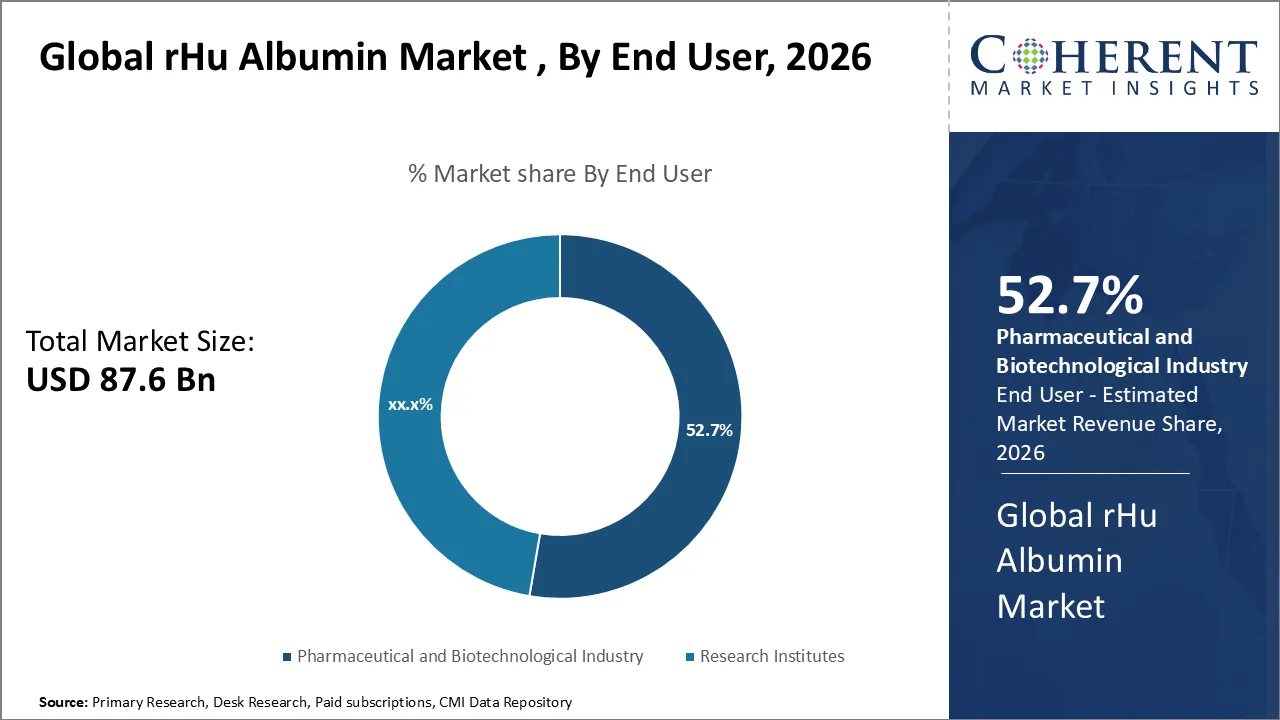
- By End User, Pharmaceutical and Biotechnological Industry acquired the prominent market share of 52.7% in 2026 owing to the rising production of biologics and biosimilars.
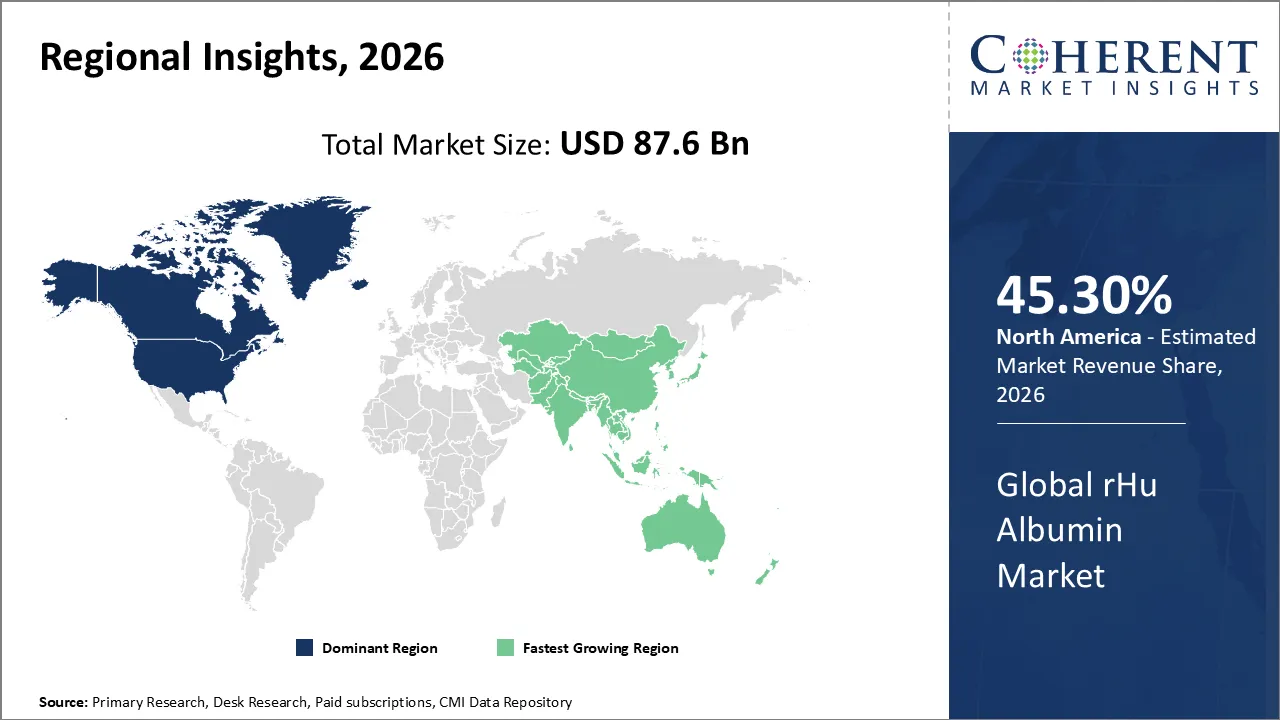
- By Region, North America dominates the overall market with an estimated share of 45.3% in 2026 owing to the strong biopharmaceutical industry.
Market Overview
Pharmaceutical, biotechnology, and research industries are driving the expansion of the recombinant human albumin (rHu albumin) market. Companies use rHu albumin in drug formulation, vaccine production, cell culture media, and regenerative medicine due to its high purity, safety, and consistent quality compared to plasma-derived albumin. The growth of biologics manufacturing, increasing stem cell research, and the adoption of animal-free cell culture systems further support market development. In addition, advancements in recombinant protein technologies and rising investments in biopharmaceutical research continue to boost global demand for rHu albumin.
Current Events and their Impact on the rHu Albumin Market
Current Events | Description and its impact |
Macro-Level Technological Advancements in Recombinant Protein Production |
|
Regional Regulatory Changes in Key Pharmaceutical Markets |
|
Clinical Demand and Epidemiological Trends |
|
Segmental Insights
- Current Industry Events of 2026
- Market Size Estimation
- Regional Breakdown
- Competitive Landscape
- Customer Intelligence
- Segmental Analysis
- Pricing Analysis
- Key Market Drivers, Challenges & Future Trends
- Customized Insights Section
Rhu Albumin Market Insights, By End User - Pharmaceutical and Biotechnological Industry contribute the highest share of the market owing to its shift toward animal-component-free raw materials
Pharmaceutical and Biotechnological Industry acquired the prominent market share of 52.7% in 2026. Pharmaceutical and biotechnology companies are fueling the growth of the recombinant human albumin (rHu albumin) market by using it in drug formulations, biologics, vaccines, and cell culture systems. They depend on rHu albumin for its high purity, consistent quality, and safety over plasma-derived alternatives. Expanding biologics production, advancing research in novel therapies, and adopting animal-free manufacturing are driving higher demand. As companies focus on reliable and reproducible materials for development and production, they increasingly integrate recombinant albumin into their processes.
Rhu Albumin Market Insights, By Source - Oryza Sativa contribute the highest share of the market owing to its expansion of biologics, cell & gene therapy
Oryza Sativa hold the largest market share of 42.2% in 2026. Biotechnology and pharmaceutical companies are increasingly adopting Oryza sativa–based expression systems to produce recombinant human albumin because they provide high-purity, animal-free products suitable for biopharmaceutical applications. Rice-derived platforms enable scalable production and help reduce contamination risks associated with plasma-derived sources. Manufacturers use this system in cell culture media, vaccine development, and drug formulation. Growing demand for reliable raw materials in biologics production and ongoing advances in plant-based recombinant technology continue to support the use of Oryza sativa–derived rHu albumin.
Rhu Albumin Market Insights, By Application - Stem Cell Therapy contribute the highest share of the market owing to its expansion of regenerative medicine applications
Stem Cell Therapy expected to hold largest market share of 38.8% in 2026. Researchers and biotechnology companies are driving demand in the recombinant human albumin (rHu albumin) market by expanding stem cell therapy applications. They use rHu albumin to maintain stable culture conditions, enhance cell viability, protect cells from oxidative stress, and improve culture efficiency in laboratory and clinical environments. The growing emphasis on regenerative medicine and personalized treatments is increasing the need for dependable culture materials. As organizations intensify stem cell research and therapeutic development, they continue to increase the use of recombinant human albumin. For instance, in March 2026, the International Society for Stem Cell Research (ISSCR) launched Stem Cell Medicine: Parkinson's Disease, a new course that trains clinicians on evidence-based stem cell therapies for Parkinson’s disease (PD).
Regional Insights
North America rHu Albumin Market Trends
North America dominates the overall market with an estimated share of 45.30% in 2026. Biotechnology and pharmaceutical companies in North America are driving the recombinant human albumin (rHu albumin) market through increased use in biologics, vaccine production, cell culture, and regenerative medicine, valuing its safety and consistent quality. Rising investments in stem cell research, advanced therapies, and animal-free manufacturing practices are accelerating adoption. Leading biopharmaceutical firms, advanced healthcare infrastructure, and strong R&D initiatives further promote innovation and sustain steady demand for recombinant albumin throughout the region.
Asia Pacific rHu Albumin Market Trends
Pharmaceutical and biotechnology companies across Asia Pacific are driving the growth of the recombinant human albumin (rHu albumin) market by using it in biologics, vaccines, and cell culture, appreciating its high purity and safety. Increasing investments in regenerative medicine, stem cell research, and animal-free manufacturing are fueling demand. Rapid industrialization, expanding healthcare infrastructure, and supportive government policies are promoting local production and research, encouraging innovation and broader adoption of recombinant albumin throughout the region’s developing biopharmaceutical sector.
United States rHu Albumin Market Trends
Pharmaceutical and biotechnology companies in the United States are expanding the recombinant human albumin (rHu albumin) market by incorporating it into drug formulations, biologics, vaccines, and cell culture applications. Researchers increasingly use rHu albumin for its consistent quality, safety, and animal-free production. Growing regenerative medicine, stem cell research, and advanced therapy initiatives are accelerating adoption. Strong healthcare infrastructure, significant R&D investments, and the presence of leading biopharmaceutical firms further drive innovation and maintain steady demand for recombinant albumin throughout the U.S.
Japan rHu Albumin Market Trends
Pharmaceutical and biotechnology companies in Japan are driving the growth of the recombinant human albumin (rHu albumin) market by using it in biologics, vaccines, and cell culture applications. Researchers rely on rHu albumin for its high purity, safety, and animal-free production, ensuring consistent laboratory and clinical results. Expanding regenerative medicine, stem cell research, and advanced therapy development are boosting demand. Strong healthcare infrastructure, government support for biotech innovation, and active R&D initiatives further promote local production and broader adoption of recombinant albumin in Japan.
In April 2024, Partner Therapeutics, Inc. (PTx) announced that its partner Nobelpharma received approval from the Japanese Pharmaceuticals and Medical Device Agency for the inhaled use of Leukine (sargramostim), marketed in Japan as Sargmalin, for the treatment of aPAP. Leukine is a glycosylated recombinant human granulocyte-macrophage colony-stimulating factor produced using recombinant DNA technology in yeast.
rHu Albumin Market Opportunity
Rising Demand for Animal-Free and Serum-Free Products
The industry’s shift toward animal-free and serum-free cell culture systems creates opportunities for recombinant albumin adoption. Biopharmaceutical and research organizations prefer rHu albumin over plasma-derived alternatives to minimize contamination risks and ensure reproducibility. Companies can capitalize by offering products compatible with serum-free media, providing safety certifications, and catering to regulatory requirements, thereby meeting evolving customer preferences in vaccines, biologics, and cell therapy manufacturing.
Market Report Scope
rHu Albumin Market Report Coverage
| Report Coverage | Details | ||
|---|---|---|---|
| Base Year: | 2025 | Market Size in 2026: | USD 87.6 Bn |
| Historical Data for: | 2020 To 2024 | Forecast Period: | 2026 To 2033 |
| Forecast Period 2026 to 2033 CAGR: | 13.6% | 2033 Value Projection: | USD 277.8 Bn |
| Geographies covered: |
| ||
| Segments covered: |
| ||
| Companies covered: | Merck KGaA, HiMedia Laboratories Pvt. Ltd., Albumin Bioscience, Albumedix, ScienCell Research Laboratories, Inc., InVitria, Lazuline Biotech Private Limited, Lee Biosolutions, Inc., Abcam Plc, and Shandong Kingtone Biotechnology Co.,Ltd. | ||
| Growth Drivers: |
| ||
| Restraints & Challenges: |
| ||
rHu Albumin Market News
- In January 2025, Partner Therapeutics, Inc. (PTx) announced a collaboration with BARDA, under the U.S. Department of Health and Human Services, to fund a phase 2 study evaluating the safety and dosing of LEUKINE (sargramostim, rhu GM-CSF) in sepsis patients.
Analyst Opinion (Expert Opinion)
- The Rhu Albumin market’s trajectory is increasingly defined by application‑driven demand rather than generic adoption, with biopharmaceutical use cases such as cell culture, drug formulation, and advanced therapies forming the backbone of demand. In 2024, cell culture media accounted for a significant portion of rHSA utilization, evidencing its role in supporting mammalian and stem cell lines with improved viability and reduced culture variability compared to undefined supplements. In CHO cell models, for example, rHSA has been shown to enhance viable cell density by 15‑20% beyond media lacking albumin.
- Manufacturers that have invested in recombinant systems are seeing tangible returns: plant‑based and yeast‑derived platforms have ramped capacity, enabling high purity (>99.9%) products that reduce batch‑to‑batch variation. Over 70% of new cell therapy pipelines now specify animal‑free culture components, reflecting a decisive industry shift toward recombinant inputs to mitigate contamination risk and fulfill regulatory expectations.
- Despite market enthusiasm, cost and scale‑up complexity remain substantive headwinds. Complex fermentation and downstream purification contribute materially to production cost structures, and about 40% of emerging biotech firms cite these costs as a barrier to adoption relative to legacy plasma‑derived forms.
- However, the trend toward recombinant albumin as a critical enabling material across advanced biologics, regenerative medicine, and precision therapeutics is robust. As cell and gene therapy pipelines expand, rHu albumin is no longer a peripheral reagent but a strategic raw material that materially influences process performance, product stability, and regulatory compliance.
Speak to the analyst
Want personalized insights?
Take the findings above to one of our principal consultants, or have the report rebuilt around the segments, geographies and competitors you actually track.
Market Segmentation
- By Source
- Oryza sativa
- Pichia pastoris
- Others
- By Application
- Cell Culture Media
- Nutrient and stabilizer
- Medium Supplement
- Stem Cell Therapy
- Drug Formulations
- Cryopreservation
- Others
- Cell Culture Media
- By End User
- Pharmaceutical and Biotechnological Industry
- Research Institutes
- By Regional Insights
- North America
- U.S.
- Canada
- Latin America
- Brazil
- Argentina
- Mexico
- Rest of Latin America
- Europe
- Germany
- U.K.
- Spain
- France
- Italy
- Russia
- Rest of Europe
- Asia Pacific
- China
- India
- Japan
- Australia
- South Korea
- ASEAN
- Rest of Asia Pacific
- Middle East
- GCC Countries
- Israel
- Rest of Middle East
- Africa
- South Africa
- North Africa
- Central Africa
- North America
- Key Players Insights
- Merck KGaA
- HiMedia Laboratories Pvt. Ltd.
- Albumin Bioscience
- Albumedix
- ScienCell Research Laboratories, Inc.
- InVitria
- Lazuline Biotech Private Limited
- Lee Biosolutions, Inc.
- Abcam Plc
- Shandong Kingtone Biotechnology Co.,Ltd.
Sources
Primary Research interviews
- Discussions with hospital procurement managers
- Interviews with nephrologists and hepatologists
- Conversations with clinical pharmacists
- Interviews with R&D heads of biopharmaceutical companies producing albumin
Databases
- PubMed
- ClinicalTrials.gov
- WHO Global Health Observatory
- FDA and EMA regulatory databases
Magazines
- Pharmaceutical Executive
- BioPharm International
- Pharma Times
Journals
- Journal of Clinical Pharmacy and Therapeutics
- American Journal of Kidney Diseases
- Hepatology
- Blood Purification
Newspapers
- The New York Times – Health Section
- The Guardian – Science & Health
- Financial Times – Healthcare Coverage
Associations
- American Society of Nephrology (ASN)
- International Society of Blood Transfusion (ISBT)
- European Association for the Study of the Liver (EASL)
Public Domain sources
- WHO Reports
- CDC Data and Publications
- National Institutes of Health (NIH) Open Access Resources
- U.S. Government Health Statistics
Proprietary Elements
- CMI Data Analytics Tool
- Proprietary CMI Existing Repository of information for last 8 years
Get access to 250+ pages report
Every segment, forecast, competitor profile and data table behind the analysis above — available for instant download.
- ESOMAR Member
- ISO 9001:2015 Certified
- D-U-N-S Registered
- GDPR & CCPA Compliant
Missing comfort of reading report in your local language? Find your preferred language:
Transform your Strategy with Exclusive Trending Reports
Frequently Asked Questions
Global rHu albumin market is expected to exhibit a CAGR of 13.6% during the forecast period.
The market is estimated to be valued at USD 87.6 Bn in 2026.
Merck KGaA, HiMedia Laboratories Pvt. Ltd., Albumin Bioscience, Albumedix, ScienCell Research Laboratories, Inc., InVitria, Lazuline Biotech Private Limited, Lee Biosolutions, Inc., Abcam Plc, and Shandong Kingtone Biotechnology Co.,Ltd. are some of the prominent players operating in the market.
The market is expected to be valued at USD 277.8 Bn in 2033.
North America is the prominent region in the market.
Increasing number of clinical trials, increasing advantages of rHu albumin and research and increasing facility expansion by market players are some of the driving factors, which are expected to drive growth of the market