

Ruthenium Catalyst Market Size and Forecast — 2026 - 2033
The Global Ruthenium Catalyst Market size is estimated to be valued at USD 1.2 billion in 2026 and is expected to reach USD 2.15 billion by 2033, exhibiting a compound annual growth rate (CAGR) of 9.1% from 2026 to 2033.
Overview
The Ruthenium Catalyst market comprises a range of products used across chemical synthesis, pharmaceuticals, and energy applications. Key product types include homogeneous and heterogeneous ruthenium catalysts, valued for their efficiency in hydrogenation, oxidation, and metathesis reactions. Supported catalysts, where ruthenium is dispersed on carriers like carbon or alumina, are widely used in industrial processes for enhanced stability and reusability. Organometallic ruthenium complexes are prominent in fine chemical and pharmaceutical manufacturing. Additionally, nano-structured catalysts are gaining traction due to their high surface area and catalytic activity. Continuous innovation focuses on improving selectivity, durability, and environmental sustainability in catalytic processes.
Key Takeaways
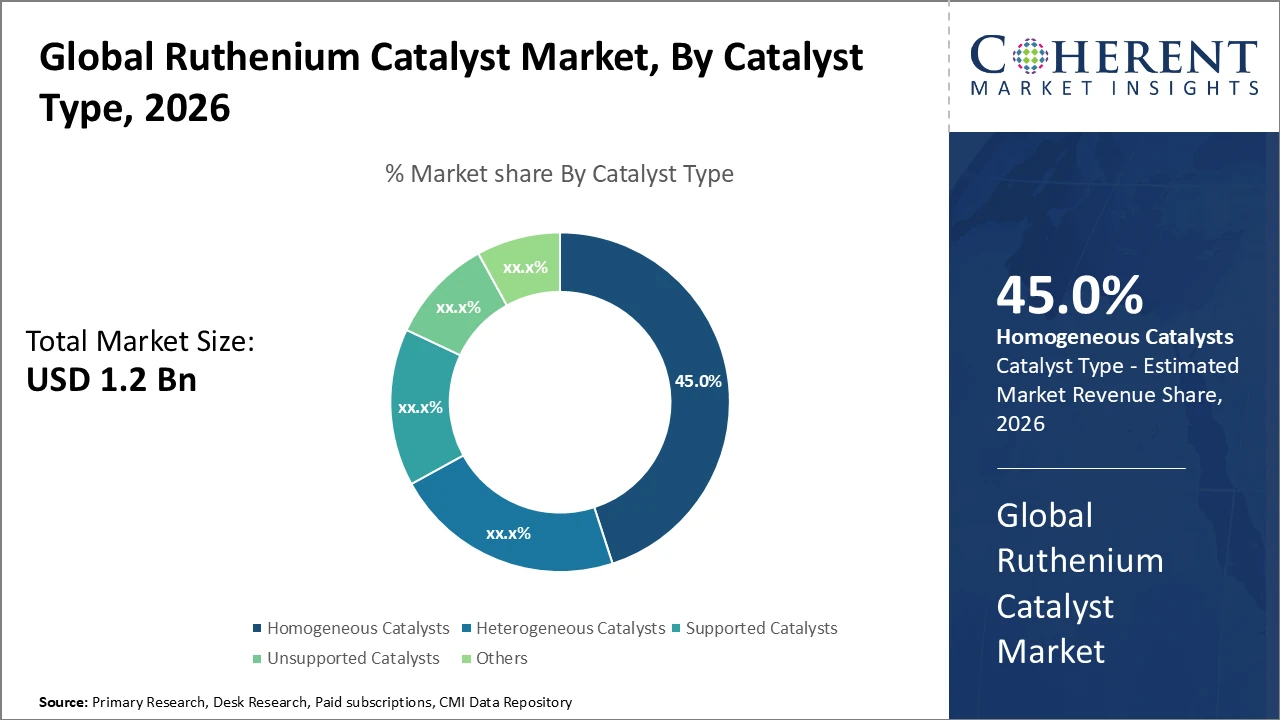
The Homogeneous Catalysts segment dominates the Ruthenium Catalyst market, accounting for 45% of the market share, driven by superior performance and high selectivity in pharmaceutical applications. The Heterogeneous Catalysts segment is witnessing rapid growth due to increasing demand in industrial chemical synthesis where catalyst reusability is essential.
Pharmaceuticals remain the leading application segment, supported by growing use of ruthenium catalysts in fine chemical synthesis and drug manufacturing. Automotive catalytic converters are a fast-growing segment, driven by stricter global emission regulations.
Asia Pacific holds a significant share of market revenue, fueled by expanding chemical manufacturing industries in China and India. Europe maintains a strong position due to stringent environmental standards and a mature automotive sector, while North America benefits from substantial R&D investments in advanced catalytic technologies.
Ruthenium Catalyst Market Segmentation Analysis
Ruthenium Catalyst Market Insights, By Catalyst Type
Homogeneous catalysts dominate the Ruthenium Catalyst market with a 45% share, primarily due to their superior selectivity and efficiency in fine chemical and pharmaceutical synthesis, making them ideal for complex reaction pathways. Heterogeneous catalysts are the fastest-growing segment, driven by their advantages in catalyst recovery and reusability, especially in large-scale industrial processes. Supported catalysts offer enhanced surface area and stability, making them suitable for continuous operations, though their adoption is limited by technological complexity. Unsupported catalysts and other variants serve niche applications with specialized requirements but currently contribute a smaller share to overall market revenue.
Ruthenium Catalyst Market Insights, By Application
Pharmaceuticals represent the largest application segment in the Ruthenium Catalyst market, driven by increasing use in drug synthesis and enantioselective transformations. The automotive catalytic converters segment is the fastest-growing, supported by stringent global emission regulations and advancements in catalyst technologies incorporating ruthenium in three-way systems. Chemical synthesis remains a stable segment, focusing on specialty and fine chemicals, while petrochemical processing is gradually adopting ruthenium catalysts to enhance process selectivity and efficiency.
Ruthenium Catalyst Market Insights, By End User Industry
Pharmaceuticals dominate the Ruthenium Catalyst market due to increasing demand for efficient catalytic systems that support large-scale drug manufacturing and complex synthesis processes. The automotive segment shows the highest growth rate, driven by stringent emission regulations and innovations in exhaust treatment technologies. Chemical industries benefit from ruthenium catalysts through improved reaction yields and enhanced operational efficiency. Petrochemical applications are gradually expanding, utilizing ruthenium catalysts in advanced refining and synthesis operations.
Ruthenium Catalyst Market Trends
The Ruthenium Catalyst market is increasingly shifting toward sustainability-driven innovations, with rising investments in recycled and heterogeneous catalyst technologies to improve efficiency and environmental performance.
A surge in patent applications between 2024 and 2026 highlights intensified R&D efforts aimed at enhancing catalyst performance, particularly in pharmaceutical and automotive sectors.
Automotive manufacturers are increasingly adopting ruthenium-based catalytic converters to comply with upcoming Euro 7 emission standards, driving significant market demand.
Growing complexity in pharmaceutical synthesis, combined with the adoption of green chemistry practices, is supporting continuous market expansion.
Asia Pacific is emerging as a key hub due to cost advantages, expanding chemical manufacturing infrastructure, and supportive government policies in countries such as China and India.
Ruthenium Catalyst Market Insights, By Geography
Asia Pacific Ruthenium Catalyst Market Analysis and Trends
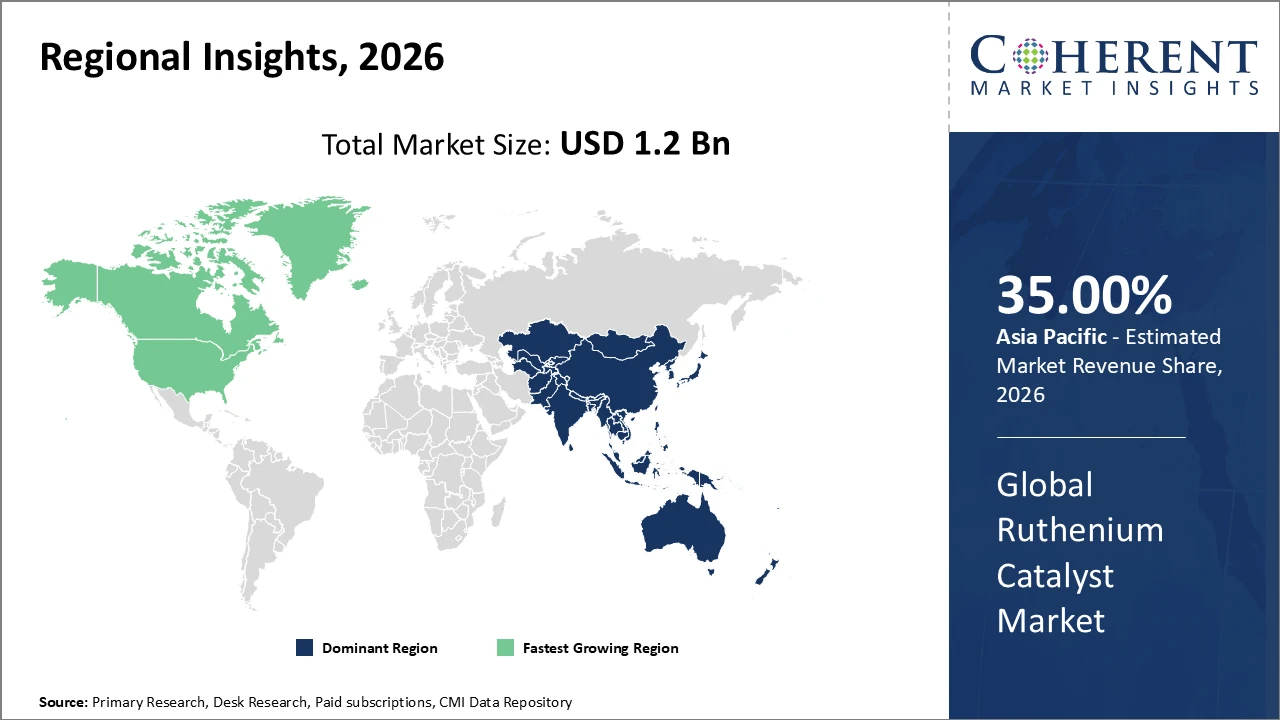
Asia Pacific dominates the Ruthenium Catalyst market, accounting for over 35% of regional market share, driven by rapidly expanding chemical and pharmaceutical manufacturing sectors. The region benefits from lower production costs, abundant raw material availability, and increasing investments in catalyst production facilities. Countries such as China and India are key contributors, supported by favorable industrial policies and growing demand for advanced catalytic solutions. Leading global companies have established manufacturing bases in the region to leverage economies of scale and strengthen supply chain efficiency. These factors collectively position Asia Pacific as a major hub for ruthenium catalyst production and consumption.
North America Ruthenium Catalyst Market Analysis and Trends
North America is experiencing the fastest growth in the Ruthenium Catalyst market, with a strong CAGR of approximately 10.2%, driven by substantial investments in research and development and strict environmental regulations. These regulations encourage the adoption of advanced catalyst technologies across automotive and industrial applications. The United States leads the regional market, supported by high adoption rates influenced by regulatory frameworks such as the Clean Air Act. Increasing focus on emission reduction, sustainable industrial processes, and technological innovation continues to strengthen market growth, positioning North America as a key region for advanced catalyst development and commercialization.
Ruthenium Catalyst Market Outlook for Key Countries
USA Ruthenium Catalyst Market Analysis and Trends
The USA’s Ruthenium Catalyst market is driven by strong pharmaceutical and automotive sectors prioritizing green technologies and regulatory compliance. Federal incentives promoting clean energy catalysis have spurred investment in R&D focused on catalyst optimization and performance enhancement. Major companies, including Johnson Matthey and BASF, maintain R&D and manufacturing facilities in the country, strengthening technological leadership and export capabilities. High adoption rates in drug synthesis, emission control, and industrial applications support market growth. In 2026, the U.S. accounted for nearly 40% of North America’s revenue, highlighting its strategic significance as a hub for innovation, production, and consumption of ruthenium catalysts.
Germany Ruthenium Catalyst Market Analysis and Trends
Germany’s Ruthenium Catalyst market is driven by a strong chemical and automotive manufacturing base, supported by stringent environmental regulations and industrial standards. The country benefits from advanced R&D infrastructure, enabling development of high-performance catalysts for pharmaceuticals, fine chemicals, and emission control applications. Automotive emission norms and the push for green technologies have accelerated adoption of ruthenium-based catalytic converters. The chemical industry leverages these catalysts to enhance reaction efficiency and selectivity in specialty chemical production. Germany also serves as a key export hub for European markets, with major companies investing in sustainable and technologically advanced catalyst manufacturing to maintain competitive leadership in the region.
Analyst Opinion
Ruthenium catalyst production capacity has expanded by approximately 15% as of 2025, driven by increasing investments in manufacturing hubs to meet rising global demand from chemical and pharmaceutical sectors. A leading producer increased capacity by 20% in 2025, supporting higher supply and stabilizing pricing.
Demand-side growth is evident in pharmaceuticals, with a 13% rise in 2024 due to efficient enantioselective hydrogenation processes. Automotive applications, particularly catalytic converters using ruthenium-doped catalysts, saw a 10% increase in unit installations in 2026, boosting overall market demand.
Ruthenium prices increased by 8% during 2024–2026 due to supply constraints and rising raw material costs, contributing to a 6% growth in market revenue in 2026.
Export volumes from Asia Pacific rose 18% in 2025, fueled by competitive production costs and demand from North America and Europe. European imports increased by 12% the same year, affecting regional trade flows and market competitiveness.
- Current Industry Events of 2026
- Market Size Estimation
- Regional Breakdown
- Competitive Landscape
- Customer Intelligence
- Segmental Analysis
- Pricing Analysis
- Key Market Drivers, Challenges & Future Trends
- Customized Insights Section
Market Scope
| Report Coverage | Details | ||
|---|---|---|---|
| Base Year: | 2025 | Market Size in 2026: | USD 1.2 billion |
| Historical Data for: | 2020 To 2024 | Forecast Period: | 2026 To 2033 |
| Forecast Period 2026 to 2033 CAGR: | 9.1% | 2033 Value Projection: | USD 2.15 billion |
| Geographies covered: |
| ||
| Segments covered: |
| ||
| Companies covered: | Umicore, BASF SE, Johnson Matthey, Clariant, Evonik Industries, Albemarle Corporation, Haldor Topsoe, Arkema, Sinopec Catalysts, TIB Chemicals AG | ||
| Growth Drivers: |
| ||
Ruthenium Catalyst Market Growth Factors
Multiple growth drivers are supporting rising revenue and market share for ruthenium catalysts. Advances in pharmaceutical synthesis favor more selective catalysts, resulting in approximately 12% annual demand growth between 2024 and 2026. Global regulatory pressure for stricter automotive emission controls has driven a 14% increase in adoption of ruthenium-based catalytic converters in 2026. Innovations in heterogeneous catalyst formulations enhance recyclability and process efficiency, addressing environmental concerns and boosting business growth. Additionally, increasing industrialization and chemical production in Asia Pacific contribute to market expansion, as ruthenium catalysts improve reaction yields and cost optimization in large-scale manufacturing operations.
Ruthenium Catalyst Market Development
In April 2024, researchers at the University of Manchester developed a novel catalyst with broad applications, capable of streamlining industrial optimization processes and enabling new scientific discoveries.
Key Players
Leading Companies of the Market
Umicore
BASF SE
Johnson Matthey
Evonik Industries
Albemarle Corporation
Haldor Topsoe
Arkema
Sinopec Catalyst
TIB Chemicals AG
Strategic collaborations and R&D initiatives have played a crucial role in driving the Ruthenium Catalyst market. In 2026, Johnson Matthey partnered with a major pharmaceutical company to develop ruthenium-based catalysts that reduced waste by 15%, significantly enhancing process sustainability. Similarly, Umicore expanded its manufacturing presence in Asia Pacific in 2025 to meet rising regional demand, resulting in a 10% increase in market share. Additionally, several industry players pursued sustainability-focused growth strategies, collectively investing over USD 50 million in green catalyst technologies between 2024 and 2026, strengthening long-term competitiveness and ensuring compliance with increasingly stringent emission regulations.
Ruthenium Catalyst Market Future Outlook
The Ruthenium Catalyst market is expected to experience robust growth over the coming years, driven by increasing demand in pharmaceuticals, automotive, and specialty chemical industries. Advances in green chemistry and heterogeneous catalyst technologies will enhance recyclability and process efficiency, supporting sustainability goals. Stringent environmental regulations globally, particularly for vehicle emissions, will continue to accelerate adoption in automotive applications. Expansion of chemical manufacturing in Asia Pacific and ongoing R&D in North America and Europe will further strengthen market growth. Emerging applications in fuel cells, biomass conversion, and advanced material synthesis are likely to create new revenue streams, positioning ruthenium catalysts as a critical component of industrial innovation.
Ruthenium Catalyst Market Historical Analysis
The Ruthenium Catalyst market has witnessed steady growth over the past decade, primarily driven by increasing demand in pharmaceuticals and chemical synthesis. Historically, homogeneous catalysts dominated due to their high selectivity and efficiency in complex reaction pathways, particularly in fine chemical and drug production. Automotive applications gradually adopted ruthenium-based catalytic converters as emission regulations became stricter. Between 2018 and 2023, Asia Pacific emerged as a key production hub due to lower manufacturing costs and expanding chemical infrastructure, while Europe and North America focused on technological innovation and R&D. Price fluctuations in ruthenium and raw material availability historically influenced market revenue and growth patterns.
Sources
Primary Research Interviews:
Executives, product managers, and operations heads at chemical manufacturing and pharmaceutical companies utilizing ruthenium catalysts
R&D directors and process engineers overseeing catalyst development, scale-up, and industrial chemical synthesis
Technology providers and suppliers of homogeneous and heterogeneous ruthenium catalysts, catalyst supports, and recycling solutions
Magazines:
Chemical & Engineering News – Innovations in Catalysis and Industrial Chemistry
Industrial & Engineering Chemistry Research – Updates on Catalysts and Chemical Manufacturing Processes
Catalyst Today – Trends in Homogeneous and Heterogeneous Catalysis
Chemistry World – Developments in Precious Metal Catalysts and Applications
Journals:
Journal of Catalysis – Ruthenium Catalysis Applications and Mechanistic Studies
Catalysis Science & Technology – Industrial and Pharmaceutical Ruthenium Catalyst Research
Applied Catalysis A: General – Process Optimization and Catalyst Performance
Journal of Industrial & Engineering Chemistry – Scale-up and Process Efficiency in Catalysis
Newspapers:
The Wall Street Journal – Chemical Industry and Specialty Catalyst Market Developments
Financial Times – Global Chemical Manufacturing Trends and Catalysis Innovations
Chemical Week – Updates on Precious Metal Catalysts and Industrial Applications
Business Insider – Market Insights on Catalysts and Green Chemistry Initiatives
Associations:
American Chemical Society (ACS) – Catalysis and Industrial Chemistry Standards
International Association of Catalysis Societies (IACS) – Research, Best Practices, and Catalyst Development
Society of Chemical Industry (SCI) – Innovations in Chemical Manufacturing and Catalyst Applications
European Catalysis Society (ECS) – Guidelines and Networking for Catalysis Research and Industry
Get access to 250+ pages report
Every segment, forecast, competitor profile and data table behind the analysis above — available for instant download.
- ESOMAR Member
- ISO 9001:2015 Certified
- D-U-N-S Registered
- GDPR & CCPA Compliant
Missing comfort of reading report in your local language? Find your preferred language:
Transform your Strategy with Exclusive Trending Reports
Frequently Asked Questions
Leading Ruthenium Catalyst market companies include Umicore, BASF SE, Johnson Matthey, Clariant, and Evonik Industries, all of which are driving technological innovation and expanding production capacities.
The Ruthenium Catalyst Market size is expected to grow from USD 1.2 billion in 2026 to USD 2.15 billion by 2033, with a CAGR of 9.1%, reflecting rising demand across pharmaceutical and automotive sectors.
The pharmaceutical industry offers the largest growth opportunity due to increasing requirements for selective catalysts in drug manufacturing and sustainable chemical synthesis.
Market trends will focus on enhanced catalyst selectivity, environmental compliance, integration with renewable feedstocks, and expansion of automotive emission control applications, supported by evolving regulations and industry-wide sustainability commitments.
The market is competitive, marked by strategic collaborations and innovation-focused R&D. Challenges include catalyst cost volatility due to ruthenium raw material price fluctuations and stringent environmental regulations impacting production processes.
Market players emphasize capacity expansion, technology partnerships, and green technology investment, alongside targeting emerging markets and regulatory-driven end-user industries to strengthen market presence.