

Global Set Top Box (STB) Chipset Market Size and Forecast – 2026 to 2033
Set Top Box (STB) Chipset Market is estimated to be valued at USD 4,578.1 Mn in 2026 and is expected to reach USD 7,399.7 Mn in 2033, exhibiting a compound annual growth rate (CAGR) of 7.1% from 2026 to 2033.
Key Takeaways
- Based on Node Size, the 28 nm segment is projected to capture the largest share of the market in 2026, due to its balance of performance, cost-efficiency, and power optimization.
- Based on Application, the IPTV STB segment is expected to account for the highest share of the market in 2026, due to the rapid shift toward internet-based content consumption, personalized streaming, and on-demand services.
- Based on Content Quality, the 4K and Above segment is projected to hold the greatest share of the market in 2026, due to increasing consumer preference for ultra-high-definition viewing.
- Based on Type, the SoC (System-on-Chip) chipsets segment leads the market holding an estimated share of 79.2 % in 2026, due to their ability to integrate processing, graphics, memory, and connectivity into a single solution.
- Based on Region, Asia Pacific is set to lead the global set top box (STB) chipset market in 2026 with a 40.9 % share. While, Europe, with an estimated share of 26.6% in 2026, is the fastest growing region.
Market Overview
The Set Top Box (STB) Chipset Market demand is expanding rapidly, driven by rising demand for high-definition content, interactive applications, and smart home integration. Growing adoption of IPTV, OTT platforms, and gaming/fitness-enabled STBs fuels innovation in multi-functional, energy-efficient chipsets. Increasing consumer preference for enhanced viewing experiences continues to drive Set Top Box (STB) Chipset Market demand globally.
Current Events and Its Impact
Current Event | Description and its Impact |
5G Network Rollout and Advanced Connectivity Integration |
|
AI Integration and Smart Entertainment Revolution |
|
Role of Artificial Intelligence (AI) in Set Top Box (STB) Chipset Market
Artificial Intelligence (AI) is transforming the Set Top Box (STB) Chipset Market by enabling smarter, more personalized user experiences. AI-powered chipsets support features such as content recommendation, voice and gesture recognition, advanced search, and predictive analytics for viewing habits. Integration of AI enhances video compression, streaming efficiency, and real-time processing for gaming and fitness applications. As consumers increasingly demand interactive and tailored entertainment, AI adoption drives innovation, efficiency, and differentiation, boosting overall Set Top Box (STB) Chipset Market demand globally.
For instance, in March 2025, Airoha Technology launched a new hybrid chipset designed for premium set-top boxes. This SoC supports 4Kp75 resolution with AI-driven upscaling and is compatible with external demodulators supporting up to four tuners. It operates on a Linux platform, offering enhanced performance for advanced home entertainment systems.
- Current Industry Events of 2026
- Market Size Estimation
- Regional Breakdown
- Competitive Landscape
- Customer Intelligence
- Segmental Analysis
- Pricing Analysis
- Key Market Drivers, Challenges & Future Trends
- Customized Insights Section
Segmental Insights
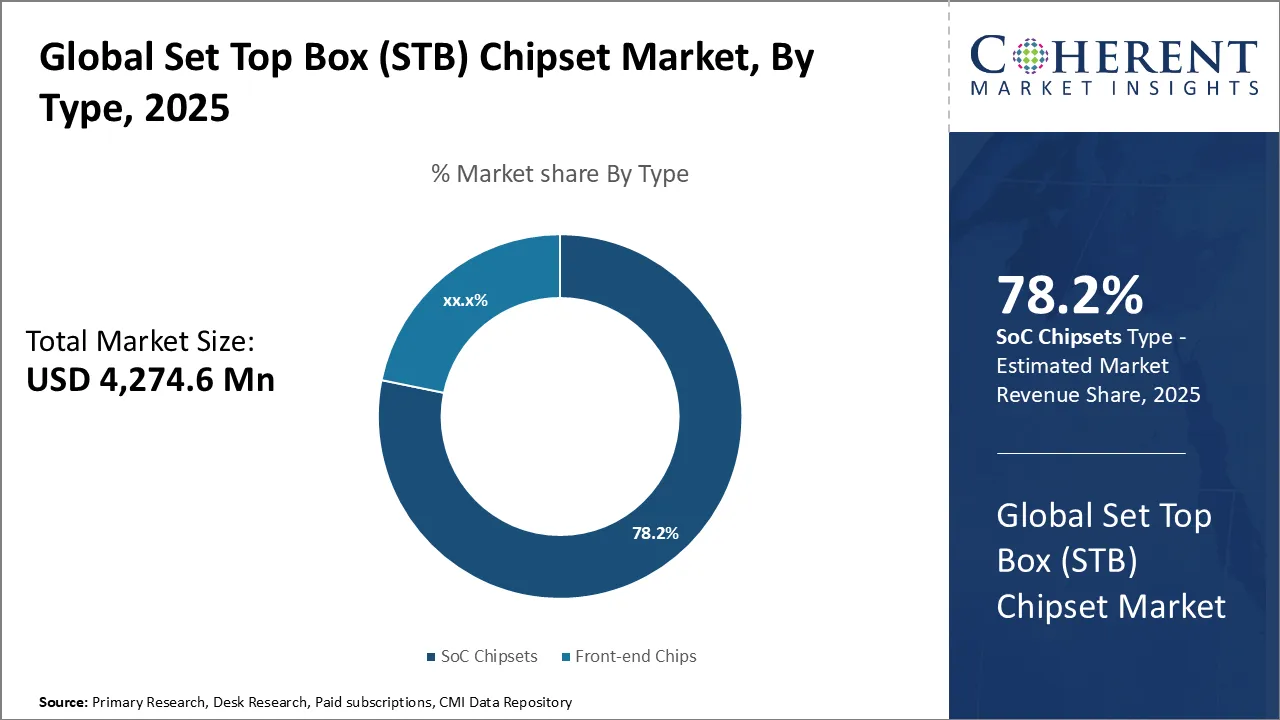
Set Top Box (STB) Chipset Market Insights, By Type - The Soc (System-On-Chip) Chipsets Dominates as they deliver cost-efficient, high-performance integration for advanced streaming and interactive features
In terms of type, the SoC (System-on-Chip) chipset segment is projected to hold 79.2% share in 2026, due to their ability to integrate processing, graphics, memory, and connectivity into a single solution. This reduces cost and power consumption while enabling advanced features such as 4K/8K streaming, OTT compatibility, AI, and gaming support, meeting evolving consumer expectations for multifunctional, high-performance STBs.
For instance, in May 2025, Chinese tech giant Xiaomi launched its first flagship-grade SoC, the XRing O1, built on a second-generation 3nm process featuring a 10-core CPU and 16-core Immortalis-G925 GPU. It powers the new Xiaomi 15S Pro and Pad 7 Ultra, aiming to rival Snapdragon 8 Elite and reduce reliance on external chipmakers.
-chipset-market-by-node-size.webp "Set Top Box (STB) Chipset Market, By Node Size")
Set Top Box (STB) Chipset Market Insights, By Node Size - 28 nm Dominance Is driven by Its Cost-Effective Balance of Performance and Power Efficiency
In terms of node size, the 28nm segment is expected to contribute the largest share of the market in 2026, due to its balance of performance, cost-efficiency, and power optimization. It enables advanced features like 4K/8K video streaming, AI integration, and gaming support while maintaining affordability. Manufacturers favor 28nm for mass-market STBs, ensuring scalability and strong Set Top Box (STB) Chipset Market demand.
For instance, India is charting a pragmatic path in the semiconductor race by focusing on mature-node chips (28 nm–65 nm) to meet surging demand in automotive, telecom, and industrial electronics. Analysts say this strategy mirrors Taiwan and South Korea’s early semiconducting journey, positioning India to fill a global supply gap.
Set Top Box (STB) Chipset Market Insights, By Application - IPTV STB Demand is Growing as Consumers Shift to Internet-Based, High-Quality, and Interactive Streaming Experiences
In terms of application, the IPTV STB segment is expected to command the highest share of the market in 2026, due to the rapid shift toward internet-based content consumption, personalized streaming, and on-demand services. Rising adoption of OTT platforms, 4K/8K content, and interactive applications requires advanced chipsets with faster processing, seamless connectivity, and efficient video decoding, making IPTV STBs a preferred choice for consumers and service providers.
For instance, in March 2025, Bharti Airtel unveiled its IPTV service across 2,000 cities in India, delivering 350+ live TV channels, high-speed internet, and streaming apps via Xstream Fiber, enhancing at-home entertainment nationwide.
Set Top Box (STB) Chipset Market Insights, By Content Quality - Rising Adoption of Ultra-High-Definition Content and OTT Platforms Is Driving Strong Demand For 4K And Above
In terms of content quality, the 4K and above segment is estimated to hold the greatest share of the market in 2026, due to increasing consumer preference for ultra-high-definition viewing, fueled by OTT platforms, smart TVs, and immersive home entertainment experiences. Advanced chipsets enable seamless 4K/8K streaming, HDR, and faster processing, driving adoption as broadcasters and service providers transition toward high-resolution content delivery.
For instance, in 2025, Dish TV entered India’s smart TV market with its VZY Smart TV lineup, offering sizes from 32-inch HD to 55-inch 4K QLED models. The televisions integrate live DTH and OTT streaming platforms within a single device, powered by Google TV (Android 14).
Regional Insights
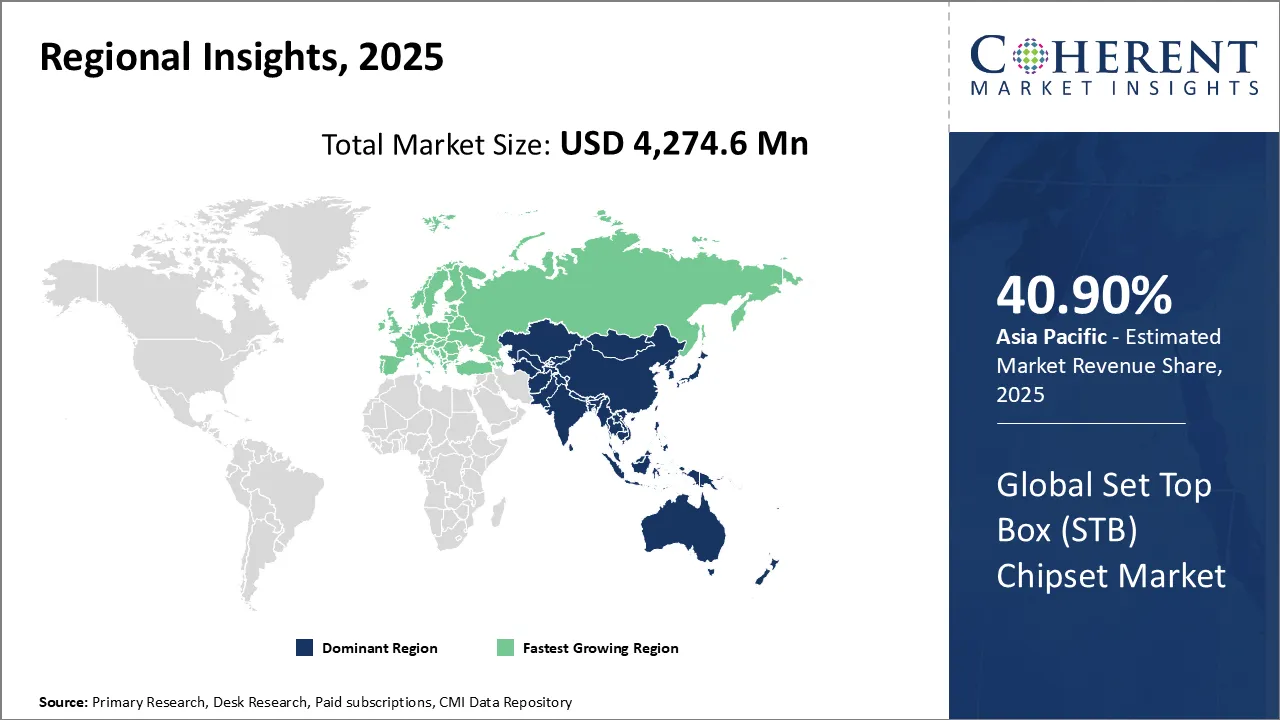
Asia Pacific Set Top Box (STB) Chipset Market Analysis & Trends
Asia Pacific region is projected to lead the market with a 40.9% share in 2026, propelled by a rapid digitalization, increasing IPTV and OTT subscriptions, and government-led digitization of broadcasting. Rising consumer demand for affordable, high-quality entertainment, coupled with expanding broadband infrastructure in countries like China and India, further accelerates adoption, boosting regional market growth and chipset innovation.
For instance, in November 2026, KT Corp. launched South Korea's first IPTV set-top box capable of 8K resolution (33.2 megapixels) with integrated AI features. The device offers enhanced video quality and smart functionalities, marking a significant advancement in
Europe Set Top Box (STB) Chipset Market Analysis & Trends
Europe region is expected to exhibit the fastest growth in the market contributing 26.6% share in 2026, due to widespread adoption of IPTV and OTT services, strong demand for high-definition and 4K/8K content, and government initiatives promoting digital broadcasting. Additionally, rising smart home integration and consumer preference for interactive entertainment drive the need for advanced, energy-efficient STB chipsets across the region.
For instance, in September 2024, ZTE unveiled its next-generation 4K AI flagship set-top box at the 2024 IBC Show in Amsterdam. The innovative device merges STB and soundbar functionality with AI processing, immersive surround sound, voice interaction, and smart-home control, redefining home entertainment while bolstering operator engagement.
Set Top Box (STB) Chipset Market Outlook Country-Wise
The U.S. Set Top Box (STB) Chipset Market Trends
The U.S. acquires the prominent share in the Set Top Box (STB) Chipset Market, holding a 17.1% share, driven by high penetration of IPTV and OTT platforms, widespread smart TVs, and advanced features such as 4K/8K streaming, gaming, and interactive applications. Major STB manufacturers and technology-driven households further accelerate market growth.
For instance, in August 2026, Guru IPTV introduced a new annual subscription plan tailored for U.S. viewers, offering over 15,000 Indian and international channels. Subscribers can enjoy HD and 4K streaming, a vast on-demand library, and multi-device compatibility. Additionally, a 24-hour free trial is available to new users. Such innovations are proliferating the demand for Set Top Box chipset.
China Set Top Box (STB) Chipset Market Trends
China holds 11.6% of the market, fueled by a large population, rapid adoption of OTT and IPTV services, and government initiatives promoting digital TV and smart home technologies. Cost-effective STBs with advanced SoC chipsets cater to the growing demand across urban and semi-urban regions.
For instance, in April 2026, China introduced the GPMI interface, a new high-speed data transmission standard designed to replace HDMI and DisplayPort. With a single cable, GPMI supports data rates up to 192 Gbps and delivers up to 480W of power, offering a significant advancement in display and computing connectivity. The interface is poised to enhance multimedia applications and device interconnectivity.
The U.K. Set Top Box (STB) Chipset Market Trends
The UK contributes 7.9% to the market, driven by adoption of digital broadcasting, interactive TV, and hybrid STBs that combine streaming, gaming, and on-demand content. Consumer preference for multifunctional devices encourages innovation in chipset design and performance.
For instance, IPTV Smarters unveiled a comprehensive IPTV service offering access to over 120,000 live TV channels and more than 250,000 video-on-demand titles, including local British content. The platform supports multiple devices, including Android, iOS, Windows, and Amazon Fire TV, and is compatible with Xtream Codes and M3U playlists. This launch aims to enhance user experience with an intuitive interface and advanced features.
GCC Countries Set Top Box (STB) Chipset Market Trends
The GCC nations account for 2.5% of the market, supported by high disposable incomes, smart TV adoption, and connected home entertainment growth. Consumers increasingly demand STBs with streaming, gaming, and interactive features, boosting chipset investments.
For instance, in July 2026, Valerion, the premium sub-brand of AWOL Vision, officially launched in the UAE and Saudi Arabia, introducing its VisionMaster Pro 2 and StreamMaster Plus 2 triple-laser 4K RGB projectors. These models cater to the region's evolving home entertainment needs, offering features like Google TV OS, voice control, and ultra-low input lag for gaming. Valerion aims to redefine the home cinema experience in the GCC.
Mexico Set Top Box (STB) Chipset Market Trends
Mexico holds 2.4% of the market, with growth driven by expanding broadband access, digital TV adoption, and rising interest in OTT platforms. Interactive and gaming-enabled STBs are gradually increasing Set Top Box (STB) Chipset Market demand in the region.
For instance, in June 2026, Fox Corporation acquired Caliente TV, a prominent sports broadcasting platform, expanding its portfolio in the sports media sector. The acquisition aims to enhance Fox's content offerings and strengthen its position in the competitive sports broadcasting market.
Market Report Scope
Set Top Box (STB) Chipset Market Report Coverage
| Report Coverage | Details | ||
|---|---|---|---|
| Base Year: | 2025 | Market Size in 2026: | USD 4578.1 Mn |
| Historical Data for: | 2020 To 2024 | Forecast Period: | 2026 To 2033 |
| Forecast Period 2026 to 2033 CAGR: | 7.1% | 2033 Value Projection: | USD 7399.7 Mn |
| Geographies covered: |
| ||
| Segments covered: |
| ||
| Companies covered: | Amlogic, Inc., ALi Corporation, Marvell, Zhuhai Allwinner Technology Co., Ltd., Broadcom Inc., Socionext Inc., HiSilicon (Shanghai) Technologies Co., Ltd., Pixelworks Inc., Novatek Microelectronics Corp., Rafael Micro, STMicroelectronics, Renesas Electronics Corporation, Synaptics Incorporated, Qualcomm Technologies, Inc., Telechips Inc., Sony Corporation, MaxLinear Inc., MediaTek Inc., Silicon Laboratories, Availink, Inc., MStar Semiconductor Inc., SOLUM Co., Ltd., Hangzhou Nationalchip Science & Technology Co, Ltd., and AltoBeam Inc. | ||
| Growth Drivers: |
| ||
| Restraints & Challenges: |
| ||
Market Dynamics
Global Set Top Box (STB) Chipset Market Drivers
Integration of 5G and Wi-Fi Connectivity in Set Top Boxes
The integration of 5G and Wi-Fi connection in set-top boxes has provided customers with new video experiences that feature low latency, fast speed, and high reliability. Furthermore, the integration of connectivity in set-top boxes provides high speed and 4K UHD video service with rich video content.
Improvement in Content Technology such as 4K, High Definition, and Others
Advanced technology such as 4K in TV has gained popularity as customers seek ultra-high-definition visual quality. Such TVs require a 4K set top box that requires more processing power than an HD or full HD set top box. As a result of the growing customer demand, numerous set-top box chipset makers are launching 4K chipsets. For instance, in November 2020, HiSilicon (Shanghai) Technologies Co., Ltd., a semiconductor design company, announced the launch of next-generation 4K and 8K chipsets with CUVA HDR, AVS2, AVS3, 3D Audio, and China DRM technical standards for STB.
Global Set Top Box (STB) Chipset Market Opportunities
Integration of Gaming and Fitness Feature in Set Top Box
The integration of gaming and fitness features in set-top boxes (STBs) is emerging as a key driver in the Set Top Box (STB) Chipset Market, enhancing device functionality beyond traditional TV streaming. Modern STBs now support interactive fitness applications, motion-controlled gaming, and gamified health tracking, which require higher processing power, advanced graphics handling, and AI-enabled chipsets. This trend is encouraging chipset manufacturers to develop more powerful, energy-efficient, and multi-functional processors capable of handling gaming and fitness workloads alongside streaming services. As consumer demand for immersive and interactive home entertainment grows, the Set Top Box (STB) Chipset Market size is expected to expand significantly, driven by the adoption of hybrid STBs offering both entertainment and lifestyle applications.
Analyst opinion (Expert Opinion)
- The Set Top Box chipset market is undergoing a structural shift from narrow video-decoding silicon to platform-class SoCs that must reconcile operator-grade reliability with consumer-facing features borrowed from the connected-TV and mobile worlds. Competition is now being fought on three axes: (a) systems integration (multi-codec + networking + Wi-Fi + USB/PCIe subsystems), (b) software and services enablement (trusted execution, DRM, Android/Google TV/Proprietary stacks), and (c) power-efficient on-device intelligence (NPUs for QoE, voice, and lightweight edge ML). The vendors that win will be those that treat the STB as a persistent edge compute appliance rather than as a one-trick video decoder.
- Operator demand for higher throughput and integrated access-technology features is concentrating value in vendors who can own both broadband access and application processing. The recent collaboration between Broadcom and major US cable operators to develop unified DOCSIS/D4.0-capable silicon illustrates that operators prefer single-vendor, validated silicon platforms that reduce integration risk and speed fleet rollouts.
Implication: Broadcom-class incumbents will continue to capture operator STB designs that require tight modem/PHY integration and field-proven lifecycle management. - Proliferation of smart TVs and streaming devices is depressing the pure-hardware premium for low-end STBs and forcing vendors to pursue software/service differentiation. In the U.S., smart TV penetration is now measured in the high-60s percent of connected households, which reduces the share of consumers who buy STBs purely for OTT feature gaps. Hardware vendors must therefore sell either premium capabilities (8K, AV1 hardware decode, local AI) or operator-grade features (QoS, multicast, multicast + DRM).
- Codec economics remain the single largest technical gating factor for next-generation visual quality (e.g., AV1). AV1 offers substantial bitrate efficiency in lab and CDN trials, but hardware decode penetration remains nascent, recent measurement shows single-digit (≈9.8%) AV1 hardware decode presence on mobile devices as of mid-2024, implying that an immediate, blanket migration to AV1 in STB fleets is impractical for most operators. The practical interim strategy is hybrid delivery: AV1 for newer device classes while maintaining HEVC/VP9/H.264 fallbacks for the installed base.
Speak to the analyst
Want personalized insights?
Take the findings above to one of our principal consultants, or have the report rebuilt around the segments, geographies and competitors you actually track.
Market Segmentation
- Global Set Top Box (STB) Chipset Market, By Node Size (Revenue, USD Mn, 2021 - 2033)
- 22 nm
- 28 nm
- 40 nm
- 65 nm
- 90 nm
- Global Set Top Box (STB) Chipset Market, By Application (Revenue, USD Mn, 2021 - 2033)
- Satellite STB
- Cable STB
- IPTV STB
- Others
- Global Set Top Box (STB) Chipset Market, By Content Quality (Revenue, USD Mn, 2021 - 2033)
- Standard Definition
- High Definition
- 4K and Above
- Global Set Top Box (STB) Chipset Market, By Type (Revenue, USD Mn, 2021 - 2033)
- Front-end Chips
- SoC Chipsets
- Global Set Top Box (STB) Chipset Market, By Region (Revenue, USD Mn, 2021 - 2033)
- North America
- U.S.
- Canada
- Latin America
- Brazil
- Argentina
- Mexico
- Rest of Latin America
- Europe
- Germany
- U.K.
- Spain
- France
- Italy
- Russia
- Rest of Europe
- Asia Pacific
- China
- India
- Japan
- Australia
- South Korea
- ASEAN
- Rest of Asia Pacific
- Middle East
- GCC Countries
- Israel
- Rest of Middle East
- Africa
- South Africa
- North Africa
- Central Africa
- North America
- Company Profiles
- MaxLinear Inc.
- Silicon Laboratories
- AltoBeam Inc.
- MediaTek Inc.
- Novatek Microelectronics Corp.
- Rafael Micro
- HiSilicon (Shanghai) Technologies CO., LIMITED
- Synaptics Incorporated
- STMicroelectronics
- TELECHIPS INC.
Sources
Primary Research Interviews from the following stakeholders
Stakeholders
- Interviews with commercial display manufacturers, AV integrators, signage installers, facility managers, digital content managers, and procurement heads across leading global markets.
Specific stakeholders
- Digital transformation leads at retail chains
- Facility and operations managers at transport
- IT infrastructure heads at hospitality and hotel groups
- Advertising and media managers at DOOH agencies and mall operators
- AV consultants and integrators in corporate and education sectors
- Product managers at display technology OEMs and component suppliers
Databases
- World Trade Organization (WTO) Trade Statistics
- UN Comtrade Database
- Ministry of Electronics and Information Technology (MeitY), India
- Bureau of Economic Analysis (U.S.)
- Eurostat
- China Customs Statistics
- Korea Customs Service Data Portal
- Japan External Trade Organization (JETRO)
- Directorate General of Commercial Intelligence and Statistics (DGCIS), India
Magazines
- AV Magazine
- Installation International
- Digital Signage Today
- InAVate
- Systems Contractor News (SCN)
- Display Daily
- TechRadar Pro (Commercial Display section)
- Future Store Guide
Journals
- Journal of Display Technology
- IEEE Transactions on Consumer Electronics
- Displays (Elsevier)
- Journal of Visual Communication and Image Representation
- Journal of Retailing and Consumer Services
Newspapers
- The Wall Street Journal – Tech & Media
- The Economic Times – Technology & Industry
- The Hindu Business Line – Consumer Tech & Retail
- Financial Times – AV & Display Industry Reports
- Nikkei Asia – Electronics and Supply Chain
- South China Morning Post – Tech & Industry
Associations
- Society for Information Display (SID)
- International Sign Association (ISA)
- AVIXA (Audiovisual and Integrated Experience Association)
- Digital Signage Federation (DSF)
- Consumer Technology Association (CTA)
- Confederation of Indian Industry (CII) – Electronics & Display Panel Forum
- Display Industry Council (Japan)
Public Domain Sources
- Ministry of Electronics and IT (Government of India)
- National Institute of Standards and Technology (NIST), U.S.
- Ministry of Economy, Trade and Industry (METI), Japan
- U.S. International Trade Commission (USITC)
- NITI Aayog
- India Investment Grid – Electronics Sector
- EU Single Market Observatory – Digital Media Reports
- Reserve Bank of India (RBI) Reports on Electronics and Retail Sectors
Proprietary Elements
- CMI Data Analytics Tool, and Proprietary CMI Existing Repository of commercial display data spanning over 8 years across panel types, applications, and regional deployments
*Definition: Global set-top box chipset market refers to the industry that encompasses the production, distribution, and sale of semiconductor chipsets specifically designed for set-top boxes (STBs). Set-top box chipsets are integrated circuits that power the functionality and performance of STBs, which are devices that are used to receive and decode television signals for display on a television set.
Get access to 250+ pages report
Every segment, forecast, competitor profile and data table behind the analysis above — available for instant download.
- ESOMAR Member
- ISO 9001:2015 Certified
- D-U-N-S Registered
- GDPR & CCPA Compliant
Missing comfort of reading report in your local language? Find your preferred language:
Transform your Strategy with Exclusive Trending Reports
Frequently Asked Questions
The Set Top Box (STB) Chipset Market is estimated to be valued at USD 4,578.1 Mn in 2026, and is expected to reach USD 7,399.7 Mn by 2033.
Global set top box (STB) chipset market is estimated to reach US$ 7,399.7 Million by 2033
Some of the key players in the market are MaxLinear Inc., Silicon Laboratories, AltoBeam Inc., MediaTek Inc., Novatek Microelectronics Corp., Rafael Micro, HiSilicon(Shanghai) Technologies CO., LIMITED, Synaptics Incorporated, STMicroelectronics, TELECHIPS INC. and many more.
Among application, the Cable STB segment held the largest market share among the in 2026.
The CAGR of the Set Top Box (STB) Chipset Market is projected to be 7.1% from 2026 to 2033.