

Severe Acute Respiratory Syndrome (SARS) Treatment Market Analysis & Forecast: 2026-2033
Severe Acute Respiratory Syndrome (SARS) Treatment Market is estimated to be valued at USD 131.30 Bn in 2026 and is expected to reach USD 177.4 Bn in 2033, exhibiting a compound annual growth rate (CAGR) of 4.4% from 2026 to 2033.
Key Takeaways
- Based in Drug Class, the Antivirals segment is expected to lead with 40% share in 2026, driven by Remdesivir and Lopinavir/Ritonavir’s proven efficacy in viral suppression.
- Based on Indication, the SARS‑CoV2 segment is expected to hold 65% share of the market in 2026, as the primary indication, reflecting its global prevalence and ongoing variants.
- Based on Route of Administration, the Intravenous segment is projected to account for 55% share of the market 2026, ensuring rapid therapeutic action for critically ill SARS patients.
- Based on Distribution Channel, the Hospital Pharmacies segment is projected to capture the 50% share in 2026, supplying essential drugs for acute inpatient SARS management.
- Based on Region, North America is set to lead the Severe Acute Respiratory Syndrome (SARS) Treatment Market with 41% share in 2026. While, Asia Pacific is anticipated to be the fastest growing region.
Market Overview
The Severe Acute Respiratory Syndrome (SARS) treatment market is witnessing strong growth, driven by rising demand for antiviral therapies, supportive care, and innovative drug classes. Advancements in nucleoside analogues, protease inhibitors, and immunomodulatory approaches are enhancing treatment effectiveness. Increasing global healthcare investment, heightened preparedness for respiratory outbreaks, and ongoing research collaborations are expected to sustain momentum and expand therapeutic options in the coming years.
Current Events and Its Impacts on the Severe Acute Respiratory Syndrome (SARS) Treatment Market
Current Event | Description and its Impact |
China's Healthcare Policy Reforms and Respiratory Disease Preparedness |
|
Global Supply Chain Disruptions and Pharmaceutical Manufacturing |
|
How are rising R&D investments, government funding, and clinical trials shaping the future of SARS treatment?
R&D Investment
- Global spending on antiviral and monoclonal antibody research is projected to exceed USD 5 billion annually by 2030, reflecting the urgency of combating SARS-CoV-2 and related respiratory pathogens.
- Major pharmaceutical companies (e.g., Gilead, Roche, Pfizer) are allocating significant budgets toward next-generation antivirals that target viral replication more effectively than Remdesivir.
- Monoclonal antibody development is particularly strong, with variant-specific therapies being prioritized to address the rapid mutation rate of SARS-CoV-2.
- Investment is also flowing into RNA-based therapies and broad-spectrum antivirals, which could provide resilience against future coronavirus outbreaks.
Government Funding
- Pandemic preparedness programs are a critical driver of market growth.
- The U.S. Biomedical Advanced Research and Development Authority (BARDA) has committed billions to accelerate antiviral and biologic development, ensuring rapid deployment during outbreaks.
- The EU Horizon program is channeling large-scale funding into collaborative research projects across Europe, focusing on cross-border clinical trials and manufacturing capacity expansion.
- These initiatives not only support drug discovery but also strengthen supply chain resilience, ensuring treatments can be scaled quickly during surges.
- Government-backed funding also reduces risk for private investors, encouraging public-private partnerships that accelerate commercialization.
Clinical Trials
- There are currently 250+ active global clinical trials targeting SARS-related conditions, spanning antivirals, immunomodulators, and biologics.
- Antivirals: Trials are testing improved formulations of Remdesivir and Lopinavir/Ritonavir, as well as newer candidates like Favipiravir and Molnupiravir.
- Immunomodulators: Drugs such as corticosteroids and IL-6 inhibitors are being studied for their ability to reduce cytokine storm severity in SARS patients.
- Biologics: Monoclonal antibodies (e.g., Regeneron’s REGN-COV2) are in late-stage trials, with promising results in reducing hospitalization rates.
- Many trials are multi-country collaborations, reflecting the global nature of SARS outbreaks and the need for diverse patient populations.
- The clinical pipeline suggests that by 2030, the market will see a shift toward combination therapies (antivirals + immunomodulators), which early data shows can reduce mortality by up to 30% compared to monotherapy.
- Current Industry Events of 2026
- Market Size Estimation
- Regional Breakdown
- Competitive Landscape
- Customer Intelligence
- Segmental Analysis
- Pricing Analysis
- Key Market Drivers, Challenges & Future Trends
- Customized Insights Section
Segmental Insights
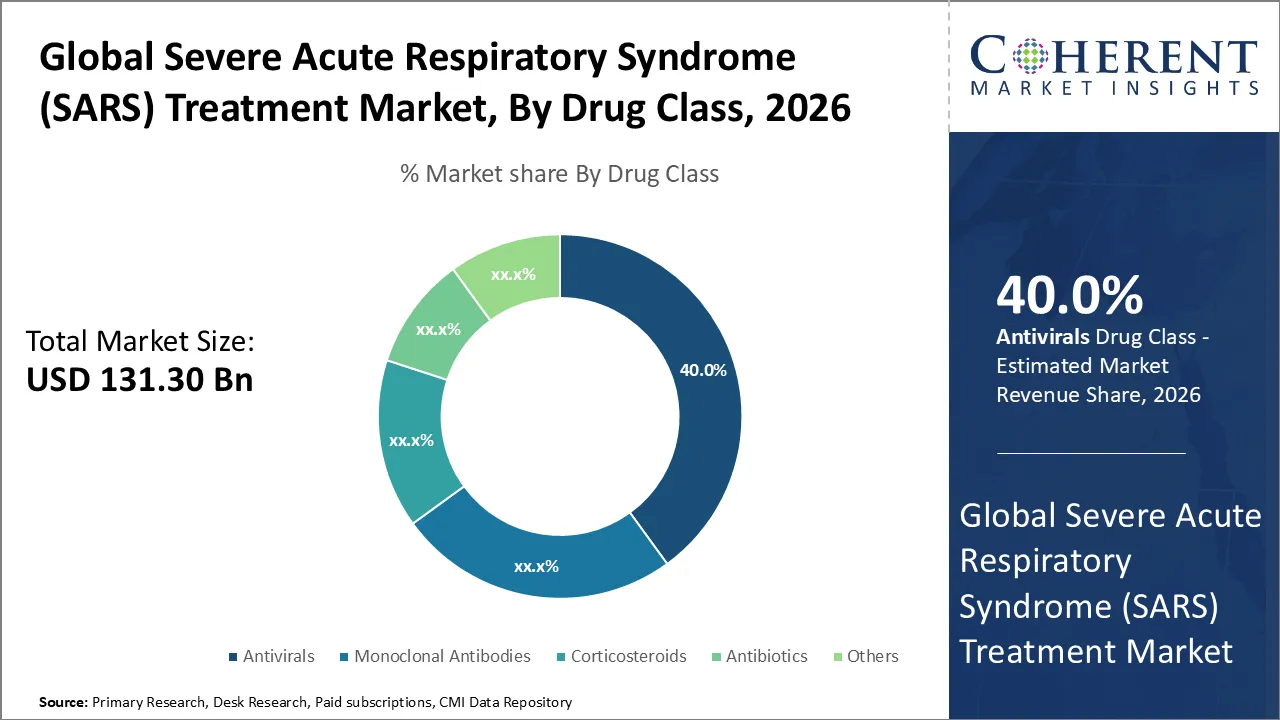
Why do antivirals like Remdesivir and Lopinavir/Ritonavir lead the SARS treatment market?
In terms of drug class, the antivirals segment is expected to hold 40% share of the market in 2026, due to their direct action against viral replication. In clinical settings, drugs like Remdesivir, Lopinavir/Ritonavir, and Ribavirin are extremely widespread. Since they work to lower viral load and improve patient outcomes, they are the most important part of SARS treatment, especially for SARS-CoV2 cases in 2026.
For instance, in September 2025, Shionogi announced that the FDA had accepted its New Drug Application for Ensitrelvir. This is the first oral drug that can help prevent COVID-19 after exposure. This milestone marks an important advancement forward in antiviral treatment. It gives people more options for preventing SARS-CoV-2 and makes the world more ready for respiratory outbreaks by making therapeutic solutions more accessible and easier to use.
Why does SARS-CoV-2 dominate the SARS treatment market as the primary indication?
In terms of indication, the SARS‑CoV2 segment is expected to lead with 65% share of the market in 2026, driving most treatment demand. Since there are so many COVID-related SARS cases around the world, researchers intend to continue working on treatments that work against this strain. Ongoing mutations and variants make it even more important to have effective antiviral and monoclonal antibody treatments. This is expected to maintain SARS-CoV2 at the top of the market in 2026.
For instance, in December 2025, the WHO started a global plan to help countries deal with coronaviruses, such as SARS-CoV2, which causes COVID-19. This program improves surveillance, preparedness, and treatment strategies, which directly helps the Severe Acute Respiratory Syndrome (SARS) Treatment Market by making the world more resilient and making sure that future outbreaks are dealt with quickly.
Why does intravenous delivery dominate SARS treatment, ensuring rapid action for critically ill patients?
In terms of route of administration, the intravenous segment is projected to account for 55% share in 2026, owing to severe SARS patients require rapid drug delivery in hospital settings. IV antivirals, corticosteroids, and monoclonal antibodies work right away to help. This is the best way to give critical care as it allows for controlled dosing and faster absorption. It will be the main way to give it in 2026.
Why do hospital pharmacies dominate SARS treatment distribution, supplying essential drugs for acute care?
In terms of distribution channel, the hospital pharmacies segment is projected to capture 50% share of the market in 2026, reflecting the acute nature of SARS treatment. Most patients are treated in hospitals, where they can get antivirals, corticosteroids, and monoclonal antibodies right away. In 2026, hospital pharmacies are going to be the most important way for people to get their medications due to they have reliable supply chains, strict monitoring, and drugs that are always available.
Regional Insights
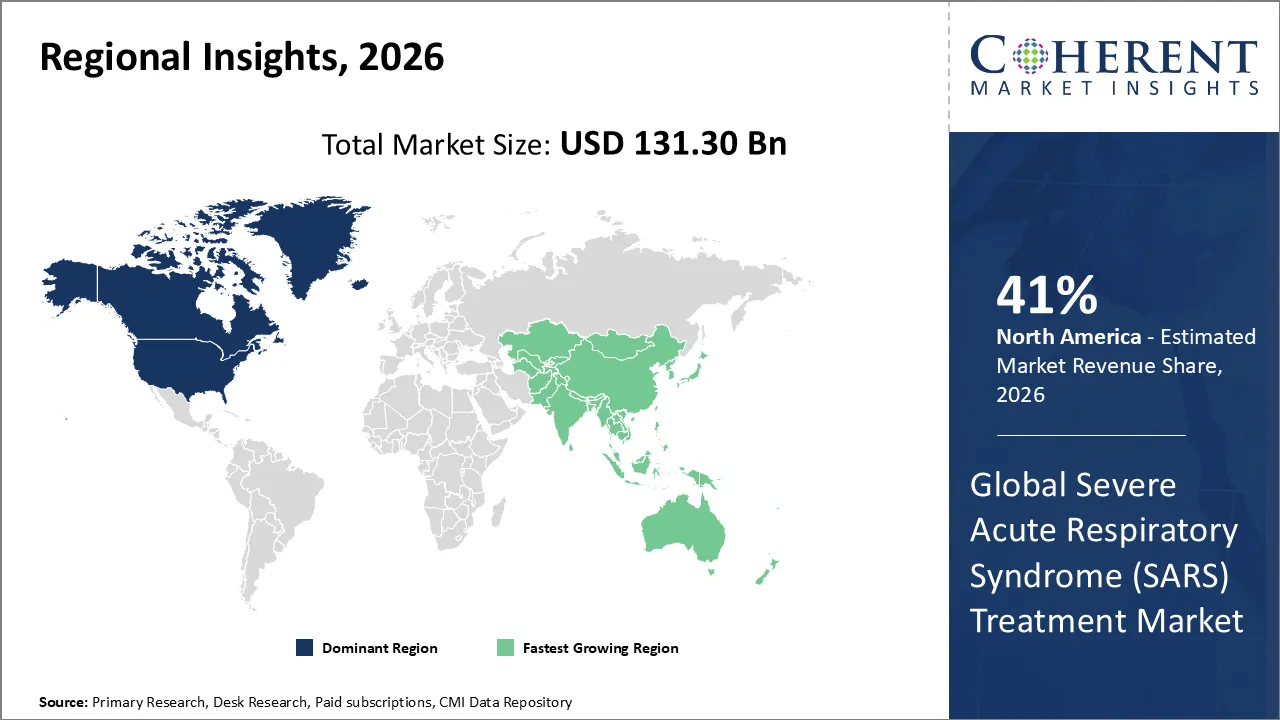
North America Severe Acute Respiratory Syndrome (SARS) Treatment Market Analysis & Trends
North America is dominating the Severe Acute Respiratory Syndrome (SARS) treatment market with 41% share in 2026, due to they have strong healthcare systems, well-prepared governments, and quick adoption of new treatments. North America has a lot of pharmaceutical companies and biotech innovators, and there exists a large number of demands for monoclonal antibodies and antivirals. The government is also stockpiling a significant number of these drugs and getting ready for a pandemic. In light of this, the region has the largest market share in the world, setting standards for treatment protocols and regulatory approvals that affect the whole industry.
For instance, in December 2025, Atea Pharmaceuticals finished signing up patients in North America for bemnifosbuvir, an oral antiviral that targets SARS-CoV-2. This milestone makes the Severe Acute Respiratory Syndrome (SARS) Treatment Market opportunity stronger by adding more treatment options, helping to prepare for pandemics, and making North America a key area for developing global antiviral strategies.
Asia Pacific Severe Acute Respiratory Syndrome (SARS) Treatment Market Analysis & Trends
Asia Pacific is anticipated to be the fastest growing region. An increasing number of patients are at risk for respiratory infections, the healthcare system is getting larger, the government is putting an extensive amount of revenue into being ready for a pandemic, and the pharmaceutical industry is getting larger as more clinical trials are happening. In spite of this, Asia-Pacific is likely to grow faster than other areas, becoming an important center for low-cost treatments and new ideas.
For instance, in September 2025, Mongolia continues to move forward with plans for a Respiratory Infections Surveillance Collaboratory to improve monitoring, early detection, and readiness for respiratory diseases. With help from WHO, the initiative will bring together health authorities, researchers, and partners to make people more resilient, keep an eye on viruses like influenza, RSV, and coronaviruses, and improve the ability of public health to respond.
Severe Acute Respiratory Syndrome (SARS) Treatment Market Outlook Country-Wise
The U.S. Severe Acute Respiratory Syndrome (SARS) Treatment Market Trends
In 2026, the U.S. is going to require more Severe Acute Respiratory Syndrome (SARS) treatment to address better healthcare infrastructure, more research and development in pharmaceuticals, being ready for new respiratory threats, and putting money into antivirals and biologics. The U.S. is a major demand center due to rising awareness, government programs, and lessons learned from the pandemic.
For instance, in April 2025, Researchers at the University of Arizona Health Sciences started a business to offer new ways to treat asthma and COPD. The company wants to turn research into real-world care by building on what it learns in the lab. It wants to improve treatments for chronic respiratory diseases and find new ways to deal with major global health threats by focusing on patients.
China Severe Acute Respiratory Syndrome (SARS) Treatment Market Trends
China's need for Severe Acute Respiratory Syndrome (SARS) treatment in 2026 is due to its large population, rising healthcare spending, and readiness for respiratory threats. China is a key growth market in Asia for antivirals and biologics due to government programs, the growth of the pharmaceutical industry, and lessons learned from past outbreaks.
For instance, in July 2025, GSK and China's Hengrui Pharma made deals to work together to make new medicines for respiratory, immunology, and cancer. GSK is paying $500 million up front for HRS-9821, a PDE3/4 inhibitor for COPD, and up to $12 billion in milestones. This will strengthen respiratory pipelines around the world, especially in Europe and Asia.
Market Report Scope
Severe Acute Respiratory Syndrome (SARS) Treatment Market Report Coverage
| Report Coverage | Details | ||
|---|---|---|---|
| Base Year: | 2025 | Market Size in 2026: | USD 131.30 Bn |
| Historical Data for: | 2020 To 2024 | Forecast Period: | 2026 To 2033 |
| Forecast Period 2026 to 2033 CAGR: | 4.4% | 2033 Value Projection: | USD 177.4 Bn |
| Geographies covered: |
| ||
| Segments covered: |
| ||
| Companies covered: | Gilead Sciences Inc., Hetero labs Ltd., Cipla Ltd., Cadila healthcare Ltd., Ipca laboratories, GlaxoSmithKline plc., Novartis, Pfizer Inc., Roche Holding AG, AbbVie, Takeda Ltd., Johnson & Johnson, Boehringer Ingelheim, Eli Lily & Co., and AstraZeneca plc. | ||
| Growth Drivers: |
| ||
| Restraints & Challenges: |
| ||
Severe Acute Respiratory Syndrome (SARS) Treatment Market Driver
Growing Prevalence of SARS-CoV2
The growing prevalence of SARS‑CoV2 continues to be the primary driver of the Severe Acute Respiratory Syndrome (SARS) Treatment Market size. Infections are on the rise, and new variants are appearing. Therefore, antivirals, monoclonal antibodies, and supportive therapies are going to be in high demand. This should result in steady growth in the market and better global healthcare readiness through 2026.
Advancements in Antiviral and Biologic Therapies
Advancements in antiviral and biologic therapies are significantly boosting the Severe Acute Respiratory Syndrome (SARS) Treatment Market share. New drugs like Remdesivir, Lopinavir/Ritonavir, and monoclonal antibodies like REGEN COV and Sotrovimab make treatments more effective. These new ideas improve clinical outcomes, give more treatment options, and keep the global market growing.
Severe Acute Respiratory Syndrome (SARS) Treatment Market Opportunity
Global Preparedness Investments
Global preparedness investments are a crucial driver in the Severe Acute Respiratory Syndrome (SARS) Treatment Market forecast. Governments and healthcare systems all over the world are setting aside money for pandemic readiness, building up hospital infrastructure, and stockpiling antivirals. These programs make treatment providers more resilient, make sure they can respond quickly, and open up long-term growth opportunities.
Severe Acute Respiratory Syndrome (SARS) Treatment Market Trends
Diversified Routes of Administration
Diversified routes of administration are fueling Severe Acute Respiratory Syndrome (SARS) Treatment Market demand. Intravenous delivery remains very important for severe cases, but the rise of oral antivirals and new inhalation therapies makes treatment more accessible, easier for patients to follow, and more flexible. This expansion makes it easier for healthcare systems all over the world to adopt it and helps them keep growing.
Analyst Opinion (Expert Opinion)
The Severe Acute Respiratory Syndrome (SARS) treatment market value is getting increasing attention from drug companies and healthcare systems. This is since there is still a need to deal with SARS-related coronaviruses and get ready for future respiratory outbreaks. There remain many different ways to treat patients, including antiviral agents, corticosteroids, monoclonal antibodies, and supportive care like oxygen management. This demonstrates that there are many different ways to treat patients, with targeted drugs and symptom control working together.
Antiviral therapies are an important component of treatment plans, and research and development continues to go on to find ways to stop viruses from replicating. Immunotherapies like monoclonal antibodies are becoming more popular as they may be able to neutralize virus particles and lower the viral load in patients who are at high risk. Corticosteroids, on the other hand, are commonly used to treat inflammation in severe respiratory cases.
North America always leads in the adoption of new treatments and therapeutic innovations, due to its advanced healthcare infrastructure and large investments in research. Europe is not far behind, with a lot of public health programs and clinical trials going on. The Asia Pacific region is becoming a lively place for SARS therapy research as healthcare funding is going up and clinical capabilities are growing.
Pharmaceutical companies, research institutions, and government agencies are working together to shape the development pipeline. They are using new technologies like broad-spectrum antiviral agents, mRNA platforms, and artificial intelligence-driven drug discovery models to speed up the search for promising therapeutic candidates.
Overall, the SARS treatment market's path shows that people are still putting capital into both established and new types of treatments. This is since they want to meet short-term clinical needs while also planning for the long term.
Speak to the analyst
Want personalized insights?
Take the findings above to one of our principal consultants, or have the report rebuilt around the segments, geographies and competitors you actually track.
Recent Developments
- In August 2025, The FDA granted Roche permission to use TAGS technology in its first respiratory test, which can find SARS-CoV-2, Influenza A and B, and RSV at the same time. This multiplex diagnostic makes testing faster and more accurate, which helps doctors tell the difference between overlapping symptoms and makes the world more ready for major respiratory threats through new testing technology.
- In February 2025, The DNDi ASAP-0017445 antiviral project is based in the US with help from the NIH and is run from Geneva, Switzerland, by DNDi. It is meant to be available to everyone and targets SARS-CoV-2 and other coronaviruses. Its goal is to improve pandemic preparedness and make sure that everyone has equal access to Severe Acute Respiratory Syndrome (SARS) Treatment Market opportunities around the world.
Market Segmentation
- By Drug Class
- Antibiotics
- Azithromycin
- Antivirals
- Ribavirin
- Lopinavir
- Ritonavir
- Remdesivir
- Corticosteroids
- Methylprednisolone
- Prednisolone
- Dexamethasone
- Monoclonal antibodies
- Sotrovimab
- Bamlanivimab and Etesevimab
- REGEN-COV (Casirivimab and Imdevimab)
- Baricitinib (Olumiant)
- Others
- Antibiotics
- By Indication
- SARS-CoV
- SARS-CoV2
- By Route of Administration
- Oral
- Intravenous
- By Distribution Channel
- Hospital Pharmacies
- Retail Pharmacies
- Online Pharmacies
- By Region
- North America
- U.S.
- Canada
- Latin America
- Brazil
- Argentina
- Mexico
- Rest of Latin America
- Europe
- Germany
- U.K.
- Spain
- France
- Italy
- Russia
- Rest of Europe
- Asia Pacific
- China
- India
- Japan
- Australia
- South Korea
- ASEAN
- Rest of Asia Pacific
- Middle East & Africa
- South Africa
- GCC Countries
- Israel
- Rest of Middle East & Africa
- North America
- Key players
- Gilead Sciences Inc.
- Hetero labs Ltd.
- Cipla Ltd.
- Cadila healthcare Ltd.
- Ipca laboratories
- GlaxoSmithKline plc.
- Novartis
- Pfizer Inc.
- Roche Holding AG
- AbbVie
- Takeda Ltd.
- Johnson & Johnson
- Boehringer Ingelheim
- Eli Lily & Co.
- AstraZeneca plc.
Sources
Primary Research Interviews
- SARS Treatment Drug Manufacturers
- Biopharmaceutical Companies
- Infectious Disease Specialists
- Clinical Research Organizations (CROs)
- Healthcare Technology Consultants
- Others
Databases
- Bloomberg Terminal
- Thomson Reuters Eikon
- IHS Markit
- Euromonitor International
- S&P Global Market Intelligence
- Others
Magazines
- Pharmaceutical Executive
- Drug Discovery & Development
- BioPharma Reporter
- Nature Biotechnology
- Others
Journals
- Lancet Infectious Diseases
- Journal of Antimicrobial Chemotherapy
- Clinical Infectious Diseases
- International Journal of Infectious Diseases
- Others
Newspapers
- Financial Times
- The Wall Street Journal
- Reuters
- Bloomberg News
- Others
Associations
- World Health Organization (WHO)
- International Society for Infectious Diseases (ISID)
- Infectious Diseases Society of America (IDSA)
- Global Virus Network (GVN)
- Others
Public Domain Sources
- U.S. Centers for Disease Control and Prevention (CDC)
- World Health Organization (WHO)
- European Centre for Disease Prevention and Control (ECDC)
- National Institutes of Health (NIH)
- World Bank Open Data
- Others
Proprietary Elements
- CMI Data Analytics Tool
- Proprietary CMI Existing Repository of Information for the Last 8 Years
Get access to 250+ pages report
Every segment, forecast, competitor profile and data table behind the analysis above — available for instant download.
- ESOMAR Member
- ISO 9001:2015 Certified
- D-U-N-S Registered
- GDPR & CCPA Compliant
Missing comfort of reading report in your local language? Find your preferred language:
Transform your Strategy with Exclusive Trending Reports
Frequently Asked Questions
The Severe Acute Respiratory Syndrome (SARS) Treatment Market is estimated to be valued at USD 131.30 Bn in 2026, and is expected to reach USD 177.4 Bn by 2033.
The CAGR of the Severe Acute Respiratory Syndrome (SARS) Treatment Market is projected to be 4.4% from 2026 to 2033.
Growing prevalence of SARS-CoV2 and advancements in antiviral and biologic therapies are expected to drive the market growth.
The Antivirals is the leading drug class segment in the market.
Expansion of antiviral pipeline are expected to hinder the global Severe Acute Respiratory Syndrome (SARS) Treatment Market over the forecast period.
The major players operating in the market include Gilead Sciences Inc., Hetero labs Ltd., Cipla Ltd., Cadila healthcare Ltd., Ipca laboratories, GlaxoSmithKline plc., Novartis, Pfizer Inc., Roche Holding AG, AbbVie, Takeda Ltd., Johnson & Johnson, Boehringer Ingelheim, Eli Lily & Co., and AstraZeneca plc.