

Small Cell Lung Cancer Therapeutics Market Size and Forecast — 2026-2033
Overview
Small Cell Lung Cancer (SCLC) is malignant form of cancer arising within the lungs. SCLC is characterized by high growth rate, shorter doubling time than the non-small cell lung tumors. SCLC is more responsive to chemotherapy than NSCLC. Small cell lung cancer is highly associated with tobacco, unhealthy food, alcohol, HIV infected, chronic infections or related family history, and physical inactivity. The decrease in smoking is reflected as the substantial decrease in the incidence of SCLC. The symptoms include dyspnea, blood in sputum, weight loss, cough, and debility.
Small Cell Lung Cancer Therapeutics Market Size and Forecast – 2026 – 2033
The Small Cell Lung Cancer Therapeutics Market size is estimated to be valued at USD 3.06 billion in 2026 and is expected to reach USD 5.70 billion by 2033, exhibiting a compound annual growth rate (CAGR) of 9.3% from 2026 to 2033.
Key Takeaways
The immunotherapy segment commands the largest industry share at 46.7%, driven by durable clinical responses and expanding FDA approvals.
The first-line treatment segment dominates with 54.2% market penetration, reflecting its critical role in patient therapy protocols.
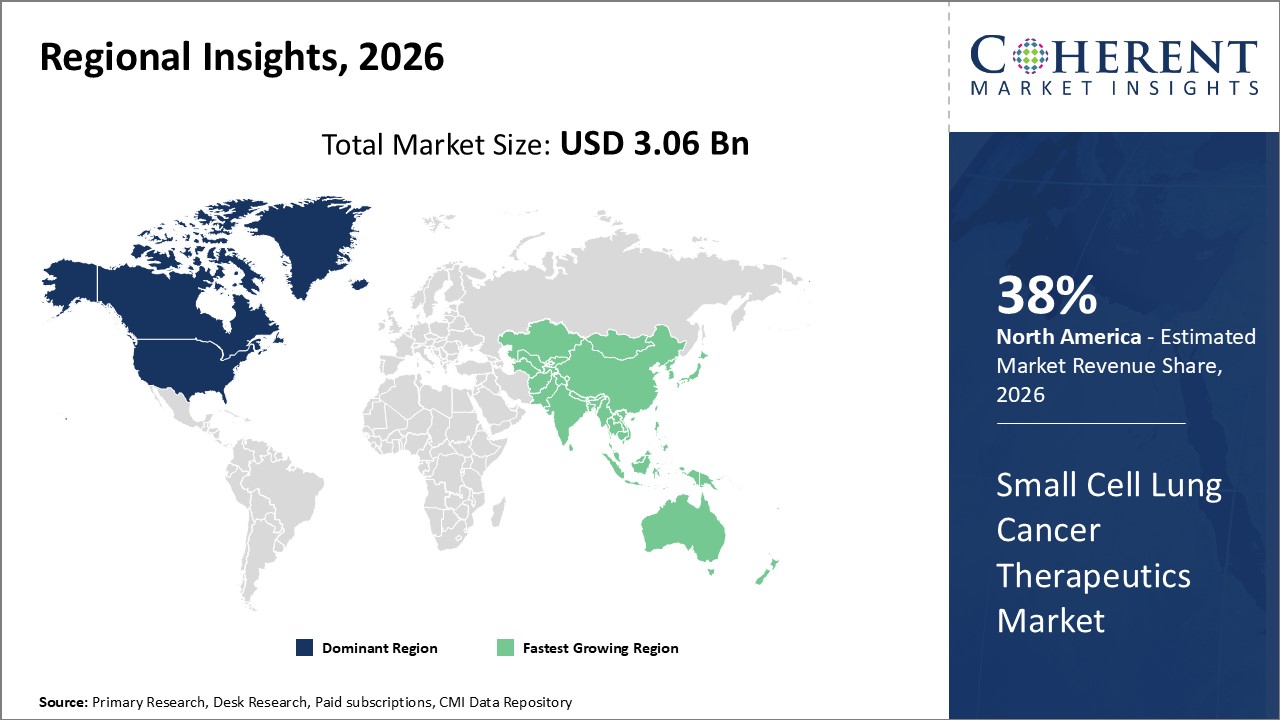
North America leads with approximately 38% market share, strengthened by advanced healthcare systems and early adoption of novel therapeutics.
Asia Pacific presents the highest CAGR of over 11%, fueled by rising disease incidence and increasing healthcare accessibility. These dynamics collectively represent the critical growth avenues and market opportunities in the Small Cell Lung Cancer Therapeutics Market.
Small Cell Lung Cancer Therapeutics Market – Segmentation Analysis
Analysis of the Small Cell Lung Cancer Therapeutics Market, By Therapy Type
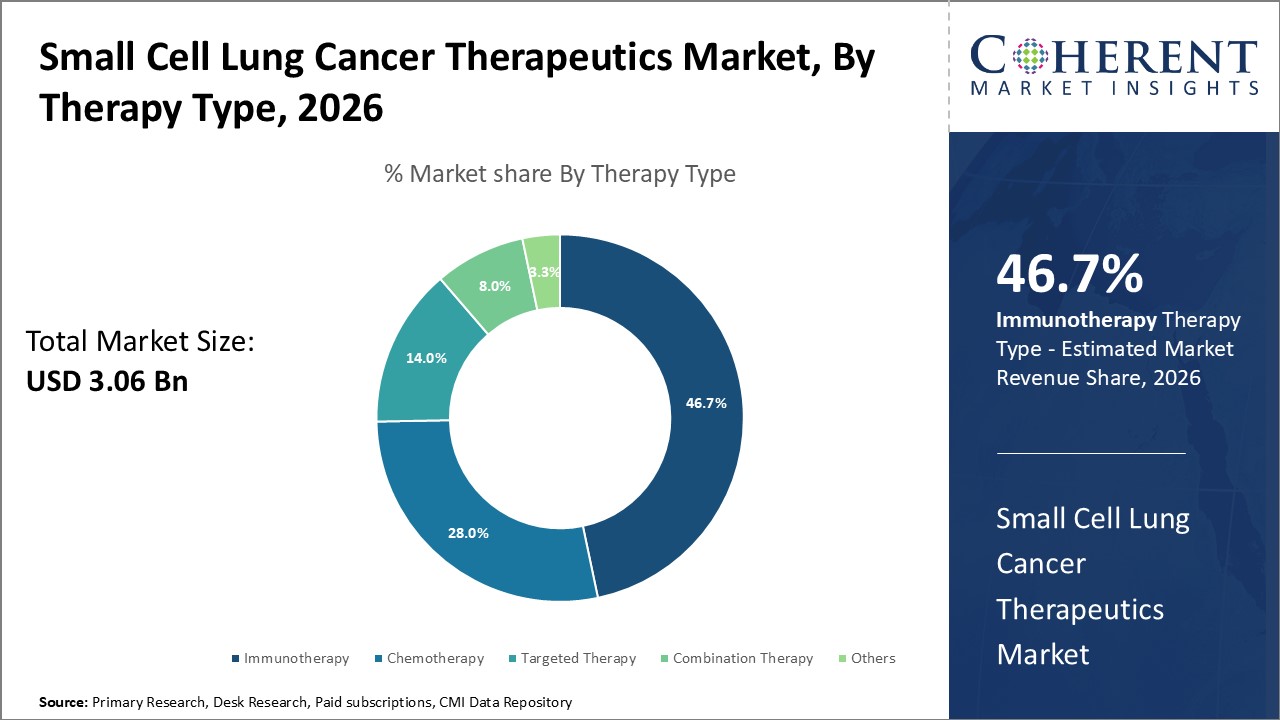
In terms of therapy type, the market is segmented into Immunotherapy, Chemotherapy, Targeted Therapy, Combination Therapy, and Others, among which Immunotherapy dominates the market share with 46.7%. Immunotherapy’s dominance is attributed to its durable clinical outcomes and expanding approved indications for small cell lung cancer, making it the preferred treatment choice among oncologists. Its ability to invoke the patient’s immune response against cancer cells provides a survival advantage over conventional chemotherapy.
Analysis of the Small Cell Lung Cancer Therapeutics Market, By Drug Class
The Small Cell Lung Cancer Therapeutics market segmentation by drug class includes Checkpoint Inhibitors, Chemotherapeutic Agents, Tyrosine Kinase Inhibitors, Monoclonal Antibodies, and Others. Checkpoint Inhibitors dominate the segment with over 50% of the market share, driven by landmark clinical trials proving survival benefits and their incorporation into treatment guidelines. These agents restore immune system function and have transformed the treatment outlook for small cell lung cancer patients.
Analysis of the Small Cell Lung Cancer Therapeutics Market, By Treatment Line
In treatment line segmentation, the market includes First-Line, Second-Line, Third-Line, Maintenance Therapy, and Others. First-Line treatment commands the largest market share at 53.2%, underscoring the focus on early intervention with advanced therapies such as immunotherapy combinations. First-Line therapies benefit from the highest patient pool and better clinical outcomes, making them the major revenue contributors.
Small Cell Lung Cancer Therapeutics Market Insights, By Geography
North America Small Cell Lung Cancer Therapeutics Market Analysis and Trends
In North America, the market dominance is attributed to well-established healthcare infrastructure, high per capita healthcare expenditure, and extensive oncology research funding. The region accounts for approximately 38% of the Small Cell Lung Cancer Therapeutics market share. The presence of major pharmaceutical companies conducting pivotal clinical trials, such as Roche and Merck, facilitates rapid incorporation of innovative therapies into clinical practice. Government initiatives targeting lung cancer awareness and screening are also enhancing early detection and treatment opportunities.
Asia Pacific Small Cell Lung Cancer Therapeutics Market Analysis and Trends
As a result of rising lung cancer incidence rates, particularly in China and India, Asia Pacific is growing at the quickest rate, with a CAGR of more than 11%. Market penetration is accelerated by government policies supporting oncology drug approvals, growing insurance coverage, and the development of healthcare infrastructure. Companies like Takeda and BeiGene have made noteworthy contributions that are promoting accessibility and innovation in the area. Market expansion is greatly aided by the region's expanding patient base and rising knowledge of targeted medicines.
Small Cell Lung Cancer Therapeutics Market Outlook for Key Countries
Analysis of the United States Market for Small Cell Lung Cancer Therapeutics and Its Trends
Due to significant R&D expenditures and the presence of top pharmaceutical companies with headquarters here, the US is a vital market for treatments for small cell lung cancer. Drug approvals and market access have been accelerated by the FDA's accelerated review processes and assistance for clinical trials based on immunotherapy. The US market continues to be a significant source of income, with about 30,000 new cases of small cell lung cancer reported each year. Prominent firms like AstraZeneca and Bristol-Myers Squibb have advanced the use of immune checkpoint inhibitors, which currently account for over 40% of all treatments.
Analysis of the China Market for Small Cell Lung Cancer Therapeutics and Its Trends
The market in China is expanding quickly due to rising lung cancer rates and changing laws that speed up the release of new medications. Clinical trials centered on new targeted treatments and combination regimens have proliferated around the nation. By utilizing regional alliances and participating in significant clinical research partnerships, market participants such as BeiGene and Novartis have increased their market share. The revenue from small cell lung cancer treatments has increased exponentially as a result of government health reforms that have boosted market penetration and expanded drug reimbursement coverage.
Analyst Opinion
The increasing adoption of immunotherapy as a first-line treatment is a pivotal market growth indicator. In 2025, over 41% of treated small cell lung cancer cases involved immune checkpoint inhibitors, contributing to a 26% improvement in five-year survival rates compared to traditional chemotherapy. This trend highlights a significant shift in demand-side dynamics favouring biologic therapies, which are projected to capture over 46% market share by 2030.
On the supply side, production capacity for targeted therapy drugs has expanded by approximately 33% between 2023 and 2026, following the approval of multiple novel agents by regulatory bodies such as the FDA and EMA. Increased manufacturing output is driving down costs and improving accessibility, enabling broader patient reach and market penetration globally.
The pricing dynamics reflect an evolving landscape where biologics command premium pricing, often surpassing USD 100,000 per treatment course, while chemotherapeutic agents have seen moderate price reductions due to generic entries. This dual pricing model influences revenue streams and market segmentation distinctly across therapy classes.
North America accounted for nearly 38% of the market share in 2025, supported by robust healthcare infrastructure and governmental support for oncology research. Meanwhile, Asia Pacific is emerging as the fastest-growing region with a CAGR exceeding 11%, driven by increasing lung cancer incidence, expanding healthcare access, and rising adoption of cutting-edge therapeutics in countries like China and Japan.
- Current Industry Events of 2026
- Market Size Estimation
- Regional Breakdown
- Competitive Landscape
- Customer Intelligence
- Segmental Analysis
- Pricing Analysis
- Key Market Drivers, Challenges & Future Trends
- Customized Insights Section
Market Scope
| Report Coverage | Details | ||
|---|---|---|---|
| Base Year: | 2025 | Market Size in 2026: | USD 3.06 billion |
| Historical Data for: | 2020 To 2024 | Forecast Period: | 2026 To 2033 |
| Forecast Period 2026 to 2033 CAGR: | 9.3% | 2033 Value Projection: | USD 5.70 billion |
| Geographies covered: |
| ||
| Segments covered: |
| ||
| Companies covered: | AstraZeneca, Merck & Co., Inc., Bristol-Myers Squibb, Roche Holding AG, Pfizer Inc., Johnson & Johnson, AbbVie Inc., Amgen Inc., Takeda Pharmaceutical Company, Novartis AG. | ||
| Growth Drivers: |
| ||
Growth factors
The rising prevalence of small cell lung cancer globally is a critical growth driver, with the American Cancer Society reporting approximately 30,000 new cases annually in the U.S. alone. Additionally, enhanced awareness and screening programs have led to earlier diagnosis, increasing therapeutic intervention opportunities. The surge in government funding and private investments in oncology R&D, exemplified by a 15% hike in NIH funding for lung cancer research in 2025, is enriching the drug development pipeline. The integration of precision medicine and biomarker-driven therapies facilitates highly effective treatment regimens, propelling market revenue upwards. Furthermore, improved healthcare infrastructure in emerging economies and expanding insurance coverage are enabling wider patient access to advanced therapeutics, accelerating business growth.
Small Cell Lung Cancer Therapeutics Market Development
In September 2026, new data from the Phase 2 IDeate-Lung01 trial revealed that ifinatamab deruxtecan (I-DXd) achieved clinically meaningful response rates in patients with previously treated extensive-stage small cell lung cancer (ES-SCLC), offering promising results for this hard-to-treat condition.
Market Trends
Recent years have witnessed a significant market shift toward combination therapies pairing immunotherapy with chemotherapy, enhancing response rates and reducing relapse. The FDA’s expedited approvals of such combinations in 2025 underscore the clinical efficacy and market acceptance of these regimens. Furthermore, an upsurge in clinical trials targeting novel biomarkers for small cell lung cancer is poised to redefine therapeutic classifications and personalize treatments further. The growing interest in liquid biopsy technologies for real-time treatment monitoring is another trend influencing market dynamics and treatment outcomes. Market revenue from targeted therapies has increased by 28% in 2025 compared to the previous year, reflecting the shifting preference for precision treatment approaches.
Key Players
Merck & Co., Inc.
Bristol-Myers Squibb
Roche Holding AG
Pfizer Inc.
Johnson & Johnson
AbbVie Inc.
Amgen Inc.
Takeda Pharmaceutical Company
Novartis AG
Leading market players have heavily invested in clinical trials and acquisition strategies to bolster their small cell lung cancer therapeutic portfolios. For instance, AstraZeneca’s acquisition of multiple immunotherapy assets in 2025 led to a 17% revenue increase in niche oncology therapies. Similarly, Merck’s expansion of pembrolizumab indications through Phase III trials contributed to a revenue growth of 23%, cementing its competitive positioning. These companies are combining innovation with strategic collaborations to enhance pipeline robustness and consolidate market share.
Prospects for the Small Cell Lung Cancer Therapeutics Market in the Future
The market for small cell lung cancer therapeutics is expected to develop significantly in the future due to factors like rising awareness, new treatment options, and the disease's increasing incidence and prevalence.
Ongoing research & development efforts centred on innovative therapeutics, such as immunotherapies and targeted treatments, are anticipated to boost the market by improving patient outcomes.
Enhancing treatment efficacy is also anticipated to be greatly aided by early detection and better diagnostic instruments. Despite ongoing issues including high treatment costs and medication resistance, the market as a whole is expected to rise because to government initiatives and expanding healthcare infrastructure.
The market is expected to develop most rapidly in North America and Asia-Pacific due to rising lung cancer cases and higher healthcare costs.
The evolving treatment landscape with combination therapies and personalized medicine approaches promises to enhance survival rates and quality of life for patients, sustaining the upward trajectory of the market in the coming years.
Historical Analysis
According to the American Cancer Society Statistics in 2017, around 222,500 cases of lung cancer were diagnosed with 116,990 prevailing in men and 105,510 in women, where small cell lung cancer accounted for 15 percent of lung cancers in the U.S. North America was expected to dominate the market owing to the highly developed regions, improved healthcare setup, and growing awareness about healthcare.
Asia Pacific was expected to drive the growth of the SCLC market in the forecast period owing to the growing awareness of healthcare, government funding, and the presence of medical requirements for cancer therapeutics in the emerging economies such as India and China.
Sources
Primary Research interviews:
Thoracic surgeons
Radiologists
Medical oncologists specializing in lung cancer
Databases:
Scopus
Web of Science
ClinicalTrials.gov
Magazines:
PharmaTimes
Pharmaceutical Executive
BioPharma Dive
Journals:
Journal of Thoracic Oncology
Lung Cancer Journal
Cancer Research
Newspapers:
The Washington Post (Health & Science)
The Times of India (Health)
Hindustan Times (Health)
Associations:
American Society of Clinical Oncology (ASCO)
European Society for Medical Oncology (ESMO)
International Association for the Study of Lung Cancer (IASLC)
Get access to 250+ pages report
Every segment, forecast, competitor profile and data table behind the analysis above — available for instant download.
- ESOMAR Member
- ISO 9001:2015 Certified
- D-U-N-S Registered
- GDPR & CCPA Compliant
Missing comfort of reading report in your local language? Find your preferred language:
Transform your Strategy with Exclusive Trending Reports
Frequently Asked Questions
The leading market players include AstraZeneca, Merck & Co., Bristol-Myers Squibb, Roche, and Pfizer, who have significant market shares bolstered by strategic clinical and commercial initiatives.
The market size is projected to grow from USD 3.06 billion in 2026 to USD 5.70 billion by 2033, expanding at a CAGR of 9.3% driven by innovative therapies and increasing patient demand.
The first-line treatment segment offers the largest growth opportunity due to increasing adoption of immunotherapy and combination regimens during initial treatment stages.
Emerging trends include a growing focus on biomarker-led precision therapies, increased combination therapies, and advancements in non-invasive diagnostic techniques which will reshape treatment protocols.
The competitive landscape is marked by innovation-driven competition with emphasis on clinical trials and regulatory approvals. Challenges include high therapy costs and market access barriers in developing regions.
Key strategies include strategic alliances, targeted mergers and acquisitions, expansion of clinical trial networks, and investments in patient access programs to enhance market penetration.