

Smart Medical Devices Market Size and Share Analysis - 2026 To 2033
The Smart Medical Devices Market size is anticipated to grow at a CAGR of 12.5% with USD 85 Bn in 2026 and is expected to reach USD 193.9 Bn in 2033. The primary drivers are defined by rising chronic disease prevalence, increasing remote-patient monitoring, growing homecare requirements, and wider adoption of connected diagnostic technologies. In 2026, the FDA launched a Digital Health Devices Pilot to advance technology-enabled patient outcomes and adoption. This is strengthening commercial applications across wearable monitors, glucose meters, cardiac devices, smart inhalers, therapeutic systems, and hospital-connected equipment worldwide.
Key Takeaways
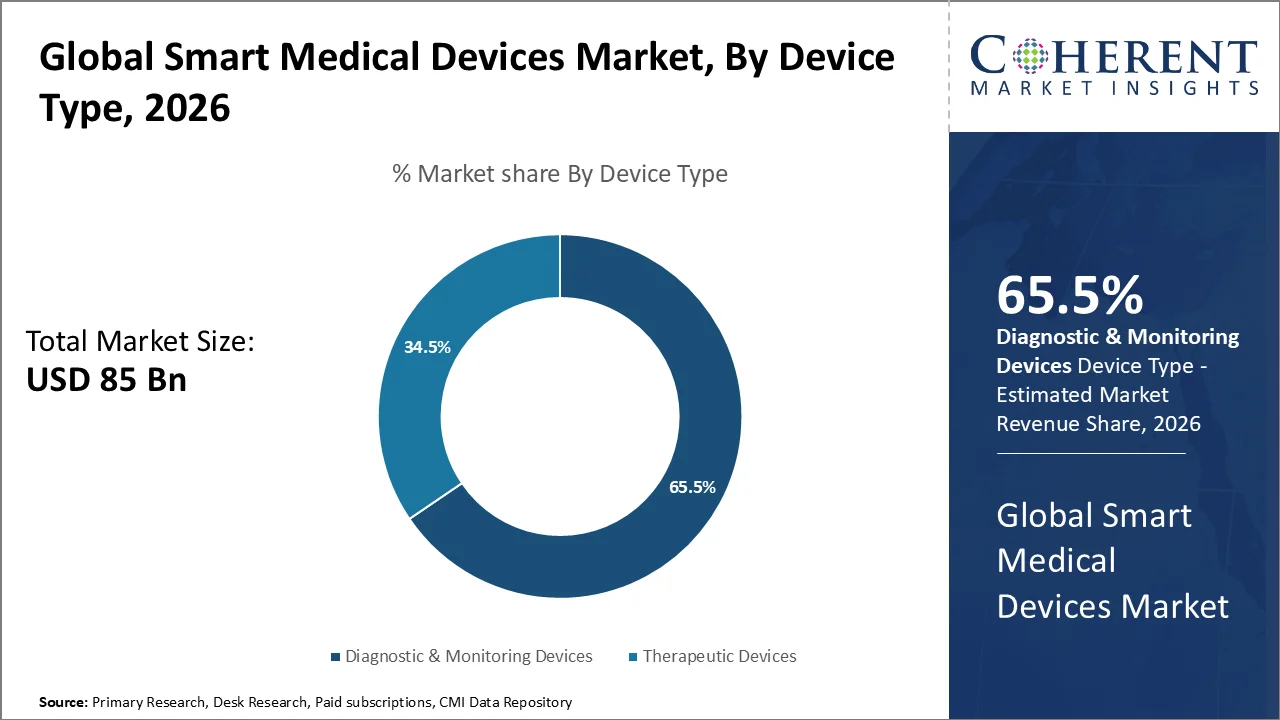
- The diagnostic & monitoring devices segment is likely to dominate the market with 65.5% in 2026. The segment’s growth is owing to growing chronic disease burden and demand for continuous patient monitoring. In February 2026, Medtronic launched the MiniMed Go Smart MDI system with the Simplera sensor across Europe. The connected system combines continuous glucose monitoring with smart insulin-pen information in a single mobile application for people managing diabetes through multiple daily injections.
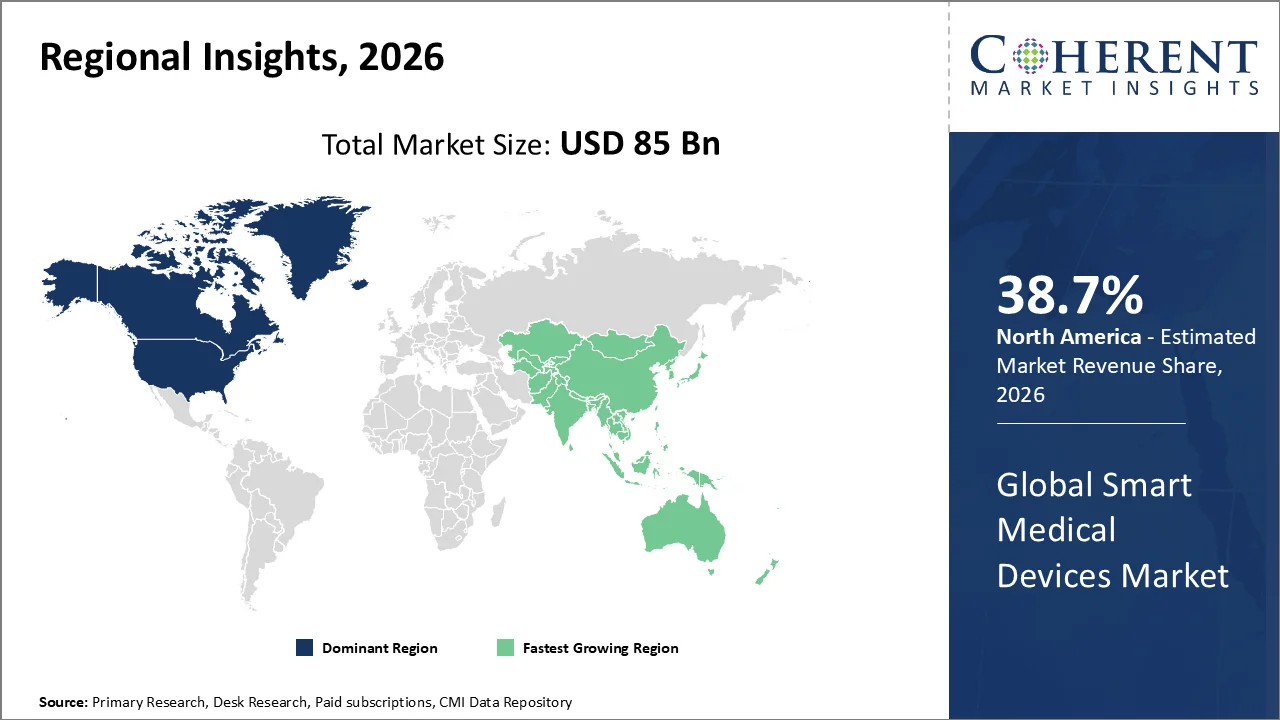
- North America is expected to acquire the prominent share of 38.7% in 2026. The region’s growth is owing to the advanced healthcare infrastructure, high digital health adoption, and supportive reimbursement policies. S. healthcare spending increased 7.2% in 2024, reaching USD 5.3 trillion, or USD 15,474 per person.
Segmental Insights
Why is Diagnostic & Monitoring Devices Segment Acquiring the Largest Share?
On the basis of device type, the diagnostic & monitoring devices segment is projected to account for the largest Smart Medical Devices Market share of 65.5% in 2026. The segment’s growth is owing to the rising demand for continuous glucose monitoring, connected blood pressure measurement, ECG monitoring, pulse oximetry, sleep tracking, and multiparameter patient surveillance across hospitals and homecare settings.
According to the World Health Organization, 1.4 billion adults aged 30–79 years had hypertension in 2024, while only 320 million, or 23%, had the condition under control. This large monitoring gap strengthens the demand for devices that enable frequent measurement, early abnormality detection, as well as remote clinical review.
In June 2026, Philips launched the IntelliVue Patient Monitor 6000 Series which offers affordable, enterprise-grade monitoring for both rural hospitals and ambulatory surgery centers. The scalable system supports built-in measurements, plug-and-play expansion, EMR connectivity, clinical decision support, cybersecurity, and simplified deployment workflows.
- Current Industry Events of 2026
- Market Size Estimation
- Regional Breakdown
- Competitive Landscape
- Customer Intelligence
- Segmental Analysis
- Pricing Analysis
- Key Market Drivers, Challenges & Future Trends
- Customized Insights Section
Market Drivers
Rising Innovations in Continuous Glucose Monitoring are Transforming the Smart Medical Devices Market in India
India is emerging as an important innovation and commercialization market for smart medical devices. This is owing to the large chronic disease population, increasing smartphone penetration, expanding diagnostic infrastructure, and growing demand for home-based disease management.
The continuous glucose monitoring is gaining traction because it provides real-time information rather than relying solely on intermittent finger-stick tests. Connected sensors can automatically transmit glucose measurements to compatible smartphones, thereby providing high- and low-glucose alerts, displaying trends, and allowing users to share information with caregivers or healthcare professionals. Smart medical devices can support earlier intervention, improve treatment adherence, and reduce the need for repeated hospital visits.
In August 2025, Abbott launched the FreeStyle Libre 2 Plus sensor in India. The device provides automatic glucose readings every minute on a compatible smartphone and also provides optional alerts for high and low glucose levels. The firm stated that India had approximately 101 million people living with diabetes, thereby creating a substantial addressable population for continuous glucose-monitoring technology.
AI-Enabled Continuous Monitoring: A Major Breakthrough in the Smart Medical Devices Market
Artificial intelligence is transforming smart medical devices from passive data-recording tools into systems capable of detecting patterns, identifying abnormalities, prioritizing alerts, as well as supporting personalized treatment decisions.
AI-enabled smart devices have the capability to evaluate continuous data streams, recognize changes in patient condition, and present actionable information to clinicians or users. AI is being incorporated in connected blood pressure monitors, ECG devices, continuous glucose monitors, wearable biosensors, sleep-monitoring devices, insulin-delivery devices, and hospital patient-monitoring platforms.
In May 2025, OMRON Healthcare introduced the home blood pressure monitors incorporating its machine-learning-based IntelliSense AFib algorithm. The system screens for atrial fibrillation during the routine blood pressure measurements without requiring a separate test. This integrates two important cardiovascular assessments in one connected home-monitoring workflow and may also support earlier identification of patients requiring further evaluation.
Current Events and Their Impact on the Smart Medical Devices Market
Current Event | Description and its Impact |
FDA Cybersecurity Guidance for Connected Medical Devices in the U.S.
|
|
Mandatory EUDAMED Registration Requirements in the European Union |
|
Smart Medical Devices Market Trends
- The growing incorporation of wearable and sensor-based medical devices is allowing for continual tracking of glucose, heart rhythm, blood pressure, oxygen saturation, and activity, thereby strengthening the earlier intervention and personalized disease management.
- Artificial intelligence integration is expanding across imaging, cardiac monitoring, diagnostics, and clinical decision support. This is improving automated interpretation, risk prediction, workflow efficiency, and real-time alerts. In 2026, the U.S. FDA continued updating its public list of AI-enabled medical devices including newly cleared radiology and cardiovascular solutions.
- Remote patient monitoring adoption is speeding up with the healthcare providers shifting care beyond hospitals. Medicare broadly covers connected devices that automatically transmit physiological data including blood pressure, weight, and glucose measurements, for both chronic as well as acute conditions.
- The rising chronic disease prevalence is strengthening the demand for connected diagnostic and therapeutic devices. The World Health Organization estimates that noncommunicable diseases like cardiovascular disease, cancer, respiratory disease, and diabetes, cause approximately 41 million deaths annually worldwide.
- Stronger cybersecurity, interoperability, and lifecycle-management requirements are shaping the product development. The FDA cybersecurity guidance emphasizes secure design, labeling, documentation, vulnerability management, and protection of network-connected medical devices throughout their operating lifecycle.
Regional Insights
North America Dominates Owing to the Advanced Healthcare Infrastructure and Reimbursement Support
The North America region accounts for 38.7% of the market share in 2026. The region’s growth is owing to the high healthcare expenditure, advanced hospital infrastructure, early adoption of connected care, favorable remote-monitoring reimbursement, strong consumer awareness, and the presence of leading medical-device manufacturers.
The U.S. has a substantial chronic disease population requiring continuous monitoring. The CDC estimated that nearly 40.1 million people in the U.S. had diagnosed or undiagnosed diabetes in 2023, while 115.2 million adults had prediabetes. These populations create considerable demand for continuous glucose monitors, smart insulin-management devices, connected weighing scales, blood pressure monitors, as well as digital disease-management platforms.
In June 2026, Philips launched the IntelliVue Patient Monitor 6000 Series in the U.S. The series provides built-in core measurements, scalable connectivity, plug-and-play measurement expansion, electronic medical-record connectivity, and enterprise-level integration options. Philips positioned the platform for rural hospitals, ambulatory surgical centers, and healthcare organizations requiring flexible monitoring infrastructure.
Asia Pacific Smart Medical Devices Market Trends
Asia Pacific is expected to witness strong growth in market over the forecast period. The region’s growth is owing to the large chronic disease populations, expanding healthcare infrastructure, increasing smartphone access, population aging, government digital-health initiatives, and rising investment by multinational and regional manufacturers. Healthcare providers across China, India, Japan, South Korea, Australia, and Southeast Asia are expanding digital patient-management capabilities.
Japan offers substantial demand for elderly-care monitoring. The Statistics Bureau of Japan reported that the country had 36.19 million people aged 65 years and above in 2025, representing 29.4% of its total population. The proportion was the highest recorded for the country. This demographic profile supports demand for fall-detection wearables, cardiac monitors, connected medication-management systems, sleep monitors, and remote elderly-care platforms.
Regulatory Support for Digital Health Technologies are Accelerating the Market in United States
In the United States, the Smart Medical Devices Market is influenced by the widespread chronic disease, expanding home monitoring, and regulatory support for digital health technologies. According to the CDC, nearly 194 million U.S. adults had at least one chronic condition in 2023, while approximately 131 million reported two or more conditions. This is creating substantial demand for connected diagnostic, wearable, as well as therapeutic devices.
In November 2025, Dexcom received FDA clearance for Dexcom Smart Basal, a CGM-integrated basal insulin-dosing optimizer for adults with type 2 diabetes using long-acting insulin. The platform uses data from the Dexcom G7 15 Day sensor and recorded insulin doses to calculate personalized daily recommendations under healthcare-provider direction.
India Smart Medical Devices Market Trends
India Smart Medical Devices Market is supported by increasing diabetes and cardiovascular disease prevalence, expanding private healthcare infrastructure, rising digital-health awareness, and wider smartphone-based access to healthcare services.
India is also becoming an important introduction market for AI-enabled diagnostic technologies. In April 2025, Philips launched its AI-enabled Elevate Platform upgrade for the EPIQ Elite ultrasound system in India. The platform incorporates AI-supported workflow capabilities and proactive system monitoring intended to improve diagnostic efficiency and enable remote consultation and troubleshooting.
Who are the Major Companies in Smart Medical Devices Industry
Some of the major key players in Smart Medical Devices Market are Apple, Inc., Fitbit, Inc., F. Hoffmann-La-Roche, Abbott Laboratories, Medtronic Plc, Dexcom, Inc., NeuroMatrix, Inc., Johnson & Johnson.
Key News
- In July 2026, IIT Hyderabad’s Centre for Healthcare Entrepreneurship partnered with Silicon Labs to develop smart medical devices using low-power wireless, edge computing, IoT, and AI technologies. The collaboration will support startups through workshops, semiconductor access, funding, and real-world clinical pilots.
- In March 2026, GE HealthCare completed its USD 2.3 billion acquisition of Intelerad. The transaction expands GE HealthCare’s cloud-first enterprise imaging footprint and supports development of connected, AI-enabled smart devices and digital solutions across hospital, ambulatory, and teleradiology settings.
Market Report Scope
Smart Medical Devices Market Report Coverage
| Report Coverage | Details | ||
|---|---|---|---|
| Base Year: | 2025 | Market Size in 2026: | USD 85 Bn |
| Historical Data for: | 2020 To 2024 | Forecast Period: | 2026 To 2033 |
| Forecast Period 2026 to 2033 CAGR: | 12.5% | 2033 Value Projection: | USD 193.9 Bn |
| Geographies covered: |
| ||
| Segments covered: |
| ||
| Companies covered: | Apple, Inc., Fitbit, Inc., F. Hoffmann-La-Roche, Abbott Laboratories, Medtronic Plc, Dexcom, Inc., NeuroMatrix, Inc., Johnson & Johnson. | ||
| Growth Drivers: |
| ||
| Restraints & Challenges: |
| ||
Analyst Opinion
- Smart Medical Devices Market growth is driven by rising chronic disease burdens. More than 1.3 billion adults live with hypertension, while hundreds of millions manage diabetes, creating continuous demand for connected monitoring, automated alerts, and real-time health insights beyond traditional hospital settings worldwide.
- Remote patient monitoring is becoming a major care model. The evidence from 116 randomized trials covering 204,523 patients included telemonitoring in 76 studies. Also, another clinical trial reduced 30-day hospital readmission or death from 23.7% to 18.2%.
- AI-enabled wearables and connected diagnostic devices are gaining substantial traction. Nearly 830 million people live with diabetes while cardiovascular diseases caused 19.8 million deaths in 2022, thus representing 32% of global deaths. Smart ECGs, CGMs, pulse oximeters, and activity sensors allow for continuous detection and personalized treatment. In June 2026, the FDA cleared an over-the-counter pediatric glucose biosensor lasting up to 15 days. This demonstrates broader adoption of smartphone-connected monitoring and strengthening demand across hospitals, clinics, homes, and remote communities.
Speak to the analyst
Want personalized insights?
Take the findings above to one of our principal consultants, or have the report rebuilt around the segments, geographies and competitors you actually track.
Market Segmentation
- By Device Type (Revenue, USD Bn, 2021-2033)
- Diagnostics & Monitoring Devices
- Blood Glucose Monitors
- Heart Rate Monitors
- Pulse Oximeters
- Breath Analyzers
- Medical Tricoders
- Smart Clothing
- Smart Watches
- Others
- Therapeutic Devices
- Insulin Pumps
- Portable Oxygen Concentrators & ventilators
- Hearing Aids
- Others
- Diagnostics & Monitoring Devices
- By Region (Revenue, USD Bn, 2021-2033)
- North America
- U.S.
- Canada
- Latin America
- Brazil
- Mexico
- Argentina
- Rest of Latin America
- Europe
- Germany
- U.K.
- France
- Italy
- Spain
- Russia
- Rest of Europe
- Asia Pacific
- China
- India
- Japan
- Australia
- South Korea
- ASEAN
- Rest of Asia Pacific
- Middle East
- GCC
- Israel
- Rest of Middle East
- Africa
- South Africa
- Central Africa
- North Africa
- North America
Source
Primary Research Interviews
- Physicians and specialist clinicians
- Hospital administrators and procurement managers
- Biomedical and clinical engineers
- Healthcare IT and digital health professionals
- Remote patient monitoring service providers
- Smart medical device manufacturers
- Medical device distributors and suppliers
- Telehealth providers
- Regulatory and reimbursement experts
- Key opinion leaders (KOLs) in digital health and connected medical devices
Databases
- World Health Organization (WHO)
- U.S. Food and Drug Administration (FDA)
- Centers for Disease Control and Prevention (CDC)
- National Institutes of Health (NIH)
- Organisation for Economic Co-operation and Development (OECD)
- Centers for Medicare & Medicaid Services (CMS)
- European Commission – Medical Devices Database (EUDAMED)
Magazines
- MedTech Dive
- Medical Device and Diagnostic Industry (MD+DI)
- MedTech Insight
- Healthcare IT News
- Medical Product Outsourcing
- Digital Health Intelligence
Journals
- The Lancet Digital Health
- npj Digital Medicine
- Journal of Medical Internet Research
- IEEE Journal of Biomedical and Health Informatics
- Journal of Medical Devices
- Digital Health
- Sensors
Newspapers
- The New York Times
- The Guardian
- The Wall Street Journal
- Financial Times
- The Washington Post
Associations
- Advanced Medical Technology Association (AdvaMed)
- Healthcare Information and Management Systems Society (HIMSS)
- Digital Medicine Society (DiMe)
- International Medical Device Regulators Forum (IMDRF)
- Medical Device Manufacturers Association (MDMA)
- European Coordination Committee of the Radiological, Electromedical and Healthcare IT Industry (COCIR)
- Association for the Advancement of Medical Instrumentation (AAMI)
Public Domain Sources
- Company Annual Reports and Investor Presentations
- Government Health Ministry Publications
- Medical Device Regulatory Authority Publications
- Product Approval and Recall Databases
- Clinical Trial Registries such as ClinicalTrials.gov
- Patent Databases and Scientific Research Publications
- Public Procurement and Hospital Tender Databases
- Reimbursement and Insurance Policy Documents
Proprietary Elements
- CMI Data Analytics Tool
- Proprietary CMI Existing Repository of Information for Last 10 Years
Get access to 250+ pages report
Every segment, forecast, competitor profile and data table behind the analysis above — available for instant download.
- ESOMAR Member
- ISO 9001:2015 Certified
- D-U-N-S Registered
- GDPR & CCPA Compliant
Missing comfort of reading report in your local language? Find your preferred language:
Transform your Strategy with Exclusive Trending Reports
Frequently Asked Questions
The Smart Medical Devices Market is expected to reach USD 193.9 Bn in 2033.
Major players operating in the global Smart Medical Devices Market include Apple, Inc., Fitbit, Inc., F. Hoffmann-La-Roche, Abbott Laboratories, Medtronic Plc, Dexcom, Inc., NeuroMatrix, Inc., Johnson & Johnson.
The high capital costs, stringent regulatory pathways, and significant data security and interoperability concerns are the key factors hampering growth of the market.
The rising prevalence of chronic diseases, a rapidly aging global population, and technological advancements in AI and IoT is boosting the demand for Smart Medical Devices.
The Smart Medical Devices Market is anticipated to grow at a CAGR of 12.5% between 2026 and 2033.
Among regions, North America is expected to account for a largest market share in the global Smart Medical Devices Market over the forecast period.
The market outlook remains positive due to shift toward remote hospital-at-home care, continuous patient monitoring, and the integration of artificial intelligence.