

Tissue Paper Market Size and Trends
Tissue Paper Market size is estimated to be valued at USD 102.98 Bn in 2026 and is expected to reach USD 165.36 Bn in 2033, exhibiting a compound annual growth rate (CAGR) of 7.0% from 2026 to 2033.
Key Takeaways
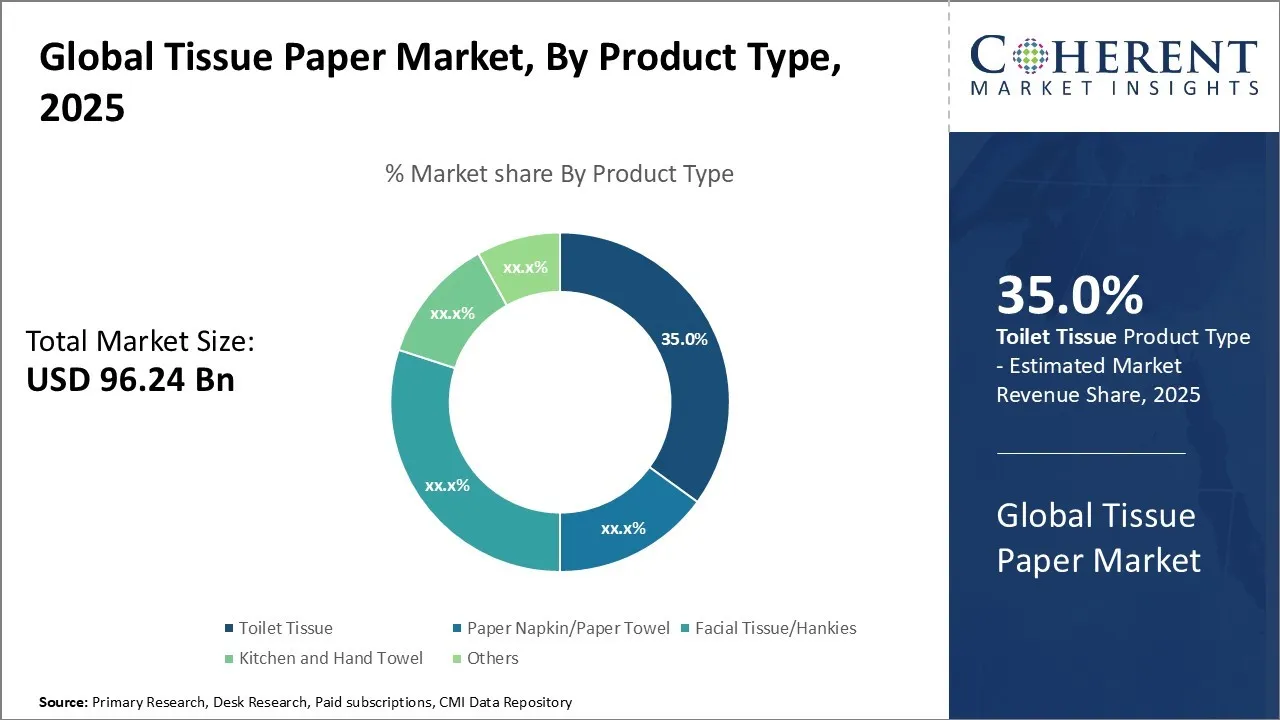
- Based on Product Type, the Toilet Tissue segment is expected to capture a 36% of the global tissue paper market share in 2026, driven by a combination of factors such as rising hygiene awareness, urbanization, and increased consumer preference for convenience and sanitation.
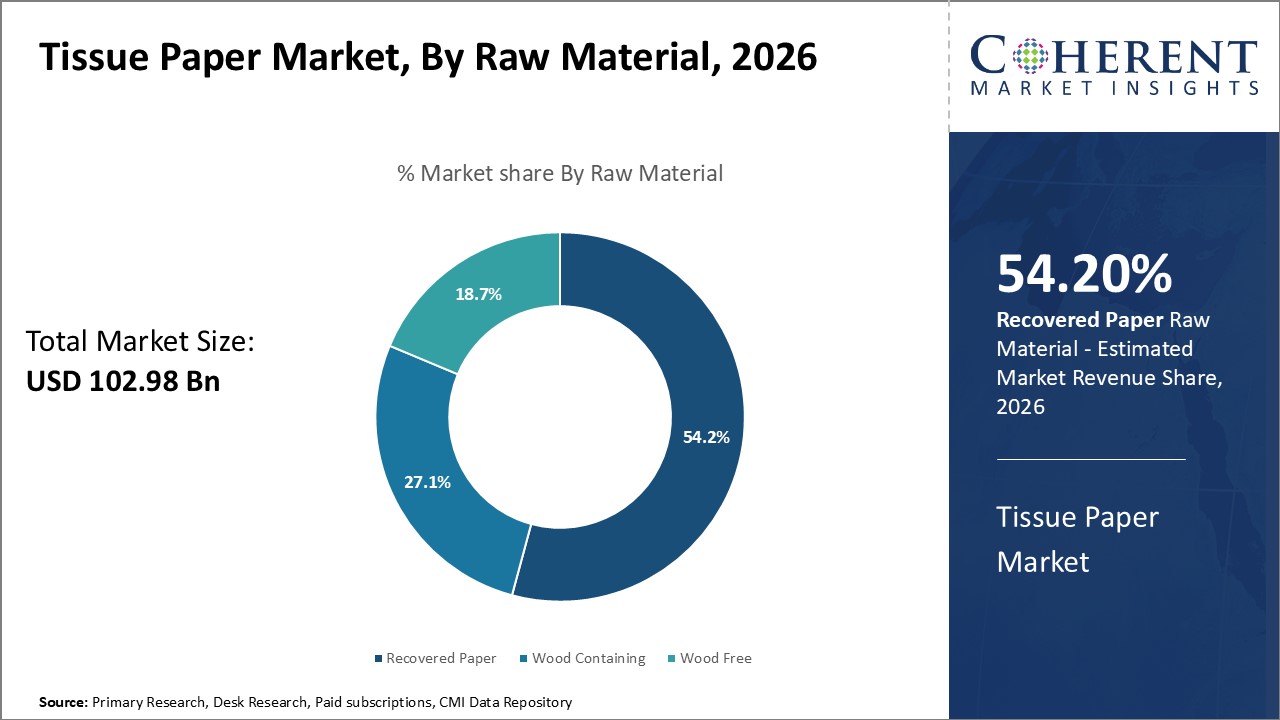
- Based on Raw Material, the Recovered Paper segment is projected to hold the largest share of the market in 2026, due to the rising environmental concerns, regulatory pressures, and cost-efficiency goals across the global paper industry.
- Based on End User, the Residential segment is expected to hold the highest share of the market in 2026, due to rising hygiene awareness, lifestyle changes, and the growing need for convenience in daily living.
- Based on Distribution Channel, Hypermarket & Supermarket segment is expected to lead the market with greatest share in 2026, owing to a combination of factors including consumer behavior, convenience, and product variety.
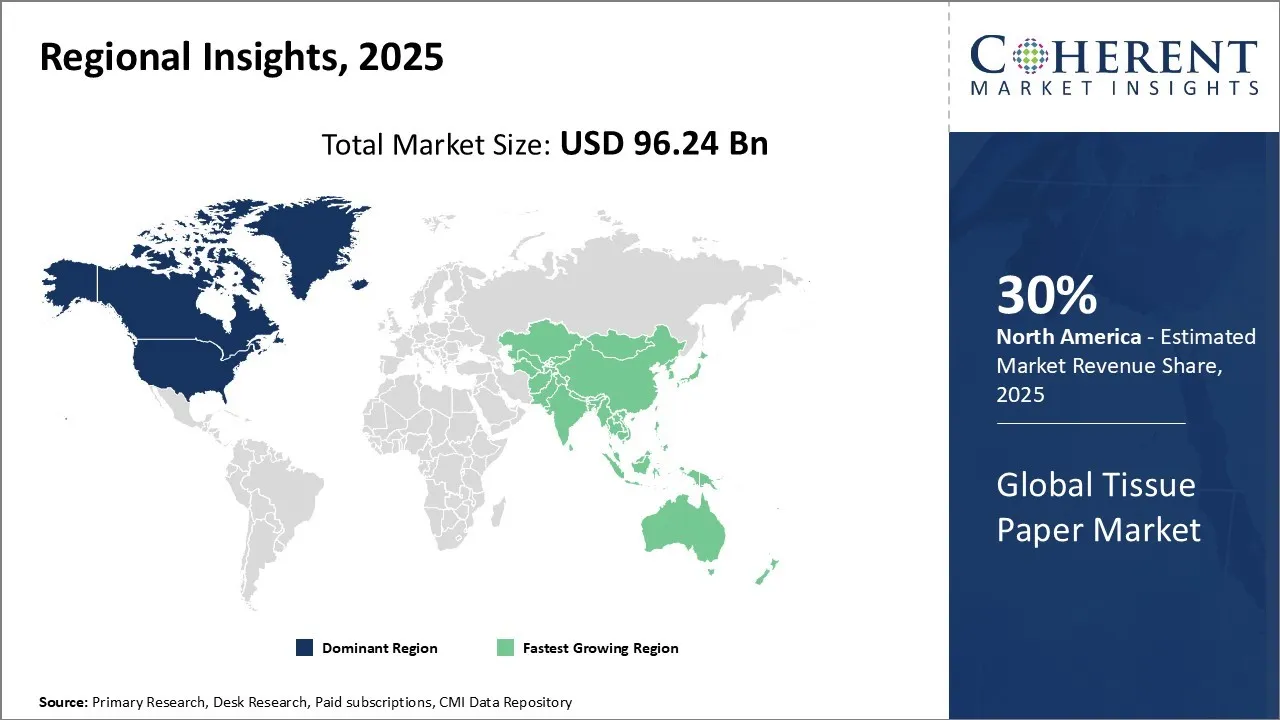
- Based on Region, North America is set to lead the global tissue paper market in 2026 with a 30% share. While, Asia Pacific is anticipated to be the fastest growing region during the forecast period.
Market Overview
The global tissue paper market demand is growing steadily, driven by rising hygiene awareness, urbanization, and changing lifestyles. Demand spans residential and commercial sectors, with strong growth in emerging regions like Asia-Pacific and Latin America. In developed markets, consumers prefer eco-friendly and premium products, prompting innovation in recycled and bamboo-based tissue paper. Hospitality, healthcare, and foodservice industries also contribute significantly to demand.
E-commerce is expanding product accessibility, while manufacturers focus on sustainability through water-efficient processes and alternative fibers. Despite raw material cost challenges, the market remains dynamic, shaped by hygiene trends and environmental priorities.
Current Events and their Impacts on the Tissue Paper Market
Current Event | Description And its Impact |
Geopolitical Trade Tensions |
|
Technological and Sustainability Innovations |
|
Export Analysis
Export Analysis of Tissue Paper
From November 2023 to October 2024 (TTM), India exported a total of 40 Tissue Paper shipments. These were carried out by 23 Indian exporters and delivered to 25 international buyers.
Specifically, in October 2024 alone, India recorded 6 Tissue Paper export shipments.
- Current Industry Events of 2026
- Market Size Estimation
- Regional Breakdown
- Competitive Landscape
- Customer Intelligence
- Segmental Analysis
- Pricing Analysis
- Key Market Drivers, Challenges & Future Trends
- Customized Insights Section
Segmental Insights
Tissue Paper Market Insights, By Product Type
Toilet Tissue Acquires the Largest Market Share due to rising Hygiene Awareness
In terms of product type, the toilet tissue segment accounted for 36% market share in the global tissue paper market in 2026, driven by a combination of factors such as rising hygiene awareness, urbanization, and increased consumer preference for convenience and sanitation. Toilet paper is a basic hygiene necessity in both homes and public facilities. In developing regions like Asia-Pacific, Latin America, and parts of Africa, increasing urbanization and rising disposable incomes have led to higher consumption of household hygiene products, including toilet paper, as more people adopt modern sanitation systems. There is also a high demand in institutional settings involving hotels, hospitals, restaurants, schools, and corporate offices all require bulk quantities of toilet tissue. As tourism and commercial activity recover globally.
In October 2024, Jani Sales Pvt Ltd inaugurated its second tissue machine (PM2) at the Sarigam facility, featuring a 60 tons‑per‑day (TPD) capacity. The 100 percent pulp‑based line, capable of producing facial tissues, toilet rolls, kitchen towels and napkins with a GSM of 11.5–42, aims to bolster both domestic and export markets. This is further proliferating the tissue paper market share.
Tissue Paper Market Insights, By Raw Material
Recovered Paper Holds the Dominant Market Share due to rising Environmental Concerns
In terms of raw material, the recovered paper segment is expected to contribute the largest share of the market in 2026, due to the rising environmental concerns, regulatory pressures, and cost-efficiency goals across the global paper industry. Tissue paper products such as toilet paper, facial tissues, and paper towels can be manufactured using recovered paper pulp, sourced from post-consumer waste like newspapers, office paper, and cartons. This process involves deinking, cleaning, and re-pulping, followed by converting the recycled pulp into soft, hygienic tissue products. Governments and consumers are pushing for reduced use of virgin wood pulp due to deforestation and high energy use. Recovered paper-based tissue significantly reduces the environmental footprint, making it a more sustainable option.
In January 2025, a public–private partnership in Japan has launched the world’s first toilet paper recycled from used disposable diapers. The Shibushi Osaki Roll, a collaboration between the cities of Shibushi and Osaki, hygiene firm Unicharm, and Poppy Paper, uses 98 metric tons of separated diapers, sanitary pads and wipes. Within two months, production reached 30,000 rolls, priced at around USD 2.70 per dozen. This innovation addresses both raw-material shortages and mounting hygiene waste.
Tissue Paper Market Insights, By End User
Residential Segment Dominates the Overall Market Due to the Growing Convenience is Daily Living
In terms of end user, the residential segment is expected to contribute the highest share of the market in 2026, due to the rising hygiene awareness, lifestyle changes, and the growing need for convenience in daily living. Tissue paper is widely used in daily lives which includes toilet paper, facial tissues, napkins, and kitchen towels have become essential in homes for maintaining cleanliness, wiping surfaces, personal hygiene, and managing spills. As more households shift to urban and nuclear family structures, there is a growing reliance on disposable, single-use hygiene products. Tissue paper is preferred for its convenience, disposability, and ease of use, especially in households with children or elderly family members.
For instance, the Navigator Company’s brand Amoos unveiled two new plastic‑free toilet paper options aimed at the residential market. Packaged entirely in recyclable paper, the launch accelerates sustainable packaging efforts and supports circular economy goals by reducing fossil‑based plastic waste. The products are designed for eco‑conscious households, tapping into growing consumer demand for environmentally friendly hygiene solutions. This is further propelling the tissue paper market revenue.
Tissue Paper Market Insights, By Distribution Channel
Hypermarket & Supermarket Acquires the Dominant Market Share
In terms of distribution channel, the hypermarket & supermarket segment is expected to contribute the greatest share of the market in 2026, owing to a combination of factors including consumer behavior, convenience, and product variety. Hypermarkets and supermarkets attract large numbers of daily shoppers. Tissue paper products, being essential household items, are prominently displayed in high-traffic aisles, increasing impulse and planned purchases. Consumers often purchase tissue paper in large quantities, especially toilet paper and kitchen towels, for cost savings and to reduce frequency of repurchase. Hypermarkets offer multi-pack options and family-size bundles that appeal to budget-conscious households.
Regional Insights
North America Tissue Paper Market Analysis & Trends
North America dominates the global tissue paper market with 30% share in 2026. This is attributed to growing health awareness and increasing healthcare spending, which is propelling the growth of the tissue paper market in this region. The region has one of the highest per capita tissue consumption rates globally, driven by the widespread use of products such as toilet paper, facial tissues, paper towels, and napkins in both households and commercial settings. According to Environment America, Americans use a significant amount of toilet paper, with some estimates indicating an average of 141 rolls per person per year. This translates to a substantial volume of tissue paper consumed annually by the US population, making it a major market for tissue paper products.
Asia Pacific Tissue Paper Market Analysis & Trends
Asia Pacific is the fastest-growing region in the global tissue paper market owing to increasing demand from countries such as China and India. Furthermore, increasing the manufacturing capacity of tissue products by market players is fueling the growth of the market in this region. Along with that, tissue paper is seeing rising demand in the Asia Pacific region due to rapid urbanization and increasing disposable incomes have led to greater adoption of modern hygiene products, including toilet paper, facial tissues, and kitchen rolls, particularly in countries like China, India, Indonesia, Thailand, and Vietnam. For example, India’s “Swachh Bharat Abhiyan” (Clean India Mission) has contributed to greater awareness and infrastructure for sanitation, boosting the use of toilet tissues and paper towels in both urban and semi-urban areas.
Tissue Paper Market Outlook Country-Wise
The U.S. Tissue Paper Market Trends
The United States continues to see high demand for tissue paper, driven by its deeply embedded hygiene practices and some of the highest per‑capita consumption rates globally. U.S. consumers consistently opt for premium and sustainable tissue options both at home and in businesses, reflecting evolving values and environmental awareness. For instance, Kimberly‑Clark Professional introduced its GreenHarvest line—blending rapidly renewable fibers like bamboo and wheat straw into Kleenex and Scott tissues—catering to eco-aware commercial customers seeking high-quality, sustainable products. The U.S. is moving towards eco-friendly DTC brands, the sustainable direct‑to‑consumer brands like Who Gives A Crap launched recycled bamboo-based toilet paper in U.S. retail channels (e.g., Whole Foods) in mid‑2024.
China Tissue Paper Market Trends
China tissue paper market is surging the due to swift urbanization, rising incomes, and a growing emphasis on hygiene, especially in metropolitan households and hospitality outlets. China is experiencing a rapid city growth and improved sanitation standards have vastly increased the use of toilet paper and facial tissues. Major hotel chains and restaurants in cities like Beijing and Shanghai have upgraded to soft, high-quality paper products to meet consumer expectations. Local manufacturers are actively embracing bamboo-based tissue. For example, Luzhou Pack launched bamboo pulp tissue products, including kitchen towels and toilet and facial tissues—highlighting bamboo's natural antibacterial properties and environmental benefits, like saving six cartons of pulp per tree avoided. Brands like Pulpage also promote bamboo's eco-advantages and contribute to social causes.
Market Report Scope
Tissue Paper Market Report Coverage
| Report Coverage | Details | ||
|---|---|---|---|
| Base Year: | 2025 | Market Size in 2026: | USD 102.98 Bn |
| Historical Data for: | 2020 To 2024 | Forecast Period: | 2026 To 2033 |
| Forecast Period 2026 to 2033 CAGR: | 7.0% | 2033 Value Projection: | USD 165.36 Bn |
| Geographies covered: |
| ||
| Segments covered: |
| ||
| Companies covered: | Major players operating in the global tissue paper market include Kimberly-Clark Corporation, Essity AB, Georgia-Pacific LLC, Asia Pulp and Paper Group, Procter & Gamble Co., Sofidel Group, CMPC Tissue S.A., WEPA Hygieneprodukte GmbH, Metsä Group, Cascades Inc. | ||
| Growth Drivers: |
| ||
| Restraints & Challenges: |
| ||
Tissue Paper Market Driver
Growing e-commerce platform
The growing e-commerce platform due to the increasing demand for high-speed internet services is one of the key factors fueling the growth of the global tissue paper market growth. Consumer can buy products from their home. According to India Brand Equity Foundation (IBEF), in recent years India has experienced a boom in internet and smartphone penetration. The number of internet connections in 2021 increased significantly to 830 million, driven by the ‘Digital India’ programme. Out of the total internet connections, around 55% of connections were in urban areas, of which 97% of connections were wireless.
Increasing hygiene awareness among consumers
Increasing hygiene awareness among consumers is driving the growth of the global tissue paper market. Tissue paper offers advantages such as the prevention of bacterial infection when used for hand drying, which reduces the risk of communicable diseases such as cold and flu, which in turn is driving demand for the tissue paper market. According to the Centers for Disease Control and Prevention (CDC), the 2021–2022 influenza season was mild and occurred in two waves, with a higher number of hospitalizations in the second wave. During the 2021-2022 influenza season, CDC estimates that influenza was associated with 9 million illnesses, 4 million medical visits, 10,000 hospitalizations, and 5,000 deaths. Such statistics underscore the importance of effective hygiene habits—key findings supporting ongoing tissue paper market research as manufacturers innovate to meet public health demands.
Tissue Paper Market Opportunity
The tissue paper market forecast is witnessing a wave of transformation, unlocking several promising future opportunities driven by sustainability, retail expansion, and global strategic alliances. One key opportunity lies in eco-friendly innovation, as seen in recent supermarket launches of recycled and biodegradable private-label tissue products across Europe and Asia, driven by rising environmental awareness and policy shifts.
Another opportunity is vertical and geographic integration, highlighted by Suzano's recent $3.4 billion joint venture with Kimberly-Clark. This deal grants Suzano global retail access to over 70 countries and control over top tissue brands like Kleenex and Scott, showcasing how upstream pulp producers are entering the branded tissue segment to capture higher value.
Additionally, the growth of organized retail, especially hypermarkets in emerging markets, is reshaping distribution models. With new retail-ready formats and customized tissue packaging introduced at events like the 2025 Paper & Tissue Show, brands are focusing on enhancing shelf presence and meeting regional demand patterns.
Finally, premiumization and hygiene awareness post-pandemic continue to support demand for soft, dermatologically tested, and multipurpose tissue products, especially in urbanizing regions of Southeast Asia, Africa, and Latin America, where local players are investing in new capacity, like Jani Sales’ new 60 TPD tissue machine in India.
Recent Development
- In June 2025, Suzano S.A., a producer, and consumer-goods giant Kimberly‑Clark unveiled a USD 3.4 billion joint venture to manage the latter’s international tissue operations.
- In June 2025, Tamil Nadu Newsprint & Papers Ltd. (TNPL) partnered with ANDRITZ to establish a cutting-edge, ₹300 crore, 34,000 tpa tissue production line at its Unit II mill in Mondipatti Village, marking its entry into the tissue segment. The new PrimeLine S 2000 machine, featuring a 2.85 m working width and 2,000 m/min speed will produce facial, toilet, towel, and napkin tissue grades from in‑house hardwood pulp.
- In January 2025, Kruger Products Inc., unveiled a new light dry crepe (LDC) tissue facility adjacent to its existing TAD plant in Sherbrooke, marking the completion of a US $377.5 million expansion. The site houses a double-wide tissue machine with a 60,000 tonnes-per-annum capacity, effectively doubling output to more than 130,000 MT/year.
- In December 2024, Gayatrishakti Paper & Boards Pvt Ltd entered into the tissue paper industry with the start‑up of a Toscotec-supplied AHEAD tissue machine at its Vapi plant. The new line boasts a 2,850 mm trim width, speeds up to 1,800 m/min, and is expected to produce over 35,000 tonnes annually.
Analyst Opinion (Expert Opinion)
The global tissue paper market value is undergoing a definitive transformation, characterized less by volume expansion and more by structural shifts in demand, product innovation, and sustainability mandates. The sector is fragmenting along two strategic axes: premiumization and environmental compliance, both driven by consumer preference and regulatory tightening, particularly across Europe and North America.
Critically, the market is no longer simply volume-driven. Take for instance the surge in demand for ultra-premium bath and facial tissues. In markets like South Korea and the Nordics, consumer migration toward three- and four-ply variants with skin-conditioning additives is outpacing standard two-ply offerings. Nielsen’s 2024 consumer panel data from Sweden indicates that premium tissue paper now accounts for 42% of total toilet tissue sales by value, up from 28% in 2019 — evidence that consumers are treating tissue not merely as a necessity but as a comfort-linked, wellness-adjacent purchase.
Moreover, sustainability is no longer a niche claim, it is becoming the baseline. The shift toward bamboo and sugarcane-based tissue is particularly telling. In Germany, REWE and dm have expanded their sustainable tissue SKUs by over 60% since Q3 2023, reflecting consumer intolerance for deforestation-linked products. The EU Deforestation Regulation (EUDR), coming into full effect in late 2024, is expected to force many private-label producers to accelerate the traceability of wood pulp or risk delisting. This directly penalizes operators with opaque forestry supply chains.
Innovation is disproportionately favoring brands that invest in R&D beyond just embossing or fragrance. For example, Japan’s Daio Paper launched "Elleair+," a tissue infused with moisturizing hyaluronic acid, capturing nearly 18% of facial tissue sales in its launch quarter in Tokyo’s urban retail network. Such developments demonstrate a clear market appetite for functionally-enhanced paper products that blur the line between tissue and skincare.
Another underreported dynamic is the rise of non-store retailing in tissue paper sales, especially in Asia-Pacific. In India, e-commerce now contributes nearly 16% of urban toilet paper sales, up from under 4% in 2020. This is not just a channel shift—it represents a consumer segment that values branded, traceable, and often imported products, effectively bypassing traditional FMCG retail hierarchies.
The embedded cost pressures from rising pulp prices (with bleached hardwood kraft pulp up 14% YoY in May 2025) are pushing smaller manufacturers, particularly in Latin America and Eastern Europe, into consolidation or exit. The margin resilience in this sector now depends on vertical integration or direct sourcing arrangements. Those without visibility into their supply chain and forward-hedged procurement strategies are already experiencing gross margin compression upwards of 300 basis points, according to April 2025 disclosures from mid-sized producers in Brazil and Poland.
In sum, the tissue paper market is splitting between legacy mass-market players constrained by price wars and emergent premium or sustainable brands capturing high-value niches. Winning strategies will come from those who treat tissue not merely as a hygiene essential but as a convergence of ethical sourcing, consumer experience, and functional innovation. Players who fail to realign their portfolios around these evolving expectations will find themselves commoditized into irrelevance.
Speak to the analyst
Want personalized insights?
Take the findings above to one of our principal consultants, or have the report rebuilt around the segments, geographies and competitors you actually track.
Market Segmentation
- Global Tissue Paper Market, By Product Type (Revenue, USD Bn, 2021 - 2033)
- Toilet Tissue
- Paper Napkin/ Paper Towel
- Kitchen and Hand Towel
- Facial Tissue / Hankies
- Others (Specialty and Wrapping Tissue)
- Global Tissue Paper Market, By Raw Material (Revenue, USD Bn, 2021 - 2033)
- Wood Free
- Wood Containing
- Recovered Paper
- Global Tissue Paper Market, By End User (Revenue, USD Bn, 2021 - 2033)
- Residential
- Commercial
- Global Tissue Paper Market, By Distribution Channel (Revenue, USD Bn, 2021 - 2033)
- Hypermarkets & Supermarkets
- Online Channel
- Others (Departmental Stores, etc.)
- Global Tissue Paper Market, By Region (Revenue, USD Bn, 2021 - 2033)
- North America
- U.S.
- Canada
- Europe
- U.K.
- Germany
- Italy
- France
- Russia
- Rest of Europe
- Asia Pacific
- China
- India
- Japan
- ASEAN
- Australia
- South Korea
- Rest of Asia Pacific
- Latin America
- Brazil
- Mexico
- Rest of Latin America
- Middle East
- GCC
- Israel
- Rest of Middle East
- Africa
- North Africa
- Central Africa
- South Africa
- North America
- Company Profiles
- Kimberly-Clark Corporation
- Essity AB
- Georgia-Pacific LLC
- Asia Pulp and Paper Group
- Procter & Gamble Co.
- Sofidel Group
- CMPC Tissue S.A.
- WEPA Hygieneprodukte GmbH
- Metsä Group
- Cascades Inc.
Sources
Primary Research Interviews from the following stakeholders
Stakeholders
- Interviews with paper manufacturers, supply chain managers, packaging technologists, retail buyers, sustainability officers, hygiene product distributors, and procurement heads across leading regional markets.
Databases
- UN Comtrade Database
- World Trade Organization (WTO) Trade Statistics
- India Brand Equity Foundation (IBEF) – Paper & Pulp Sector Reports
- Directorate General of Commercial Intelligence and Statistics (DGCIS), Indi
- Eurostat – Tissue and Sanitary Paper Trade Data
- China Customs Statistics
- Korea Statistical Information Service (KOSIS)
- U.S. Census Bureau – Manufacturing and Trade Inventory and Sales (MTIS)
- Japan Paper Association Trade Statistics
Magazines
- Paper Mart
- Tissue World Magazine
- Pulp & Paper International (PPI)
- PaperAge
- Perini Journal
- Tappi Journal News
- Recycling Today (Sanitary Tissue Section)
- Packaging Strategies – Hygiene & Tissue Category
Journals
- BioResources (NC State University) – Pulp and Paper Studies
- Cellulose (Springer)
- Journal of Cleaner Production (Elsevier)
- TAPPI Journal
- Journal of Environmental Management
- Industrial Crops and Products (Biodegradable Alternatives)
- Forest Policy and Economics
Newspapers
- The Economic Times – Paper Industry & Consumer Goods
- The Hindu Business Line – Packaging & Hygiene Section
- Financial Express – Sustainability & Industry Insights
- The Wall Street Journal – Consumer Products and Retail Trends
- Nikkei Asia – Raw Materials and Paper Manufacturing
- South China Morning Post – Pulp and Paper Sector Coverage
Associations
- Indian Paper Manufacturers Association (IPMA)
- Confederation of European Paper Industries (CEPI)
- American Forest & Paper Association (AF&PA)
- Asian Paper & Pulp Industry Association (APPIA)
- TAPPI (Technical Association of the Pulp and Paper Industry)
- Federation of Indian Chambers of Commerce and Industry (FICCI) – Paper and Packaging Division
- International Confederation of Paper and Board Converters
Public Domain Sources
- Ministry of Commerce & Industry (India) – Paper Product Export Reports
- Ministry of Environment, Forest and Climate Change (India) – Recycled Material Use Policies
- Central Pollution Control Board (CPCB) – Guidelines for Tissue and Sanitary Waste
- Ministry of Economy, Trade and Industry (METI), Japan – Paper Sector Updates
- Reserve Bank of India (RBI) – Industry Trends and Credit Insights
- NITI Aayog – Circular Economy and Resource Efficiency Reports
- United States Environmental Protection Agency (EPA) – Tissue Paper and Recycling Data
- EU Circular Economy Observatory
Proprietary Elements
- CMI Data Analytics Tool, and Proprietary CMI Existing Repository of information for last 8 years
Get access to 250+ pages report
Every segment, forecast, competitor profile and data table behind the analysis above — available for instant download.
- ESOMAR Member
- ISO 9001:2015 Certified
- D-U-N-S Registered
- GDPR & CCPA Compliant
Missing comfort of reading report in your local language? Find your preferred language:
Transform your Strategy with Exclusive Trending Reports
Frequently Asked Questions
The Tissue Paper Market is estimated to be valued at USD 102.98 Bn in 2026, and is expected to reach USD 165.36 Bn by 2033.
Major players operating in the market include Kimberly-Clark Corporation, Essity AB, Georgia-Pacific LLC, Asia Pulp and Paper Group, Procter & Gamble Co., Sofidel Group, CMPC Tissue S.A., WEPA Hygieneprodukte GmbH, Metsä Group, Cascades Inc.
Increased concerns related to deforestation are the key factors hampering the growth of the market.
Growing e-commerce platforms and increasing hygiene awareness among consumers are the key factors driving the growth of the market.
The CAGR of the Tissue Paper Market is projected to be 7.0% from 2026 to 2033.
North America region held the largest market share in the tissue paper market.
Preferences for hygiene, sustainability, and convenience drive product innovations, eco-friendly materials, and premium tissue varieties across regions.