

Typhoid Fever Vaccines Market Size and Share Analysis - Growth Trends and Forecasts (2026 - 2033)
The global typhoid fever vaccines market was valued at USD 558.6 Mn in 2026 and is forecast to reach a value of USD 1,244.0 Mn by 2033 at a CAGR of 12.2% between 2026 and 2033.
Key Takeaways
- Based on Vaccine Type, the conjugate vaccines segment is expected to hold 57.8% share in 2026.
- Based on Route of Administration, the parenteral vaccines segment is expected to lead the market with 72.4% share in 2026.
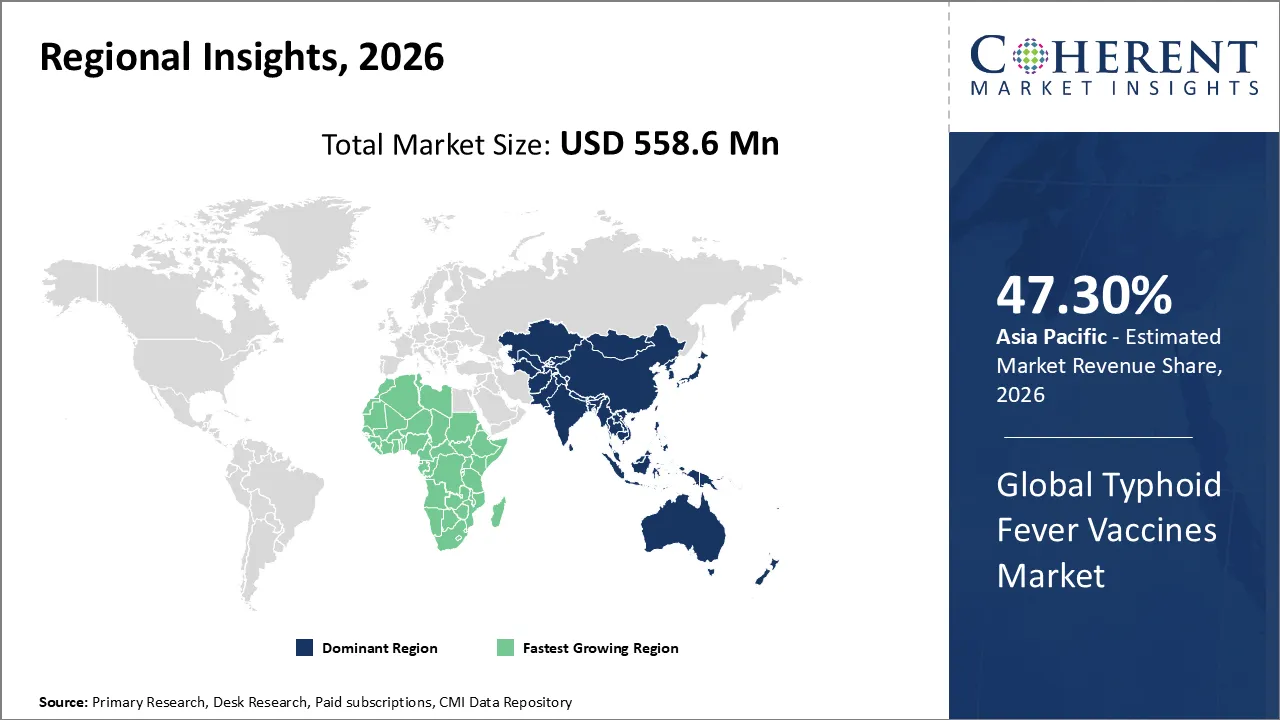
- Based on Region, Asia Pacific is set to lead the typhoid fever vaccines market with 47.3% share in 2026. While, Africa is projected to be the fastest growing region.
Market Overview
Typhoid fever, also simply called as typhoid is a bacterial infection caused by Salmonella typhi, also known as Salmonella enterica serotype Typhi. The typhoid fever is usually caused due to ingestion of contaminated food or water. Typhoid vaccine prevents typhoid fever and provides protection against it. The World Health Organization (WHO) has recommended three typhoid vaccines for use, which include live attenuated vaccine, capsular polysaccharide vaccine, and conjugate vaccine.
Current Events and their Impacts
Current Event | Description and its Impact |
Technological Advancements in Vaccine Development |
|
Public Health Policy and Vaccination Campaigns |
|
Will Typhoid Conjugate Vaccines cut 20 million cases and 160,000 deaths?
Metric | Data | Notes |
Annual Incidence | 11–20 million cases worldwide | Based on WHO and systematic reviews |
Annual Deaths | 128,000–161,000 | Primarily in low- and middle-income countries |
Incidence Rate | 132–206 cases per 100,000 person-years | Variation between hybrid surveillance and population-based studies |
High-Burden Regions | South Asia, Sub-Saharan Africa | Persistently high incidence, multidrug resistance common |
Countries with TCV in Routine Programs (2024) | ~20 | Includes Bangladesh, Nepal, Pakistan, Liberia, Malawi, Fiji, Kenya, etc. |
Campaign Scale Example – Bangladesh (2023–24) | 13 million children vaccinated | Including ~500,000 Rohingya refugees |
Campaign Scale Example – Kenya (2025) | Targeted ~10 million children | Integrated with measles-rubella campaign |
Efficacy of TCV | 79–85% | Long-lasting protection up to 5 years |
AMR Concern | >40% multidrug resistance in South Asia | Vaccination critical to reduce antibiotic reliance |
- Current Industry Events of 2026
- Market Size Estimation
- Regional Breakdown
- Competitive Landscape
- Customer Intelligence
- Segmental Analysis
- Pricing Analysis
- Key Market Drivers, Challenges & Future Trends
- Customized Insights Section
Segmental Insights
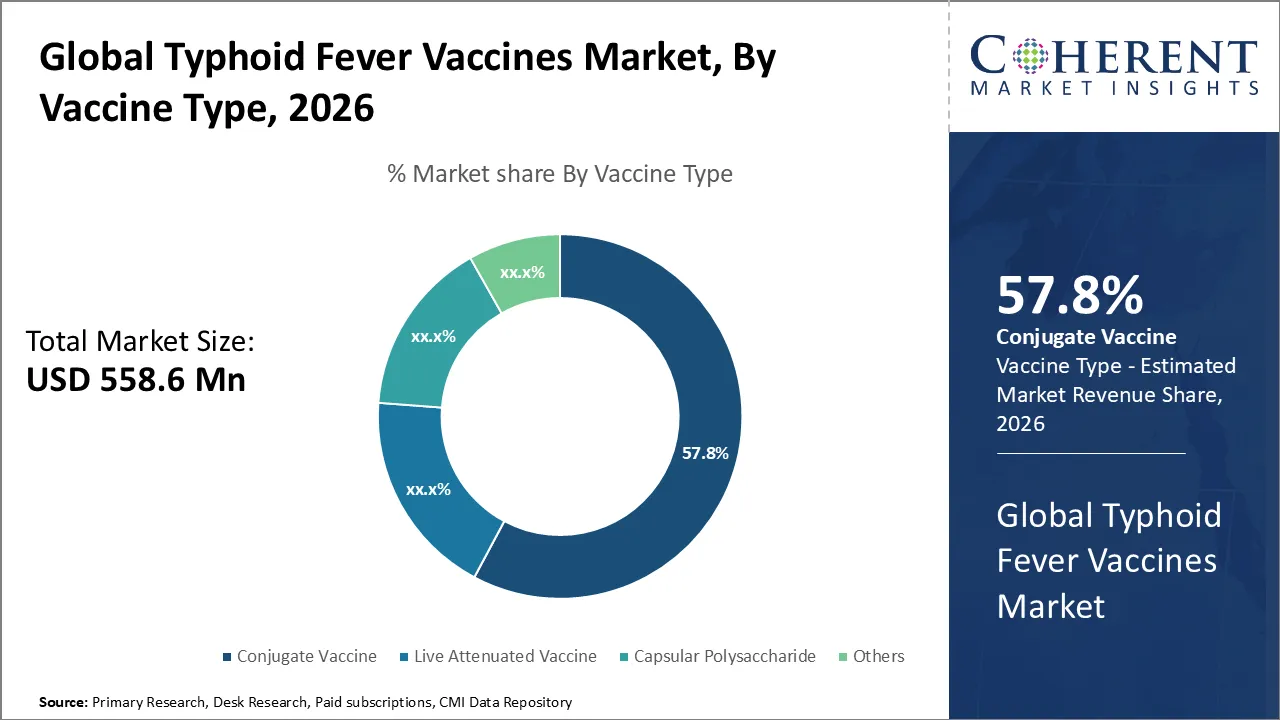
Typhoid Fever Vaccines Market Insights, By Vaccine Type - Conjugate vaccines dominate offering strong, long-lasting infant protection
In terms of vaccine type, the conjugate vaccines segment is expected to hold 57.8% share in 2026, as they are highly immunogenic, safe for babies, and provide long-lasting protection. Global health organizations put them at the top of their immunization programs, which has led to their widespread use. Conjugate vaccines are the most important part of typhoid prevention plans around the world.
For instance, in October 2025, Bangladesh started a nationwide campaign to give nearly 50 million children aged nine months to under fifteen years a typhoid conjugate vaccine. With the help of Gavi, UNICEF, and WHO, this project shows the importance of conjugate vaccines are around the world for lowering the number of typhoid cases and making immunization programs stronger.
Typhoid Fever Vaccines Market Insights, By Route of Administration - Parenteral vaccines lead is driven by superior efficacy and program integration
In terms of route of administration, the parenteral vaccines segment is expected to lead the market with 72.4% share in 2026. Injectable conjugate vaccines fit right in with regular immunization schedules, ensuring higher coverage and compliance. Their greater effectiveness compared to oral options makes them more popular with governments and healthcare providers, making parenteral administration the most common method.
Regional Insights
Asia Pacific Typhoid Fever Vaccines Market Analysis & Trends
Asia Pacific is expected to lead the typhoid fever vaccines market with 47.30% share in 2026. This is due to typhoid fever is highly prevalent in South Asia, there are strong government immunization programs, and NGO-backed programs that keep people getting vaccines.
For instance, in June 2025, the Ty-FIVE project from the Murdoch Children's Research Institute is focused on the Indo-Pacific region, especially Fiji. This campaign gives injectable typhoid conjugate vaccines to people between the ages of nine months and sixty-five years. It strengthens immunization programs and shows the importance of injectable vaccines are for large-scale public health efforts.
Africa Typhoid Fever Vaccines Market Analysis & Trends
Africa is expected to exhibit the fastest growth, driven by rising awareness of water-borne diseases, international funding, and immunization programs are growing. Better healthcare infrastructure and strong partnerships with NGOs are making vaccines easier to get, making Africa is the fastest-growing region for typhoid vaccine use and market growth.
For instance, in July 2025, Kenya's Ministry of Health started a 10-day national vaccination campaign that included both the typhoid conjugate and measles-rubella vaccines. The goal of the program was to protect millions of kids, and the typhoid conjugate vaccine was given by injection, which is the best way to do it in large-scale immunization programs across the country.
Typhoid Fever Vaccines Market Outlook Country-Wise
India Typhoid Fever Vaccines Market Trends
India has a huge population, a high rate of typhoid fever, and government-supported vaccination programs, which makes the typhoid fever vaccines market extremely prevalent in 2026. India is the country that is most responsible for the growth of the vaccine market and the adoption of vaccines, due to strong support from NGOs like Gavi, better healthcare infrastructure, and public awareness campaigns.
For instance, in March 2025, Zydus Lifesciences, which is based in India, stated it would make a combination vaccine for typhoid and shigellosis. This new candidate, which is given through injection, aims to protect against multiple enteric diseases with just one dose. It strengthens India's role in advancing global vaccine development and improving immunization strategies.
Nigeria Typhoid Fever Vaccines Market Trends
In 2026, the typhoid fever vaccines market is highly popular in Nigeria because the country has an elevated incidence of typhoid fever cases, people are becoming more aware of water-borne diseases, and international organizations are backing the vaccines. Nigeria is a key growth driver because immunization programs are growing, healthcare infrastructure is getting better, and NGOs are working together to make vaccines more available.
Market Report Scope
Typhoid Fever Vaccines Market Report Coverage
| Report Coverage | Details | ||
|---|---|---|---|
| Base Year: | 2025 | Market Size in 2026: | USD 558.6 Mn |
| Historical Data for: | 2020 To 2024 | Forecast Period: | 2026 To 2033 |
| Forecast Period 2026 to 2033 CAGR: | 12.2% | 2033 Value Projection: | USD 1,244.0 Mn |
| Geographies covered: |
| ||
| Segments covered: |
| ||
| Companies covered: | GlaxoSmithKline Plc., Sanofi SA, Bharat Biotech, Bio-Med Pvt. Ltd., PT Bio Farma, PaxVax, Inc. Shanghai Institute of Biological Products Co., Ltd., and Prokarium | ||
| Growth Drivers: |
| ||
| Restraints & Challenges: |
| ||
Market Dynamics
Typhoid Fever Vaccines Market Driver
Rising Immunization Programs
The typhoid fever vaccines market growth is due to governments and global health organizations are expanding their vaccination programs. In places where typhoid fever is still an major issue, large-scale vaccination campaigns are being used to cut down on the number of cases. These programs not only make people healthier, but they also keep the demand for vaccines high. Putting more emphasis on preventive care is making healthcare systems stronger in many countries. This is directly related to the growing use of typhoid vaccines around the world.
Growing Awareness of Water-Borne Diseases
Typhoid Fever Vaccines Market demand has expanded with increasing awareness of the risks of water-borne diseases. People in communities are starting to see the connection between poor sanitation, contaminated water, and the spread of typhoid fever. This is making more people willing to get vaccinated as a way to stop the disease from spreading. Public health campaigns and educational programs stress how important it is to get vaccinated, especially for people who are at risk. This increased awareness is making people and governments invest in vaccines, which will protect against typhoid outbreaks for a long time.
Typhoid Fever Vaccines Market Opportunity
Expansion of Conjugate Vaccines
One of the most promising chances in the Typhoid Fever Vaccines Market forecast is for conjugate vaccines. Conjugate formulations are safer for kids under two years old and provide longer-lasting immunity than traditional polysaccharide vaccines. This makes them a great choice for mass immunization programs. As governments and NGOs put more emphasis on these vaccines in their public health plans, manufacturers can expect new revenue streams. This move toward more advanced vaccine technology is expected to accelerate market penetration and long-term growth by long-term.
Analyst Opinion (Expert Opinion)
The market for typhoid fever vaccines is shaped by the ongoing burden of the disease and the growing number of immunization programs in endemic regions. According to global health data, typhoid fever causes between 11 and 21 million cases of febrile illness each year, leading to more than 110,000 deaths. The disease is most common in South and Southeast Asia and sub-Saharan Africa. A significant number of severe diseases happens in young children, so getting them vaccinated as soon as possible is a top priority for public health.
Market trends show that people want different types of vaccines and administration route. Increasingly national immunization programs are using conjugate vaccines, which provide longer-lasting immunity and are safe for younger people, supported by organizations like WHO and UNICEF support. Routine purchases of conjugate vaccine doses have reached hundreds of millions, which shows that they are being used on a large scale in countries with a lot of disease.
The public sector still plays a big role in distributing vaccines, especially in low- and middle-income countries where government and international programs try to lower the number disease incidence. The demand from the private sector, such as travel medicine and vaccinations at retail clinics, also helps with overall uptake, especially now that international travel is starting up again.
Technological progress, such as better vaccine formulations and new delivery platforms, is changing the market and making it easier for more people to get vaccines. Vaccine use continues to evolve around the world because people are becoming more aware of typhoid and antibiotic resistance and because people are still focusing on prevention.
Speak to the analyst
Want personalized insights?
Take the findings above to one of our principal consultants, or have the report rebuilt around the segments, geographies and competitors you actually track.
Global Typhoid Fever Vaccines Market: Key Developments
- In January 2026, St. George's University of London declared they would do a clinical study to test a new paratyphoid A vaccine. The candidate is given through the skin and aims to treat both enteric fever and typhoid. Since there are no licensed paratyphoid vaccines available, this trial is a big step toward making more injectable vaccines available for immunization around the world.
- In December 2025, The WHO Bangladesh feature discusses the nationwide rollout of the typhoid conjugate vaccine, which is given by injection. This campaign protected almost 500,000 Rohingya children in Cox's Bazar. It shows how important injectable conjugate vaccines are for protecting vulnerable groups and making large-scale immunization programs stronger.
Market Segmentation
- By Vaccine Type
- Live Attenuated Vaccine
- Capsular Polysaccharide Vaccines
- Conjugate Vaccine
- Others
- By Route of Administration
- Oral
- Parenteral
- By Region
- North America
- U.S.
- Canada
- Latin America
- Brazil
- Argentina
- Mexico
- Rest of Latin America
- Europe
- Germany
- U.K.
- Spain
- France
- Italy
- Russia
- Rest of Europe
- Asia Pacific
- China
- India
- Japan
- Australia
- South Korea
- ASEAN
- Rest of Asia Pacific
- Middle East & Africa
- GCC Countries
- Israel
- Rest of Middle East & Africa
- North America
- Key Players
- GlaxoSmithKline Plc.
- Sanofi SA
- Bharat Biotech
- Bio-Med Pvt. Ltd.
- PT Bio Farma
- PaxVax, Inc.
- Shanghai Institute of Biological Products Co., Ltd.
- Prokarium
Sources
Primary Research Interviews
- Typhoid Vaccine Manufacturers (e.g., Bharat Biotech, GlaxoSmithKline, Sanofi)
- Public Health Immunization Program Managers
- Pediatric Infectious Disease Specialists
- Travel Medicine Clinics & Hospital Procurement Heads
- Vaccine Distribution & Cold Chain Logistics Providers
- Global Health Procurement Agencies (e.g., UNICEF, Gavi, the Vaccine Alliance)
- Others
Databases
- Bloomberg Terminal
- Thomson Reuters Eikon
- IHS Markit
- Global Health Observatory (World Health Organization) Database
- World Bank Open Data
- Others
Magazines
- Vaccine Insights
- Pharmaceutical Technology Magazine
- Fierce Pharma
- Genetic Engineering & Biotechnology News
- Others
Journals
- Vaccine
- The Lancet Infectious Diseases
- Clinical Infectious Diseases
- Human Vaccines & Immunotherapeutics
- Others
Newspapers
- Financial Times
- The Wall Street Journal
- Reuters
- Bloomberg News
- The Hindu BusinessLine
- Others
Associations
- World Health Organization
- Gavi, the Vaccine Alliance
- UNICEF
- Bill & Melinda Gates Foundation
- International Society for Infectious Diseases (ISID)
- Others
Public Domain Sources
- World Health Organization – Immunization, Vaccines and Biologicals (IVB) Reports
- Centers for Disease Control and Prevention – Typhoid Surveillance Reports
- World Bank – Health & Population Data
- Ministry of Health and Family Welfare – National Immunization Programme Updates
- European Medicines Agency – Vaccine Approvals & Regulatory Filings
- Others
Proprietary Elements
- CMI Data Analytics Tool
- Proprietary CMI Existing Repository of Information for the Last 8 Years
Get access to 250+ pages report
Every segment, forecast, competitor profile and data table behind the analysis above — available for instant download.
- ESOMAR Member
- ISO 9001:2015 Certified
- D-U-N-S Registered
- GDPR & CCPA Compliant
Missing comfort of reading report in your local language? Find your preferred language:
Transform your Strategy with Exclusive Trending Reports
Frequently Asked Questions
The global Typhoid Fever Vaccines Market size was valued at USD 558.6 million in 2026 and is expected to reach USD 1,244.0 million in 2033.
Factors such as rising immunization programs and growing awareness of water-borne diseases are expected to drive the market growth.
Conjugate Vaccine is the leading vaccine type segment in the market.
The major factors hampering growth of the market include limited awareness in remote areas and high cost of advanced vaccines.
Major players operating in the market include GlaxoSmithKline Plc., Sanofi SA, Bharat Biotech, Bio-Med Pvt. Ltd., PT Bio Farma, PaxVax, Inc., Shanghai Institute of Biological Products Co., Ltd., and Prokarium.