

U.S. Diabetic Neuropathy Market Size and Forecast – 2026 to 2033
The U.S. Diabetic Neuropathy Market is estimated to be valued at USD 682.3 Mn in 2026 and is expected to reach USD 962.8 Mn by 2033, exhibiting a compound annual growth rate (CAGR) of 7.2% from 2026 to 2033.
Key Takeaways
- By Drug, SNRIs hold the largest market share of 34.4% in 2026 owing to its clinical positioning & guideline‑backing.
- By Type, Peripheral Neuropathy expected to hold the largest market share of 42.2% in 2026 owing to the chronic hyperglycemia.
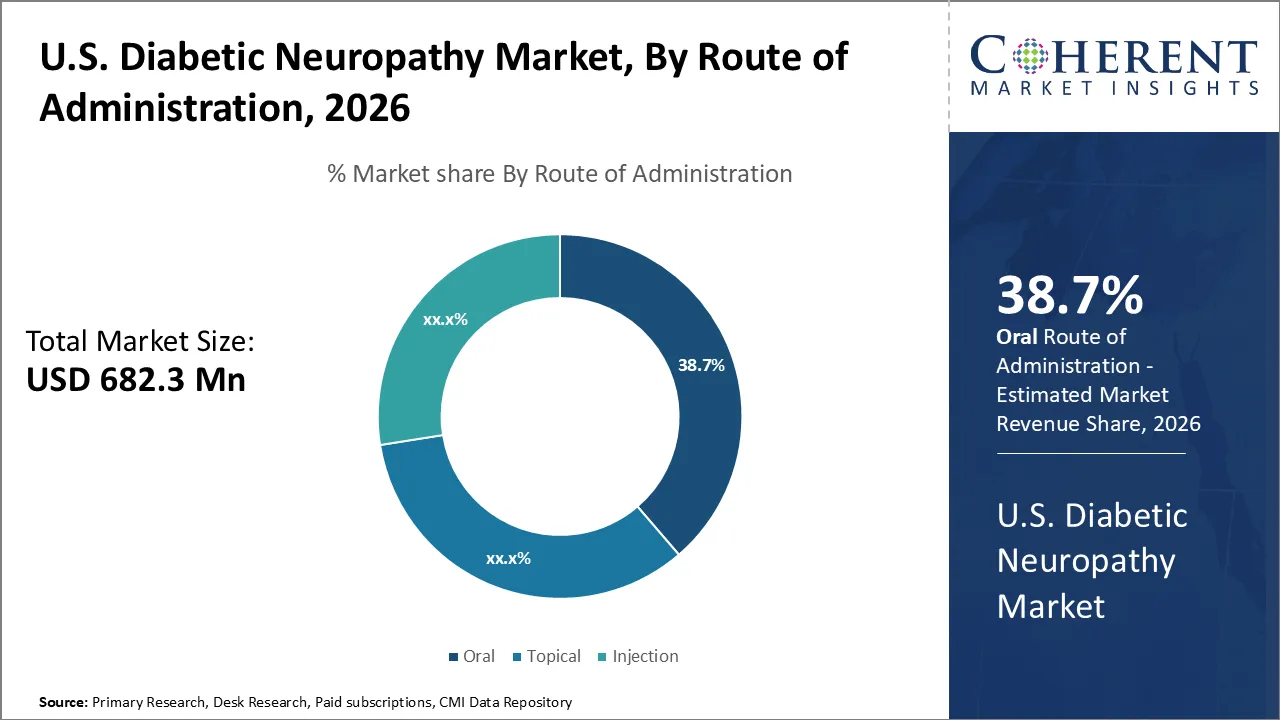
- By Route of Administration, Oral acquired the prominent market share of 38.7% in 2026 owing to the patient convenience & adherence.
- By Distribution Channel, Hospital Pharmacies capture the largest market share of 42.8% in 2026 owing to the high rates of hospital visits and referrals.
Market Overview
The U.S. diabetic neuropathy market focuses on treating nerve damage caused by diabetes, with clinicians most frequently diagnosing peripheral neuropathy in patients. A growing diabetic population, heightened awareness of complications, and continuous therapeutic advancements drive strong demand for symptom‑relief medications and supportive care. Healthcare providers offer a wide range of pharmaceuticals and therapies through hospital and retail pharmacies, while ongoing innovation and clinical adoption actively shape treatment strategies and improve patient outcomes.
Current Events and their Impact
Current Events | Description and its impact |
Technological Advancements in Diabetic Neuropathy Treatment |
|
Regulatory and Reimbursement Landscape Changes |
|
Epidemiological Trends and Public Health Initiatives |
|
Segmental Insights
- Current Industry Events of 2026
- Market Size Estimation
- Regional Breakdown
- Competitive Landscape
- Customer Intelligence
- Segmental Analysis
- Pricing Analysis
- Key Market Drivers, Challenges & Future Trends
- Customized Insights Section
U.S. Diabetic Neuropathy Market Insights, By Route of Administration - Oral contributes the highest share of the market owing to its established clinical evidence & guideline support
Oral acquired the prominent market share of 38.7% in 2026. In the U.S. diabetic neuropathy market, patients and clinicians actively choose oral therapies for their convenience and ease of daily use. Doctors rely on a wide range of oral medications—including antidepressants and anticonvulsants—to customize treatment based on individual symptoms and tolerability. Clinicians trust these medicines because extensive clinical evidence supports their effectiveness, and their design suits long‑term outpatient care. Wider insurance coverage and lower costs compared with alternative treatments further encourage healthcare providers to prescribe oral therapies. For instance, in August 2025, Audizen Labs launched Audizen Drops in 2025, a liquid supplement for sciatic nerve pain and neuropathy that offers faster absorption than conventional oral painkillers via sublingual delivery.
U.S. Diabetic Neuropathy Market Insights, By Drug - SNRIs contribute the highest share of the market owing to its dual benefits for comorbid conditions
SNRIs hold the largest market share of 34.4% in 2026. Clinicians rely on SNRIs, particularly duloxetine, because strong clinical evidence and guideline recommendations position it as a first‑line therapy for relieving painful neuropathic symptoms. By boosting serotonin and norepinephrine in pain‑inhibitory pathways, duloxetine actively reduces pain and enhances patients’ quality of life. Its proven safety, tolerability, and ability to address both mood and pain encourage widespread adoption among healthcare providers managing diabetic peripheral neuropathy.
U.S. Diabetic Neuropathy Market Insights, By Type - Peripheral Neuropathy contribute the highest share of the market owing to its duration and severity of diabetes
Peripheral Neuropathy expected to hold the largest market share of 42.2% in 2026. high blood sugar levels over time actively damage nerves and the small blood vessels that supply them, causing numbness, tingling, pain, and loss of sensation in the feet and legs. Extended periods of poor glycemic control, longer diabetes duration, metabolic imbalances like high cholesterol or blood pressure, and lifestyle factors such as smoking or obesity all contribute to increasing a patient’s risk of developing this chronic nerve damage. For instance, Eli Lilly announced that the U.S. FDA approved Cymbalta as safe and effective for treating diabetic peripheral neuropathic pain, affecting up to 5 million Americans.
U.S. Diabetic Neuropathy Market Insights, By Distribution Channel - Hospital Pharmacies contribute the highest share of the market owing to its integrated multidisciplinary care
Hospital Pharmacies capture the largest market share of 42.8% in 2026. In the U.S. diabetic neuropathy market, hospital pharmacies actively manage a large share of treatment because specialists diagnose, treat, and refer many patients within hospital settings. Physicians use centralized medication systems and in‑house formularies to prescribe and dispense a wide range of neuropathy therapies efficiently. Hospitals treat more complex cases that require coordinated care, and favorable insurance reimbursement motivates providers to utilize hospital pharmacies for initiating and managing diabetic neuropathy medications.
U.S. Diabetic Neuropathy Market Trend
Shift Toward Non‑Opioid Pain Management
Healthcare providers increasingly prioritize non‑opioid treatments for diabetic neuropathy pain due to safety concerns with long‑term opioid use. This trend favors therapies like antidepressants, anticonvulsants, and novel non‑opioid analgesics that offer targeted relief without the risks of dependency or severe side effects. Patients and clinicians alike are more open to multimodal pain strategies that balance effectiveness with tolerability, improving overall long‑term management.
Growth in Personalized Treatment Approaches
Clinicians are moving away from one‑size‑fits‑all regimens toward individualized care plans based on symptom severity, patient tolerability, and comorbidities such as depression or sleep disruption. Advances in clinical assessment tools support this trend by better capturing patient‑specific neuropathic pain profiles. Personalized strategies enhance patient satisfaction and adherence, as therapies are better matched to individual needs, leading to more sustainable long‑term outcomes and improved daily functioning.
Market Report Scope
U.S. Diabetic Neuropathy Market Report Coverage
| Report Coverage | Details | ||
|---|---|---|---|
| Base Year: | 2025 | Market Size in 2026: | USD 682.3 Mn |
| Historical Data for: | 2020 To 2024 | Forecast Period: | 2026 To 2033 |
| Forecast Period 2026 to 2033 CAGR: | 7.2% | 2033 Value Projection: | USD 962.8 Mn |
| Geographies covered: |
| ||
| Segments covered: |
| ||
| Companies covered: | Eli Lilly and Company, Johnson & Johnson Services, Inc., Novartis AG, Pfizer, Inc., GSK plc., Glenmark Pharmaceuticals Ltd., Lupin, Regenacy Pharmaceuticals, Inc., Alembic Pharmaceuticals Limited, Abbott, Ionis Pharmaceuticals, NeuroMetrix, Inc., Tissue Tech, Inc., and Averitas Pharma, Inc. | ||
| Growth Drivers: |
| ||
| Restraints & Challenges: |
| ||
U.S. Diabetic Neuropathy Market News
- In August 2024, the U.S. FDA approved AstraZeneca’s Farxiga (dapagliflozin) to improve glycaemic control in children aged 10 and older with type-2 diabetes, based on positive Phase III T2NOW trial results.
Analyst Opinion (Expert Opinion)
- The current landscape for diabetic neuropathy in the United States reflects a structurally entrenched clinical burden that continues to outpace the pace of meaningful therapeutic turnaround. Despite nearly half of all individuals with diabetes developing neuropathic complications over the course of their disease, a significant proportion remain inadequately diagnosed and treated due to persistent gaps in screening protocols and real‑world clinical practice patterns. Studies indicate that a large share of cases go unrecognized even in routine care settings, with standard screening failing to detect up to 60–80% of neuropathy when present, which underscores a systemic issue in disease management rather than a lack of therapeutic options.
- From a treatment adoption perspective, the reliance on legacy pharmacologic modalities continues to dominate, yet this dominance obscures critical limitations. Traditional agents — including anticonvulsants, antidepressants, and NSAIDs — mainly provide symptomatic relief and do not address the underlying neurodegenerative processes. Their widespread use signals a gap in innovation; the absence of breakthroughs in disease‑modifying therapies specifically approved for painful diabetic neuropathy over recent years highlights this deficit. Even as the clinical community exhibits heightened awareness of the need for non‑opioid pain strategies and broader multimodal care pathways, the pipeline advancement remains incremental rather than transformative.
- The economic and clinical burden borne by the U.S. healthcare system further accentuates unmet needs. Peripheral diabetic neuropathy alone affects an estimated 13 million patients, and direct cost analyses attribute nearly $46 billion annually to related care, hospitalizations, prescription treatments, and complication management such as foot ulcers and amputations. These figures reveal that current standards of care are not effectively reducing downstream sequelae or healthcare utilization, which in turn pressures payers and providers to reassess therapeutic value rather than simply expand utilization.
- Overall, the market’s evolutionary trajectory is increasingly defined by unmet clinical needs and a growing imperative for meaningful therapeutic innovation, rather than by simple growth in treatment volume. Market players and care stakeholders must therefore prioritize strategies that deepen diagnostic precision, accelerate adoption of disease‑modifying interventions, and demonstrate real‑world value in reducing complications and economic burden.
Speak to the analyst
Want personalized insights?
Take the findings above to one of our principal consultants, or have the report rebuilt around the segments, geographies and competitors you actually track.
Market Segmentation
- By Drug
- Tricyclic Antidepressants
- Amitriptyline
- Nortyptyline
- Imipramine
- Desipramine
- SSRI
- Paroxetine
- Citalopram
- Anticonvulsants
- Gabapentin
- Pregabalin
- Carbamazepine
- Opioids
- Tramadol
- Tapentadol
- Oksikodon
- SNRIs
- Duloxetine
- Other Drugs
- Capsaicin
- Lidocaine
- Botilinum Toxin
- Tricyclic Antidepressants
- By Type
- Peripheral Neuropathy
- Proximal Neuropathy
- Autonomic Neuropathy
- Focal Neuropathy
- By Route of Administration
- Oral
- Topical
- Injection (Intramuscular)
- By Distribution Channel
- Hospital Pharmacies
- Retail Pharmacies
- Online Pharmacies
- Key Players Insights
- Eli Lilly and Company
- Johnson & Johnson Services, Inc.
- Novartis AG
- Pfizer, Inc.
- GSK plc.
- Glenmark Pharmaceuticals Ltd.
- Lupin
- Regenacy Pharmaceuticals, Inc.
- Alembic Pharmaceuticals Limited
- Abbott
- Ionis Pharmaceuticals
- NeuroMetrix, Inc.
- Tissue Tech, Inc.
- Averitas Pharma, Inc.
Sources
Primary Research interviews
- Endocrinologists and diabetologists in U.S. hospitals and clinics
- Neurologists specializing in diabetic neuropathy
- Pharmacists and healthcare providers managing diabetic patients
- Clinical trial investigators and principal investigators in diabetic neuropathy studies
- Patients with diabetic neuropathy (for real-world insights)
Databases
- U.S. Food and Drug Administration (FDA) drug approvals and adverse event reporting system
- Centers for Disease Control and Prevention (CDC) Diabetes Surveillance System
- National Institutes of Health (NIH) clinical trial database (ClinicalTrials.gov)
- National Health and Nutrition Examination Survey (NHANES)
Magazines
- Diabetes Forecast (American Diabetes Association publication)
- Diabetes Health
- Neurology Today
- MedPage Today
Journals
- Diabetes Care
- Journal of Diabetes and Its Complications
- Diabetic Medicine
- Neurology
- Journal of Peripheral Nervous System
Newspapers
- The New York Times – Health Section
- The Washington Post – Health Section
- USA Today – Health & Wellness
Associations
- American Diabetes Association (ADA)
- American Association of Neuromuscular & Electrodiagnostic Medicine (AANEM)
- Endocrine Society
- American Neurological Association (ANA)
Public Domain sources
- U.S. Census Bureau population and demographic data
- Centers for Medicare & Medicaid Services (CMS) data
- National Center for Health Statistics (NCHS) reports
- World Health Organization (WHO) public reports on diabetes
Proprietary Elements
- CMI Data Analytics Tool, and Proprietary CMI Existing Repository of information for last 8 years
Get access to 250+ pages report
Every segment, forecast, competitor profile and data table behind the analysis above — available for instant download.
- ESOMAR Member
- ISO 9001:2015 Certified
- D-U-N-S Registered
- GDPR & CCPA Compliant
Missing comfort of reading report in your local language? Find your preferred language:
Transform your Strategy with Exclusive Trending Reports
Frequently Asked Questions
The U.S. Diabetic Neuropathy Market is estimated to be valued at USD 682.3 Mn in 2026 and is expected to reach USD 962.8 Mn by 2033.
Adoption of inorganic strategies such as drug approval by key regulatory authorities such as the U.S. Food and Drug Administration is expected to drive the market
Peripheral neuropathy is the leading type segment in the market
High cost treatment of diabetic neuropathy in the U.S. is expected to hamper the market.
Major players operating in the market include Eli Lilly and Company, Johnson & Johnson Services, Inc., Novartis AG, Pfizer, Inc., GSK plc., Glenmark Pharmaceuticals Ltd., Lupin, Regenacy Pharmaceuticals, Inc., Alembic Pharmaceuticals Limited, Abbott, Ionis Pharmaceuticals, NeuroMetrix, Inc., Tissue Tech, Inc., and Averitas Pharma, Inc.