

U.S. Endoscopy Video Processor Market Size and Forecast – 2026 to 2033
The U.S. Endoscopy Video Processor Market is anticipated to grow at a CAGR of 5.7% with USD 23.7 Bn share in 2026 and is expected to reach USD 29.6 Bn in 2033. Rising gastrointestinal disease rates and increased colorectal cancer screening drive demand in the U.S. endoscopy video processor market. Colorectal cancer (CRC) is the second leading cause of cancer-related deaths in the United States and the leading cause among adults under 50 years of age.
Key Takeaways
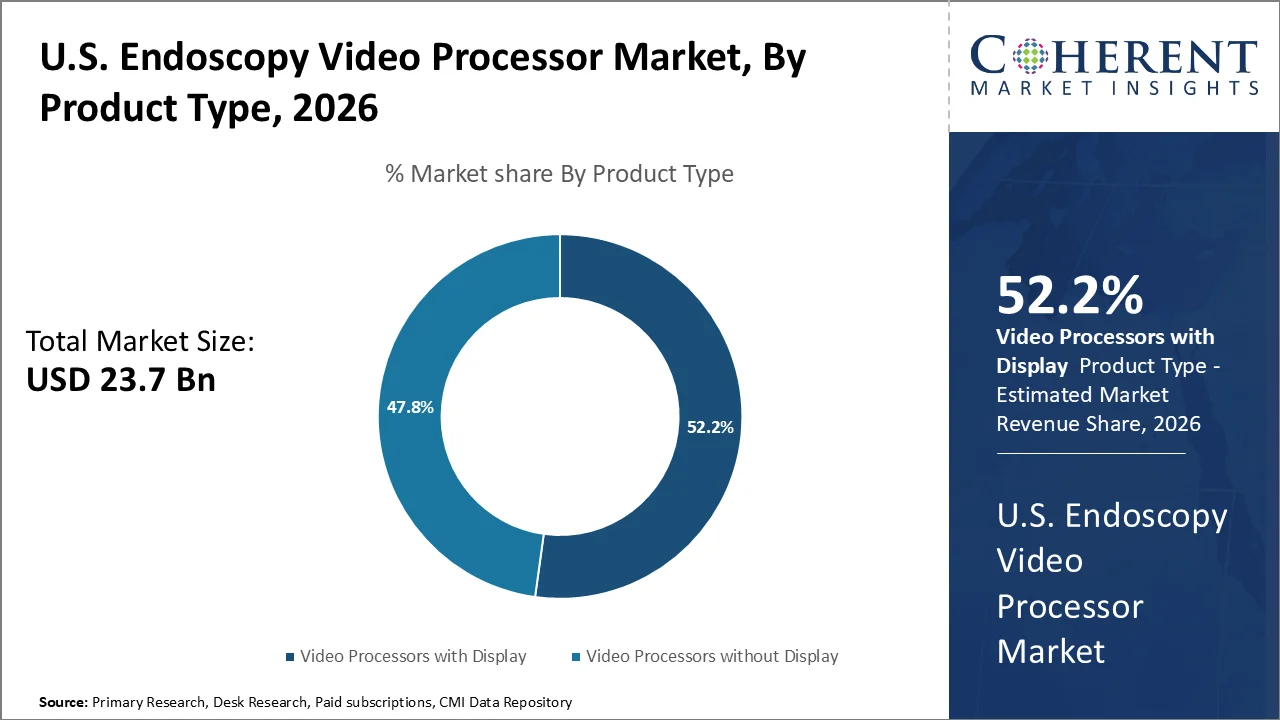
- Video Processors with Display hold the largest market share of 52.2% in 2026 owing to the display & visualization drivers as it converts raw optical signals into high-definition or 4K video, enhances image quality through advanced processing, and manages integrated light sources to support accurate diagnosis and surgical visualization.
- Colonoscopy expected to hold largest market share of 32.2% in 2026 owing to its rising colorectal cancer burden. According to the National Institute of Diabetes and Digestive and Kidney Diseases, 885,593 procedures were performed during the period, of which 61.2% were colonoscopies.
- Hospitals acquired the prominent market share of 38.8% in 2026 owing to the high volume of endoscopic procedures. Over 22 million gastrointestinal (GI) endoscopic procedures are performed each year in the United States.
Current Events and Their Impact on the U.S. Endoscopy Video Processor Market
Current Event | Description and its Impact |
Geopolitical and Regulatory Developments |
|
Medical Device Cybersecurity Regulation |
|
Segmental Insights
- Current Industry Events of 2026
- Market Size Estimation
- Regional Breakdown
- Competitive Landscape
- Customer Intelligence
- Segmental Analysis
- Pricing Analysis
- Key Market Drivers, Challenges & Future Trends
- Customized Insights Section
Why is Video Processors with Display Acquiring the Largest Market Share?
Video Processors with Display hold the largest market share of 52.2% in 2026. Healthcare providers in the U.S. endoscopy market drive demand for video processors with display as they increasingly rely on high-quality real-time imaging for minimally invasive procedures such as colonoscopy and gastroscopy. Growing cases of gastrointestinal diseases and expanding cancer screening programs encourage wider adoption. Hospitals and surgical centers choose integrated systems that combine processing and visualization to improve workflow efficiency. Manufacturers advance HD and 4K imaging, AI-based diagnostics, and enhanced color processing, while clinicians prioritize greater procedural accuracy and faster diagnosis, further supporting market growth. For instance, PENTAX Medical America Inc., part of the HOYA Group, has launched its INSPIRA™ 4K video processor and i20c video endoscope series. The company designed these innovations to enhance imaging quality and upgrade its endoscope lineup with advanced, high-definition endoscopy standards.
Colonoscopy expected to hold largest market share
Colonoscopy expected to hold largest market share of 32.2% in 2026 owing to its shift toward early diagnosis & minimally invasive care. Increasing colorectal cancer incidence and a strong focus on early detection drive healthcare providers in the U.S. endoscopy video processor market to perform more colonoscopies through routine screening programs. Clinicians widely use colonoscopy as a standard diagnostic and preventive tool for gastrointestinal disorders. An aging population increases procedure demand, while advancements in high-definition and AI-enabled imaging improve diagnostic accuracy. The number of Americans aged 100 and older is expected to rise from about 101,000 in 2024 to roughly 422,000 by 2054, more than quadrupling, according to U.S. Census Bureau projections. Centenarians, currently 0.03% of the population, are projected to increase to 0.1% by 2054. Physicians prefer minimally invasive techniques that enhance recovery and outcomes, and supportive reimbursement policies along with growing preventive healthcare awareness further drive colonoscopy adoption. Guardant Health, Inc. has launched the “Shield Across America” mobile screening tour to expand access to its Shield blood test for colorectal cancer screening across more than 100 U.S. communities. The FDA-approved test identifies potential signs of colorectal cancer or advanced adenoma, and positive results require follow-up colonoscopy.
Which End User segment dominates the market?
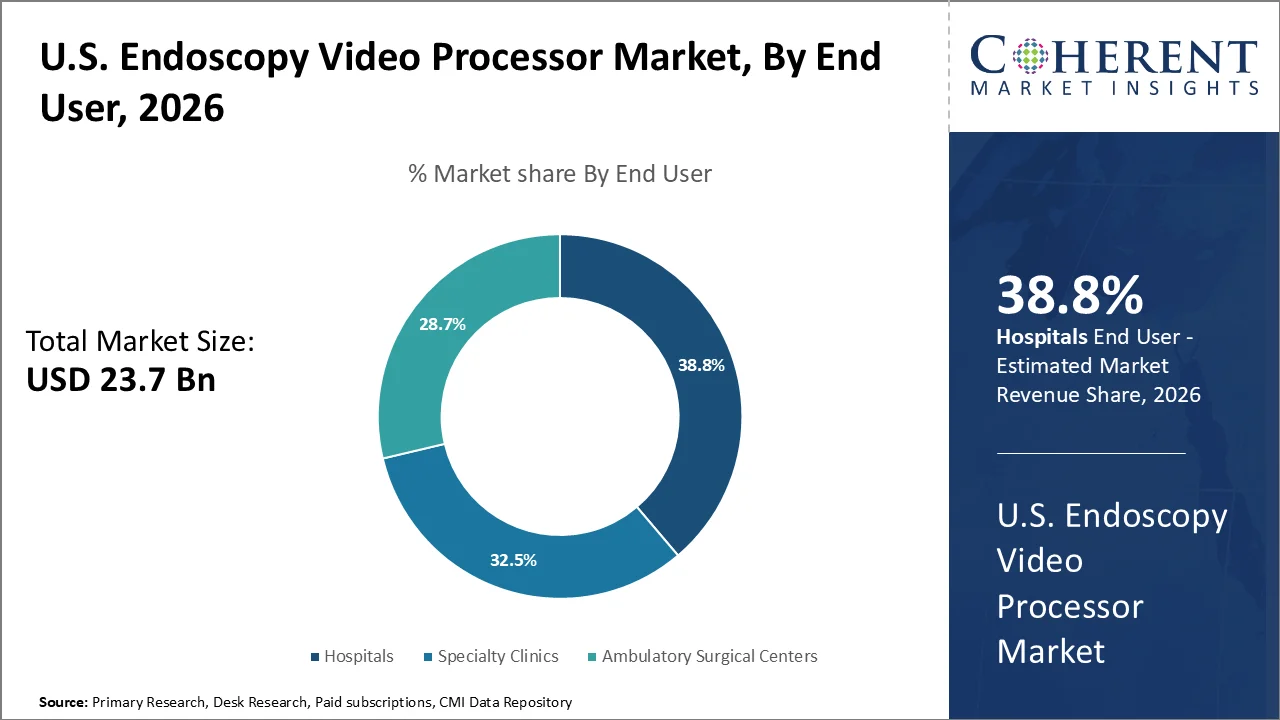
Hospitals acquired the prominent market share of 38.8% in 2026. Rising volumes of endoscopic procedures and increasing gastrointestinal and respiratory diseases drive hospitals in the U.S. endoscopy video processor market to expand their services. According to the National Library of Medicine, in the United States, over 3 million hospitalizations occur each year due to gastrointestinal diseases, and about one-third of these cases involve inpatient endoscopic procedures. Hospitals adopt advanced video processors to enable high-resolution imaging and support accurate diagnosis in complex cases. Growing demand for minimally invasive procedures pushes them to upgrade endoscopy systems. They integrate these systems with hospital IT infrastructure and electronic health records to improve workflow efficiency. Strong capital investment capacity and skilled specialists also allow hospitals to implement advanced imaging technologies and AI-enabled solutions.
U.S. Endoscopy Video Processor Market Trends
- Growing integration of artificial intelligence (AI) in endoscopy video processors enables real-time polyp detection, lesion characterization, and clinical decision support, improving diagnostic accuracy. FDA has cleared multiple AI-based endoscopy systems, reflecting accelerating clinical adoption.
- Aging population and rising GI disease burden significantly drive demand for endoscopy systems. The CDC reports that about 1 in 3 colorectal cancer deaths could be prevented with regular screening, and colorectal cancer remains the second leading cause of cancer-related deaths in the U.S. when men and women are combined. Risk increases sharply after age 50, supporting routine screening colonoscopy adoption.
- Favorable reimbursement policies and preventive screening guidelines support steady procedure volumes. Under CMS and private insurers, colorectal cancer screening colonoscopy is typically covered at no cost-sharing under preventive services mandates (Affordable Care Act provisions). Additionally, the U.S. Preventive Services Task Force (USPSTF) recommends screening for adults aged 45 to 75 years, expanding the eligible screening population.
Who are the Major Companies in U.S. Endoscopy Video Processor Industry
Some of the major key players in U.S. Endoscopy Video Processor are Olympus Corporation, Fujifilm Holdings Corporation, Karl Storz SE & Co. KG, Stryker Corporation, Boston Scientific Corporation, Richard Wolf GmbH, Sonoscape Medical Corp., XION GMBH, and PENTAX Medical.
Key News
- In July 2025, Olympus Corp. has launched its next-generation EU-ME3 Ultrasound Processor in the U.S., integrating endoscopic and endobronchial ultrasound (EUS/EBUS) into a single workstation. The system delivers high-end ultrasound imaging performance in a compact design.
Market Report Scope
U.S. Endoscopy Video Processor Market Report Coverage
| Report Coverage | Details | ||
|---|---|---|---|
| Base Year: | 2025 | Market Size in 2026: | USD 23.7 Bn |
| Historical Data for: | 2020 To 2024 | Forecast Period: | 2026 To 2033 |
| Forecast Period 2026 to 2033 CAGR: | 5.7% | 2033 Value Projection: | USD 29.6 Bn |
| Geographies covered: |
| ||
| Segments covered: |
| ||
| Companies covered: | Olympus Corporation, Fujifilm Holdings Corporation, Karl Storz SE & Co. KG, Stryker Corporation, Boston Scientific Corporation, Richard Wolf GmbH, Sonoscape Medical Corp., XION GMBH, and PENTAX Medical. | ||
Analyst Opinion
- The U.S. endoscopy video processor market is fundamentally driven by unmet clinical demand rather than discretionary technology adoption. Colorectal cancer remains a dominant pressure point, with the American Cancer Society estimating about 153,000 new colorectal cancer cases annually in the U.S. alone, reinforcing that imaging demand is structurally embedded in disease burden rather than cyclical healthcare spending patterns.
- Colonoscopy volumes remain one of the strongest anchors for video processor utilization, with clinical practice guidelines recommending routine screening starting at age 45. Given that more than 50 million screening-eligible Americans fall within this age bracket, hospitals are forced to continuously upgrade imaging systems to maintain diagnostic accuracy, especially as adenoma detection rates directly correlate with outcomes.
- AI-assisted endoscopy is no longer experimental in the U.S. clinical environment; it is becoming operationally embedded. For example, real-world studies of computer-aided detection (CADe) systems have shown adenoma detection rate improvements of up to 14–20% compared to conventional colonoscopy workflows, which directly pressures providers to invest in next-generation video processors capable of real-time computational imaging.
- Technology upgrades are being pulled forward by precision requirements rather than replacement cycles. Modern 4K and narrow-band imaging systems improve polyp detection sensitivity in flat or subtle lesions, which account for a significant proportion of missed adenomas in traditional white-light endoscopy, making legacy systems clinically obsolete in high-volume academic and tertiary care hospitals.
Speak to the analyst
Want personalized insights?
Take the findings above to one of our principal consultants, or have the report rebuilt around the segments, geographies and competitors you actually track.
Market Segmentation
- By Product Type (Revenue, USD Bn, 2021-2033)
- Video Processors with Display
- Video Processors without Display
- By Application (Revenue, USD Bn, 2021-2033)
- Upper GI Endoscopy
- Colonoscopy
- Bronchoscopy
- Sigmoidoscopy
- ENT Endoscopy
- Others
- By End User (Revenue, USD Bn, 2021-2033)
- Hospitals
- Specialty Clinics
- Ambulatory Surgical Centers
Sources
Primary Research Interviews
- Gastroenterologists and endoscopy specialists across U.S. hospitals
- Biomedical engineers and clinical equipment managers
- Procurement heads in ambulatory surgical centers (ASCs)
- Hospital IT and medical device integration teams
- Distributors and channel partners of endoscopy equipment
Databases
- U.S. FDA device clearance and approval databases
- National medical device registries
- Hospital procurement and tender databases
- ClinicalTrials.gov for device-related clinical evaluations
- Medicare and healthcare reimbursement databases
- University hospital research databases
Magazines
- Medical Device & Diagnostic Industry (MD+DI)
- EndoNurse Magazine
- Healthcare Technology Report publications
- Biomedical Instrumentation & Technology magazines
- Clinical Endoscopy-focused trade publications
Journals
- Gastrointestinal Endoscopy Journal
- Digestive Endoscopy Journal
- Journal of Medical Devices
- IEEE Journal of Biomedical and Health Informatics
- Surgical Endoscopy Journal
- American Journal of Gastroenterology
Newspapers
- The Wall Street Journal (Healthcare & MedTech sections)
- The New York Times (Health/Science coverage)
- USA Today (Health section)
- Financial Times (Healthcare innovation reporting)
- Regional U.S. healthcare business newspapers
Associations
- American Society for Gastrointestinal Endoscopy (ASGE)
- Society of American Gastrointestinal and Endoscopic Surgeons (SAGES)
- Medical Device Manufacturers Association (MDMA)
- Association for the Advancement of Medical Instrumentation (AAMI)
- Healthcare Information and Management Systems Society (HIMSS)
- American Hospital Association (AHA)
Public Domain Sources
- U.S. Food and Drug Administration (FDA) publications and device approvals
- Centers for Medicare & Medicaid Services (CMS) reports
- National Institutes of Health (NIH) publications
- World Health Organization (WHO) medical device reports
- Government healthcare statistics portals
- Open-access clinical research repositories
Proprietary Elements
- CMI Data Analytics Tool
- Proprietary CMI Existing Repository of information for last 10 years
Get access to 250+ pages report
Every segment, forecast, competitor profile and data table behind the analysis above — available for instant download.
- ESOMAR Member
- ISO 9001:2015 Certified
- D-U-N-S Registered
- GDPR & CCPA Compliant
Missing comfort of reading report in your local language? Find your preferred language:
Transform your Strategy with Exclusive Trending Reports
Frequently Asked Questions
The U.S. Endoscopy Video Processor Market is anticipated to grow at a CAGR of 5.7% with USD 23.7 Bn share in 2026 and is expected to reach USD 29.6 Bn in 2033.
Increasing incidences of gastrointestinal and other diseases, increasing geriatric population, and rapid innovation in endoscopy technologies are the major factors driving the market.
Colonoscopy is the major application segment in the market.
Architectural challenges in the light source of endoscope system is the major factor restraining growth of the market.
Major players operating in the market include Olympus Corporation, Fujifilm Holdings Corporation, Karl Storz SE & Co. KG, Stryker Corporation, Boston Scientific Corporation, Richard Wolf GmbH, Sonoscape Medical Corp., XION GMBH, and PENTAX Medical