

U.S., Europe, and China Myelodysplastic Syndrome (MDS) Treatment Market Analysis- 2026 - 2033
The U.S., Europe, and China Myelodysplastic Syndrome (MDS) Treatment Market size is anticipated to grow at a CAGR of 8.3% with USD 3.07 Bn in 2026 and is expected to reach USD 5.37 Bn in 2033. The primary drivers are defined by the rising elderly population, increasing diagnosis of transfusion-dependent anemia, adoption of novel therapies such as erythroid maturation agents and telomerase inhibitors, and expanding use of molecular-risk-based treatment decisions. According to the American Cancer Society, around 10,000 to 15,000 new MDS cases are estimated to be diagnosed each year in the U.S., and MDS is most commonly diagnosed among people in their 70s. This is strengthening demand for disease-modifying therapies, supportive care, blood transfusion management, and advanced hematology services across hospitals, cancer centers, and specialty clinics.
Key Takeaways
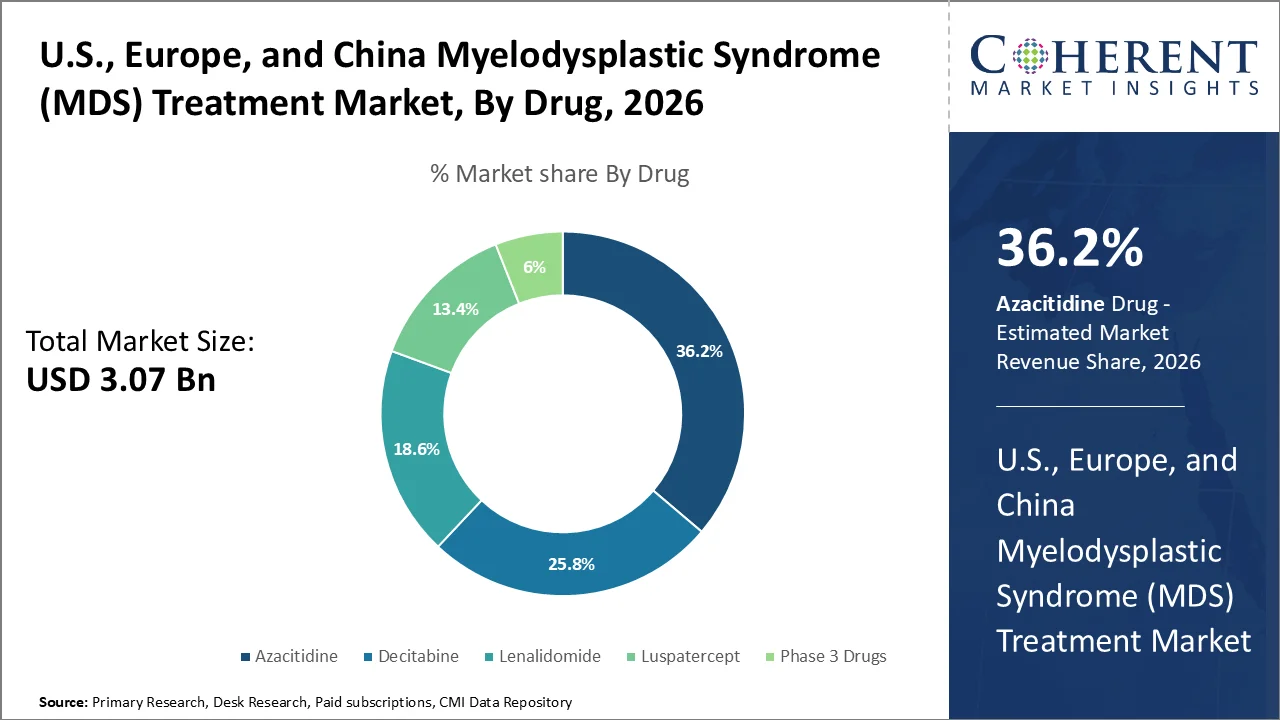
- The azacitidine segment is likely to dominate the market with 36.2% in 2026. The segment’s growth is owing to the long-established use as a hypomethylating therapy for higher-risk MDS and continued clinical reliance on transfusion-reducing treatment options.
- The injection segment is set to lead the market with 57.4% in 2026. The segment’s growth is owing to the widespread use of injectable azacitidine and decitabine regimens, which remain central to myelodysplastic syndrome treatment protocol
- The hospital pharmacies segment is set to dominate the market with 47.7% in 2026. The segment’s growth is owing to the specialist oncology care, treatment monitoring, transfusion support, and high dependence on hospital-based hematology drug access.
- U.S. is expected to acquire the prominent share of 44.8% in 2026. The country’s growth is owing to the strong diagnosis rates among older adults, advanced hematology infrastructure, reimbursement access, and early availability of FDA-approved MDS therapies. The US reports approximately 15,000–20,000 new cases annually, with a median diagnosis age in the mid-70s.
Segmental Insights
Why is Azacitidine Segment Acquiring the Largest Share?
On the basis of drug, the azacitidine segment is projected to account for the largest U.S., Europe, and China Myelodysplastic Syndrome (MDS) Treatment Market share of 36.2% in 2026. The segment’s growth is owing to the broad use in higher-risk MDS, physician familiarity, established treatment protocols, and use across multiple geographies. According to the National Cancer Institute, azacitidine and decitabine are hypomethylating agents used in MDS and may help slow progression to acute myeloid leukemia. This makes azacitidine a core treatment option for patients requiring disease-modifying therapy rather than supportive care alone.
In November 2025, SELLAS Life Sciences Group announced that Phase 2 data for SLS009, a selective CDK9 inhibitor, in combination with azacitidine and venetoclax will be presented at ASH 2025. The study focuses on relapsed/refractory AML with MDS-related changes after prior venetoclax treatment, thereby supporting the SLS009’s potential in difficult-to-treat hematologic malignancies.
- Current Industry Events of 2026
- Market Size Estimation
- Regional Breakdown
- Competitive Landscape
- Customer Intelligence
- Segmental Analysis
- Pricing Analysis
- Key Market Drivers, Challenges & Future Trends
- Customized Insights Section
Why is Injection Segment Acquiring the Largest Share?
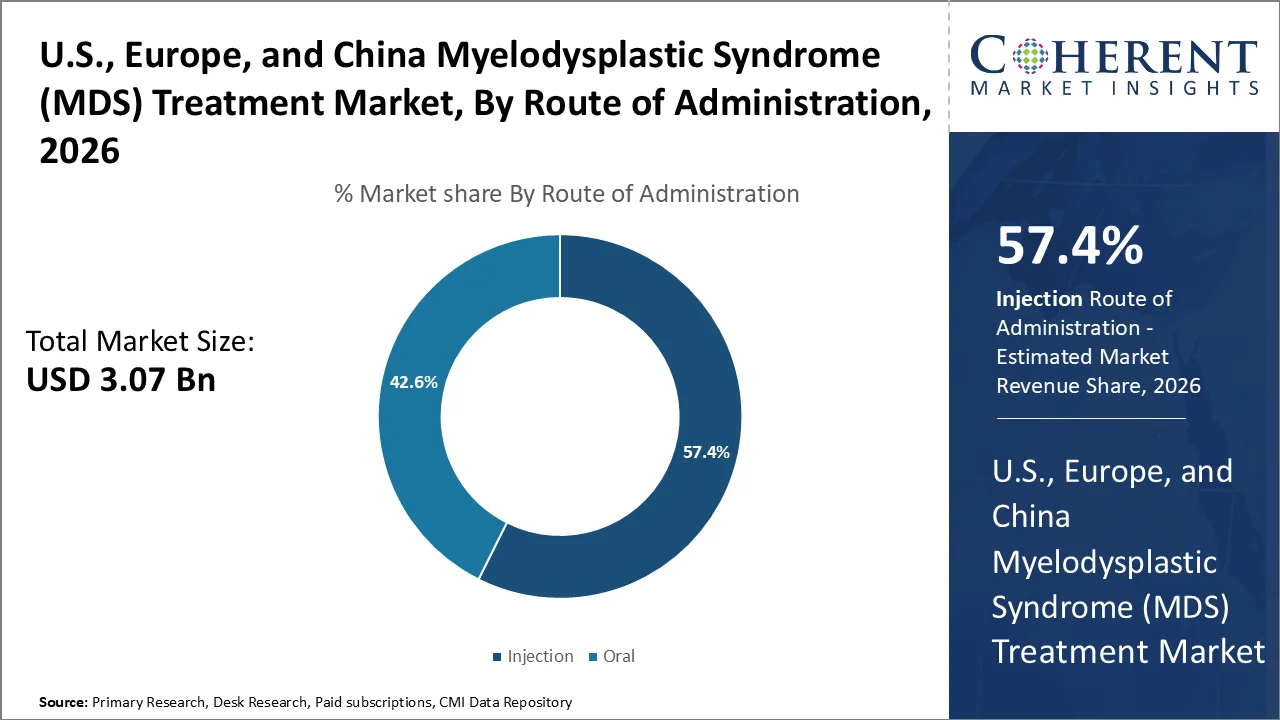
On the basis of route of administration, the injection segment is projected to account for the largest U.S., Europe, and China Myelodysplastic Syndrome (MDS) Treatment Market share of 57.4% in 2026. This is because several leading therapies for MDS are administered by injection or infusion. These include azacitidine, decitabine, luspatercept, and imetelstat. Injectable therapies are administered under clinical supervision because MDS patients frequently require monitoring for cytopenias, transfusion dependence, infection risk, and treatment-related adverse events.
The injectable segment is supported by the recent product approvals. In August 2023, Bristol Myers Squibb announced that the U.S. FDA approved Reblozyl (luspatercept-aamt) as first-line treatment of anemia in ESA-naive adults with very low- to intermediate-risk MDS who may require red blood cell transfusions. The firm stated that the COMMANDS trial showed 58.5% of patients receiving Reblozyl achieved red blood cell transfusion independence for at least 12 weeks with hemoglobin increase, compared with 31.2% for epoetin alfa.
Market Drivers
Rising Innovations in Anemia-directed Therapies are Transforming the Myelodysplastic Syndrome Treatment Market in the U.S.
The U.S. MDS treatment market is being transformed by the shift from conventional supportive care toward targeted anemia-directed therapies. Historically, the lower-risk MDS patients with symptomatic anemia were managed through erythropoiesis-stimulating agents, red blood cell transfusions, iron chelation, lenalidomide for del(5q) disease, as well as observation-based strategies. However, treatment pathways are changing as therapies like luspatercept and imetelstat provide additional options for patients who are transfusion dependent or have inadequate response to ESAs.
In June 2024, the U.S. FDA approved Rytelo/imetelstat, developed by Geron Corporation, for adults with low- to intermediate-1-risk MDS with transfusion-dependent anemia requiring four or more red blood cell units over eight weeks after ESA failure, loss of response, or ineligibility. Rytelo is an oligonucleotide telomerase inhibitor and represents a new mechanism in the MDS anemia treatment landscape. The approval is expected to support adoption of novel non-ESA treatment pathways across hematology clinics and cancer centers, especially for lower-risk MDS patients with persistent transfusion needs.
Telomerase Inhibition: A Major Breakthrough in U.S., Europe, and China Myelodysplastic Syndrome Treatment Market
Telomerase inhibition is emerging as a major breakthrough in MDS treatment, particularly for lower-risk patients with transfusion-dependent anemia who have limited options after ESA failure. It introduces a novel mechanism that may reduce transfusion burden and provide a new therapeutic pathway for patients who remain dependent on red blood cell transfusions.
The clinical importance of telomerase inhibition lies in its ability to address a high-need patient segment like lower-risk MDS patients who are not adequately managed by ESAs. These patients may remain chronically dependent on transfusions, thereby creating a need for therapies that improve transfusion independence.
In March 2025, European regulatory authorization strengthened the international commercialization pathway for Rytelo. EMA noted that Rytelo can minimize the need for blood transfusions in patients with myelodysplastic syndromes and that its side effects are considered manageable with monitoring measures, including blood cell count and liver function monitoring. Such innovations are expected to speed up the U.S., Europe, and China Myelodysplastic Syndrome Treatment Market growth during the forecast period.
Current Events and Their Impact on the U.S., Europe, and China Myelodysplastic Syndrome (MDS) Treatment Market
Current Event | Description and its Impact |
Medicare Part D Redesign and Drug Cost-Sharing Changes in the U.S. |
|
EU HTA Regulation and China NRDL Price Negotiation Pressure |
|
U.S., Europe, and China Myelodysplastic Syndrome (MDS) Treatment Market Trends
- Rising use of hypomethylating agents like azacitidine and decitabine supports standard frontline treatment for higher-risk MDS patients.
- Growing adoption of anemia-directed therapies like luspatercept and imetelstat improves transfusion independence and expands lower-risk MDS treatment options.
- Oral and less-frequent dosing therapies improve patient convenience, reduce hospital visits, and support the long-term disease management in elderly patients.
- Aging populations in the U.S., Europe, and China are increasing the diagnosed MDS pool, as MDS mainly affects older adults. Around 86% of MDS cases are diagnosed in people aged 60 years or above, while European data notes median diagnosis age above 70 years.
- Supportive regulatory approvals are speeding up the market access. The U.S. FDA approved Rytelo for transfusion-dependent lower-risk MDS in June 2024, while EMA granted EU authorization in March 2025. China also approved luspatercept for very low-, low-, and intermediate-risk MDS requiring regular RBC transfusions in June 2025.
Region Insights
U.S. Dominates Owing to the Faster Regulatory Approvals and Clinical Trial Availability
The U.S. is expected to dominate the market with 44.8% share in 2026. The country’s growth is owing to the rapid FDA approvals, strong academic cancer centers, favorable adoption of premium branded therapies, clinical trial availability, and high use of molecular diagnostics. According to the MDS Foundation, around 60,000 to 170,000 people live with MDS in the U.S. These indicators support a steady base of patients requiring diagnosis, transfusion management, and advanced treatment.
In October 2025, Orca Bio announced FDA acceptance and Priority Review of Orca-T’s BLA for hematological malignancies, including AML, ALL, and MDS. With an April 2026 PDUFA date, approval could make Orca-T the first allogeneic T-cell immunotherapy for these cancer indications.
Europe Myelodysplastic Syndrome Treatment Market Trends
Europe is expected to hold a significant market share due to strong hematology networks, EMA-backed approvals, national reimbursement systems, transplant infrastructure, and high elderly population. Orphanet reports that MDS has an annual incidence of 1 per 17,000 to 25,000 people and a median diagnosis age of around 70 years, making Europe’s aging population a key demand factor. World Bank data indicate that the EU population aged 65 and above was around 22% in 2025, supporting higher need for elderly hematology care.
In May 2026, Halia Therapeutics announced final Phase 2 data for ofirnoflast in ESA-refractory lower-risk MDS, to be presented at EHA2026 in Stockholm, Europe. The oral NEK7 inhibitor showed 67% hematological improvement, durable transfusion independence, and no treatment-related serious adverse events.
Who are the Major Companies in U.S., Europe, and China Myelodysplastic Syndrome (MDS) Treatment Industry
Some of the major key players in U.S., Europe, and China Myelodysplastic Syndrome (MDS) Treatment Market are Bristol Myers Squibb, Otsuka Pharmaceutical Co., Ltd., Teva Pharmaceutical Industries Ltd., Mylan N.V., Dr. Reddy's Laboratories Ltd., Sun Pharmaceutical Industries Limited, Cipla Limited, Acceleron Pharma, Inc., Onconova Therapeutics, Inc., Aprea Therapeutics, Geron, Fibrogen, Inc., Jazz Pharmaceuticals, AbbVie Inc., Lixte Biotechnology Holdings, Inc., Gilead Sciences, CrystalGenomics, Inc., ALX Oncology Inc., and Keros Therapeutics.
Key News
- In June 2026, Stelexis BioSciences, Inc. announced positive Phase 1 data for oral PI3K-gamma inhibitor eganelisib in relapsed/refractory AML and higher-risk MDS. The study showed complete remissions, hematologic improvements, longer survival in PI3K-gamma-high patients, and favorable safety.
- In December 2025, Rigel Pharmaceuticals presented the updated Phase 1b data for R289 in relapsed/refractory lower-risk MDS at the 67th ASH Annual Meeting. The oral IRAK1/4 inhibitor showed tolerability and achieved red blood cell transfusion independence in 33% of evaluable patients at doses of 500 mg QD or higher.
- In October 2024, NIH launched myeloMATCH, an NCI-funded precision medicine trial for AML and MDS. The study uses rapid genetic testing to match patients with targeted treatment substudies, thereby aiming to speed personalized therapy development as well as improve outcomes in myeloid cancers.
Market Report Scope
U.S., Europe, and China Myelodysplastic Syndrome (MDS) Treatment Market Report Coverage
| Report Coverage | Details | ||
|---|---|---|---|
| Base Year: | 2025 | Market Size in 2026: | USD 3.07 Bn |
| Historical Data for: | 2020 To 2024 | Forecast Period: | 2026 To 2033 |
| Forecast Period 2026 to 2033 CAGR: | 8.3% | 2033 Value Projection: | USD 5.37 Bn |
| Geographies covered: | U.S., Europe (U.K., Germany, Italy, France, Spain, Russia, Rest of Europe), and China | ||
| Segments covered: |
| ||
| Companies covered: | Bristol Myers Squibb, Otsuka Pharmaceutical Co., Ltd., Teva Pharmaceutical Industries Ltd., Mylan N.V., Dr. Reddy's Laboratories Ltd., Sun Pharmaceutical Industries Limited, Cipla Limited, Acceleron Pharma, Inc., Onconova Therapeutics, Inc., Aprea Therapeutics, Geron, Fibrogen, Inc., Jazz Pharmaceuticals, AbbVie Inc., Lixte Biotechnology Holdings, Inc., Gilead Sciences, CrystalGenomics, Inc., ALX Oncology Inc., and Keros Therapeutics. | ||
| Growth Drivers: |
| ||
| Restraints & Challenges: |
| ||
Analyst Opinion
- The U.S., Europe, and China MDS treatment market is supported by a clear patient pool. In the U.S. alone, the American Cancer Society estimates around 10,000 new MDS diagnoses annually, with some estimates much higher. This is creating the sustained need for hematology care as well as disease-modifying therapies.
- MDS creates a strong treatment burden because anemia is the most common complication. Around 80% to 85% of MDS patients develop anemia, while 30% to 45% have thrombocytopenia and nearly 40% have neutropenia at diagnosis. This is propelling the demand for transfusions, ESAs, luspatercept, hypomethylating agents, and supportive care.
- New therapies are improving outcomes for transfusion-dependent lower-risk MDS. In the MEDALIST trial, 37.9% of luspatercept-treated patients achieved red blood cell transfusion independence for at least 8 weeks, compared with 13.2% on placebo, thereby supporting the wider adoption across the U.S., Europe, and China.
Speak to the analyst
Want personalized insights?
Take the findings above to one of our principal consultants, or have the report rebuilt around the segments, geographies and competitors you actually track.
Market Segmentation
- By Drug (Revenue, USD Bn, 2021-2033)
- Lenalidomide
- Decitabine
- Azacitidine
- Luspatercept
- Phase 3 Drugs
- By Route of Administration (Revenue, USD Bn, 2021-2033)
- Injection
- Oral
- By Distribution Channel (Revenue, USD Bn, 2021-2033)
- Hospital Pharmacies
- Retail Pharmacies
- Online Pharmacies
- By Region (Revenue, USD Bn, 2021-2033)
- U.S.
- Europe
- U.K.
- Germany
- Italy
- France
- Spain
- Russia
- Rest of Europe
- China
Sources
Primary Research Interviews
- Hematologists and hemato-oncologists
- Medical oncologists treating myelodysplastic syndromes
- Bone marrow transplant specialists
- Hospital administrators and oncology department heads
- Specialty pharmacy and hospital pharmacy managers
- Clinical researchers and principal investigators in hematologic malignancies
- Pharmaceutical distributors and market access professionals
- Key opinion leaders (KOLs) in hematology and oncology
Databases
- World Health Organization (WHO)
- Centers for Disease Control and Prevention (CDC)
- National Institutes of Health (NIH)
- National Cancer Institute (NCI)
- Surveillance, Epidemiology, and End Results (SEER) Program
- European Medicines Agency (EMA)
- U.S. Food and Drug Administration (FDA)
- National Medical Products Administration (NMPA), China
- Organisation for Economic Co-operation and Development (OECD)
- Eurostat
Magazines
- Hematology Advisor
- Oncology Times
- OncLive
- Cancer Network
- The ASCO Post
- Managed Healthcare Executive
Journals
- Blood
- The Lancet Haematology
- Leukemia
- Haematologica
- Journal of Clinical Oncology
- Annals of Hematology
- Blood Advances
- New England Journal of Medicine
Newspapers
- The New York Times
- The Guardian
- The Wall Street Journal
- Financial Times
- China Daily
Associations
- American Society of Hematology
- European Hematology Association
- MDS Foundation
- National Comprehensive Cancer Network
- European Society for Medical Oncology
- Chinese Society of Hematology
- Chinese Society of Clinical Oncology
Public Domain Sources
- Company annual reports and investor presentations
- Government health ministry publications
- Drug approval databases from FDA, EMA, and NMPA
- Clinical trial registries such as ClinicalTrials.gov, EU Clinical Trials Register, and Chinese Clinical Trial Registry
- Hospital and cancer registry publications
- Reimbursement and health technology assessment reports
Proprietary Elements
- CMI Data Analytics Tool
- Proprietary CMI Existing Repository of Information for Last 10 Years
Get access to 250+ pages report
Every segment, forecast, competitor profile and data table behind the analysis above — available for instant download.
- ESOMAR Member
- ISO 9001:2015 Certified
- D-U-N-S Registered
- GDPR & CCPA Compliant
Missing comfort of reading report in your local language? Find your preferred language:
Transform your Strategy with Exclusive Trending Reports
Frequently Asked Questions
The U.S., Europe, and China Myelodysplastic Syndrome (MDS) Treatment Market is expected to reach USD 5.37 Bn in 2033.
Major players operating in the global U.S., Europe, and China Myelodysplastic Syndrome (MDS) Treatment Market include Bristol Myers Squibb, Otsuka Pharmaceutical Co., Ltd., Teva Pharmaceutical Industries Ltd., Mylan N.V., Dr. Reddy's Laboratories Ltd., Sun Pharmaceutical Industries Limited, Cipla Limited, Acceleron Pharma, Inc., Onconova Therapeutics, Inc., Aprea Therapeutics, Geron, Fibrogen, Inc., Jazz Pharmaceuticals, AbbVie Inc., Lixte Biotechnology Holdings, Inc., Gilead Sciences, CrystalGenomics, Inc., ALX Oncology Inc., and Keros Therapeutics.
The exorbitant cost of targeted therapies and the fact that stem cell transplantation, the only potential cure, carries severe risks and excludes ineligible patients are the key factors hampering growth of the market.
The aging geriatric population, robust FDA Pathways and EMA approvals for novel therapies, and a strong emphasis on precision genomics and targeted therapies is boosting the demand for Myelodysplastic Syndrome (MDS) Treatment.
The U.S., Europe, and China Myelodysplastic Syndrome (MDS) Treatment Market is anticipated to grow at a CAGR of 8.3% between 2026 and 2033.
U.S. is expected to account for a largest market share in the global U.S., Europe, and China Myelodysplastic Syndrome (MDS) Treatment Market over the forecast period.
The MDS treatment market includes drugs, supportive care products, and distribution channels used to manage myelodysplastic syndromes, a group of bone marrow cancers in which immature blood cells do not mature normally. Treatment includes supportive care, hypomethylating agents, anemia-directed therapies, chemotherapy, and stem cell transplant evaluation.