

Micro-hospitals Market Size and Share Analysis- 2026 To 2033
The Micro-hospitals Market size is anticipated to grow at a CAGR of 8.1% with USD 334.2 Bn in 2026 and is expected to reach USD 576.4 Bn in 2033. The primary drivers are defined by shortages in local healthcare access, increasing urban and suburban populations, rising treatment costs, hospital capacity constraints, and stronger demand for convenient community-based medical services. According to the U.S. Health Resources and Services Administration, around 20% of the U.S. population resides in designated primary medical-care shortage areas. This is strengthening demand for micro-hospitals providing emergency treatment, diagnostic imaging, laboratory services, short-stay inpatient care, outpatient procedures, and pharmacy support. Micro-hospitals are increasingly adopted across underserved urban neighborhoods, suburban communities, rapidly expanding cities, and regions located far from full-service hospitals.
Key Takeaways
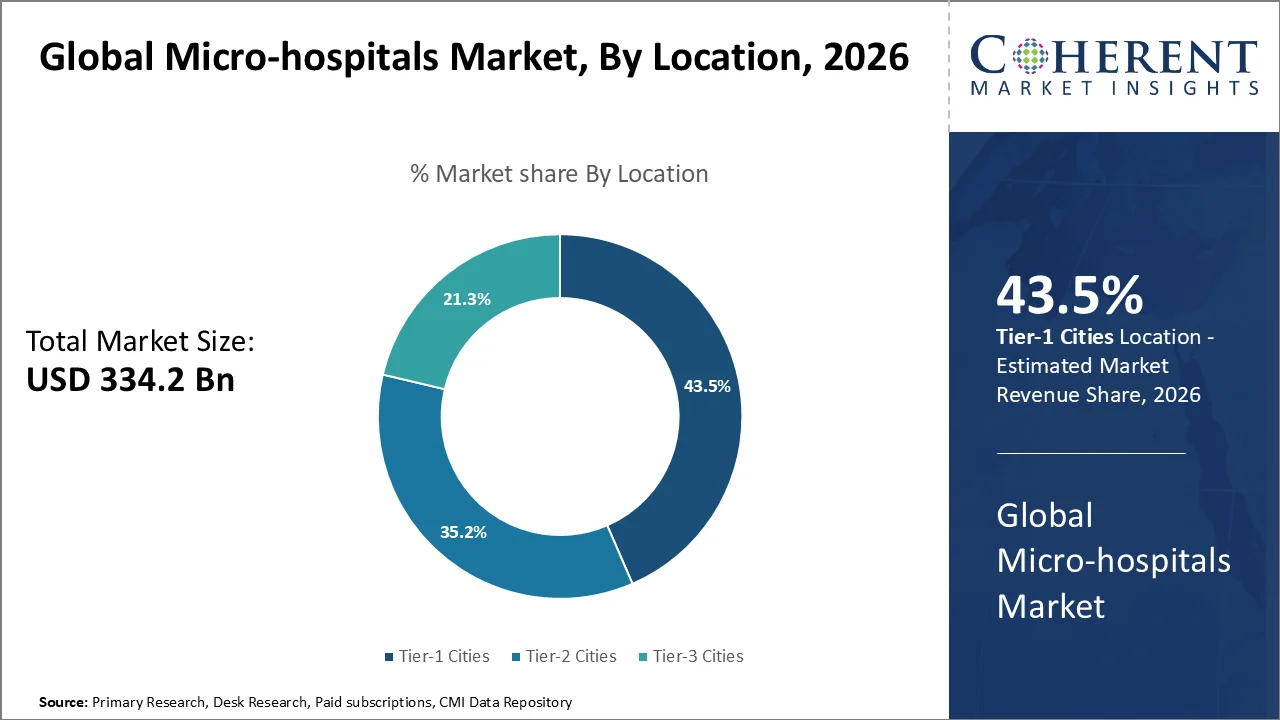
- The tier-1 cities segment is likely to dominate the market with 43.5% in 2026. The segment’s growth is owing to the dense populations, greater healthcare expenditure, and demand for accessible emergency services. According to the U.S. Census Bureau, 80% of the U.S. population lived in urban areas.
- The 15,000–40,000 sq. feet segment is set to lead with 66.8% in 2026. The segment’s growth is owing to the ability to accommodate emergency rooms, inpatient beds, diagnostics, pharmacies, and surgical facilities.
- The corporate segment is expected to dominate the market with a share of 74.2% in 2026. The segment’s growth is owing to the growing investments by private hospital groups in scalable and cost-efficient healthcare facilities.
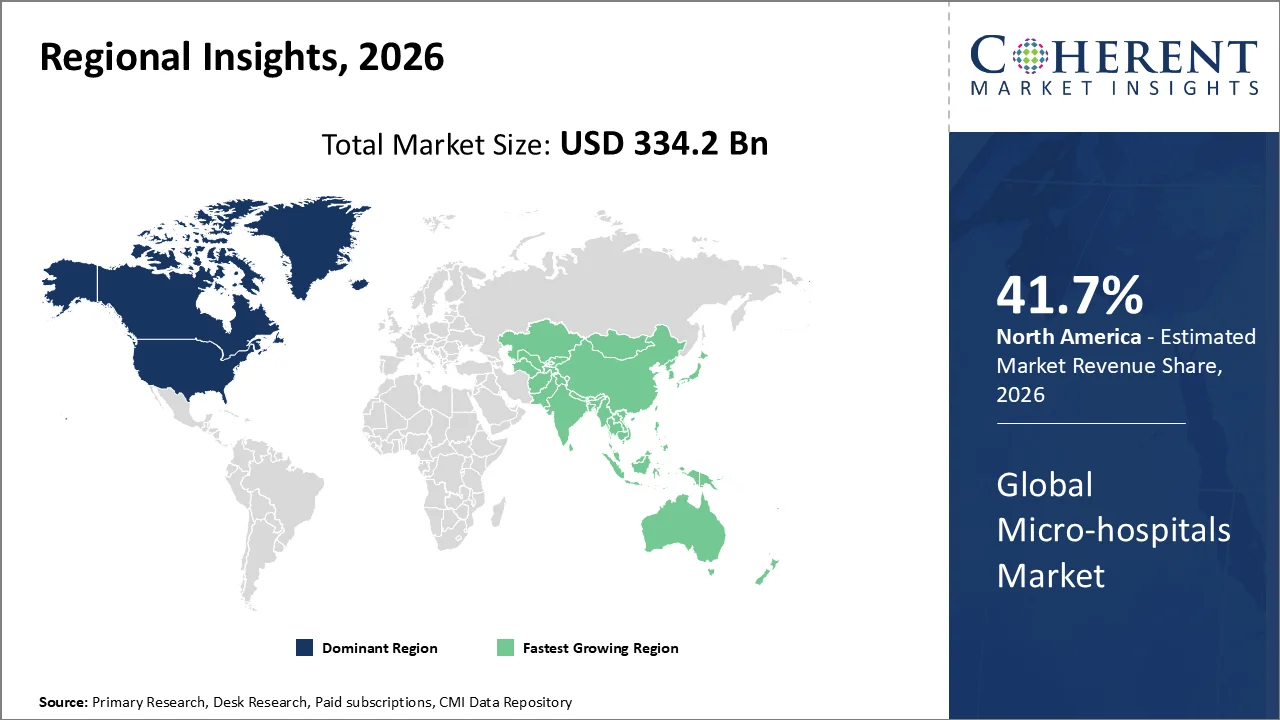
- North America is expected to acquire the prominent share of 41.7% in 2026. The region’s growth is owing to the advanced healthcare infrastructure, high emergency-care utilization, and increasing demand for community-based facilities. CMS evaluated 4,609 hospitals under its April 2026 Hospital Quality Star Ratings program, highlighting the region’s extensive healthcare network.
Segmental Insights
Why is Tier-1 Cities Segment Acquiring the Largest Share?
On the basis of location, the tier-1 cities segment is projected to account for the largest Micro-hospitals Market share of 43.5% in 2026. The segment’s growth is owing to the concentration of patients, physicians, and referral hospitals in major metropolitan areas.
In March 2026, WellSpan Health opened WellSpan Shrewsbury Hospital in Pennsylvania in partnership with Emerus. The small-format hospital operates 24/7 and includes a modern emergency department, 10 inpatient beds, laboratory testing, X-ray, CT, and ultrasound services.
- Current Industry Events of 2026
- Market Size Estimation
- Regional Breakdown
- Competitive Landscape
- Customer Intelligence
- Segmental Analysis
- Pricing Analysis
- Key Market Drivers, Challenges & Future Trends
- Customized Insights Section
15,000–40,000 Sq. Feet hold the Largest Market Share
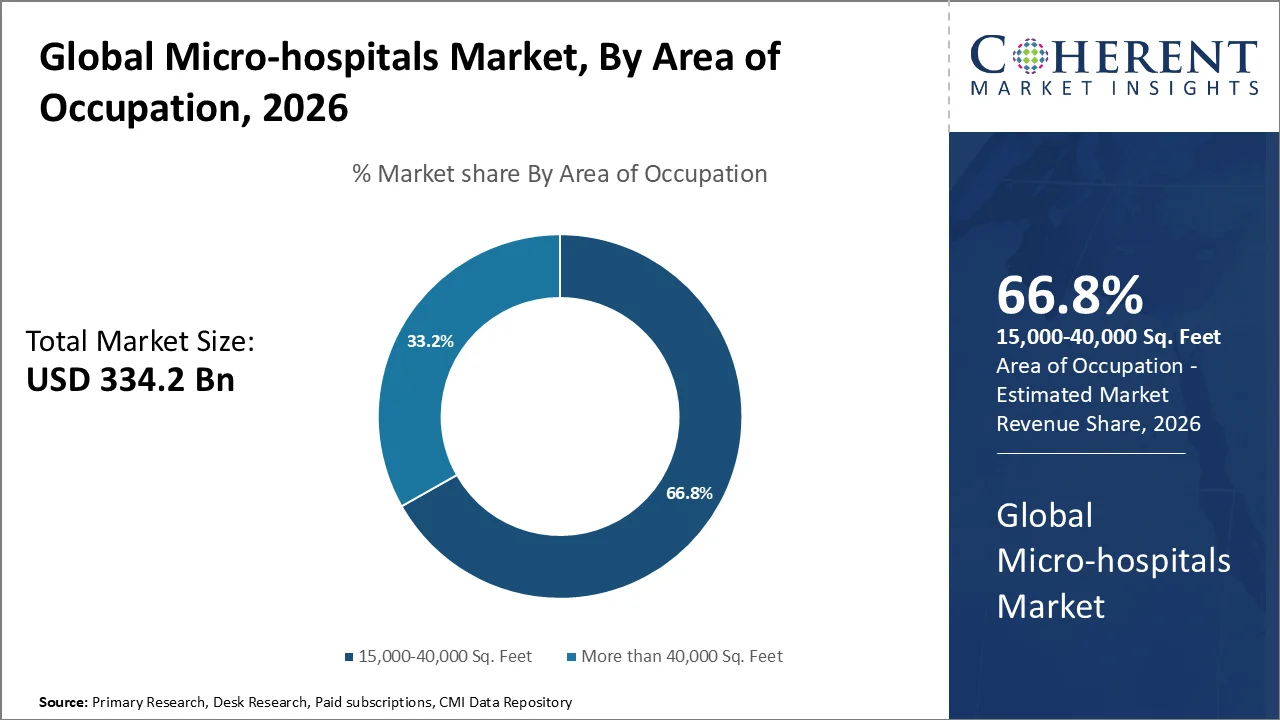
On the basis of occupation, the 15,000–40,000 sq. feet segment lead with a major 66.8% share in 2026. Facilities in this range can accommodate 24/7 emergency care, diagnostic imaging, laboratories, pharmacies, observation rooms, and limited short-stay inpatient capacity while maintaining lower construction, staffing, and operating requirements than conventional hospitals.
In June 2026, ChristianaCare opened its Aston neighborhood hospital in Pennsylvania. The 20,000-square-foot, fully licensed facility includes a 10-bed emergency department, a 10-bed inpatient unit, diagnostic services, and round-the-clock care.
Market Drivers
Rising Neighborhood-Hospital Innovation Is Transforming the U.S. Micro-Hospitals Market
The U.S. remains the principal center of commercial micro-hospital development because the model can be integrated into existing hospital licenses, emergency-care networks, payer contracts, electronic medical records, physician groups, and referral systems. Unlike urgent-care clinics, licensed micro-hospitals can provide inpatient care, continuous nursing care services, advanced diagnostic imaging, hospital pharmacy support, and 24/7 emergency-physician coverage.
Health systems are increasingly adopting an integrated campus approach. A neighborhood hospital forms the anchor facility, while primary care, specialty clinics, ambulatory surgery, rehabilitation, and imaging services are developed in the same building or on an adjacent site. This allows the system to establish an initial acute-care presence and expand services as local demand increases.
In April 2026, ChristianaCare advanced a proposed neighborhood-hospital campus in Camden, Delaware. The approximately 38,000-square-foot campus is planned with eight emergency-department beds, eight inpatient beds, primary care, specialty care, and outpatient services.
Virtual Specialty Integration: A Major Breakthrough in the Micro-Hospitals Market
Virtual specialist integration is becoming an important technology supporting the operational feasibility of micro-hospitals. Small facilities cannot economically maintain every medical specialty onsite throughout the day and night. Telemedicine platforms enable emergency physicians, hospitalists, and nurses to consult cardiologists, neurologists, critical-care specialists, infectious-disease physicians, radiologists, and other experts located at larger referral hospitals.
WellSpan’s neighborhood hospitals similarly provide immediate access to specialists through virtual care. WellSpan states that its smaller hospital design and staffing model enables most patients to be seen by a board-certified physician within approximately 15 minutes. Patients requiring complex acute care or surgery can be assessed and transferred to another WellSpan hospital.
Current Events and Their Impact on the Micro-hospitals Market
Current Event | Description and its Impact |
2026 Medicare Outpatient Payment and Price-Transparency Reforms in the U.S.
|
|
Expansion of the Rural Emergency Hospital Framework |
|
Micro-hospitals Market Trends
- Rising demand for neighborhood-based emergency and acute care facilities improves healthcare access, reduces travel time, and eases congestion at large hospitals.
- Integration of telemedicine, remote diagnostics, electronic health records, and centralized specialist support enhances clinical efficiency and expands micro-hospital capabilities.
- Health systems increasingly deploy micro-hospitals in suburban and underserved communities, offering emergency care, diagnostics, short-stay inpatient services, and outpatient procedures.
- Growing outpatient volumes and aging populations support demand for smaller, flexible healthcare facilities. In 2026, the American Hospital Association projected outpatient volumes to increase 18% by 2035, while inpatient days are expected to rise 10%, reflecting sustained demand for decentralized care delivery.
- Supportive public funding for small rural hospitals encourages modernization and decentralized healthcare delivery. In 2026, HRSA’s Small Rural Hospital Improvement Program supported approximately 1,600 small rural hospitals and Critical Access Hospitals across the United States. Funding for hardware, software, staff training, and operational improvements strengthens the ability of compact facilities to provide efficient community-based care.
Regional Insights
North America Dominates Owing to the Expanding Localized Healthcare Access
The North America region accounts for 41.7% of the market share in 2026. The region’s growth is owing to the high emergency-care utilization, strong health-system investment, and growing demand for localized inpatient services.
HRSA reported that 64.5 million people, representing 19.3% of the U.S. population, live in rural communities, creating demand for facilities that provide emergency, diagnostic, observation, and short-stay inpatient services closer to patients.
In March 2026, WellSpan Health opened WellSpan Newberry Hospital in Pennsylvania as part of its plan to launch three smaller-format hospitals during early 2026. The facility operates 24/7 and includes an emergency department, 10 inpatient beds, ultrasound, CT, X-ray, and laboratory services, demonstrating continued investment in localized acute-care infrastructure across North America.
Asia Pacific Micro-hospitals Market Trends
Asia Pacific is expected to witness strong growth in market over the forecast period. The region’s growth is owing to the rising need for compact inpatient facilities extending emergency, diagnostic, and short-stay care beyond metropolitan hospitals.
Australia recorded 9.1 million emergency-department presentations in public hospitals during 2024–25, equal to 328 per 1,000 population, indicating demand for accessible acute-care capacity. Singapore’s Ministry of Health plans to add about 2,800 public acute and community hospital beds by 2030, increasing capacity from 12,000 to 15,000 beds, or 25%. These pressures support micro-hospital models combining emergency care, limited inpatient beds, imaging, laboratory services, and digital referral links across underserved regional locations.
Rising Rural Hospital Closures is Accelerating the Micro-hospitals Market in United States
The U.S. is the largest individual market for Micro-hospitals. This is owing to the need for smaller, lower-cost care facilities offering emergency, diagnostic, observation, and outpatient services. HRSA reported that 152 rural hospitals closed between 2010 and 2025, including 52 Critical Access Hospitals, widening local access gaps.
China Micro-hospitals Market Trends
China is emerging as an important Asia Pacific market owing to rising demand for accessible, neighborhood-based care and stronger integration between primary facilities and larger hospitals. By the end of 2025, China had 38,000 community health service centers, supporting a broad operating base for compact outpatient, diagnostic, chronic-care, and short-stay facilities.
Who are the Major Companies in Micro-hospitals Industry
Some of the major key players in Micro-hospitals Market are Emerus Hospitals, SCL Health, Baylor Scott & White Saint Luke’s Health System, Dignity Health, Baylor Health Care System, and Christus Health.
Key News
- In March 2026, Pacific OneHealth announced an investment of INR 300 crore to develop more than 15 micro-hospitals across North, Central, East, and Northeast India. The first phase involves ₹100 crore, including five facilities planned for Delhi NCR. The 15–75-bed hospitals will integrate emergency care, minimally invasive surgery, diagnostics, ICUs, short-stay admissions, chronic-care management, home healthcare, and digital workflows.
- In January 2026, Nutex Health reopened Bayou City ER & Hospital in Humble, Texas, following an extensive facility transformation. The 40,000-square-foot hospital provides eight emergency-room beds, 46 inpatient beds, a full-service laboratory, and CT, X-ray, and ultrasound The hospital is also expanding specialized services for behavioral health, medical detoxification, and complex patient conditions.
Market Report Scope
Micro-hospitals Market Report Coverage
| Report Coverage | Details | ||
|---|---|---|---|
| Base Year: | 2025 | Market Size in 2026: | USD 334.2 Bn |
| Historical Data for: | 2020 To 2024 | Forecast Period: | 2026 To 2033 |
| Forecast Period 2026 to 2033 CAGR: | 8.1% | 2033 Value Projection: | USD 576.4 Bn |
| Geographies covered: |
| ||
| Segments covered: |
| ||
| Companies covered: | Emerus Hospitals, SCL Health, Baylor Scott & White Saint Luke’s Health System, Dignity Health, Baylor Health Care System, and Christus Health. | ||
| Growth Drivers: |
| ||
| Restraints & Challenges: |
| ||
Analyst Opinion
- The Micro-hospitals Market growth is supported by the need for faster and more accessible acute care. U.S. emergency departments record approximately 155.4 million visits annually, including 17.8 million visits resulting in hospital admission. This sustained patient volume supports smaller facilities that provide emergency, diagnostic, observation, and short-stay inpatient services closer to residential communities.
- Micro-hospitals offer a practical alternative where full-scale hospitals are financially difficult to operate. Since 2010, more than 140 rural hospitals have closed, while nearly 450 remain at risk, strengthening demand for compact healthcare models that preserve essential emergency and outpatient services with lower infrastructure and operating requirements.
- Supportive reimbursement models are improving the commercial viability of small-format hospitals. For 2026, CMS established a monthly payment of approximately USD 295,051.54 for qualifying Rural Emergency Hospitals. Such financial support encourages hospitals to maintain round-the-clock emergency care, laboratory testing, imaging, pharmacy, and outpatient services despite limited inpatient capacity, further supporting micro-hospital adoption across underserved and lower-density markets.
Speak to the analyst
Want personalized insights?
Take the findings above to one of our principal consultants, or have the report rebuilt around the segments, geographies and competitors you actually track.
Market Segmentation
- By Location (Revenue, USD Bn, 2021-2033)
- Tier-1 Cities
- Tier-2 Cities
- Tier-3 Cities
- By Area of Occupation (Revenue, USD Bn, 2021-2033)
- 15,000–40,000 Sq. Feet
- More than 40,000 Sq. Feet
- By End User (Revenue, USD Bn, 2021-2033)
- Individual
- Corporate
- By Region (Revenue, USD Bn, 2021-2033)
- North America
- U.S.
- Canada
- Latin America
- Brazil
- Mexico
- Argentina
- Rest of Latin America
- Europe
- Germany
- U.K.
- France
- Italy
- Spain
- Russia
- Rest of Europe
- Asia Pacific
- China
- India
- Japan
- Australia
- South Korea
- ASEAN
- Rest of Asia Pacific
- Middle East
- GCC
- Israel
- Rest of Middle East
- Africa
- South Africa
- Central Africa
- North Africa
- North America
Sources
Primary Research Interviews
- Micro-hospital physicians and clinical specialists
- Emergency medicine physicians
- Hospital administrators and facility managers
- Healthcare operations and strategy executives
- Nursing and clinical workforce managers
- Health system executives
- Medical equipment and technology suppliers
- Healthcare real estate developers
- Insurance providers and healthcare payers
- Key opinion leaders (KOLs) in hospital infrastructure and healthcare delivery
Databases
- World Health Organization (WHO)
- Centers for Disease Control and Prevention (CDC)
- Centers for Medicare & Medicaid Services (CMS)
- National Institutes of Health (NIH)
- Organisation for Economic Co-operation and Development (OECD)
- U.S. Bureau of Labor Statistics
- Agency for Healthcare Research and Quality (AHRQ)
Magazines
- Modern Healthcare
- Becker’s Hospital Review
- Healthcare Facilities Management
- Health Facilities Management
- Healthcare Design Magazine
Journals
- Health Affairs
- Journal of Healthcare Management
- The American Journal of Emergency Medicine
- Journal of Hospital Administration
- International Journal of Health Planning and Management
- New England Journal of Medicine
Newspapers
- The New York Times
- The Guardian
- The Wall Street Journal
- Financial Times
- USA Today
Associations
- American Hospital Association
- Federation of American Hospitals
- American College of Healthcare Executives
- American College of Emergency Physicians
- Healthcare Financial Management Association
- International Hospital Federation
- National Rural Health Association
Public Domain Sources
- Company Annual Reports and Investor Presentations
- Government Health Ministry Publications
- Federal and State Healthcare Infrastructure Reports
- Hospital Licensing and Accreditation Databases
- Medicare and Medicaid Enrollment and Reimbursement Data
- Healthcare Construction and Facility Development Records
- Clinical Trial Registries such as ClinicalTrials.gov
- Publicly Available Hospital Capacity, Bed, Admission, and Emergency Department Data
Proprietary Elements
- CMI Data Analytics Tool
- Proprietary CMI Existing Repository of Information for Last 10 Years
Get access to 250+ pages report
Every segment, forecast, competitor profile and data table behind the analysis above — available for instant download.
- ESOMAR Member
- ISO 9001:2015 Certified
- D-U-N-S Registered
- GDPR & CCPA Compliant
Missing comfort of reading report in your local language? Find your preferred language:
Transform your Strategy with Exclusive Trending Reports
Frequently Asked Questions
The Micro-hospitals Market is expected to reach USD 576.4 Bn in 2033.
Major players operating in the global Micro-hospitals Market include Emerus Hospitals, SCL Health, Baylor Scott & White Saint Luke’s Health System, Dignity Health, Baylor Health Care System, and Christus Health.
The lack of advanced facilities for complex needs, complex regulatory and reimbursement hurdles, and slower consumer/market adoption rates the key factors hampering growth of the market.
The lower capital investment costs, increased consumer demand for localized, community-based care, and faster construction timelines is boosting the demand for Micro-hospitals.
The Micro-hospitals Market is anticipated to grow at a CAGR of 8.1% between 2026 and 2033.
Among regions, North America is expected to account for a largest market share in the global Micro-hospitals Market over the forecast period.
The global Micro-hospitals Market is on a steady upward trajectory owing to the rapid expansion, rising chronic illnesses, and a shift toward localized care.