

U.S. Lime Market Analysis & Forecast - 2026 to 2033
U.S. Lime Market is estimated to be valued at USD 3.79 Bn in 2026 and is expected to reach USD 5.44 Bn in 2033, exhibiting a compound annual growth rate (CAGR) of 5.4% from 2026 to 2033.
Key Takeaways
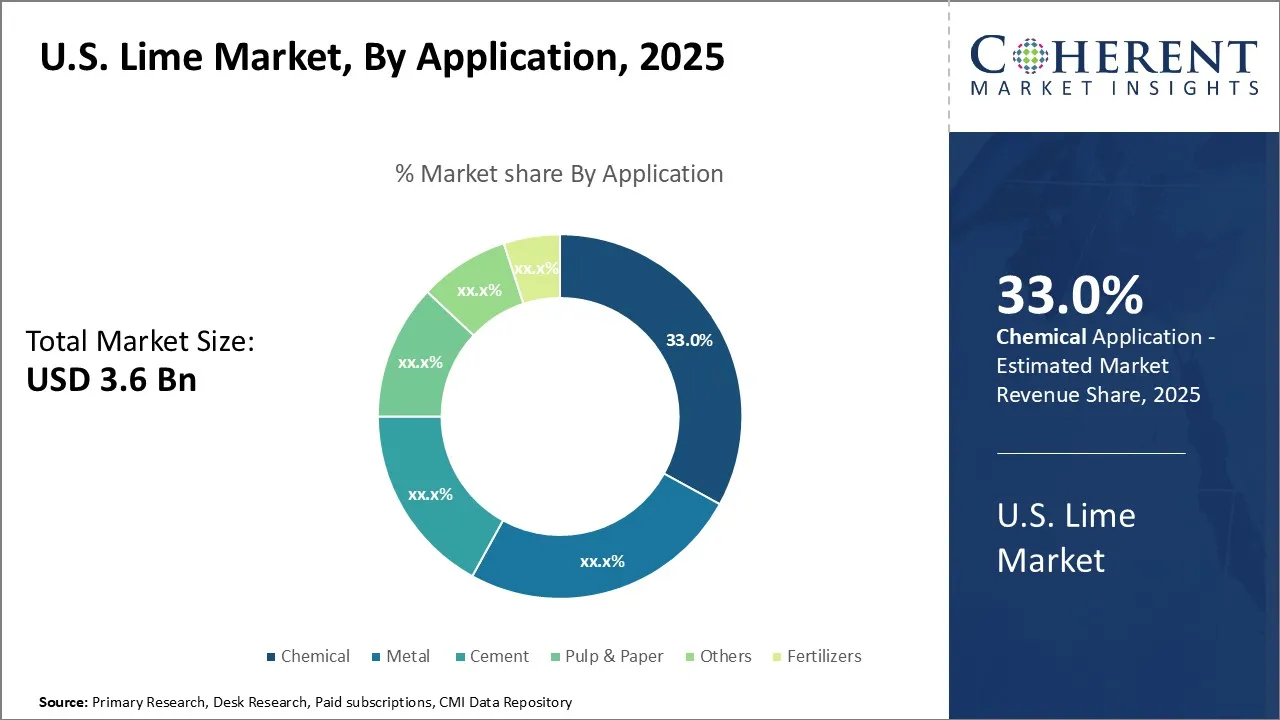
- By Application, the chemicals segment is projected to dominate the U.S. lime market with approximately 34% revenue share in 2026, driven by its extensive use in producing citric acid, polyols, and synthetic plasters.
Market Overview
The U.S. lime market is experiencing robust growth driven by its versatile applications across chemicals, metallurgy, cement, and environmental sectors. Key growth factors include increasing demand for lime in steel manufacturing to improve product quality by removing impurities, and its critical role in cement for early curing and enhanced bond strength. Additionally, rising environmental regulations are propelling lime use in air, water, and wastewater treatment.
Current Events and Its Impact on the Market
Event | Description and Impact |
Infrastructure Investment and Construction Activity |
|
Environmental Regulations and Sustainability Pressures |
|
Energy Sector Dynamics and Fuel Cost Volatility |
|
U.S. Lime Market Pricing Analysis
Premium Grade (Extra Fancy)
- Price Range: USD 28-45 per 40 lb box
- Size Classifications: 110s, 150s, 175s, 200s
- Primary Markets: High-end restaurants, premium retail chains
- Key Suppliers: Mission Produce, Calavo Growers, West Pak Avocado
Standard Grade (Fancy)
- Price Range: USD 20-35 per 40 lb box
- Volume Discounts: 5-10% for orders exceeding 500 boxes
- Target Customers: Mid-tier restaurants, conventional grocery chains
- Seasonal Variations: Prices peak during summer months (June-August)
Utility Grade
- Price Range: USD15-25 per 40 lb box
- Applications: Juice processing, industrial applications
- Quality Parameters: Slight cosmetic defects acceptable
- Volume Requirements: Typically sold in trailer loads (1,000+ boxes)
- Current Industry Events of 2026
- Market Size Estimation
- Regional Breakdown
- Competitive Landscape
- Customer Intelligence
- Segmental Analysis
- Pricing Analysis
- Key Market Drivers, Challenges & Future Trends
- Customized Insights Section
Segmental Insights
U.S. Lime Market Insights, By Application
In terms of application, the chemicals segment dominated the U.S. lime market with approximately 34% revenue share in 2026, driven by its extensive use in chemical manufacturing and industrial processes. Lime plays a crucial role in producing citric acid, polyvalent alcohols, and synthetic plasters, and serves as an essential reactant in chemical synthesis and pH regulation. Its versatility makes it indispensable across multiple chemical applications.
In the steel industry, lime is primarily used to remove impurities such as silica, phosphorus, and sulfur. By forming slag with these impurities, lime facilitates their removal, significantly enhancing steel quality. The metal sector holds a significant share, following chemicals, due to lime’s critical role in steel purification.
In cement applications, lime improves early curing of cementitious materials thanks to its high-water retention capacity. The resulting cement-lime mortar exhibits enhanced bond strength and low air content, contributing to durable construction materials. Cement is another major application segment in the market.
Additionally, lime is extensively utilized in pulp and paper mills, particularly in the sulfite-pulping process, where it aids in dissolving lignin to separate cellulose fibers. Environmental applications represent the fastest-growing segment, as lime is increasingly employed to meet stringent air, drinking water, wastewater, and solid waste treatment standards.
Other applications of lime include its use in metallurgy, building materials, and various chemical and industrial processes, underscoring its broad utility across diverse sectors.
Market Report Scope
U.S. Lime Market Report Coverage
| Report Coverage | Details | ||
|---|---|---|---|
| Base Year: | 2025 | Market Size in 2026: | USD 3.79 Bn |
| Historical Data for: | 2020 To 2024 | Forecast Period: | 2026 To 2033 |
| Forecast Period 2026 to 2033 CAGR: | 5.4% | 2033 Value Projection: | USD 5.44 Bn |
| Geographies covered: | U.S: Northeast, Midwest, South, Western | ||
| Segments covered: |
| ||
| Companies covered: | Carmeuse, The United States Lime & Minerals, Inc., Cheney Lime & Cement Company, Lhoist, Linwood Mining & Minerals, Pete Lien & Sons, Inc., Mississippi Lime Company, Graymont Limited, and Valley Minerals LLC | ||
| Growth Drivers: |
| ||
| Restraints & Challenges: |
| ||
Market Trends
- Popularity in the usage of lime in environmental applications
The rising trend of using lime in environmental applications such as wastewater treatment is expected to augment market growth. Moreover, the majority of industrialists in the country produced a large amount of wastewater that contain harmful chemicals and other product which are required to be treated before it disposes of in the environment.
Most metals are stabilized by lime by transforming them into more chemically stable forms that are less likely to leach. Furthermore, when applied to soil, lime can be a very efficient technique to harden debris and avoid future hazardous waste release. Thus, the growing demand for lime from the wastewater treatment industry is expected to augment the market growth.
- Growing use of precipitated calcium carbonate (PCC) in the polymer and pulp paper industry
Increase in the use of precipitated calcium carbonate (PCC) in the polymer and pulp paper industry is another major trend expected to foster market growth. Precipitated calcium carbonate is used as a filler and surface coating material in the paper industry for high grades paper products such as office paper and cigarette/tissue paper.
The use of calcium carbonate facilitates polymer extrusion while also lowering the cost. It improves the polymer's heat resistance, stiffness, and hardness. Moreover, manufacturers are focusing on introducing fine-grade lime to meet the rising demand from end-use industries in the region is expected to accelerate the market growth of the U.S. lime over the forecast period.
Drivers
- Rise in demand for lime in the production of precipitated calcium carbonate -
Growing demand for lime in the production of precipitated calcium carbonate is expected to serve as a major driving factor for the market of U.S. lime. As per the National Lime Association precipitated calcium carbonate (PCC) is an innovative product derived from lime. Paper, plastic, paint, rubber, and ink are just a few of the applications for precipitated calcium carbonate.
Furthermore, because to its high calcium content, precipitate calcium carbonate is utilised in the manufacture of calcium-based antacid formulations and multi-vitamin tablets. Due to its high calcium concentration, PCC may be used to create multivitamin/mineral pills and calcium supplements with large dosages. Precipitated calcium carbonate production utilizes the milk of lime process, which involves direct carbonation of hydrated lime slurry.
- Growth in the construction industry in the U.S.
Growth in the construction industry in the U.S. is propelling the market growth of lime in the region. Lime is commonly used in steel manufacturing. The main application of lime in construction is in soil stabilization for airfields, highways, earthen dams, and building foundations plus lime could be used with specific chemicals to make other metals, and it is also a crucial component in lime slurry mortar and plaster.
For instance, according to the associated general contractors of America, construction employment increases in 42 states and D.C. from May 2022 to May 2023, while 24 states add construction employees for the month. Therefore, growth in the construction industry of the U.S. is expected to accelerate the market growth of the overall U.S. lime market over the forecast period.
Market Opportunity
- Escalation in consumption of cement in the U.S.
A rise in the consumption of cement is expected to represent potential opportunities for the lime market. As the popularity of the construction business started to rise in the U.S., cement, which is considered one of the important factors for construction, also requires lime content. It can be seen that the percentage of lime in cement is 62 – 65%, i.e. approximately 60 – 67%.
Since lime mortar produced by lime aging has strong water retention, it may be used with cement mortar to increase mortar water retention and therefore facilitate building. According to the data from the U.S Energy Information Administration, the total energy consumption of the cement industry in 2022 was 406.9 trillion Btu.
- Growth in the pulp & paper industry
Increase in the pulp & paper industry in the U.S. country is expected to present lucrative growth opportunities to the market of the U.S. Lime. Lime can be used as a coagulant in color removal, an air conditioner, and, to a lesser extent, a neutralizing agent in the treatment of pulp and paper mill liquid wastes. It's also utilized to recover valuable by-products from pulp and paper mill trash. For instance, according to the United States Federal Reserve.
Historically, U.S. Producer Price Index by Commodity: Pulp, Paper, and Allied Products: Wood Pulp reached a record high of 222.30000. Therefore, the growing pulp and paper industry in the country is expected to augment the market growth of the U.S. lime over the forecast timeframe.
Recent Developments
- In June 2025, the United States established trade agreements with Thailand and Vietnam, expanding market access for fruit exporters, including lime producers. The agreements allow citrus fruits from Arizona, including limes, to be packaged in California facilities before export to Thailand, improving operational efficiency and market opportunities.
- In June 2025, Colombian Tahiti lime exporters are prioritizing the U.S. market due to high shipping costs and logistical challenges in reaching Europe. Favorable weather and increased plantings have boosted production, but Europe’s complex cold chain and phytosanitary requirements make the U.S. a more viable destination.
Market Segmentation
- U.S. Lime Market, By Product Type (Revenue, USD Bn, 2021 - 2033)
- Quick Lime
- Hydrated Lime
- U.S. Lime Market, By Application (Revenue, USD Bn, 2021 - 2033)
- Cement Manufacturing
- Metal Manufacturing
- Chemical
- Water Treatment
- Flue Gas
- Others
- Fertilizer
- Pulp & Paper
- Others
Regional Insights (Revenue, USD Bn, 2021 - 2033)
- North America
- U.S.
- Canada
- Latin America
- Brazil
- Argentina
- Mexico
- Rest of Latin America
- Europe
- Germany
- U.K.
- Spain
- France
- Italy
- Russia
- Rest of Europe
- Asia Pacific
- China
- India
- Japan
- Australia
- South Korea
- ASEAN
- Rest of Asia Pacific
- Middle East
- GCC Countries
- Israel
- Rest of Middle East
- Africa
- South Africa
- North Africa
- Central Africa
- North America
- Company Profiles
- Carmeuse
- The United States Lime & Minerals, Inc.
- Cheney Lime & Cement Company
- Lhoist
- Linwood Mining & Minerals
- Pete Lien & Sons, Inc.
- Mississippi Lime Company
- Graymont Limited
- Valley Minerals Llc
Sources
Primary Research Interviews
- Lime producers and manufacturers
- Construction industry executives
- Steel industry professionals
- Environmental compliance managers
- Others
Databases
- U.S. Geological Survey (USGS) Mineral Commodity Summaries
- IBISWorld Industry Research
- Bureau of Labor Statistics (BLS) Database
- Euromonitor International
- Others
Magazines
- Rock Products Magazine
- Pit & Quarry Magazine
- Aggregates Manager
- Construction Equipment Magazine
- Others
Journals
- Journal of Cleaner Production
- Cement and Concrete Research
- Industrial Minerals Magazine
- Others
Newspapers
- The Wall Street Journal
- Financial Times
- USA Today
- Chemical Week
- Others
Associations
- National Lime Association (NLA)
- American Chemistry Council (ACC)
- National Stone, Sand & Gravel Association (NSSGA)
- Portland Cement Association (PCA)
- Others
Public Domain Sources
- U.S. Census Bureau Manufacturing Reports
- Environmental Protection Agency (EPA) Publications
- Department of Energy Statistical Reports
- Federal Trade Commission Industry Reports
- Others
Proprietary Elements
- CMI Data Analytics Tool
- Proprietary CMI Existing Repository of information for last 8 years
*Definition: Lime is a calcium compound in the wastewater treatment process and is also used in the steel industry for removing which consists of calcium oxide and calcium hydroxide. It has a wide range of applications across construction, chemical, environmental, and metallurgical application. It is majorly used the impurities. Moreover, it is also used in the construction industry in the road, buildings, and dams where it is used to stabilize the soil.
Get access to 250+ pages report
Every segment, forecast, competitor profile and data table behind the analysis above — available for instant download.
- ESOMAR Member
- ISO 9001:2015 Certified
- D-U-N-S Registered
- GDPR & CCPA Compliant
Missing comfort of reading report in your local language? Find your preferred language:
Transform your Strategy with Exclusive Trending Reports
Frequently Asked Questions
The U.S. Lime Market size is estimated to be valued at USD 3.79 Bn in 2026, and is expected to reach USD 5.44 Bn by 2033.
The CAGR of the U.S. Market is projected to be 5.44% from 2026 to 2033.
Growth in the construction industry and mining industries in the country is fuelling the growth of the market in the region.
Rising trend of using lime in environmental applications such as wastewater treatment is expected to favor market growth over the forecast period.
Manufacturers face major challenges to store lime especially for major players and limited production of lime due to harsh weather conditions is expected to hamper the growth of the market during the forecast period.
Major players operating in the market include Carmeuse, The United States Lime & Minerals, Inc., Cheney Lime & Cement Company, Lhoist, Linwood Mining & Minerals, Pete Lien & Sons, Inc., Mississippi Lime Company, Graymont Limited, and Valley Minerals LLC.