

U.S. Ophthalmic Compounding Pharmacies Market Size and Forecast: 2026 - 2033
The U.S. Ophthalmic Compounding Pharmacies Market is estimated to be valued at USD 4.3 Bn in 2026 and is expected to reach USD 6.6 Bn by 2033, exhibiting a compound annual growth rate (CAGR) of 5.2% from 2026 to 2033.
Key Takeaways
- By Drug, Mitomycin hold the largest market share of 38.3% in 2026 owing to its increasing prevalence of ophthalmic conditions requiring mitomycin.
- By Formulation, Ointments expected to hold largest market share of 41.1% in 2026 owing to the growing need for personalized topical ophthalmic therapies.
- By Therapeutic Application, Cataracts acquired the prominent market share of 39.7% in 2026 owing to its aging population & higher cataract prevalence.
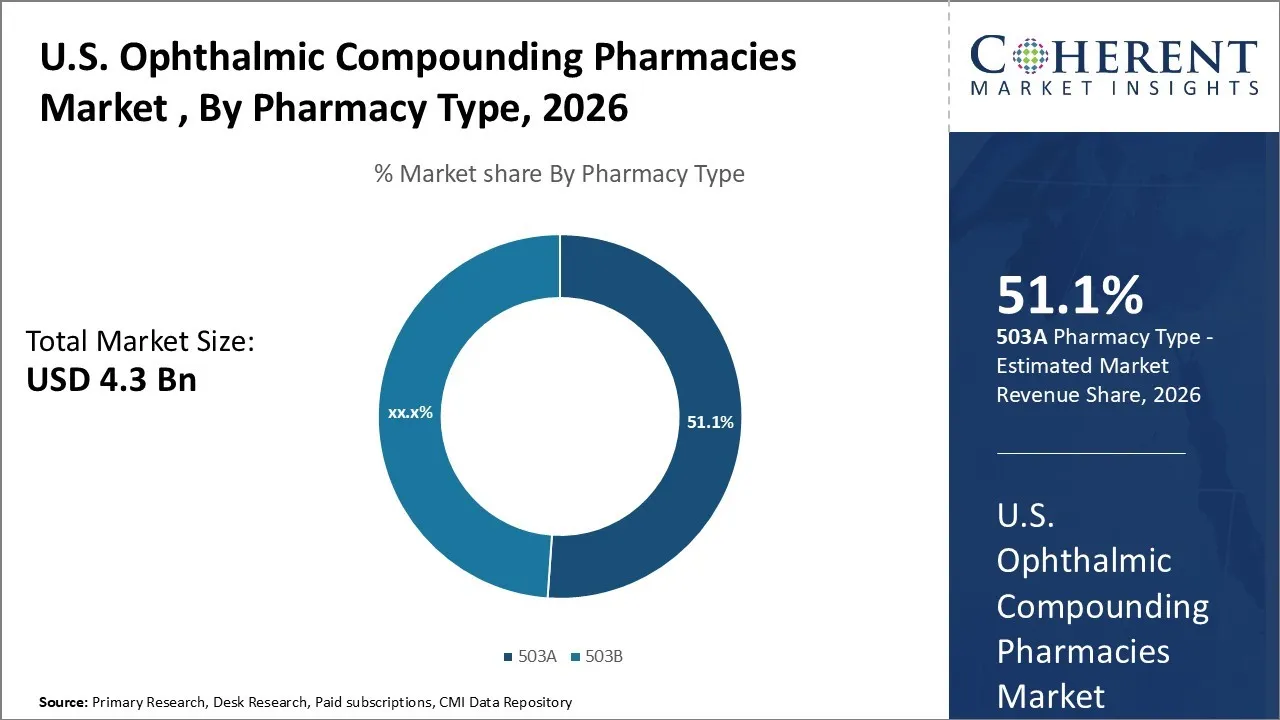
- By Pharmacy Type, 503A capture the largest market share of 51.1% in 2026 owing to the large market share in U.S. compounding.
Market Overview
U.S. ophthalmic compounding pharmacies prepare customized eye medications based on individual patient prescriptions. They formulate sterile compounded products such as eye drops, ointments, and perioperative solutions to treat glaucoma, dry eye, infections, and post-surgical inflammation. Growing demand for preservative-free formulations, combination therapies, and alternatives during drug shortages continues to support market expansion. Operating under 503A and 503B regulatory frameworks, these pharmacies actively supply ophthalmologists, ambulatory surgery centers, and hospitals across the country.
Current Events and their Impact on the U.S. Ophthalmic Compounding Pharmacies Market
Current Events | Description and its impact |
Regulatory and Policy Developments |
|
Technological Advances in Ophthalmic Drug Formulations |
|
Geopolitical and Public Health Events |
|
Segmental Insights
- Current Industry Events of 2026
- Market Size Estimation
- Regional Breakdown
- Competitive Landscape
- Customer Intelligence
- Segmental Analysis
- Pricing Analysis
- Key Market Drivers, Challenges & Future Trends
- Customized Insights Section
U.S. Ophthalmic Compounding Pharmacies Market Insights, By Pharmacy Type - 503A contribute the highest share of the market owing to its increasing prevalence of chronic diseases and aging population
503A capture the largest market share of 51.1% in 2026. Increasing demand for patient-specific, prescription-based medications is driving the growth of the 503A segment in the U.S. ophthalmic compounding market. Physicians turn to 503A pharmacies to provide customized ophthalmic formulations with unique dosages, concentrations, or preservative-free options. Shortages of commercially available drugs and growing awareness of personalized eye care further boost reliance on these providers. By employing advanced compounding techniques and maintaining strict quality standards, 503A pharmacies supply safe, effective, and tailored solutions that clinicians depend on for diverse ocular conditions.
U.S. Ophthalmic Compounding Pharmacies Market Insights, By Drug - Mitomycin contribute the highest share of the market owing to its drug shortages for standard ophthalmic medications
Mitomycin hold the largest market share of 38.3% in 2026. Increasing demand for specialized, patient-specific eye therapies is driving the growth of mitomycin in the U.S. ophthalmic compounding market. Clinicians turn to compounded solutions as more patients present with ocular disorders requiring anti-fibrotic or anti-proliferative intervention and need customized concentrations in sterile preparations. Shortages of commercially available formulations, along with growing physician awareness of personalized ophthalmic care, further promote its use. Compounding pharmacies employ advanced technology and strict sterile standards to make mitomycin a dependable option for specialized ocular treatments. For instance, in June 2025, UroGen Pharma Ltd., a biotech firm focused on urothelial and specialty cancers, announced that the FDA approved ZUSDURI, the first and only treatment for adults with recurrent LG-IR-NMIBC. ZUSDURI combines mitomycin with sterile hydrogel using UroGen’s proprietary RTGel sustained-release technology and is designed to provide effective tumor ablation.
U.S. Ophthalmic Compounding Pharmacies Market Insights, By Formulation - Ointments contribute the highest share of the market owing to its rising prevalence of eye conditions requiring compounded topicals
Ointments expected to hold largest market share of 41.1% in 2026. Rising needs for customized, patient-specific topical therapies are driving demand for ophthalmic ointments in the U.S. compounding market. Physicians turn to ointments to treat chronic eye conditions, support post-surgical care, and manage dry eye disorders, as these formulations provide sustained drug delivery. They increasingly prescribe personalized preparations to address allergies, sensitivities, or unique dosing requirements. Shortages of commercial products and greater awareness of preservative-free, tailored options prompt compounding pharmacies to use advanced techniques, delivering safe, effective, and patient-centered ophthalmic ointments. For instance, in February 2026, Lupin unveiled Clobetasol Propionate Ointment USP 0.05% after the FDA approved the product in the United States.
U.S. Ophthalmic Compounding Pharmacies Market Insights, By Therapeutic Application - Cataracts contribute the highest share of the market owing to its increased eye health awareness and screening
Cataracts acquired the prominent market share of 39.7% in 2026. Increasing numbers of patients needing surgical and post-surgical eye care are driving growth in the cataracts segment of the U.S. ophthalmic compounding market. Clinicians prescribe customized, prescription-based medications to manage inflammation, prevent infection, and support recovery, responding to the aging population and the rising prevalence of age-related eye disorders. When standard treatments cannot meet individual patient needs, physicians turn to compounded ophthalmic formulations. Growing awareness of personalized care and limited availability of certain commercial products further promote the use of these customized therapies for cataract management. For instance, in October 2025, Horizon Surgical Systems (Horizon), a robotics company transforming ophthalmic surgery with robotics and AI, announced that surgeons performed the world’s first cataract surgery using the Polaris™ platform.
U.S. Ophthalmic Compounding Pharmacies Market Trend
Shift Toward Personalized Ophthalmic Care
The market is increasingly moving toward patient-specific therapies, with compounding pharmacies offering customized eye drops, ointments, and injectables. Clinicians prioritize formulations tailored to individual conditions, sensitivities, and dosing requirements. This trend reflects broader healthcare personalization, as physicians aim to improve efficacy, reduce adverse reactions, and enhance patient satisfaction. The demand for customized ophthalmic medications continues to grow as patients and providers recognize the value of individualized treatment in managing complex or chronic eye disorders.
Rising Adoption of Sterile Compounding Technology
Advanced sterile compounding techniques are becoming standard across ophthalmic pharmacies. Investments in cleanroom facilities, automated preparation systems, and strict quality control protocols ensure the safety and reliability of compounded eye medications. This trend addresses clinician and patient concerns over contamination, dosing accuracy, and consistency. Pharmacies adopting such technology gain a competitive advantage, reinforcing trust in compounded formulations and supporting expansion into complex therapies such as mitomycin or post-surgical ocular treatments.
U.S. Ophthalmic Compounding Pharmacies Market Opportunity
Filling Gaps from Commercial Drug Shortages
Frequent shortages of commercially available ophthalmic drugs create a significant market opportunity for compounding pharmacies. By supplying medications that are unavailable or discontinued, including rare or niche formulations, pharmacies can establish reliability with physicians and healthcare providers. Addressing these supply gaps allows compounding pharmacies to strengthen relationships with clinicians, expand their market presence, and become a critical source for uninterrupted patient care in areas such as post-surgical therapy and chronic eye condition management.
Market Report Scope
U.S. Ophthalmic Compounding Pharmacies Market Report Coverage
| Report Coverage | Details | ||
|---|---|---|---|
| Base Year: | 2025 | Market Size in 2026: | USD 4.3 Bn |
| Historical Data for: | 2020 To 2024 | Forecast Period: | 2026 To 2033 |
| Forecast Period 2026 to 2033 CAGR: | 5.2% | 2033 Value Projection: | USD 6.6 Bn |
| Geographies covered: |
| ||
| Segments covered: |
| ||
| Companies covered: | Fagron Sterile Services US, New Drug Loft & VLS Pharmacy, Nora Apothecary, Lifecare Pharmacy, Avella Specialty Pharmacy, Triangle Compounding Pharmacy, O’Brien Pharmacy, Tache Pharmacy, Northmark Pharmacy, Edge Pharma, and ImprimisRx. | ||
| Growth Drivers: |
| ||
| Restraints & Challenges: |
| ||
U.S. Ophthalmic Compounding Pharmacies Market News
- In February 2026, Harrow, a top ophthalmic solutions provider, launched PharmaPack, a Direct-to-Prescriber cash-pay program delivering affordable FDA-approved branded products as alternatives to off-label compounded medications.
Analyst Opinion (Expert Opinion)
- The U.S. ophthalmic compounding pharmacy landscape exhibits structural demand rooted in gaps left by mainstream manufacturers, particularly for niche ophthalmic agents such as mitomycin and tailored ointment formulations. Specialty providers like Fagron Sterile Services and Nora Apothecary have secured share by addressing clinician demand for customized, preservative‑free compounds, especially for post‑surgical and chronic care where off‑the‑shelf drugs fail to meet therapeutic precision.
- 503A compounding plays a defining role, capturing the largest segment of prescriptions because it aligns with clinician requirements for individualized dosing and unique combinations, which are rarely available commercially. Data from sector reports confirm this dominance, with 503A pharmacies accounting for substantially higher revenue compared to 503B counterparts.
- Despite robust clinical demand, persistent regulatory scrutiny underscores systemic risk. The FDA’s recent focus on quality and safety—evident in increased inspections and surveys of compounding operations—signals heightened enforcement, particularly for sterile preparations that directly impact ophthalmic care.
- The market’s growth trajectory is further complicated by chronic and episodic drug shortages. Although compounded drugs have historically helped fill voids, recent legal and regulatory decisions restricting compounded versions of high‑profile therapies (e.g., semaglutide analogs) highlight emerging limitations to this dynamic.
Speak to the analyst
Want personalized insights?
Take the findings above to one of our principal consultants, or have the report rebuilt around the segments, geographies and competitors you actually track.
Market Segmentation
- By Drug
- Mitomycin
- Amphotericin
- Fluconazole
- Voriconazole
- Tropicamide
- Atropine Sulfate
- Albumin 5%
- Cyclosporine 0.5-2%
- Moxifloxacin
- Gentamicin
- Vancomycin
- Amikacin
- Tobramycin
- Tetracycline
- Metronidazole
- Acetylcysteine
- Bevacizumab
- Tacrolimus
- Retinoic Acid
- Carosine
- Latanoprost
- Dorzolamide
- Brimonidine
- Timolol
- Others
- By Formulation
- Eye Drops
- Ointments
- Injections
- Others
- By Therapeutic Application
- Dry Eyes
- Glaucoma
- Cataracts
- Conjunctivitis
- Age-related Macular Degeneration
- Uveitis (Eye Inflammation)
- Others
- By Pharmacy Type
- 503A
- 503B
- Key Players Insights
- Fagron Sterile Services US
- New Drug Loft & VLS Pharmacy
- Nora Apothecary
- Lifecare Pharmacy
- Avella Specialty Pharmacy
- Triangle Compounding Pharmacy
- O’Brien Pharmacy
- Tache Pharmacy
- Northmark Pharmacy
- Edge Pharma
- ImprimisRx.
Sources
Primary Research interviews
- Ophthalmologists specializing in glaucoma, cataracts, and corneal disorders
- Pharmacists from 503A and 503B compounding pharmacies
- Hospital and clinic procurement managers for ophthalmic medications
- Regulatory affairs experts in FDA compliance for sterile ophthalmic compounding
Databases
- U.S. Food and Drug Administration (FDA) Drug Shortages Database
- National Institutes of Health (NIH) PubMed database
- ClinicalTrials.gov for ophthalmic drug trials
- U.S. National Library of Medicine
Magazines
- Ophthalmology Times
- Review of Ophthalmology
- American Pharmacy News
Journals
- Journal of Cataract & Refractive Surgery
- American Journal of Ophthalmology
- Clinical Ophthalmology
- Journal of Ocular Pharmacology and Therapeutics
Newspapers
- The New York Times – Health Section
- The Washington Post – Health and Science
- Los Angeles Times – Medical News
Associations
- American Academy of Ophthalmology (AAO)
- American Pharmacists Association (APhA)
- Association for Research in Vision and Ophthalmology (ARVO)
- U.S. Pharmacopeia (USP)
Public Domain sources
- U.S. Census Bureau population and aging statistics
- Centers for Disease Control and Prevention (CDC) vision health reports
- National Eye Institute (NEI) publications
- FDA guidance documents on ophthalmic compounding
Proprietary Elements
- CMI Data Analytics Tool
- Proprietary CMI Existing Repository of information for last 8 years
Get access to 250+ pages report
Every segment, forecast, competitor profile and data table behind the analysis above — available for instant download.
- ESOMAR Member
- ISO 9001:2015 Certified
- D-U-N-S Registered
- GDPR & CCPA Compliant
Missing comfort of reading report in your local language? Find your preferred language:
Transform your Strategy with Exclusive Trending Reports
Frequently Asked Questions
The U.S. Ophthalmic Compounding Pharmacies Market is estimated to be valued at USD 4.3 Bn in 2026 and is expected to reach USD 6.6 Bn by 2033.
Factors such as increasing drug shortage in the U.S., increasing geriatric population and improved longevity due to customized medicines, and increasing eye disorders in the U.S. are expected to drive the growth of the market during forecast period.
Mitomycin segment is the leading drug segment in the market.
The major factors hampering growth of the market include product recalls and issues related to safety standards of ophthalmic compounded drugs.
Major players operating in the market include Fagron Sterile Services US, New Drug Loft & VLS Pharmacy, Nora Apothecary, Lifecare Pharmacy, Avella Specialty Pharmacy, Triangle Compounding Pharmacy, O’Brien Pharmacy, Tache Pharmacy, Northmark Pharmacy, Edge Pharma, and ImprimisRx