

U.S. P2Y12 Inhibitors Market Size and Forecast – 2026 to 2033
The U.S. P2Y12 Inhibitors Market is estimated to be valued at USD 23.7 Bn in 2026 and is expected to reach USD 38.3 Bn by 2033, exhibiting a compound annual growth rate (CAGR) of 8.6% from 2026 to 2033.
Key Takeaways
- By Drug, Clopidogrel hold the largest market share of 36.8% in 2026 owing to its rising prevalence of cardiovascular diseases (CVD).
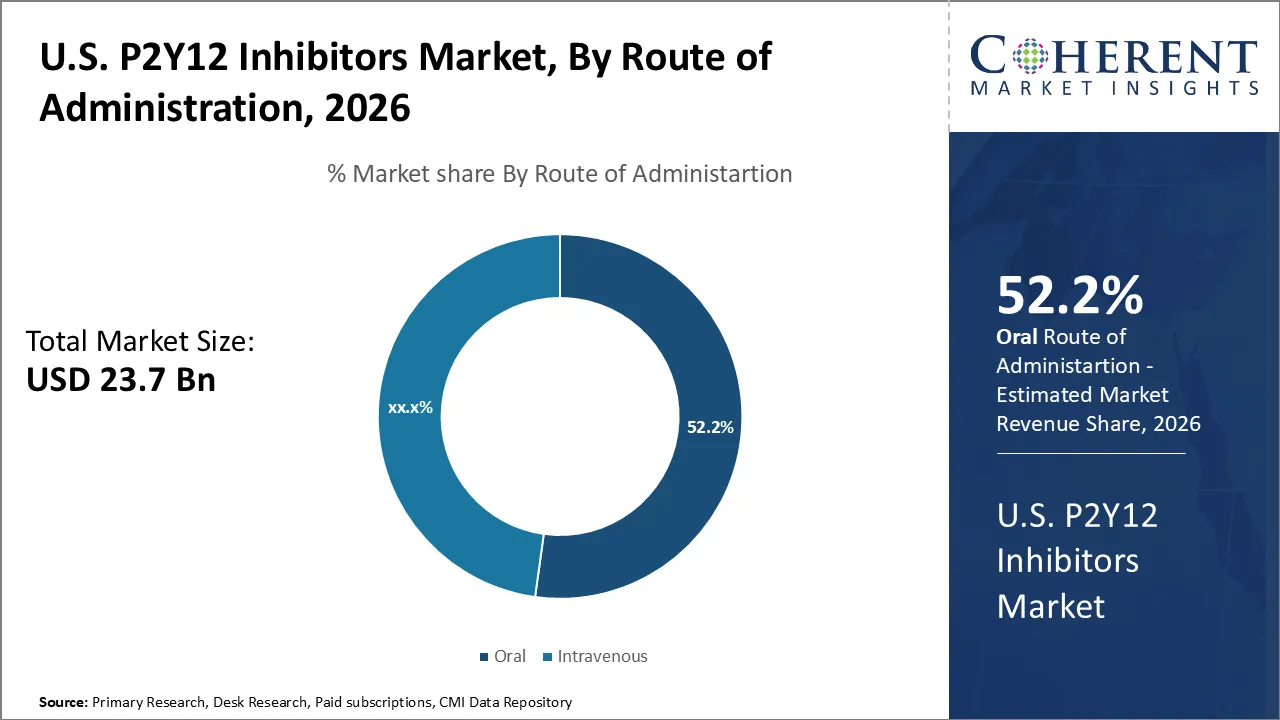
- By Route of Administration, Oral expected to hold the largest market share of 52.2% in 2026 owing to the standard use in dual antiplatelet therapy.
- By Application, Angioplasty acquired the prominent market share of 36.6% in 2026 owing to the increasing number of percutaneous coronary interventions.
- By Distribution Channel, Hospital Pharmacies capture the largest market share of 35.7% in 2026 owing to its increasing hospital admissions for acute coronary syndromes.
Market Overview
The U.S. P2Y12 inhibitors market grows as cardiovascular diseases become more prevalent, hospitals treat increasing numbers of acute coronary syndrome patients, and healthcare providers perform more percutaneous coronary interventions. Patients and physicians rely on oral agents like clopidogrel, ticagrelor, and prasugrel for their convenience, suitability for long-term therapy, and adherence to dual antiplatelet therapy guidelines. Hospital pharmacies actively distribute these drugs, while generics make them more affordable. Advances in stent technology, an aging population, and preventive cardiovascular care continue to drive consistent demand in both outpatient and inpatient settings.
Current Events and their Impact on the U.S. P2Y12 Inhibitors Market
Current Events | Description and its impact |
Regulatory and Policy Developments |
|
Technological Advancements in Drug Development |
|
Geopolitical and Trade Factors |
|
Segmental Insights
- Current Industry Events of 2026
- Market Size Estimation
- Regional Breakdown
- Competitive Landscape
- Customer Intelligence
- Segmental Analysis
- Pricing Analysis
- Key Market Drivers, Challenges & Future Trends
- Customized Insights Section
U.S. P2Y12 Inhibitors Market Insights, By Route of Administration: Oral contributes the highest share of the market owing to its growth in percutaneous coronary interventions.
Oral expected to hold the largest market share of 52.2% in 2026. The oral segment drives the U.S. P2Y12 inhibitors market as patients and physicians choose it for its convenience and suitability for long-term antiplatelet therapy. Clinicians prescribe drugs like clopidogrel, ticagrelor, and prasugrel to manage dual antiplatelet therapy effectively after acute coronary events and stent placement. Hospitals start the treatment, and patients continue it at home, maintaining steady demand. Affordable generics improve access, while newer oral agents gain adoption for their fast action and strong platelet inhibition, keeping oral formulations central to cardiovascular care. For instance, Atherosclerotic plaque rupture can trigger intravascular thrombosis, which reduces or blocks arterial blood flow and can cause stroke, acute coronary syndromes, or limb ischemia depending on the affected vessel. Clinicians commonly use dual antiplatelet therapy (DAPT) with aspirin and a P2Y12 inhibitor to treat acute coronary syndromes, percutaneous interventions, peripheral vascular disease, and acute stroke.
U.S. P2Y12 Inhibitors Market Insights, By Drug: Clopidogrel contribute the highest share of the market owing to its generic availability and cost advantage.
Clopidogrel hold the largest market share of 36.8% in 2026. Clopidogrel drives the U.S. P2Y12 inhibitors market as clinicians widely prescribe it to prevent thrombotic events in patients with coronary artery disease, stroke, and peripheral vascular conditions. Physicians rely on its well-established safety and proven effectiveness in dual antiplatelet therapy following stent placement. Affordable generic versions increase patient access, and hospitals and outpatient clinics consistently administer it. By supporting long-term cardiovascular care, clopidogrel maintains robust and steady demand across the market.
U.S. P2Y12 Inhibitors Market Insights, By Application: Angioplasty contribute the highest share of the market owing to its mandatory use of dual antiplatelet therapy (DAPT) after stenting.
Angioplasty acquired the prominent market share of 36.6% in 2026. The increasing number of angioplasty procedures drives the U.S. P2Y12 inhibitors market as physicians prescribe antiplatelet therapy to prevent stent thrombosis and recurrent cardiovascular events. Clinicians administer clopidogrel, ticagrelor, or prasugrel before and after percutaneous coronary interventions to ensure effective platelet inhibition. Expanding access to interventional cardiology and advancements in stent technology boost procedure volumes, while hospitals actively manage therapy during inpatient care.
U.S. P2Y12 Inhibitors Market Insights, By Distribution Channel: Hospital Pharmacies contribute the highest share of the market owing to its guideline-driven inpatient treatment protocols.
Hospital Pharmacies capture the largest market share of 35.7% in 2026. Hospital pharmacies drive the U.S. P2Y12 inhibitors market by providing timely antiplatelet therapy to patients with acute coronary syndromes and those undergoing percutaneous coronary interventions. Physicians start treatment in hospital settings, and pharmacy teams actively manage dosing, monitor safety, and maintain drug supply. By offering both intravenous and oral formulations, hospitals deliver care for emergencies and long-term therapy. Through efficient distribution, strict adherence to clinical protocols, and integration into inpatient management, hospital pharmacies sustain strong and consistent demand for P2Y12 inhibitors.
End-User Feedback and Unmet Needs in the U.S. P2Y12 Inhibitors Market
- Patient Adherence Challenges: Patients report difficulty maintaining long-term dual antiplatelet therapy due to daily dosing requirements, side effects such as bleeding, and complex medication schedules. Improved patient support, simplified regimens, and clear guidance on managing side effects are needed to enhance adherence and ensure better therapeutic outcomes.
- Safety and Bleeding Concerns: Physicians and patients express concern over bleeding risks associated with P2Y12 inhibitors, particularly in elderly or comorbid populations. There is an unmet need for therapies that balance potent platelet inhibition with a lower bleeding profile to optimize safety without compromising efficacy.
- Limited Personalized Therapy Options: Current P2Y12 inhibitors offer limited personalization based on genetic variations, platelet response, or comorbidities. End-users seek more tailored treatment options, including rapid-acting agents or dose-adjusted therapies, to improve efficacy, minimize adverse effects, and address variability in patient response.
U.S. P2Y12 Inhibitors Market Trend
Shift Toward Newer Oral Agents
Physicians increasingly favor ticagrelor and prasugrel over clopidogrel in high-risk acute coronary syndrome patients due to their faster onset and stronger platelet inhibition. This trend reflects growing adoption of guideline-recommended therapies that improve clinical outcomes. Hospitals and outpatient providers are gradually transitioning patients to these newer agents while balancing cost considerations, safety monitoring, and long-term therapy management, supporting a gradual evolution in the oral P2Y12 inhibitor landscape.
Integration with Percutaneous Coronary Interventions
P2Y12 inhibitors continue to see strong use alongside percutaneous coronary interventions and drug-eluting stent procedures. Clinicians emphasize peri-procedural optimization, combining antiplatelet therapy with advanced interventional techniques. This integration supports reduced stent thrombosis and recurrent ischemic events, reinforcing hospital reliance on these drugs. The trend also drives demand for intravenous formulations like cangrelor during acute interventions, while maintaining oral therapy continuity post-discharge.
U.S. P2Y12 Inhibitors Market Opportunity
Expansion in Hospital and Specialty Pharmacy Channels
As hospital and specialty pharmacies remain central to drug distribution, opportunities exist to strengthen supply chains, improve inventory management, and provide training for clinical staff. Enhanced hospital engagement ensures rapid drug availability for acute coronary events, supports post-procedural adherence, and reinforces therapy continuity. Manufacturers can partner with hospitals to optimize drug utilization, integrate clinical decision support, and offer specialized services, driving broader adoption and consistent market growth.
Market Report Scope
U.S. P2Y12 Inhibitors Market Report Coverage
| Report Coverage | Details | ||
|---|---|---|---|
| Base Year: | 2025 | Market Size in 2026: | USD 23.7 Bn |
| Historical Data for: | 2020 To 2024 | Forecast Period: | 2026 To 2033 |
| Forecast Period 2026 to 2033 CAGR: | 8.6% | 2033 Value Projection: | USD 38.3 Bn |
| Geographies covered: |
| ||
| Segments covered: |
| ||
| Companies covered: | Mylan N.V., Bristol-Myers Squibb, Dr Reddy's Laboratories, Teva Pharmaceuticals USA, Inc., AstraZeneca, Genentech, Eli Lilly and Company, Panacea Biotec, CHIESI USA, Inc., Lupin, Cipla, and Biocon. | ||
| Growth Drivers: |
| ||
| Restraints & Challenges: |
| ||
U.S. P2Y12 Inhibitors Market News
In March 2025, Inari Medical, now part of Stryker, launched the Artix Thrombectomy System, a combined aspiration and mechanical thrombectomy solution designed for the peripheral arterial system to enhance procedural control and versatility.
Analyst Opinion (Expert Opinion)
- The current trajectory of the U.S. P2Y12 inhibitors market reflects a persistent tension between clinical evidence, guideline indoctrination, and entrenched prescribing habits. Despite robust guideline recommendations advocating potent agents such as ticagrelor and prasugrel over clopidogrel for acute coronary syndrome (ACS) patients undergoing percutaneous coronary intervention (PCI), real‑world utilization patterns tell a more nuanced story. Analysis of nationally representative data through 2022 shows that clopidogrel remains a dominant prescription, used in more than half of ACS cases overall, with ticagrelor and prasugrel accounting for the remainder, and substantial variation by clinical presentation – ticagrelor leading in STEMI while prasugrel adoption remains modest, especially in non–ST‑elevation ACS.
- It would be remiss to ignore powerful registry evidence demonstrating that potent P2Y12 inhibitors confer significant reductions in mortality and major adverse cardiovascular events compared with clopidogrel, especially in high‑risk subgroups such as diabetics. The strong differential in efficacy, consistently reproduced across large observational cohorts, should theoretically drive deeper penetration of ticagrelor and prasugrel. Yet adoption plateaus and slow uptake beyond early adopters reveal structural challenges in translating evidence into practice: fragmented care pathways, heterogeneous payer coverage, and persistent clinician concerns regarding bleeding risk in elderly or comorbid patients consistently blunt market momentum toward newer agents.
- Importantly, disparities in utilization by insurance status, gender, and ethnicity in U.S. cohorts signal that the P2Y12 inhibitor landscape is not merely about therapeutic choice but also access and equity. Patients without private insurance are statistically more likely to be discharged on clopidogrel than potent alternatives, a pattern that has survived successive guideline updates. This underscores a critical market insight: barrier reduction – whether financial, educational, or systemic – is central to any meaningful shift in prescribing dynamics.
Speak to the analyst
Want personalized insights?
Take the findings above to one of our principal consultants, or have the report rebuilt around the segments, geographies and competitors you actually track.
Market Segmentation
- By Drug
- Clopidogrel
- Ticlopidine
- Ticagrelor
- Prasugrel
- Cangrelor
- Others
- By Route of Administration
- Oral
- Intravenous
- By Application
- Angioplasty
- Arterial Thrombosis
- Percutaneous Coronary Interventions
- Myocardial Infarction
- Others
- By Distribution Channel
- Hospital Pharmacies
- Retail Pharmacies
- Online Pharmacies
- Key Players Insights
- Mylan N.V.
- Bristol-Myers Squibb
- Dr Reddy's Laboratories
- Teva Pharmaceuticals USA, Inc.
- AstraZeneca
- Genentech
- Eli Lilly and Company
- Panacea Biotec
- CHIESI USA, Inc.
- Lupin
- Cipla
- Biocon
Sources
Primary Research interviews
- Cardiologists and hematologists in leading U.S. hospitals
- Interventional cardiology specialists
- Pharmacy directors at major hospital networks
- Clinical trial investigators for P2Y12 inhibitor therapies
- Medical affairs and regulatory professionals in pharmaceutical companies
Databases
- PubMed
- ClinicalTrials.gov
- FDA Drug Database
- Centers for Medicare & Medicaid Services (CMS) data
- American Hospital Association (AHA) database
Magazines
- MedPage Today
- Cardiology Today
- Pharmacy Times
- Drug Topics
Journals
- Journal of the American College of Cardiology (JACC)
- Circulation
- American Heart Journal
- Thrombosis and Haemostasis
- European Heart Journal – Cardiovascular Pharmacotherapy
Newspapers
- The New York Times – Health Section
- The Washington Post – Health & Science
- Wall Street Journal – Health & Medicine
Associations
- American Heart Association (AHA)
- American College of Cardiology (ACC)
- Society for Cardiovascular Angiography & Interventions (SCAI)
- National Institutes of Health (NIH) – cardiovascular studies
Public Domain sources
- FDA drug approval announcements and labeling
- NIH National Library of Medicine
- CDC Heart Disease & Stroke Statistics
- Medicare & Medicaid public datasets
Proprietary Elements
- CMI Data Analytics Tool
- Proprietary CMI Existing Repository of information for last 8 years
Get access to 250+ pages report
Every segment, forecast, competitor profile and data table behind the analysis above — available for instant download.
- ESOMAR Member
- ISO 9001:2015 Certified
- D-U-N-S Registered
- GDPR & CCPA Compliant
Missing comfort of reading report in your local language? Find your preferred language:
Transform your Strategy with Exclusive Trending Reports
Frequently Asked Questions
The U.S. P2Y12 Inhibitors Market is estimated to be valued at USD 23.7 Bn in 2026 and is expected to reach USD 38.3 Bn by 2033.
The U.S. P2Y12 Inhibitors Market is estimated to be valued at USD 23.7 Bn in 2026 and is expected to reach USD 38.3 Bn by 2033, exhibiting a compound annual growth rate (CAGR) of 8.6%.
The rising incidence of cardiovascular diseases and increasing product approvals is expected to drive the market growth during the forecast period.
Clopidogrel segment is expected to hold a major market share in the market over the forecast period.
The major factors hampering growth of the market include potential side effects of drugs.
Major players operating in the market include Mylan N.V., Bristol-Myers Squibb, Dr Reddy's Laboratories, Teva Pharmaceuticals USA, Inc., AstraZeneca, Genentech, Eli Lilly and Company, Panacea Biotec, CHIESI USA, Inc., Lupin, Cipla, and Biocon.