

U.S. Speech Therapy Market Size and Forecast 2026-2033
The U.S. Speech Therapy Market is estimated to be valued at USD 5.72 Billion in 2026 and is expected to reach USD 9.94 Billion by 2033, exhibiting a compound annual growth rate (CAGR) of 8.2% from 2026 to 2033.
Key Takeaways of the U.S. Speech Therapy Market
- In terms of age group, the adults segment is estimated to hold the highest share of 67.5% in 2026.
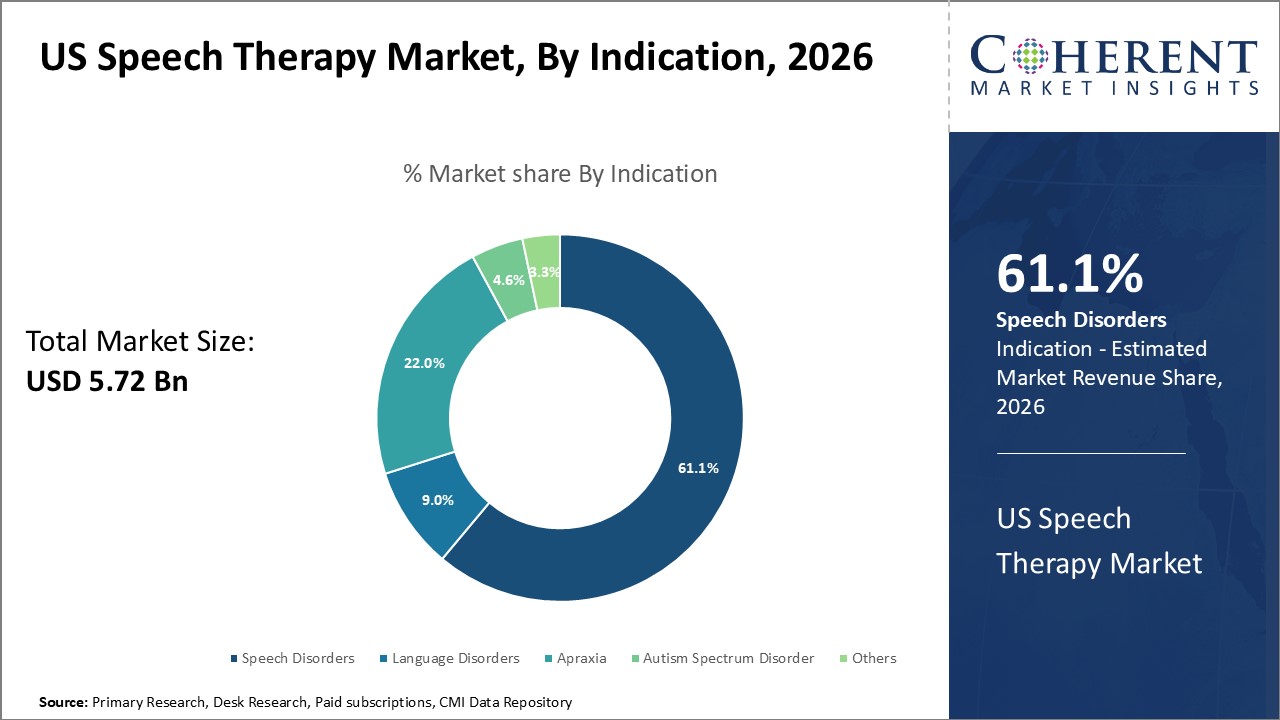
- In terms of indication, the speech disorders segment is estimated to hold the highest share of 61.1% in 2026.
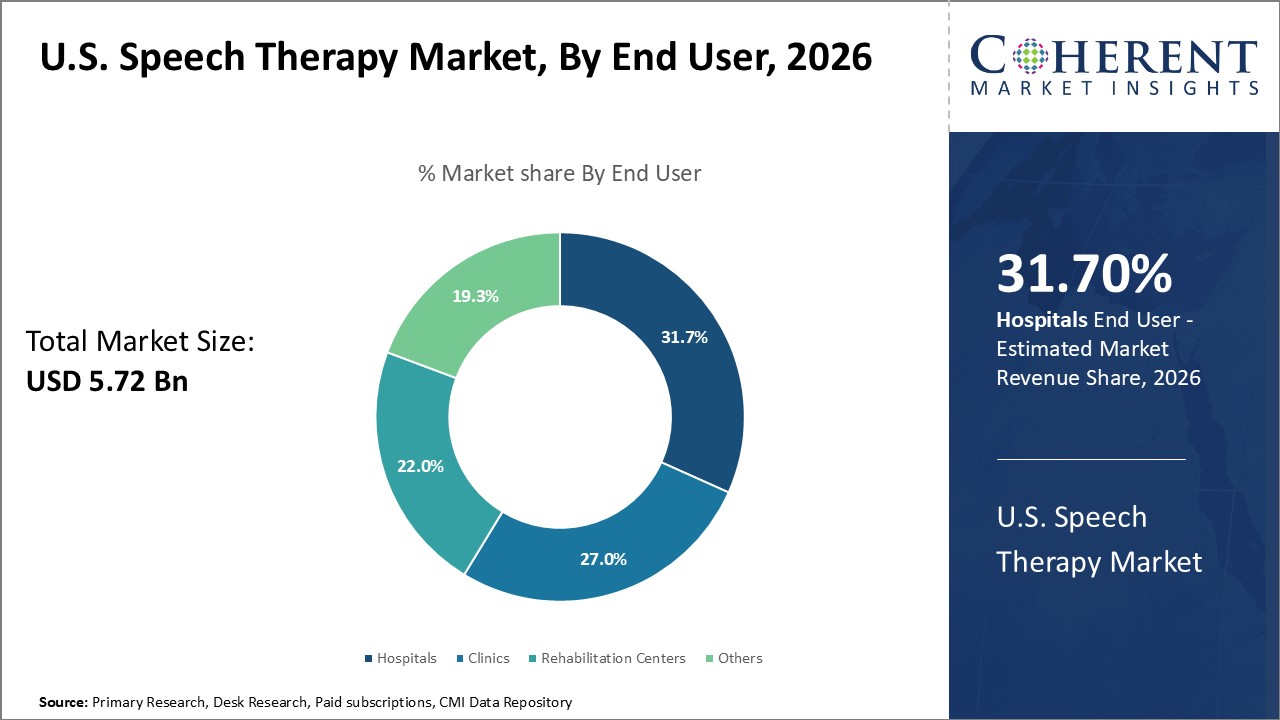
- In terms of end user, the hospitals segment is estimated to hold the highest share of 30. 71% in 2026.
Market Overview
The rising prevalence of communicative and speech disorders among individuals has been driving the market growth. Moreover, the increasing incidence of neurological conditions and accidents resulting in speech impairments has also augmented the need for speech therapy.
The growing geriatric population, who are more prone to conditions like dementia and Parkinson's disease, further leading to difficulties in communication, is also fueling the demand for speech therapists. Various technological advancements in speech therapy solutions aiming to provide more effective and convenient treatments are further expected to drive the market growth during the forecast period.
Market Concentration and Competitive Landscape
Impact of AI on the U.S. Speech Therapy Market
AI tools are supporting speech-language pathologists (SLPs) by analyzing speech, creating personalized therapy plans, and streamlining tasks like progress tracking. This allows SLPs to focus more on direct patient interaction.
- Companies are launching AI-driven apps that offer interactive therapy and diagnostic devices that significantly cut down assessment times. These tools adapt to patient progress and provide data for better treatment adjustments.
- The integration of AI is addressing therapist shortages and improving access to quality speech therapy, especially through enhanced teletherapy. As AI matures, it's set to revolutionize the U.S. speech therapy market, making care more widely available.
- Current Industry Events of 2026
- Market Size Estimation
- Regional Breakdown
- Competitive Landscape
- Customer Intelligence
- Segmental Analysis
- Pricing Analysis
- Key Market Drivers, Challenges & Future Trends
- Customized Insights Section
Current Events and their Impact on the U.S. Speech Therapy Market
Current Events | Description and its impact |
Regulatory and Reimbursement Policy Changes |
|
Telehealth Infrastructure Expansion |
|
Industry Trends
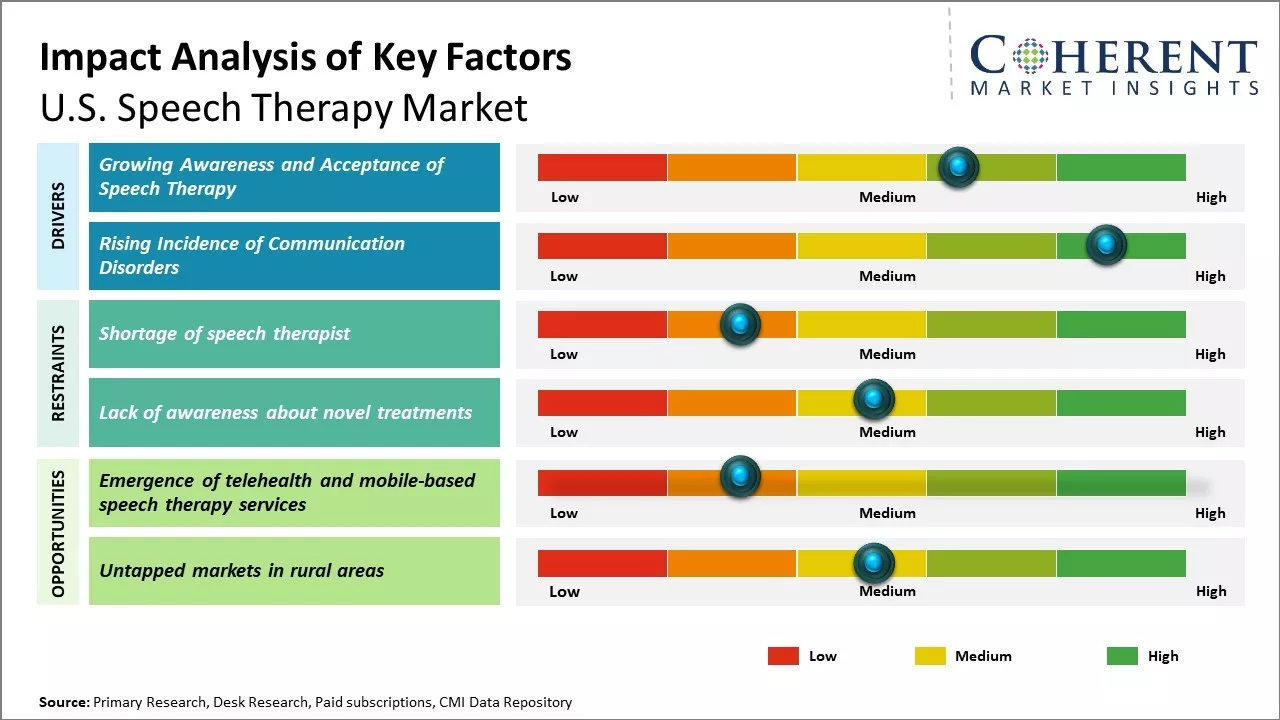
Rising Incidence of Communication Disorders
The prevalence of communication disorders is rising, driven by factors like increased life expectancy and environmental influences. These disorders, common across all age groups but especially in children and the elderly, include issues with speech, language, voice, and hearing.
For instance, many individuals experiencing long COVID-19 symptoms also report related communication challenges, such as voice changes and difficulty with language processing. This trend, combined with favorable reimbursement for speech-language pathology in the U.S., is boosting the demand for therapy services.
Growing Awareness and Acceptance of Speech Therapy
Awareness and acceptance of speech therapy have significantly increased due to the efforts of professionals, advocacy groups, and educational programs. Communication disorders are now recognized as treatable medical conditions, and the stigma around seeking help has lessened.
Multidisciplinary therapy approaches have proven effective, and the internet has made reliable healthcare information and therapist reviews readily accessible. Telepractice has further expanded access to services, ensuring continuity and broader reach for practitioners.
Market Opportunity: The emergence of telehealth and mobile-based speech therapy
The rise of telehealth and mobile speech therapy presents significant growth avenues in the U.S. market, a trend greatly accelerated by the COVID-19 pandemic's push for virtual healthcare. Recognizing its convenience, flexibility, and comparable efficacy to in-person sessions, both patients and providers are embracing this shift. Speech therapy, inherently suited for remote delivery, effectively leverages video conferencing and mobile apps for demonstrations, feedback, and between-session practice.
For example, a speech-language pathologist can effectively guide a client through articulation drills via video call, providing real-time feedback and assigning app-based practice exercises, making therapy more accessible and continuous.
Segmental Analysis
U.S. Speech Therapy Market Insights by Indication
In terms of indication, the speech disorders segment is estimated to hold the highest share of 61.1% in 2026, due to its high prevalence rates. Speech disorders refer to impairments in the ability to produce sounds, syllables, words, and phrases, which are the building blocks of speech.
The social stigma and personal frustration associated with communication difficulties can also drive increased demand for services addressing these conditions. As a result, demand will remain concentrated within the speech disorders indication segment, given its widespread impact on individuals.
U.S. Speech Therapy Market Insights by End User
In terms of end user, the hospitals segment is estimated to hold the highest share of 31.7% in 2026, due to convenient access and multi-disciplinary treatment capabilities. Many patients undergo surgery, injury rehabilitation, or treatment for diseases and disorders where speech abilities are impacted as a secondary condition.
For cases requiring team-based, coordinated care, hospitals can facilitate the involvement of multiple professionals like physicians, physical therapists, and occupational therapists alongside speech treatment. Their dominance in the market reflects hospitals' advantages in providing comprehensive, accessible care for a variety of indications necessitating speech rehabilitation.
Market Report Scope
U.S. Speech Therapy Market Report Coverage
| Report Coverage | Details | ||
|---|---|---|---|
| Base Year: | 2025 | Market Size in 2026: | USD 5.72 Bn |
| Historical Data for: | 2020 To 2024 | Forecast Period: | 2026 To 2033 |
| Forecast Period 2026 to 2033 CAGR: | 8.2% | 2033 Value Projection: | USD 9.94 Bn |
| Geographies covered: |
| ||
| Segments covered: |
| ||
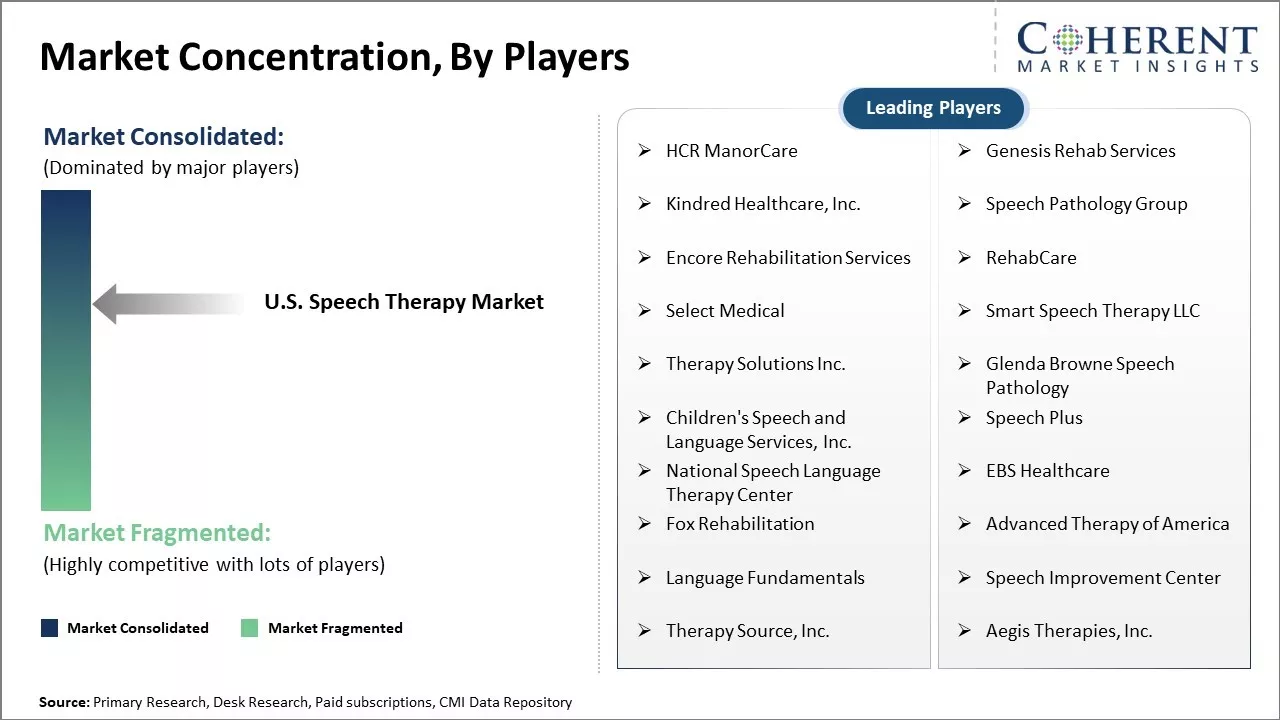
| Companies covered: | HCR ManorCare, Genesis Rehab Services, Kindred Healthcare, Inc., Speech Pathology Group, Encore Rehabilitation Services, RehabCare, Select Medical, Smart Speech Therapy LLC, Therapy Solutions Inc., Glenda Browne Speech Pathology, Children's Speech and Language Services, Inc., Speech Plus, National Speech Language Therapy Center, EBS Healthcare, Fox Rehabilitation, Advanced Therapy of America, Language Fundamentals, Speech Improvement Center, Therapy Source, Inc., and Aegis Therapies, Inc. | ||
| Growth Drivers: |
| ||
| Restraints & Challenges: |
| ||
U.S. Speech Therapy Industry News
- In 2024, Vanderbilt Data Science, in collaboration with experts like Dr. Matthew Pontell, explored the potential of generative AI to enhance speech therapy.
- In April 2023, Great Speech, a virtual speech therapy company, introduced voice therapy services tailored to specific genders, alongside specialized training for speech-language specialists. The training was led by seasoned speech-language therapists with expertise in working with non-binary and transgender individuals, supplemented by insights from a speech-language therapist who has transitioned to align with her gender.
Analyst View
- The market is fundamentally strong, underpinned by demographic shifts like an aging population and increasing childhood developmental disorders, creating a sustained demand for rehabilitation services.
- Growth is significantly constrained by affordability issues, including inadequate insurance coverage and high treatment costs, exacerbated by a critical shortage of qualified therapists, particularly in underserved rural areas.
- The clear path forward involves aggressively leveraging telehealth and developing innovative, affordable at-home therapy solutions. Strategic partnerships are crucial for optimizing early intervention and expanding overall market reach.
Macro-Economic Factors Impacting the U.S. Speech Therapy Market
Demographic Shifts and Disease Prevalence
- The aging U.S. population and the rising incidence of neurodevelopmental disorders are key drivers of demand for speech therapy services. In 2023, approximately 1 in 12 children (8%) aged 3–17 were reported to have speech disorders, underscoring the growing need for pediatric speech-language services.
- By 2030, an estimated 20% of the U.S. population will be over the age of 65, leading to a significant increase in demand for speech therapy related to stroke recovery, dementia, and other age-associated conditions.
Emerging Applications Areas in the U.S. Speech Therapy Market
Novel applications, like neurostimulation-augmented therapy for disorders such as Primary Progressive Aphasia, are emerging but remain largely underutilized in clinical practice, showing promise for enhanced neural plasticity.
- Advanced AI-driven real-time speech analytics can dynamically adjust therapy plans during sessions, a capability currently leveraged by only a few providers despite its potential to personalize treatment.
- Future innovations include predictive speech pathology using AI to identify disorders early from vocal patterns and wearable biofeedback systems providing tactile feedback for rehabilitation, promising more effective and preventative interventions.
Market Segmentation
- Age Group Insights (Revenue, USD Bn, 2021 - 2033)
- Children
- Adults
- Indication Insights (Revenue, USD Bn, 2021 - 2033)
- Speech Disorders
- Language Disorders
- Apraxia
- Autism Spectrum Disorder (ASD)
- Others
- End User Insights (Revenue, USD Bn, 2021 - 2033)
- Hospitals
- Clinics
- Rehabilitation Centers
- Others
- Key Players Insights
- HCR ManorCare
- Genesis Rehab Services
- Kindred Healthcare, Inc.
- Speech Pathology Group
- Encore Rehabilitation Services
- RehabCare
- Select Medical
- Smart Speech Therapy LLC
- Therapy Solutions Inc.
- Glenda Browne Speech Pathology
- Children's Speech and Language Services, Inc.
- Speech Plus
- National Speech Language Therapy Center
- EBS Healthcare
- Fox Rehabilitation
- Advanced Therapy of America
- Language Fundamentals
- Speech Improvement Center
- Therapy Source, Inc.
- Aegis Therapies, Inc.
Sources
Stakeholders:
- Speech-language Pathologists
- Healthcare Providers
- Healthcare IT Experts
- Online Speech Therapy Solution Providers
- Others
Databases:
- Centers for Medicare & Medicaid Services (CMS)
- American Speech-Language-Hearing Association (ASHA) Database
- Others
Magazines:
- The ASHA Leader Magazine
- Advance for Speech & Hearing Magazine
- SpeechPathology.com Magazine
- Others
Journals:
- Journal of Speech, Language, and Hearing Research
- American Journal of Speech-Language Pathology
- International Journal of Telerehabilitation
- Others
Newspapers:
- The New York Times
- The Washington Post
- USA Today
- Others
Associations:
- American Speech-Language-Hearing Association (ASHA)
- American Telemedicine Association (ATA)
- National Aphasia Association
- Others
Public Domain Sources:
- American Telemedicine Association (ATA) Website
- National Institute on Deafness and Other Communication Disorders (NIDCD)
- Centers for Disease Control and Prevention (CDC)
- U.S. Department of Health & Human Services (HHS)
- Others
Proprietary Elements:
- CMI Data Analytics Tool
- Proprietary CMI Existing Repository of information for last 8 years
*Definition: Speech therapy is the treatment of cognitive-linguistic skills, voice production, swallowing function, speech/language production, and/or general communication abilities that have been impaired as a result of a disease, injury, developmental delay, or surgical procedure.
Get access to 250+ pages report
Every segment, forecast, competitor profile and data table behind the analysis above — available for instant download.
- ESOMAR Member
- ISO 9001:2015 Certified
- D-U-N-S Registered
- GDPR & CCPA Compliant
Missing comfort of reading report in your local language? Find your preferred language:
Transform your Strategy with Exclusive Trending Reports
Frequently Asked Questions
The U.S. Speech Therapy Market is estimated to be valued at USD 5.72 Bn in 2026, and is expected to reach USD 9.94 Bn by 2033.
The CAGR of the U.S. Speech Therapy Market is projected to be 8.2% from 2026 to 2033.
Growing awareness and acceptance of speech therapy and rising incidence of communication disorders are the major factors driving the growth of the U.S. speech therapy market.
Shortage of speech therapists and lack of awareness about novel treatments are the major factors hampering the growth of the U.S. speech therapy market.
In terms of age group, the adults segment is estimated to dominate the market revenue share in 2026.
HCR ManorCare, Genesis Rehab Services, Kindred Healthcare, Inc., Speech Pathology Group, Encore Rehabilitation Services, RehabCare, Select Medical, Smart Speech Therapy LLC, Therapy Solutions Inc., Glenda Browne Speech Pathology, Children's Speech and Language Services, Inc., Speech Plus, National Speech Language Therapy Center, EBS Healthcare, Fox Rehabilitation, Advanced Therapy of America, Language Fundamentals, Speech Improvement Center, Therapy Source, Inc., and Aegis Therapies, Inc. are the major players operating in the U.S. speech therapy market.