

Vehicle Balance Shaft Market Size and Forecast — 2026 - 2033
The Global Vehicle Balance Shaft Market size is estimated to be valued at USD 3.6 billion in 2026 and is expected to reach USD 6.1 billion by 2033, exhibiting a compound annual growth rate (CAGR) of 8.1% from 2026 to 2033.
Overview
The Vehicle Balance Shaft Market primarily features components designed to reduce engine vibrations, enhance smoothness, and improve overall driving comfort. Key products include single and dual balance shafts, which are integrated into inline-four, inline-three, and V-type engines to counteract secondary and primary engine imbalances. Automotive OEMs increasingly incorporate lightweight, high-strength materials such as forged steel and aluminum alloys to improve performance and fuel efficiency. Aftermarket balance shaft kits also cater to engine repair and performance upgrades. Advanced products now include electronically controlled and variable-speed balance shafts that optimize vibration damping based on engine load, RPM, and operating conditions, driving market innovation and adoption.
Key Takeaways
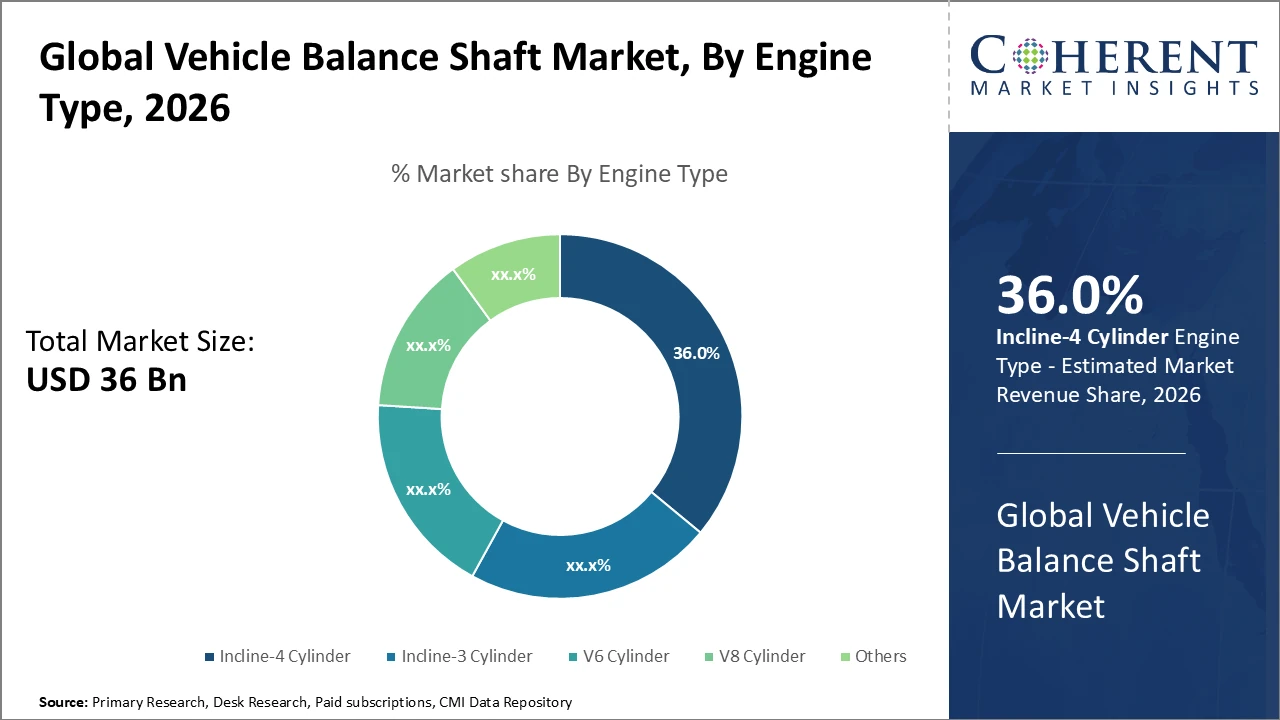
Inline-4 cylinder engines dominate the vehicle balance shaft market with a 36% share, driven by widespread use in compact and midsize vehicles.
Passenger cars represent the largest vehicle type segment due to stringent global emissions regulations.
Commercial vehicles show growth potential, fueled by demand for heavy-duty engines with enhanced smoothness and durability.
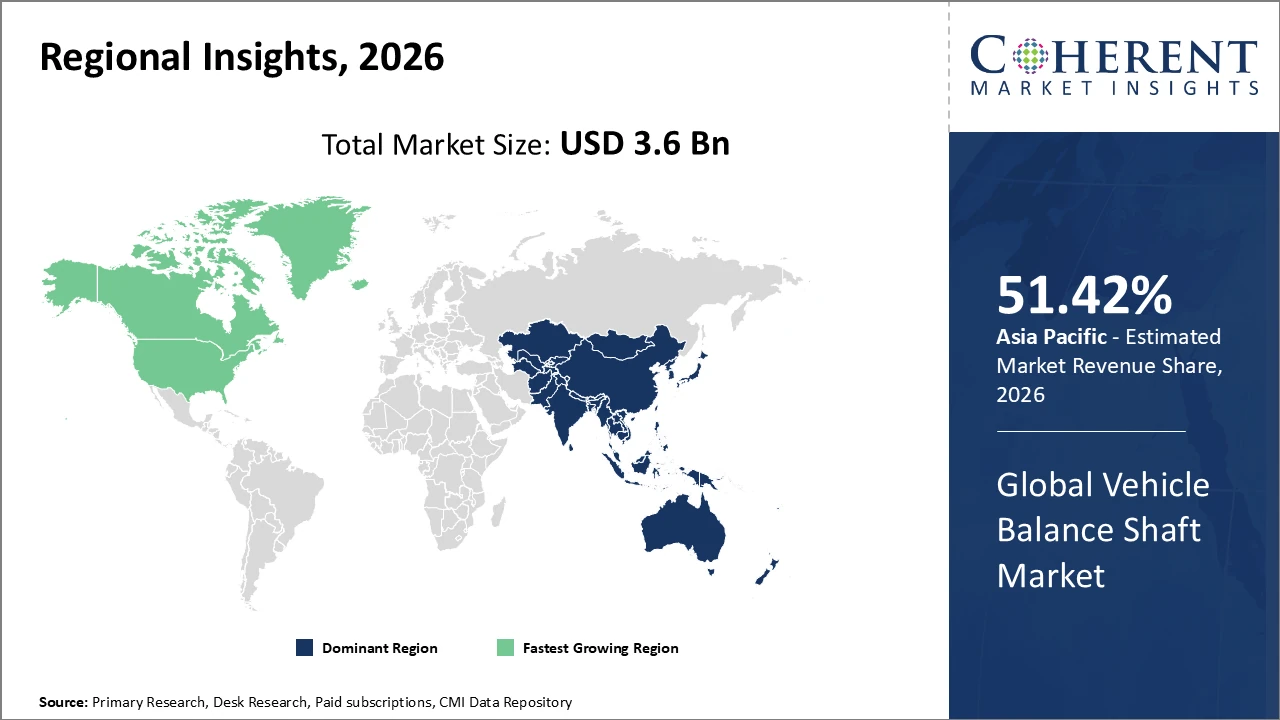
Asia Pacific leads in market revenue, driven by major automotive manufacturing hubs in China and India.
North America maintains steady growth, supported by strict emission norms and strong aftermarket demand.
Europe focuses on advanced technologies like composite balance shafts, promoting innovation and sustainability in the market.
Vehicle Balance Shaft Market Segmentation Analysis
Vehicle Balance Shaft Market Insights, By Engine Type
Inline-4 Cylinder engines dominate the vehicle balance shaft market with a share of 36% due to their widespread use in passenger cars and commercial vehicles, offering an optimal balance of performance and fuel efficiency. Their prevalence is further supported by global emission regulations, which encourage OEMs to enhance engine smoothness through balance shaft integration to reduce vibrations. The fastest-growing subsegment is Inline-3 Cylinder engines, driven by the rise of compact, turbocharged powertrains in urban mobility, providing fuel efficiency without compromising drivability. V6 and V8 engines retain steady demand in luxury and high-performance vehicles, while ‘Others’ include niche configurations like inline-5 engines for specialized commercial applications.
Vehicle Balance Shaft Market Insights, By Vehicle Type
Passenger cars dominate the vehicle balance shaft market, driven by high global production volumes and strict emissions regulations requiring enhanced engine smoothness. The fastest-growing subsegment is commercial vehicles, fueled by rising demand for vibration reduction in heavy-duty engines, improving driver comfort and vehicle durability over long-distance operations. Two-wheelers and off-road vehicles show moderate growth, influenced by regional transportation patterns and specific NVH (Noise, Vibration, and Harshness) requirements. Off-road applications are seeing innovation with balance shafts tailored for agricultural and construction machinery engines. The ‘Others’ category includes specialty and niche vehicles, characterized by low production volumes but highly customized technical requirements.
Vehicle Balance Shaft Market Insights, By Material Type
Steel continues to dominate the vehicle balance shaft market due to its affordability, proven manufacturing processes, and excellent mechanical strength. The fastest-growing subsegment is composite materials, driven by innovations in carbon fiber and advanced polymers that provide significant weight reduction and enhanced corrosion resistance, supporting the automotive sector’s shift toward lighter, more fuel-efficient vehicles. Aluminum balance shafts maintain steady demand in midrange segments for their favorable strength-to-weight ratio. The ‘Others’ category includes high-performance materials like titanium alloys, applied in specialty vehicles where performance outweighs cost considerations. Material innovation remains a key driver, meeting stricter emissions and efficiency regulations.
Vehicle Balance Shaft Market Trends
The vehicle balance shaft market is shifting toward lightweight and electrification-ready components to meet fuel efficiency and emission standards.
Adoption of composite materials, as seen with Schaeffler AG, reduces engine block weight and supports regulatory compliance.
Electrified solutions are increasingly used to mitigate vibrations in hybrid and electric powertrains, exemplified by Mahle GmbH’s 2026 product launches.
Modular design technologies are enabling faster product customization and shorter launch cycles, allowing OEMs to tailor balance shafts for diverse engine configurations.
Overall, trends emphasize innovation in materials, electrification compatibility, and flexible design for evolving automotive requirements.
Vehicle Balance Shaft Market Insights, By Geography
Asia Pacific Vehicle Balance Shaft Market Analysis and Trends
In Asia Pacific, the Vehicle Balance Shaft market is dominated by China’s extensive automotive manufacturing infrastructure and India’s rapidly expanding passenger car sector. The region captures the highest market revenue share, supported by localized production facilities, cost-efficient supply chains, and government incentives promoting domestic manufacturing and exports. Rising demand for fuel-efficient and low-vibration engines further fuels adoption. Leading companies like NSK Ltd. and JTEKT Corporation have ramped up regional investments, enhancing production capacity and technological capabilities. Additionally, increasing OEM collaborations and the growth of electric and hybrid vehicle segments in Asia Pacific are driving sustained market expansion.
North America Vehicle Balance Shaft Market Analysis and Trends
North America is experiencing rapid growth in the Vehicle Balance Shaft market, with a CAGR exceeding 9%, driven by strict emission regulations and strong aftermarket demand for engine smoothness and efficiency. The U.S. leads the region, leveraging advanced R&D infrastructure that fosters innovation in electrified and lightweight balance shaft technologies. Increasing adoption of hybrid and electric powertrains is accelerating demand for precision-engineered components to manage vibrations effectively. Key players such as Federal-Mogul Corporation are instrumental in supplying advanced NVH solutions, while collaborations with OEMs and investments in technology development continue to strengthen the region’s competitive position and market expansion.
Vehicle Balance Shaft Market Outlook for Key Countries
USA Vehicle Balance Shaft Market Analysis and Trends
The U.S. vehicle balance shaft market demonstrates strong growth, supported by advanced automotive R&D hubs and a mature aftermarket ecosystem. In 2025, adoption of enhanced balance shaft systems in the passenger car segment rose by 14%, driven by compliance with Corporate Average Fuel Economy (CAFE) standards. Key players, including Federal-Mogul and Mahle GmbH, have forged strategic partnerships with domestic OEMs, resulting in patented innovations in electronically controlled balance shafts that improve hybrid vehicle performance and durability. Coupled with a supportive regulatory environment and efficient supply chain infrastructure, these factors collectively underpin sustained market expansion and technological advancement in the United States.
Germany Vehicle Balance Shaft Market Analysis and Trends
Germany’s vehicle balance shaft market is witnessing steady growth, driven by the country’s strong automotive manufacturing base and emphasis on high-performance, low-vibration engines. OEMs are increasingly adopting balance shafts in inline-four and V-type engines to meet stringent emission and noise, vibration, and harshness (NVH) standards. Trends include the use of lightweight materials such as aluminum and high-strength steel to improve fuel efficiency and engine performance. Additionally, the integration of electronically controlled and variable-speed balance shafts is gaining traction to optimize engine smoothness under different operating conditions. Growing exports of German-engineered engines further support market expansion.
Analyst Opinion
The rising demand for inline-four and inline-three-cylinder engines in passenger vehicles is a key demand-side driver. In 2025, global production of four-cylinder engines increased by 12%, promoting wider integration of balance shafts to reduce inherent engine vibrations.
Supply-side growth is supported by enhanced manufacturing capacity for precision-engineered balance shafts. In 2024, investments in CNC machining centers in automotive hubs like Germany and Japan grew by 15%, enabling higher throughput with tighter tolerances and shorter lead times.
Pricing pressures emerged due to raw material cost fluctuations, with steel alloys and composites increasing ~6% in early 2026, prompting manufacturers to optimize production efficiency.
Cross-sector applications, including hybrid vehicles and light commercial trucks, expanded market potential. By 2026, hybrid vehicles incorporating balance shafts are projected to account for 20% of total applications, diversifying usage and revenue streams.
- Current Industry Events of 2026
- Market Size Estimation
- Regional Breakdown
- Competitive Landscape
- Customer Intelligence
- Segmental Analysis
- Pricing Analysis
- Key Market Drivers, Challenges & Future Trends
- Customized Insights Section
Market Scope
| Report Coverage | Details | ||
|---|---|---|---|
| Base Year: | 2025 | Market Size in 2026: | USD 3.6 billion |
| Historical Data for: | 2020 To 2024 | Forecast Period: | 2026 To 2033 |
| Forecast Period 2026 to 2033 CAGR: | 8.1% | 2033 Value Projection: | USD 6.1 billion |
| Geographies covered: |
| ||
| Segments covered: |
| ||
| Companies covered: | NSK Ltd., JTEKT Corporation, Mahle GmbH, NTN Corporation, Hyundai Mobis, Valeo S.A., DENSO Corporation, GKN Driveline, TPR Co. Ltd., ADI | ||
| Growth Drivers: |
| ||
Vehicle Balance Shaft Market Growth Factors
The growing preference for fuel-efficient engine designs with reduced vibrations serves as a key growth catalyst in the vehicle balance shaft market. OEMs are increasingly implementing advanced balance shafts to comply with stringent emission standards, exemplified by a 10% rise in adoption across Europe’s passenger cars in 2025. The production of lightweight vehicles using aluminum and composite balance shafts further boosts market revenue by reducing overall engine weight. Additionally, the integration of hybrid and mild-hybrid powertrains requires sophisticated balance shaft mechanisms for smooth operation under variable loads, particularly driving growth in Asia Pacific. Enhanced aftermarket penetration in mature markets like North America also supports business expansion, addressing longevity concerns for inline engine configurations.
Vehicle Balance Shaft Market Development
In December 2024, American Axle & Manufacturing launched a lightweight balance shaft for inline engines.
Key Players
Leading Companies of the Market
NSK Ltd.
Mahle GmbH
NTN Corporation
JTEKT Corporation
Valeo S.A.
Hyundai Mobis
DENSO Corporation
GKN Driveline
TPR Co. Ltd.
ADI
Competitive strategies in the vehicle balance shaft market heavily focus on R&D collaborations and supply chain optimization. For example, Schaeffler AG partnered with automotive OEMs to develop lightweight composite balance shafts, achieving a 7% improvement in engine NVH (noise, vibration, and harshness) performance across several 2025 model launches. Similarly, Mahle GmbH expanded into electrically actuated balance shaft systems, driving a 15% revenue increase in their powertrain division during 2024. These strategic initiatives highlight how leading companies leverage innovation and diversification to enhance product performance, meet evolving regulatory requirements, and strengthen market positioning.
Vehicle Balance Shaft Market Future Outlook
The vehicle balance shaft market is poised for robust growth, driven by increasing demand for smoother, low-vibration engines in passenger cars, commercial vehicles, and hybrid powertrains. Stricter emission and fuel-efficiency regulations, particularly in Europe and North America, are pushing OEMs to adopt advanced balance shaft systems to optimize engine performance and reduce NVH levels. The rise of lightweight and electronically controlled balance shafts enhances adaptability and efficiency, supporting the transition to hybrid and mild-hybrid engines. Additionally, Asia Pacific is expected to witness significant expansion due to growing automotive production and adoption of advanced engine technologies, positioning the market for sustained long-term growth.
Vehicle Balance Shaft Market Historical Analysis
The vehicle balance shaft market has experienced steady growth over the past decade, primarily driven by increasing consumer demand for smoother and quieter engines in passenger and commercial vehicles. Historically, balance shafts were predominantly used in inline-four and three-cylinder engines to reduce vibrations and improve driving comfort. Regulatory pressure on fuel efficiency and emission reduction, particularly in Europe and North America, prompted widespread adoption of advanced balance shaft systems. Technological improvements, such as integration with lightweight materials and optimized designs, enhanced engine performance and durability. These historical developments laid the foundation for the current emphasis on hybrid and high-efficiency powertrains.
Sources
Primary Research Interviews:
Automotive engineers and powertrain specialists involved in engine design and vibration control.
Vehicle OEMs, procurement managers, and production planners responsible for sourcing and integrating balance shafts into engines.
Product managers, R&D experts, and regulatory specialists from component manufacturers developing advanced balance shaft systems for internal combustion and hybrid engines.
Magazines:
Automotive Engineering – Updates on engine technologies, vibration mitigation, and vehicle performance trends.
Engine Technology International – Insights into powertrain innovations, balance shaft designs, and emissions compliance.
Motor Trend – Coverage of vehicle engineering trends, passenger comfort, and performance optimization.
Journals:
SAE International Journal of Engines – Research on balance shaft design, engine vibration reduction, and durability studies.
International Journal of Automotive Technology – Studies on engine dynamics, component integration, and noise, vibration, and harshness (NVH) performance.
Journal of Mechanical Design – Investigations on mechanical system optimization and balance shaft mechanisms.
Newspapers:
Automotive News – Global automotive industry trends, new vehicle launches, and component innovations.
Reuters – Updates on OEM strategies, supplier developments, and automotive market expansion.
Bloomberg – Market performance, investment trends, and technological developments in the automotive sector.
Associations:
Society of Automotive Engineers (SAE) – Standards, research, and best practices in engine design and vibration management.
International Organization of Motor Vehicle Manufacturers (OICA) – Global automotive standards, production statistics, and regulatory updates.
European Automobile Manufacturers Association (ACEA) – Insights into vehicle technology trends, emissions regulations, and component innovations.
Get access to 250+ pages report
Every segment, forecast, competitor profile and data table behind the analysis above — available for instant download.
- ESOMAR Member
- ISO 9001:2015 Certified
- D-U-N-S Registered
- GDPR & CCPA Compliant
Missing comfort of reading report in your local language? Find your preferred language:
Transform your Strategy with Exclusive Trending Reports
Frequently Asked Questions
The market is led by major companies such as JTEKT Corporation, NSK Ltd., NTN Corporation, and Mahle GmbH, which drive innovation, advanced engineering, and maintain substantial global market share.
The market is expected to grow from USD 3.6 billion in 2026 to USD 6.1 billion by 2033, reflecting a compound annual growth rate (CAGR) of 8.1%.
Passenger cars offer the largest growth potential due to stringent fuel efficiency regulations and the widespread use of inline engines requiring balance shafts.
Trends point to increased adoption of electrified powertrains, lightweight composite materials, and modular designs, enhancing engine performance, NVH reduction, and production flexibility.
The market is highly competitive, driven by R&D and technological innovation; key challenges include raw material cost fluctuations and adapting balance shafts for hybrid and electric vehicles.
Leading players focus on strategic OEM collaborations, expansion into emerging vehicle segments, and leveraging advanced digital manufacturing and precision engineering to improve efficiency and market reach.