

Veterinary Tuberculosis Vaccine Market Size and Share Analysis - 2026 to 2033
The global veterinary tuberculosis vaccine market value is at USD 57 Mn in 2026 and is forecast to reach a value of USD 71 Mn by 2033 at a CAGR of 3.2% between 2026 and 2033, since individuals are more worried about the health of their livestock, research is moving forward, and there is more demand around the world for disease prevention.
Key Takeaways
- Based on Type, the live attenuated segment is expected to lead the market with 57% share in 2026, due to proven bovine TB efficacy.
- Based on Route of Administration, the subcutaneous administration segment is expected to hold 52% share of the market in 2026, ensuring reliable immune response in cattle herds.
- Based on Animal Type, the cattle segment is projected to account for 68% share of the market in 2026.
- Based on Region, North America is set to lead the veterinary tuberculosis vaccine market with 37.5% share in 2026. While, Asia Pacific is anticipated to be the fastest growing region.
Market Overview
The veterinary tuberculosis vaccine market is growing because people are more concerned about the health of their livestock, the government is getting involved, and improved technologies. Demand is rising as farmers are becoming more aware of the issue and because zoonotic transmission needs to be reduced.
Investing in research and working together with pharmaceutical companies and veterinary schools will help the market grow even more, making sure that animal health management is sustainable.
Current Events and their Impacts on the Veterinary Tuberculosis Vaccine Market
Current Event | Description and its Impact |
Rising Global Bovine Tuberculosis Outbreaks and Regulatory Responses |
|
Technological Breakthroughs in Vaccine Development and Delivery |
|
Can veterinary TB vaccines in cattle, badgers, and wildlife significantly reduce global disease transmission?
Species / Region | Vaccine Type | Delivery Method | Reported Efficacy | Trial Duration |
Cattle (UK) | BCG (Bacillus Calmette–Guérin) | Injection | Up to 56% reduction in bovine TB incidence | Multi-year field trials |
Badgers (UK) | BCG | Injection (trap-and-vaccinate) | ~76% reduction in TB risk after 4 years | Long-term vaccination campaigns |
Deer (US) | Oral bait vaccine (under development) | Oral (bait pellets) | Early trials show significant immune response, efficacy data pending | Ongoing research |
Goats (Spain) | BCG and experimental candidates | Injection | Lesion severity reduced by 30–40% in challenge studies | Controlled experiments |
Wild Boar (Spain) | Oral BCG formulations | Oral bait | Reduction in TB prevalence by ~60% in pilot studies | Field trials |
- Current Industry Events of 2026
- Market Size Estimation
- Regional Breakdown
- Competitive Landscape
- Customer Intelligence
- Segmental Analysis
- Pricing Analysis
- Key Market Drivers, Challenges & Future Trends
- Customized Insights Section
Segmental Insights
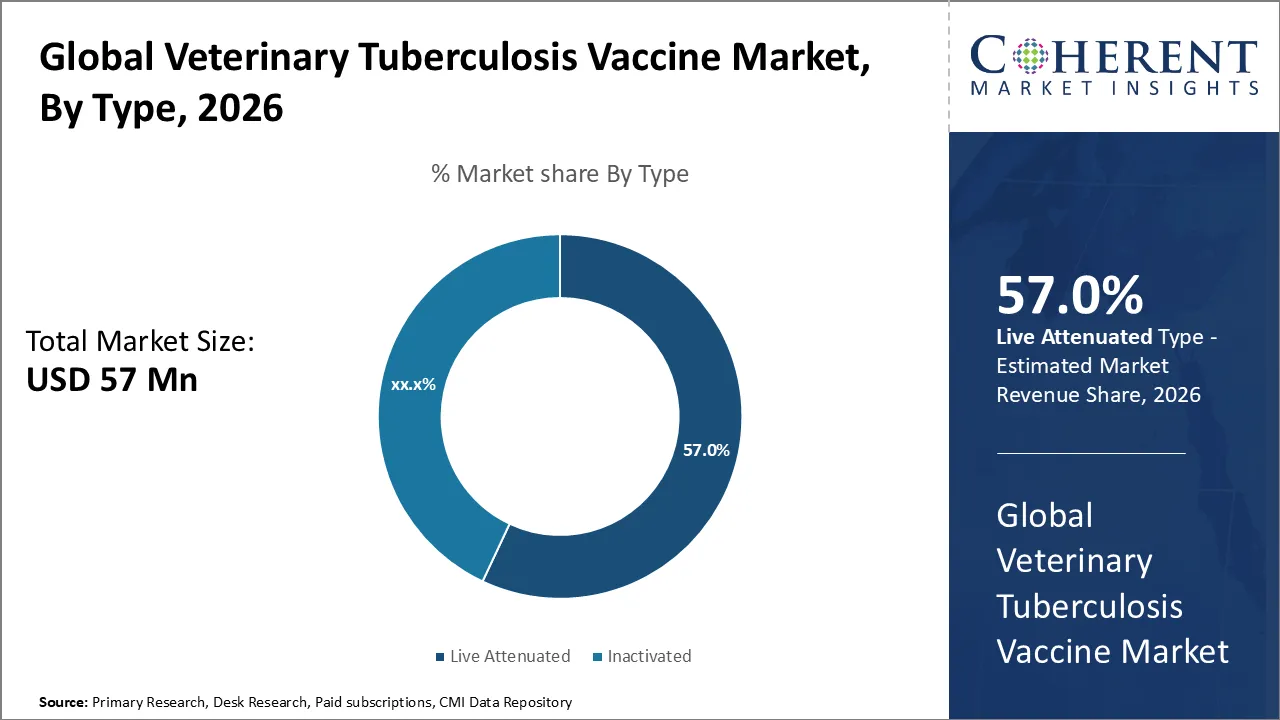
Which type leads the veterinary tuberculosis vaccine market?
Based on type, the live attenuated segment is expected to lead the market with 57% share in 2026, because it has been shown to lower the severity of lesions and the number of bacteria in cattle. Widespread adoption is bolstered by extensive field tests, backing from regulatory bodies, and the long-standing safety standards that have been established.
Which route of administration dominates the veterinary tuberculosis vaccine market?
Based on route of administration, the subcutaneous administration segment is expected to hold 52% share of the market in 2026, as it makes sure that the immune response is always the same and is easy to use for herd-level vaccination. Veterinarians such as it is easy to use, reliable, and works well with large-scale cattle programs. It is more effective and more widely used than oral and intramuscular routes.
Which animal type drives the veterinary tuberculosis vaccine market?
Based on animal type, the cattle segment is projected to account for 68% share of the market in 2026, due to bovine TB is an enormous concern for public health and the economy. Cattle vaccination is the most important part of government-backed eradication strategies, which are backed by large-scale trials and surveillance systems. This focus makes sure that cattle represent the majority of veterinary TB vaccine applications around the world.
For instance, the UK bovine TB vaccine trials are now in Phase 3, which includes 750 cows on 10 farms. The program tests the BCG vaccine and the DIVA diagnostic tool at the same time to make sure they are safe, effective, and work with surveillance. This is a big step toward getting rid of bovine TB in the whole country and making livestock healthier.
Regional Insights
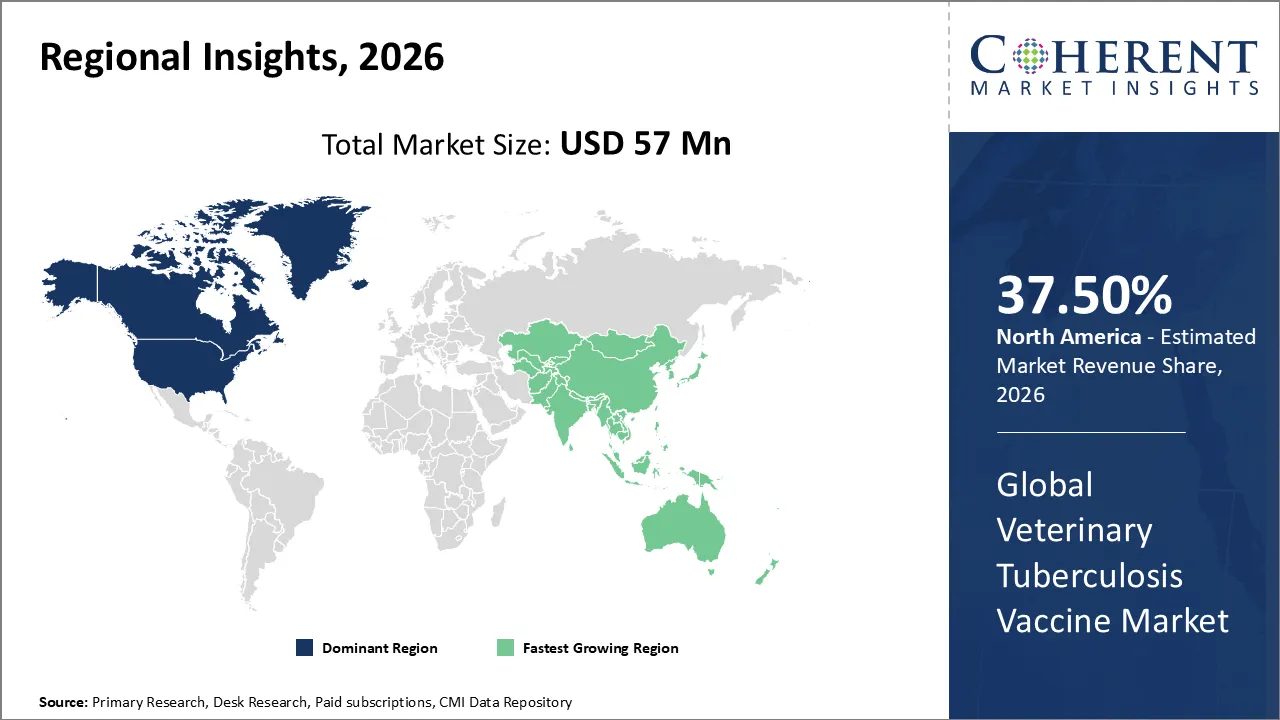
North America Veterinary Tuberculosis Vaccine Market Analysis & Trends
North America is expected to dominate the veterinary tuberculosis vaccine market with 37.50% share in 2026, because of strong government-backed eradication programs, advanced veterinary infrastructure, and a high level of awareness of zoonotic disease risks. Established vaccine makers and strict rules make adoption even more likely, making sure that livestock stays healthy and food stays safe in the whole area.
For instance, in September 2025, Scientists at VIDO in Saskatoon, Canada, found a new gene for tuberculosis and made a candidate for a next-generation vaccine. Their new idea protects against TB in a way that is similar to BCG but does not interfere with TB skin tests. This discovery could lead to better vaccines for tuberculosis in both people and animals, which would help control and eliminate the disease around the world.
Asia Pacific Veterinary Tuberculosis Vaccine Market Analysis & Trends
Asia Pacific is expected to exhibit the fastest growth, because livestock is growing quickly, people are becoming more aware of the risks of zoonotic diseases, and there are strong government-backed vaccination campaigns. Countries like India and China push adoption, which helps keep food safe and protects public health. This makes the region the fastest-growing market in the world.
Veterinary Tuberculosis Vaccine Market Outlook Country-Wise
The U.S. Veterinary Tuberculosis Vaccine Market Trends
The veterinary tuberculosis vaccine market in the United States is expected to expand in 2026. This growth is driven by tightened biosecurity protocols, a heightened emphasis on the safety of meat and dairy products, and federal investment in disease control initiatives. The presence of robust veterinary research facilities and well-established distribution channels further facilitate vaccine accessibility, thereby safeguarding livestock and, consequently, public health.
For instance, in November 2025, Researchers at Michigan State University in Michigan, USA, started working on an oral probiotic-based vaccine to fight bovine tuberculosis in wildlife, especially white-tailed deer. This new method aims to stop TB from spreading from wild animals to cattle, which will help control and eliminate the disease in areas that have had a lot of bovine TB outbreaks.
India Veterinary Tuberculosis Vaccine Market Trends
The veterinary tuberculosis vaccine Market in India is anticipated to grow in 2026 because there is a vast population of cows, people are eating more dairy, and people are paying more attention to food safety. India is a key hub for adoption because of government-backed vaccination campaigns and a growing awareness of zoonotic risks. This is driving strong market growth across the country.
Market Report Scope
Veterinary Tuberculosis Vaccine Market Report Coverage
| Report Coverage | Details | ||
|---|---|---|---|
| Base Year: | 2025 | Market Size in 2026: | USD 57 Mn |
| Historical Data for: | 2020 To 2024 | Forecast Period: | 2026 To 2033 |
| Forecast Period 2026 to 2033 CAGR: | 3.2% | 2033 Value Projection: | USD 71 Mn |
| Geographies covered: |
| ||
| Segments covered: |
| ||
| Companies covered: | Merck KGaA, Colorado Serum Company, CZ Vaccines (Zendal), and Zoetis Inc. | ||
| Growth Drivers: |
| ||
| Restraints & Challenges: |
| ||
Veterinary Tuberculosis Vaccine Market Driver
Increasing government initiatives for veterinary tuberculosis vaccine
Governments all over the world are working to stop animal tuberculosis because it affects food security and public health. These efforts include giving funds to help make vaccines, working with veterinary schools, and running campaigns to get people to adopt them.
These kinds of factors are helping the veterinary tuberculosis vaccine market growth as they make it easier for manufacturers and researchers to develop new ideas. Governments are making sure that livestock stays healthy by putting disease control first. This directly increases agricultural productivity and economic stability.
Increasing research and development for tuberculosis vaccine
Pharmaceutical companies and research institutions are spending highly on new technologies to make better vaccines for veterinary tuberculosis. Recombinant DNA techniques, better adjuvants, and targeted delivery systems are just a few examples of new technologies that are making vaccines more effective and safer.
The rise in research and development is driving up the veterinary tuberculosis vaccine market demand, as farmers and veterinarians look for dependable ways to stop disease outbreaks. Ongoing scientific progress not only improves animal health but also lowers the risk of zoonotic diseases, making research and development (R&D) is so important for market growth.
For instance, in January 2026, Scientists at the Roslin Institute looked into how the BCG vaccine affects the immune cells of cows. They found that vaccination increased the activity of natural killer cells, which made them more resistant to bovine tuberculosis. These findings could help make future veterinary TB vaccines better, which would help farmers by lowering the disease's effects and costs while also moving forward with plans to get rid of it.
Veterinary Tuberculosis Vaccine Market Opportunity
Rising Global Awareness of Zoonotic Diseases
A greater number of individuals are becoming aware of zoonotic diseases, which are diseases that can be passed between animals and people. This has led to more focus on preventive measures in livestock management. Since tuberculosis is dangerous for both animals and people, an increasing number of individuals are putting vaccination programs at the top of their lists. This increased awareness is changing the rules of the framework, encouraging investment, and pushing the use of new ideas. In view of this, the Veterinary Tuberculosis Vaccine Market forecast shows strong growth. Demand is expected to rise steadily as governments, farmers, and researchers work together to protect food security and reduce the risk of zoonotic diseases.
Analyst Opinion (Expert Opinion)
- Controlled trials in cattle have demonstrated that vaccination with BCG (Bacillus Calmette–Guérin) diminishes lesion severity by up to 65% and significantly reduces bacterial load in comparison to unvaccinated controls. Immunological studies show that cell-mediated immunity is stronger, with higher levels of interferon-gamma responses. These are important signs of protective immunity against Mycobacterium bovis. These results indicate that vaccination can enhance conventional test-and-slaughter strategies, particularly in extensive livestock systems where wildlife reservoirs hinder eradication initiatives.
- Modeling data suggest that extensive vaccination in cattle herds could lead to a 40–60% decrease in bovine TB incidence over ten years, contingent upon coverage levels and simultaneous biosecurity measures. Vaccination has been predicted to decrease transmission rates by as much as 50% in areas with a lot of wildlife-livestock interaction. This would lower economic losses caused by lower productivity and trade restrictions. These results show that the vaccine is a cost-effective way to help control TB in areas where it is common and hard to get rid of.
Speak to the analyst
Want personalized insights?
Take the findings above to one of our principal consultants, or have the report rebuilt around the segments, geographies and competitors you actually track.
Recent Developments
- In January 2026, A veterinarian from the Department of Agriculture called an effective animal TB vaccine the "holy grail" of disease control. Testing, culling, and biosecurity are the main ways we deal with the problem right now. But if vaccine trials are successful, they could change eradication programs and lower trade and economic losses.
- In July 2025, to prevent bovine tuberculosis, farmers and scientists in Cornwall, UK, are giving badgers the BCG vaccine. This joint effort aims to lower the risk of disease spreading from wildlife to cattle. It is a more humane option than culling and supports the UK's long-term plan to get rid of bovine TB.
Market Segmentation
- By Type
- Live Attenuated
- Inactivated
- By Route of Administration
- Sub-cutaneous
- Intramuscular
- Oral
- By Animal Type
- Cattle
- Dogs
- Cats
- Others
- By Region
- North America
- U.S.
- Canada
- Latin America
- Brazil
- Argentina
- Mexico
- Rest of Latin America
- Europe
- Germany
- U.K.
- Spain
- France
- Italy
- Russia
- Rest of Europe
- Asia Pacific
- China
- India
- Japan
- Australia
- South Korea
- ASEAN
- Rest of Asia Pacific
- Middle East
- GCC Countries
- Israel
- Rest of Middle East
- Africa
- South Africa
- North Africa
- Central Africa
- North America
- Key Players
- Merck KGaA
- Colorado Serum Company
- CZ Vaccines (Zendal)
- Zoetis Inc
Sources
Primary Research Interviews
- Veterinary Tuberculosis Vaccine Manufacturers
- Animal Health Vaccine Developers
- Veterinary Immunology Researchers
- Livestock Health Specialists
- Veterinary Diagnostic Experts
- Regulatory and Animal Disease Control Consultants
- Others
Databases
- Bloomberg Terminal
- Thomson Reuters Eikon
- Euromonitor International
- Others
Magazines
- Animal Pharm
- Veterinary Practice News
- The Cattle Site
- Animal Health International Magazine
- Poultry World / Livestock-related industry magazines
- Others
Journals
- Veterinary Microbiology
- Transboundary and Emerging Diseases
- Preventive Veterinary Medicine
- Vaccine
- Journal of Veterinary Science
- Frontiers in Veterinary Science
- Others
Newspapers
- Financial Times
- The Wall Street Journal
- Reuters
- Bloomberg News
- The Economic Times
- Others
Associations
- World Organisation for Animal Health (WOAH)
- Food and Agriculture Organization (FAO)
- International Union Against Tuberculosis and Lung Disease (The Union)
- Animal Health Institute (AHI)
- HealthforAnimals
- Others
Public Domain Sources
- World Organisation for Animal Health (WOAH)
- Food and Agriculture Organization (FAO)
- U.S. Department of Agriculture (USDA)
- European Medicines Agency (EMA)
- World Health Organization (WHO)
- National Centre for Biotechnology Information (NCBI)
- Others
Proprietary Elements
- CMI Data Analytics Tool
- Proprietary CMI Existing Repository of Information for the Last 8 Years
Get access to 250+ pages report
Every segment, forecast, competitor profile and data table behind the analysis above — available for instant download.
- ESOMAR Member
- ISO 9001:2015 Certified
- D-U-N-S Registered
- GDPR & CCPA Compliant
Missing comfort of reading report in your local language? Find your preferred language:
Transform your Strategy with Exclusive Trending Reports
Frequently Asked Questions
The global Veterinary Tuberculosis Vaccine Market size was valued at USD 57 Mn in 2026 and is expected to reach USD 71 Mn in 2033.
Global veterinary tuberculosis vaccine market is expected to exhibit a CAGR of 3.2% during the forecast period (2026-2033).
Merck KGaA, Colorado Serum Company, CZ Vaccines (Zendal), and Zoetis Inc. are some of the prominent players operating in the market.
North America is the prominent region in the market.
Live Attenuated, which belongs to the type segment, is the prominent segment in the market.