

Video On Demand Service Market Size and Trends, 2026-2033
The global video on demand service market is estimated to be valued at USD 123.22 Bn in 2026 and is expected to reach USD 247.86 Bn by 2033, exhibiting a compound annual growth rate (CAGR) of 10.5%. Increasing penetration of smart TVs and mobile devices are contributing significantly to the growth of this market.
Key Takeaways
- Based on Offering, the Solutions segment is expected to lead the market with 63.6% share in 2026, driven by the growing demand for personalized and on-demand content among consumers.
- Based on Content Type, the Movies segment is projected to account for 41.2% share in 2026, owing to the expanding access to diverse streaming content across genres, regions, and languages.
- Based on Vertical, the Educational/Fitness Programs segment is expected to hold 48.7% share in 2026, driven by the rising popularity of online learning and wellness applications.
- Based on Region, North America is set to lead the global video on demand service market with 36.4% share in 2026. While, Asia Pacific is anticipated to be the fastest growing region.
Market Overview
Market trends suggest that there is increasing demand for video streaming on multiple devices from users, driving OTT platforms to invest in expanding their content libraries as well as improving streaming quality. Rising subscription of broadband and 5G penetration will further propel this growth. Major players are also focusing on localized content and regional language interfaces to target new audience.
Current Events and Its Impact
Current Events | and its impact |
Geopolitical Content Regulation and Censorship Shifts |
|
Global Economic Pressures and Consumer Spending Patterns |
|
Regional Market Consolidation and Competition Dynamics |
|
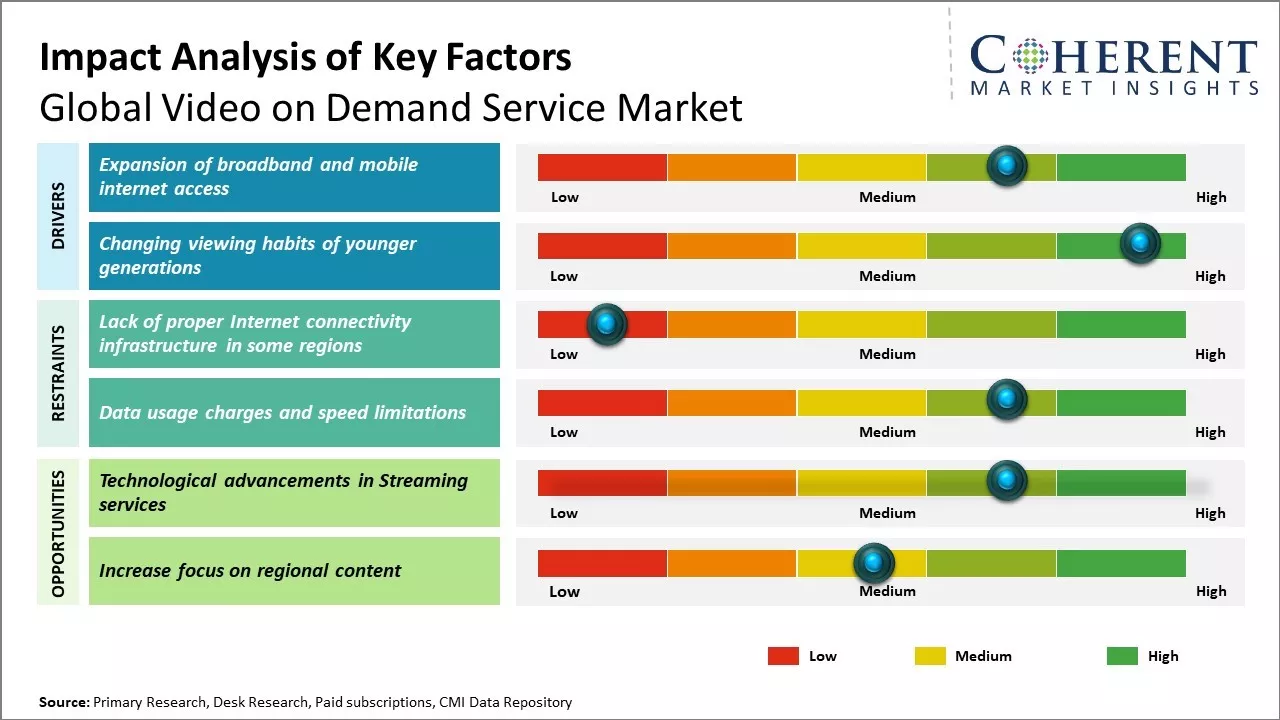
Expansion of broadband and mobile internet access
The global penetration of high-speed broadband and mobile internet access has been steadily growing over the past decade. According to recent reports, over half of the world's population now has an internet connection with speeds fast enough to support high-quality video streaming. This growth has been particularly strong in emerging economies which are increasingly adopting smartphones and building out their telecom infrastructure. As access expands to rural and remote areas worldwide, more consumers now have the ability to enjoy video content anytime, anywhere on their mobile devices. As long as worldwide broadband and 5G deployment continues its rapid trajectory, it will bring hundreds of millions of additional viewers within reach of online video services in the coming years.
For instance, in October 2025, Nokia and fibertime announced that they’ll roll out fiber-broadband access to an additional 400,000 homes in underserved townships across South Africa, enabling unlimited high-speed internet (up to 950 Mbps) at very low cost for many homes.
- Current Industry Events of 2026
- Market Size Estimation
- Regional Breakdown
- Competitive Landscape
- Customer Intelligence
- Segmental Analysis
- Pricing Analysis
- Key Market Drivers, Challenges & Future Trends
- Customized Insights Section
Segmental Insights
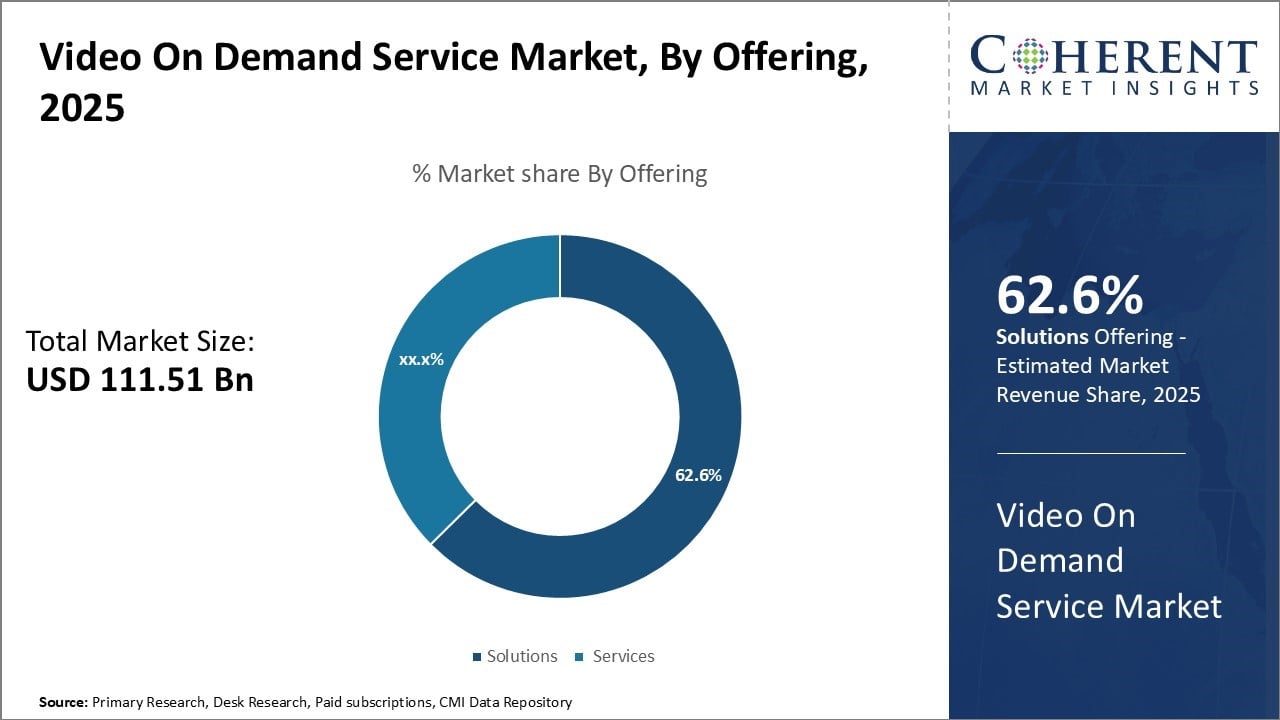
Video On Demand Service Insights, By Offering - Solutions Dominates Due To Growing Demand For Personalized and On-Demand Content
In terms of offering, solutions segment is expected to contribute 63.6% share of the market in 2026 owing to the growing demand for personalized and on-demand content amongst consumers. As viewers seek more control over what they want to watch and when, the ability of solutions to deliver tailored content directly to users has accelerated their adoption. Solutions allow media companies and service providers to analyze viewer preferences and recommend customized playlists, movies, shows based on past viewing behavior and interests. This degree of personalized experience enhances viewer satisfaction and engagement.
Solutions assist platforms in expanding their content libraries and monetizing older or long-tail content through recommenders. The flexibility of solutions also helps platforms experimental with various pricing and bundling strategies to attract different subscriber segments.
For instance, in September 2025, Viaccess‑Orca and ContentWise announced a strategic partnership to deliver a unified solution combining VO’s service delivery platform, customizable TV apps, and ContentWise’s UX engine for personalization.
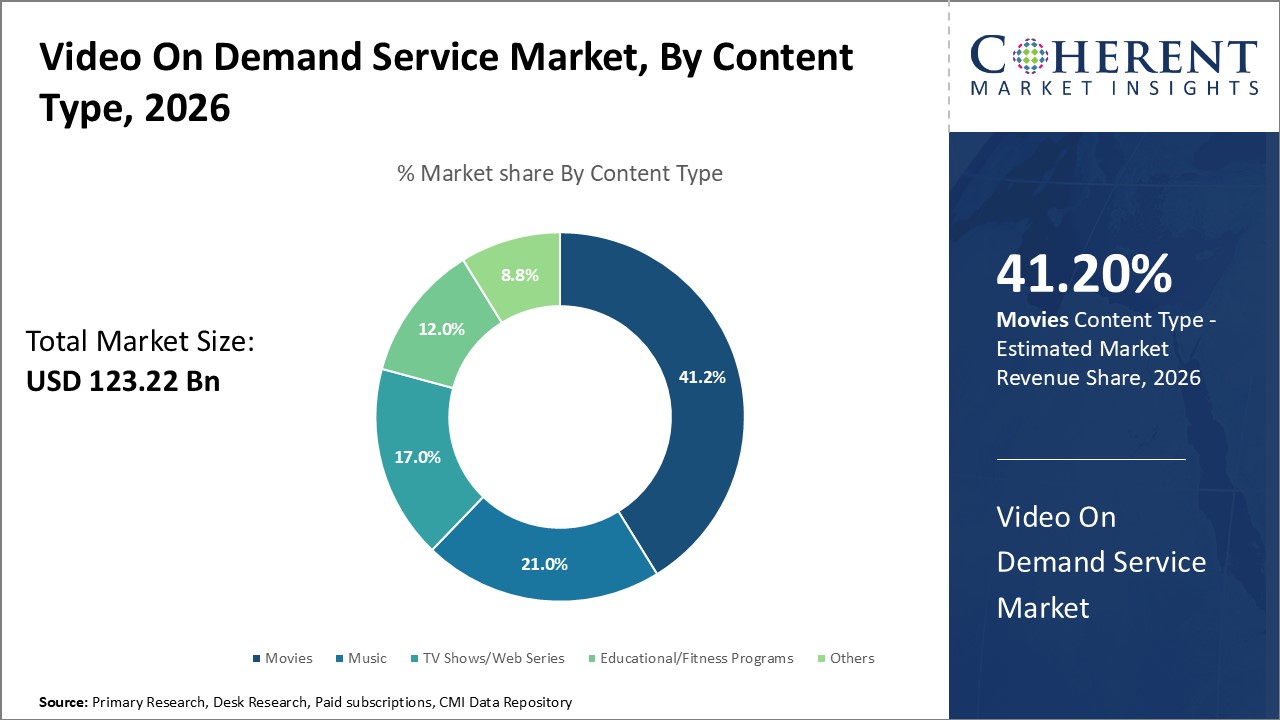
Video On Demand Service Insights, By Content Type - Movies acquires the largest share driven by Expanding access to diverse streaming content fuels
In terms of content type, movies segment is expected to contribute 41.2% share in 2026 owing to the expanding access of diverse streaming movie content. Movie buffs now have access to an immense catalog of films spanning various genres, eras and regions on video streaming platforms. Services are investing heavily in procuring exclusive rights to both contemporary blockbusters as well as back catalogs of major studios and indie films. This allows users to easily find rare, obscure and niche movies increasing their choices multifold compared to traditional distribution avenues.
Platforms regularly curate movie collections and playlists catering to specific moods, themes, directors etc. enriched discovery experience. The availability of movies in multiple languages with subtitles has also expanded the potential audience base. Driven by these advantages, movies continue gaining traction particularly amongst streaming-first younger demographic covetous of on-demand viewing flexibility.
For instance, in January 2025, Lionsgate Play signed a strategic partnership with Vi Movies & TV (India) to make its premium content library available through Vi’s subscription service, featuring global hit movies and franchises.
Video On Demand Service Insights, By Vertical - Education segment growth is driven by Growing Popularity Of Various Use Cases
In terms of vertical, educational/fitness programs segment is expected to contribute 48.7% share in 2026 driven by the growing popularity of various use cases for online learning and wellness. Integrating short video and audio formats, educational and training platforms are effectively delivering bite-sized lessons and how-tos on diverse topics for individualized and self-paced learning. Fitness applications and workout videos are helping people practice yoga, dance, exercises routines from the comfort of their homes. Video also enhances understanding through visual demonstrations compared to text-based methods. It allows reaching disadvantaged populations with internet access only. The flexible consumption of VOD education and wellness programs suit busy modern lifestyles and population. This is contributing to higher adoption of such programs across verticals.
For instance, in October 2024, Informit launched a pilot called “Explore Media” in Australia, an on-demand educational video streaming add-on for schools that covers subjects like history, law, Indigenous studies, media & more.
Regional Insights
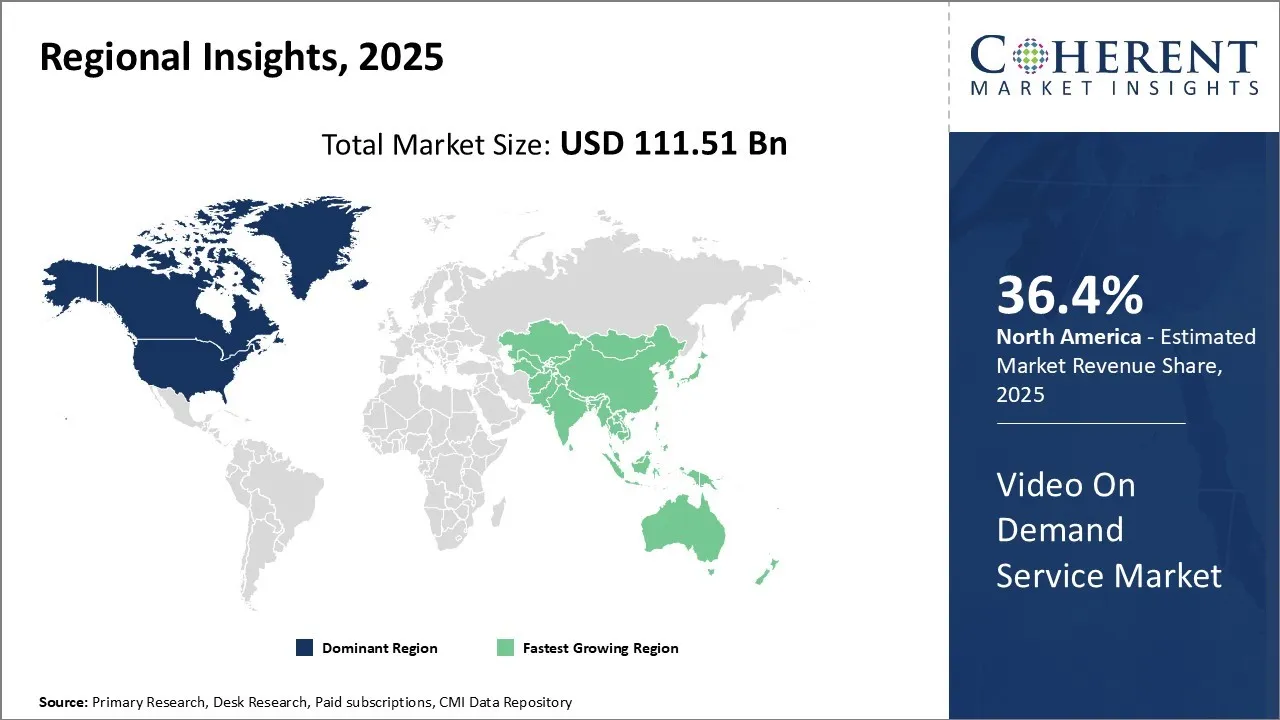
North America Video On Demand Service Market Analysis & Trends
North America has established itself as the dominant region in the global video on demand service market. The region is expected to account for 36.4% of the market share in 2026. With significant industry presence of leading OTT players like Netflix, Hulu, and Amazon Prime Video, the U.S. and Canada account for the largest share of subscriptions. Ease of access combined with affordable pricing has made video streaming services enormously popular in the region. The presence of Hollywood and availability of English content catering to local tastes has helped drive high adoption rates over the last decade. An excellent connectivity infrastructure with widespread availability of broadband also provides consumers with a seamless viewing experience regardless of location.
For instance, in August 2026, FOX One, launched, this new direct-to-consumer streaming service from Fox Corporation offers both live and on-demand content, combining news, sports and entertainment under one platform.
Asia Pacific Video On Demand Service Market Analysis & Trends
The Asia Pacific region has emerged as the fastest growing market, led by countries like India and China. With over 60.5% of the world's population and massive untapped potential, digital platforms are aggressively focused on expanding their footprint. While pricing in the price-sensitive markets is lower as compared to North America and Europe, userbase growth is exponentially high. Localized content and payment options have accelerated signups across various Asian nations.
For instance, in October 2026, HBO Max launched 14 Asia‑Pacific markets (including Bangladesh, Brunei, Cambodia, Laos, Macau, Mongolia, Pakistan, Sri Lanka).
Video On Demand Service Market Outlook Country-Wise
U.S. Video On Demand Service Market Trends
The U.S. Video-on-Demand (VoD) market is one of the most mature and competitive globally, driven by the widespread adoption of high-speed broadband, smart TVs, and mobile devices. Leading platforms like Netflix, Disney+, HBO Max, and Amazon Prime Video dominate the market, continuously investing in original content, exclusive movie releases, and localized offerings. Consumers increasingly prefer subscription-based on-demand services over traditional cable due to convenience, personalized recommendations, and flexible viewing options.
For instance, in August 2026, Howdy was launched in the U.S. as an ad‑free streaming service priced at USD 2.99/month, featuring thousands of hours of content from studios such as Lionsgate and Warner Bros.
China Video On Demand Service Market Trends
China’s VoD market has experienced explosive growth over the past decade, fueled by massive smartphone penetration, affordable high-speed internet, and a young, digitally savvy population. Leading domestic players like iQIYI, Tencent Video, Youku, and Bilibili offer a mix of subscription-based and advertising-supported content, including movies, TV series, variety shows, and anime. Local content is heavily prioritized due to government regulations, but international titles are increasingly licensed to cater to rising consumer demand. Mobile-first consumption dominates, with users preferring short-form videos, on-demand movies, and interactive features on apps. Platforms also leverage AI-powered recommendations, live streaming, and social integrations to enhance engagement and retention.
For instance, China’s regulator, in August 2026, the National Radio and Television Administration, announced relaxing of certain drama‑production rules (e.g., reducing the interval between seasons and lifting caps on episode counts) to boost content supply for long‑form streaming platforms and encourage monetization across digital video services.
Market Report Scope
Video On Demand Service Market Report Coverage
| Report Coverage | Details | ||
|---|---|---|---|
| Base Year: | 2025 | Market Size in 2026: | USD 123.22 Bn |
| Historical Data for: | 2020 To 2024 | Forecast Period: | 2026 To 2033 |
| Forecast Period 2026 to 2033 CAGR: | 10.5% | 2033 Value Projection: | USD 247.86 Bn |
| Geographies covered: |
| ||
| Segments covered: |
| ||
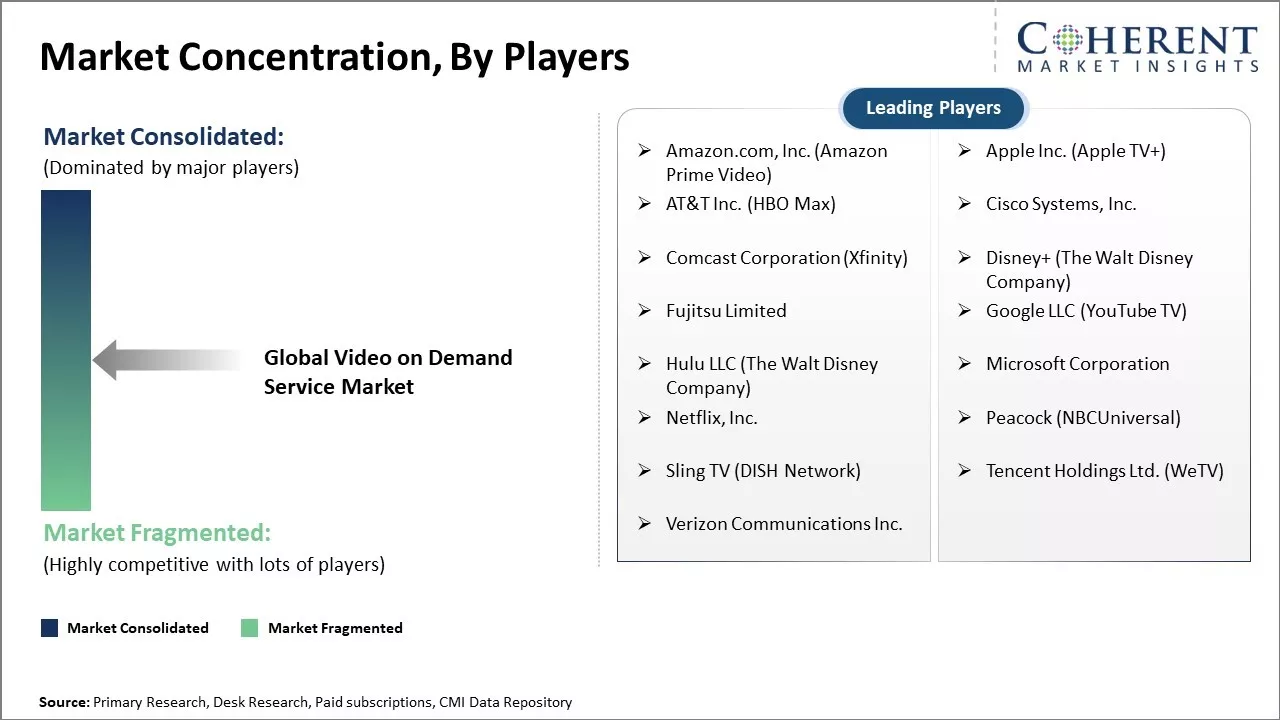
| Companies covered: | Amazon.com, Inc. (Amazon Prime Video), Apple Inc. (Apple TV+), AT&T Inc. (HBO Max), Cisco Systems, Inc., Comcast Corporation (Xfinity), Disney+ (The Walt Disney Company), Fujitsu Limited, Google LLC (YouTube TV), Hulu LLC (The Walt Disney Company), Microsoft Corporation, Netflix, Inc., Peacock (NBCUniversal), Sling TV (DISH Network), Tencent Holdings Ltd. (WeTV), and Verizon Communications Inc. | ||
| Growth Drivers: |
| ||
| Restraints & Challenges: |
| ||
Video On Demand Service Market Driver
Changing viewing habits of younger generations
One of the key drivers has been the changing media consumption patterns of younger audiences who have grown up with the internet. Millennials and generation Z are highly connected digitally and have much lower rates of traditional pay TV subscriptions compared to older consumers. They are comfortable navigating the online world and expect to be able to access all types of media on demand whenever and wherever they want. Streaming services provide this level of flexibility and ability to watch only the specific shows and movies that interest them the most. In particular, binge-watching full seasons of a series has become a very popular pastime for younger viewers.
Video On Demand Service Market Opportunities
Technological advancements in streaming services
Technological advancements in streaming services have opened up huge opportunities in the global video on demand service market. With improving internet connectivity and widespread use of smartphones, streaming services are able to deliver high quality video content to customers anywhere, anytime on their preferred devices. This shift from traditional linear TV viewing to on-demand streaming is revolutionizing the entertainment experience of audiences globally.
Platforms like Netflix, Amazon Prime Video, Disney+, Hulu, etc. have vastly expanded their original content libraries and invested heavily in producing localized regional language content. This has not only helped them gain new subscribers internationally but also engaged existing customers by catering to their language preferences.
Concentration and Competitive Landscape
Analyst Opinion (Expert Opinion)
Consumers are demanding anytime, anywhere access to a wide range of movies and TV shows of their choice fuelling the adoption of video streaming services. This change in audience viewing behavior has prompted media companies to offer VOD platforms and invest heavily in developing exclusive original content. Improving internet infrastructure in developing countries is expanding the market reach of major players.
However, capital intensive investments in content creation and frequent change in consumer preferences pose challenges. Technical issues related to connectivity and device compatibility restrict the growth potential to some extent. Pricing wars between providers is also intensifying competition.
Speak to the analyst
Want personalized insights?
Take the findings above to one of our principal consultants, or have the report rebuilt around the segments, geographies and competitors you actually track.
Video On Demand Service Industry News
- In January 2023, FOX Entertainment, a prominent television network, and Hulu, a leading streaming service owned by Disney, announced a multi-year content partnership that includes in-season streaming rights for FOX's extensive programming lineup. Under the terms of the agreement, all FOX primetime entertainment shows, such as Family Guy, The Cleaning Lady, The Masked Singer, and Next Level Chef, will continue to stream on Hulu the day after their linear broadcast.
- In April 2025, Amazon Prime Video launched Apple TV+ as an add-on subscription in India, allowing users to access Apple’s streaming content directly through Prime Video.
Market Segmentation
- Offering Insights (Revenue, USD Bn, 2026 - 2033)
- Solutions
- Services
- Content Type Insights (Revenue, USD Bn, 2026 - 2033)
- Movies
- Music
- TV Shows/Web Series
- Educational/Fitness Programs
- Others
- Vertical Insights (Revenue, USD Bn, 2026 - 2033)
- BFSI
- Education
- Government & Public Sector
- Healthcare & Life Sciences
- Media & Entertainment
- Others
- Regional Insights (Revenue, USD Bn, 2026 - 2033)
- North America
- U.S.
- Canada
- Latin America
- Brazil
- Argentina
- Mexico
- Rest of Latin America
- Europe
- Germany
- U.K.
- Spain
- France
- Italy
- Russia
- Rest of Europe
- Asia Pacific
- China
- India
- Japan
- Australia
- South Korea
- ASEAN
- Rest of Asia Pacific
- Middle East & Africa
- GCC Countries
- Israel
- South Africa
- Rest of Middle East & Africa
- Key Players Insights (Revenue, USD Bn, 2021 - 2033)
- Amazon.com, Inc. (Amazon Prime Video)
- Apple Inc. (Apple TV+)
- AT&T Inc. (HBO Max)
- Cisco Systems, Inc.
- Comcast Corporation (Xfinity)
- Disney+ (The Walt Disney Company)
- Fujitsu Limited
- Google LLC (YouTube TV)
- Hulu LLC (The Walt Disney Company)
- Microsoft Corporation
- Netflix, Inc.
- Peacock (NBCUniversal)
- Sling TV (DISH Network)
- Tencent Holdings Ltd. (WeTV)
- Verizon Communications Inc.
Sources
Primary Research Interviews from the following stakeholders
Stakeholders
- Interviews with streaming service providers, content creators, OTT platform executives, telecom operators, technology solution providers, and media analysts across major regional markets.
Specific stakeholders
- Product and content strategy heads at leading VoD platforms (e.g., Netflix, Disney+, Amazon Prime Video, Hulu, Apple TV+)
- Technology and platform operations managers at telecom and broadband service providers (e.g., AT&T, Verizon, Comcast, Vodafone)
- Content acquisition and licensing executives at studios and production houses (e.g., Warner Bros., Sony Pictures, Tencent Video, Huayi Brothers)
- Data analytics and recommendation engine specialists at OTT and VoD solution providers (e.g., Brightcove, Kaltura, Roku)
- Marketing and subscriber growth officers at streaming services (e.g., Peacock, Sling TV, HBO Max)
- Regulatory and digital media policy representatives from government and industry bodies
- Finance and monetization teams at digital media platforms focusing on subscription, ad-supported, and hybrid models
Databases
- United Nations Comtrade Database – Media & Broadcasting
- World Bank – ICT & Digital Media Statistics
- International Telecommunication Union (ITU) – Broadband & Internet Access Reports
- U.S. Census Bureau – Media & Entertainment Statistics
- China Ministry of Industry and Information Technology (MIIT) – Digital Media Statistics
- Eurostat – Digital Economy & Streaming Media
- Japan External Trade Organization (JETRO) – Media and Broadcasting Industry Data
- Korea Communications Commission – OTT & VOD Market Data
- Telecom Regulatory Authority of India (TRAI) – Internet & OTT Statistics
- Federal Communications Commission (FCC), USA – Video & Broadband Access Data
Magazines
- Variety – Streaming & Digital Media Section
- The Hollywood Reporter – OTT & Streaming Insights
- Broadcasting & Cable – Video on Demand Coverage
- Digital TV Europe
- Screen International – OTT & Streaming
- FierceVideo – VOD and OTT News
- Multichannel News – Streaming & Pay TV Section
- TechCrunch – OTT & Streaming Services
- Stream TV Insider
- MediaPost – Video and OTT Reports
Journals
- Journal of Media Economics
- International Journal on Media Management
- Journal of Broadcasting & Electronic Media
- Journal of Digital Media & Policy
- Journal of Interactive Media
- Telecommunications Policy – Media & Streaming Section
- Convergence: The International Journal of Research into New Media Technologies
- International Journal of Information Management – Digital Media Section
Newspapers
- The Wall Street Journal – Media & Entertainment Section
- The Economic Times – Digital Media & Broadcasting
- Business Standard – Telecom & OTT Coverage
- Financial Times – Technology & Media Reports
- Nikkei Asia – Media & Streaming Services
- The Hindu Business Line – Digital Media & Telecom
- South China Morning Post – OTT and Streaming Industry
- The Guardian – Digital Media & Entertainment
Associations
- International Federation of the Phonographic Industry (IFPI) – Digital & Streaming Insights
- Digital Entertainment Group (DEG)
- European Audiovisual Observatory (EAO)
- Asia Video Industry Association (AVIA)
- Interactive Advertising Bureau (IAB) – Video & Streaming
- National Association of Broadcasters (NAB) – OTT & VOD Section
- OTT Platform Association of India
- Streaming Media Association (SMA)
- Motion Picture Association (MPA) – Digital Distribution
- World Broadcasting Unions – OTT & Streaming Committee
Public Domain Sources
- Federal Communications Commission (FCC), USA – Broadband & Streaming Reports
- U.S. Department of Commerce – Digital Media Reports
- Ministry of Industry and Information Technology (MIIT), China – Digital Media Policy
- European Commission – Audiovisual Media Services Directive Reports
- United Nations Conference on Trade and Development (UNCTAD) – Digital Economy & Streaming
- Telecom Regulatory Authority of India (TRAI) – OTT & Broadband Statistics
- Organisation for Economic Co-operation and Development (OECD) – Media & Streaming Reports
- United Nations Environment Programme (UNEP) – Digital Infrastructure & Sustainability Reports
- Reserve Bank of India (RBI) – Telecom & Digital Media Sector Reports
- Japan Ministry of Internal Affairs and Communications (MIC) – Media & Broadband Reports
Proprietary Elements
- CMI Data Analytics Tool, and Proprietary CMI Existing Repository of information for last 8 years
*Definition: The Global Video on Demand Service Market provides video streaming services to consumers worldwide, allowing them on-demand access to TV shows, movies, and other video content from any internet-connected device. Major players in this market operate streaming platforms and content libraries that users can access for a monthly subscription fee or pay-per-view rental charges. The market has seen tremendous growth with increased availability of high-speed internet and continues expanding as more premium content becomes available instantly to stream globally.
Get access to 250+ pages report
Every segment, forecast, competitor profile and data table behind the analysis above — available for instant download.
- ESOMAR Member
- ISO 9001:2015 Certified
- D-U-N-S Registered
- GDPR & CCPA Compliant
Missing comfort of reading report in your local language? Find your preferred language:
Transform your Strategy with Exclusive Trending Reports
Frequently Asked Questions
The Video On Demand Service Market is estimated to be valued at USD 123.22 Bn in 2026, and is expected to reach USD 247.86 Bn by 2033.
The CAGR of the Video On Demand Service Market is projected to be 10.5% from 2026 to 2033.
Expansion of broadband and mobile internet access and changing viewing habits of younger generations are the major factors driving the growth of global video on demand service market.
Lack of proper Internet connectivity infrastructure in some regions and data usage charges and speed limitations are the major factors hampering the growth of global video on demand service market.
In terms of offering, solutions segment is estimated to dominate the market in 2026.
Amazon.com, Inc. (Amazon Prime Video), Apple Inc. (Apple TV+), AT&T Inc. (HBO Max), Cisco Systems, Inc., Comcast Corporation (Xfinity), Disney+ (The Walt Disney Company), Fujitsu Limited, Google LLC (YouTube TV), Hulu LLC (The Walt Disney Company), Microsoft Corporation, Netflix, Inc., Peacock (NBCUniversal), Sling TV (DISH Network), Tencent Holdings Ltd. (WeTV), and Verizon Communications Inc. are the major players.
North America is expected to lead the global video on demand service market.