

WiGig Market Size and Forecast – 2026 To 203 3
The WiGig Market is anticipated to grow at a CAGR of 8.3% with USD 13.6 Bn in 2026 and is expected to reach USD 16.5 Bn in 2033. Rising demand for high-speed wireless connectivity drives the WiGig market, while growing VR/AR applications, 4K/8K video streaming, and wireless docking solutions further boost adoption. As of June 2025, the global OTT video market had nearly 400 million users.
Key Takeaways
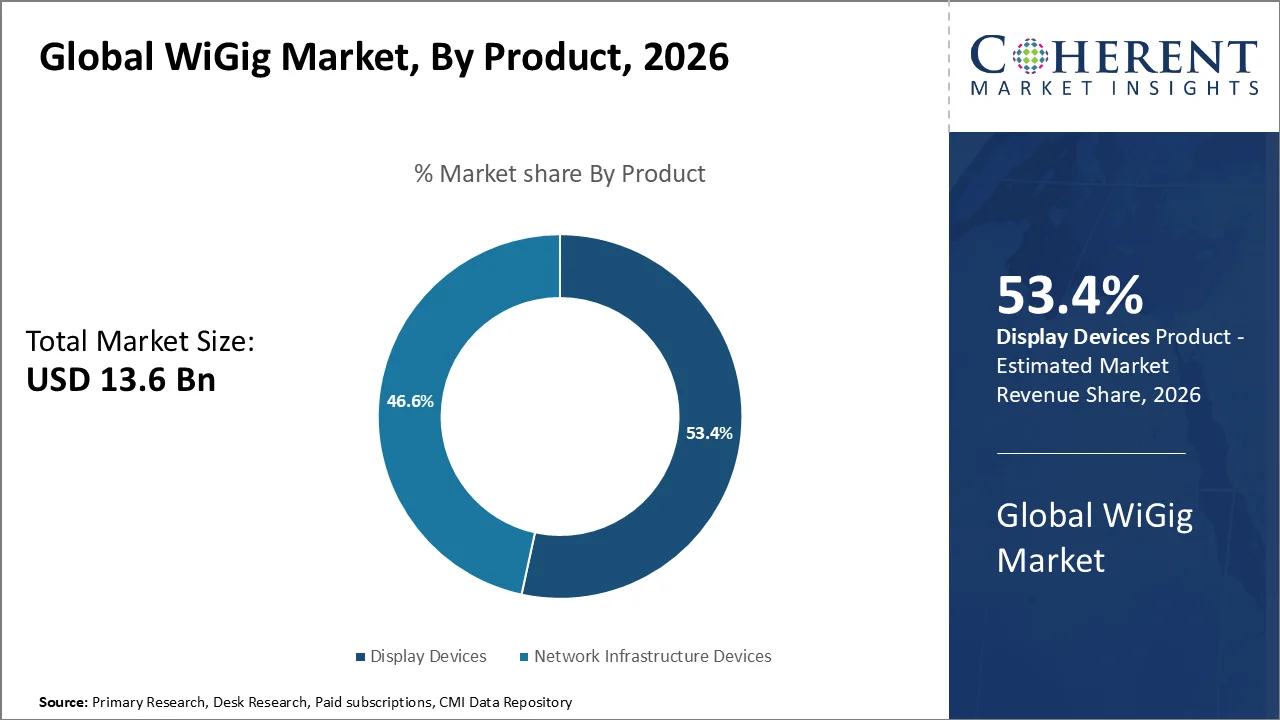
- Display Devices are expected to hold the largest market share of 53.4% in 2026, driven by increasing adoption of 4K/8K displays, wireless docking stations, AR/VR headsets, and ultra-high-definition video streaming, all of which require WiGig's multi-gigabit data transfer capabilities and low latency. The segment benefits significantly from advancements in video interface and receiver controller technologies.
- Networking is projected to account for 43.3% of the market share in 2026, supported by growing deployment of 60 GHz wireless networks, enterprise wireless backhauls solutions, and high-speed indoor connectivity applications. The demand for WiGig baseband and MAC controllers is increasing as organizations seek alternatives to wired Gigabit Ethernet for bandwidth-intensive applications.
- North America is anticipated to dominate the market with a 38.6% share in 2026, supported by high penetration of advanced consumer electronics, early adoption of next-generation wireless technologies, and strong investments in digital infrastructure. The region also benefits from the presence of major semiconductor and networking technology companies, along with increasing demand for multi-gigabit wireless connectivity capable of delivering speeds of up to 7 Gbps over the 60 GHz spectrum.
Current Events and Their Impact
Current Event | Description and its Impact |
FCC Expansion of 60 GHz Spectrum Usage in the U.S. |
|
U.S.-China Semiconductor Export Restrictions |
|
Segmental Insights
- Current Industry Events of 2026
- Market Size Estimation
- Regional Breakdown
- Competitive Landscape
- Customer Intelligence
- Segmental Analysis
- Pricing Analysis
- Key Market Drivers, Challenges & Future Trends
- Customized Insights Section
Why is Display Devices Acquiring the Largest Market Share?
Display Devices hold the largest market share of 53.4% in 2026. Rising demand for wireless high-resolution video transmission, including 4K and 8K streaming, gaming, and virtual reality applications, drives display devices in the WiGig market. Users seek to eliminate cable clutter in workplaces, homes, and enterprise environments, which further boosts adoption. Continuous improvements in display driver ICs and wireless video receiver technologies improve performance by enabling low latency and high bandwidth. Manufacturers integrate WiGig into smart displays, docking stations, and immersive devices to expand usage and support market growth. For instance, in June 2026, KTC launched its upgraded COB display technology solution and expanded its global customized smart display services, taking a new step in strengthening its portfolio of high-performance flat panel display solutions.
Which Application segment dominates the market?
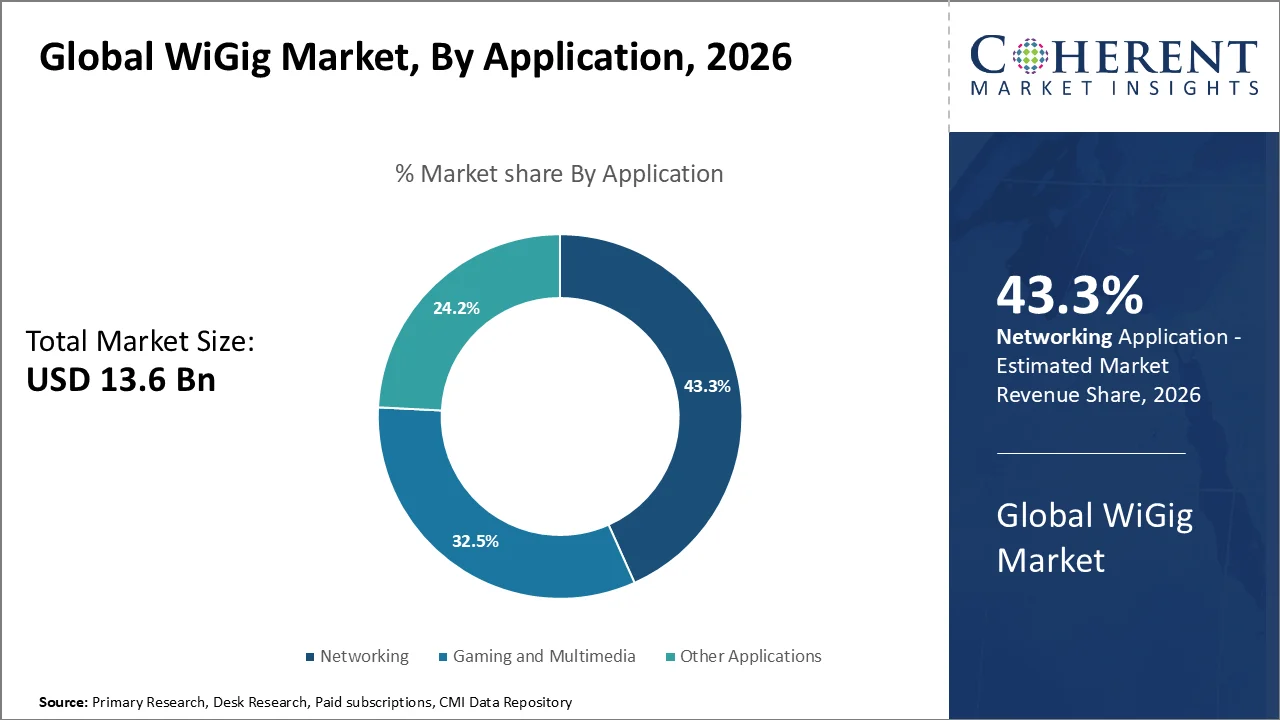
Networking expected to hold largest market share of 43.3% in 2026 owing to the wigig access points & docking station controllers. Rising demand for ultra-fast short-range wireless connectivity drives networking growth in the WiGig market, particularly for high-bandwidth uses such as data transfer, video streaming, and cloud-based services. Enterprises and consumers adopt WiGig to enable seamless device communication without cables. Manufacturers improve speed, stability, and efficiency through advancements in 60 GHz RF transceivers, beamforming technology, and WiGig network interface controllers. They also integrate WiGig with existing Wi-Fi networks and implement low-latency protocols to enhance performance and broaden networking applications across environments. For instance, Peraso Technologies, Inc. introduced the first mobile WiGig USB adapter reference design based on its W120 phased array chipset. The solution enables smartphone vendors to add IEEE 802.11ad connectivity through a USB interface and represents the first such implementation for mobile devices using WiGig technology.
WiGig Market Trends
- Rising demand for ultra-fast wireless connectivity is driving the adoption of WiGig in applications such as wireless docking, VR/AR streaming, and 4K/8K video transmission. Operating in the 60 GHz spectrum, WiGig can deliver data transfer speeds of up to 7 Gbps with IEEE 802.11ad and over 20 Gbps with IEEE 802.11ay, significantly outperforming conventional Wi-Fi technologies for short-range, high-bandwidth applications.
- Growing integration of WiGig in enterprise networking and smart workplaces is supporting cable-free collaboration and high-speed connectivity. Wireless docking solutions powered by WiGig can transfer multi-gigabit data while simultaneously supporting multiple displays, peripherals, and enterprise applications, reducing workstation cable clutter and deployment costs.
- Increasing deployment of WiGig-enabled consumer electronics such as laptops, wireless docking stations, monitors, and AR/VR headsets is accelerating market growth. The number of global AR/VR users is projected to exceed 1 billion by 2030, creating substantial demand for high-speed wireless connectivity technologies capable of supporting immersive content delivery.
- Supportive spectrum allocation and regulatory policies for the unlicensed 57–71 GHz band across the U.S., Europe, Japan, and other major markets are facilitating commercialization of WiGig solutions. The availability of up to 14 GHz of unlicensed spectrum provides significantly greater bandwidth capacity than traditional Wi-Fi bands, enabling next-generation wireless communication systems and enterprise-grade networking applications.
Regional Insights
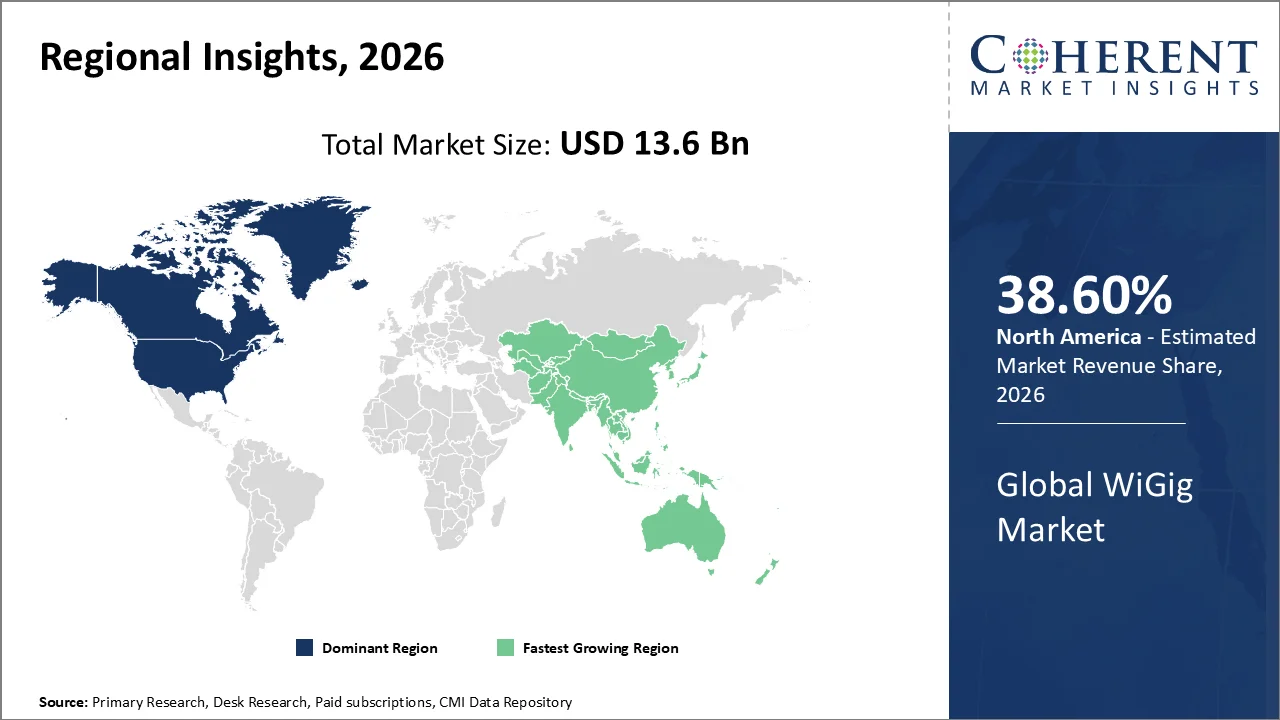
North America dominates owing to strong regulatory and spectrum support
North America is expected to acquire the dominant share of 38.60% in 2026. Strong demand for high-speed wireless connectivity drives WiGig adoption across North America, particularly for VR/AR, cloud gaming, and ultra-HD streaming applications. Enterprises and consumers adopt WiGig to enable seamless, cable-free communication between devices in offices, homes, and data centers. Major semiconductor and networking companies accelerate ecosystem development through rapid technological innovation. Regulatory bodies support deployment by enabling access to the 60 GHz spectrum. Organizations expand market growth by implementing smart workplaces, wireless docking stations, and advanced digital infrastructure across the region. For instance, StarTech has launched the DKWG30DPHPD docking station, a consumer-ready WiGig device that also functions as a USB Type-C and Thunderbolt 3 docking station, offering enthusiast-level features ahead of mainstream demand.
Asia Pacific WiGig Market Trends
Rapid digital transformation drives the Asia Pacific WiGig market, while strong demand for high-speed wireless connectivity fuels its expansion. Smart homes and enterprise environments adopt advanced networking devices, and companies invest heavily in next-generation communication infrastructure. Robust technology ecosystems further strengthen development across the region. Users increasingly prefer low-latency experiences for gaming, virtual reality, and data-intensive applications. These factors collectively push adoption across major economies such as India, China, Japan, South Korea, Singapore, and Australia, accelerating innovation and deployment. For instance, ASUS has launched its ROG Phone in India as its first gaming smartphone, featuring WiGig-certified IEEE 802.11ad connectivity with 2×2 MIMO and WiFi Direct, along with a side-mounted port supporting Gigabit Ethernet over USB Type-C, HDMI, and USB.
United States WiGig Market Trends
In the United States, rising demand for ultra-fast and low-latency wireless connectivity is driving WiGig adoption, particularly for virtual reality (VR), augmented reality (AR), wireless docking, and high-resolution video applications. The availability of the 57–71 GHz unlicensed spectrum band, providing 14 GHz of contiguous bandwidth, enables WiGig to deliver multi-gigabit wireless speeds exceeding 7 Gbps with IEEE 802.11ad and over 20 Gbps with IEEE 802.11ay technologies.
China WiGig Market Trends
China’s growing demand for ultra-fast wireless connectivity drives the WiGig market, especially for data-heavy uses like virtual reality, augmented reality, and high-definition video streaming. Smart factories and industrial automation expand adoption across manufacturing and technology industries, while enterprises increasingly use cloud-based networks. Government initiatives support digital infrastructure development and encourage integration with 5G ecosystems. China has invested over USD 170 billion in 5G infrastructure as part of its "new infrastructure" strategy to strengthen technological leadership. The deployment is led by state-owned telecom operators and supported through government subsidies, policy incentives, and local government initiatives. Domestic chipmakers and telecom companies invest heavily in the technology, and rising deployment in education, healthcare, and enterprise Wi-Fi upgrades further strengthens market expansion.
Who are the Major Companies in WiGig Industry
Some of the major key players in WiGig are HP Development Company L.P., Panasonic Corporation, Lenovo Group Limited, Qualcomm Technologies Inc., Dell Technologies Inc., Intel Corporation, Cisco Systems Inc., Broadcom Inc., Sivers Ima Holding AB, Peraso Technologies Inc., Tensorcom Inc., Blu Wireless Technology Limited, and Fujikura Ltd.
Key News
- Qualcomm strengthened its high-speed wireless networking portfolio through the acquisition of Wilocity for approximately USD 300 million. The acquisition enhanced Qualcomm's WiGig capabilities, enabling the development of wireless networking solutions capable of delivering speeds significantly higher than conventional Wi-Fi routers.
Market Report Scope
WiGig Market Report Coverage
| Report Coverage | Details | ||
|---|---|---|---|
| Base Year: | 2025 | Market Size in 2026: | USD 13.6 Bn |
| Historical Data for: | 2020 To 2024 | Forecast Period: | 2026 To 2033 |
| Forecast Period 2026 to 2033 CAGR: | 8.3% | 2033 Value Projection: | USD 16.5 Bn |
| Geographies covered: |
| ||
| Segments covered: |
| ||
| Companies covered: | HP Development Company L.P., Panasonic Corporation, Lenovo Group Limited, Qualcomm Technologies Inc., Dell Technologies Inc., Intel Corporation, Cisco Systems Inc., Broadcom Inc., Sivers Ima Holding AB, Peraso Technologies Inc., Tensorcom Inc., Blu Wireless Technology Limited, and Fujikura Ltd. | ||
Analyst Opinion
- WiGig adoption is fundamentally driven by an unavoidable bandwidth bottleneck in conventional Wi-Fi. WiGig based on IEEE 802.11ad/ay operates in the 60 GHz band and delivers multi-gigabit speeds up to 7–10 Gbps with ultra-low latency, making it essential for environments where wired connections are impractical. In enterprise deployments, a single 4K/8K VR training setup can require sustained multi-gigabit throughput, and this is already pushing manufacturers to integrate WiGig into laptops, docking stations, and enterprise access points rather than treating it as a niche add-on.
- The strongest real-world pull comes from immersive computing and spatial workloads. VR and AR headset ecosystems, including enterprise-grade devices used in simulation and industrial design, depend on WiGig to eliminate tethering delays; latency sensitivity below a few milliseconds is non-negotiable for motion accuracy. In controlled pilots such as wireless VR training labs and medical simulation rooms, WiGig has demonstrated stable high-bandwidth streaming for multiple simultaneous users, reinforcing its role as the only viable short-range wireless alternative to fiber-like performance in dense environments.
- Demand is also being reinforced by infrastructure constraints in high-density digital ecosystems. Modern smart factories and enterprise campuses often deploy hundreds of connected endpoints, and traditional Wi-Fi congestion becomes a structural limitation rather than a performance issue. WiGig offloading for backhaul, wireless docking, and device-to-access-point high-speed links is increasingly used in these scenarios. With global shipments of 60 GHz-enabled chipsets already moving into mainstream enterprise hardware cycles, the technology is shifting from experimental deployment to targeted replacement of wired Ethernet in high-performance zones.
Speak to the analyst
Want personalized insights?
Take the findings above to one of our principal consultants, or have the report rebuilt around the segments, geographies and competitors you actually track.
Market Segmentation
- By Product: (Revenue, USD Bn, 2021-2033)
- Display Devices
- Network Infrastructure Devices
- By Application: (Revenue, USD Bn, 2021-2033)
- Gaming and Multimedia
- Networking
- Other Applications
- By Region: (Revenue, USD Bn, 2021-2033)
- North America
- U.S.
- Canada
- Latin America
- Brazil
- Mexico
- Argentina
- Rest of Latin America
- Europe
- Germany
- U.K.
- France
- Italy
- Spain
- Russia
- Rest of Europe
- Asia Pacific
- China
- India
- Japan
- Australia
- South Korea
- ASEAN
- Rest of Asia Pacific
- Middle East
- GCC
- Israel
- Rest of Middle East
- Africa
- South Africa
- Central Africa
- North Africa
- North America
- Key Players
- HP Development Company L.P.
- Panasonic Corporation
- Lenovo Group Limited
- Qualcomm Technologies Inc.
- Dell Technologies Inc.
- Intel Corporation
- Cisco Systems Inc.
- Broadcom Inc.
- Sivers Ima Holding AB
- Peraso Technologies Inc.
- Tensorcom Inc.
- Blu Wireless Technology Limited
- Fujikura Ltd.
Sources
Primary Research interviews
- Network equipment manufacturers (WiGig chip designers, hardware OEMs)
- Telecom operators and ISPs deploying short-range high-speed wireless solutions
- Enterprise IT infrastructure teams using 60 GHz wireless for indoor connectivity
- Semiconductor companies working on 802.11ad / 802.11ay chipsets
- System integrators and wireless solution providers
Databases
- IEEE Xplore Digital Library (research papers on 802.11ad/ay, WiGig PHY/MAC evolution)
- ScienceDirect (Elsevier) – wireless communication and mmWave studies
- SpringerLink – academic publications on 60 GHz wireless systems
- Wiley Online Library – RF engineering and next-gen WLAN research
- ACM Digital Library – networking protocols and high-speed wireless systems
- Global patent databases (USPTO, WIPO) for WiGig-related IP trends
Magazines
- IEEE Spectrum – advancements in wireless communication and WiGig applications
- Wireless Design & Development – RF and mmWave product insights
- Microwaves & RF magazine – 60 GHz propagation and hardware trends
- Network Computing – enterprise wireless deployment insights
- EE Times – semiconductor and wireless chipset developments
Journals
- IEEE Transactions on Wireless Communications
- IEEE Transactions on Microwave Theory and Techniques
- IEEE Communications Magazine
- International Journal of Wireless Communications and Mobile Computing
- Ad Hoc Networks (Elsevier)
- Physical Communication Journal
Newspapers
- The Wall Street Journal – enterprise wireless and semiconductor industry updates
- Financial Times – telecom infrastructure and connectivity investments
- The Economic Times – India telecom and wireless ecosystem developments
- Nikkei Asia – Asia-Pacific semiconductor and wireless technology trends
- Reuters Technology section – global connectivity and networking updates
Associations
- Wi-Fi Alliance (certification and standards for WiGig / 60 GHz Wi-Fi evolution)
- IEEE (802.11ad/ay standards development)
- FCC (spectrum allocation for 60 GHz band in the US)
- ETSI (European mmWave and wireless standards)
- ITU (International Telecommunication Union) – global spectrum regulation and wireless frameworks
Public Domain sources
- Government telecom policy documents on mmWave spectrum allocation
- FCC public filings and regulatory updates on 57–71 GHz band usage
- ITU reports on IMT spectrum and high-frequency wireless communication
- Open-access IEEE papers and preprints on WiGig technology
- University research repositories (MIT, Stanford, IITs) on mmWave propagation
- Open-source technical whitepapers from chipset manufacturers
Proprietary Elements
- CMI Data Analytics Tool, and Proprietary CMI Existing Repository of information for last 10 years
Get access to 250+ pages report
Every segment, forecast, competitor profile and data table behind the analysis above — available for instant download.
- ESOMAR Member
- ISO 9001:2015 Certified
- D-U-N-S Registered
- GDPR & CCPA Compliant
Missing comfort of reading report in your local language? Find your preferred language:
Transform your Strategy with Exclusive Trending Reports
Frequently Asked Questions
The WiGig Market is anticipated to grow at a CAGR of 8.3% with USD 13.6 Billion share in 2026 and is expected to reach USD 16.5 Billion in 2033.
Rise in technological development in communication sector and growing adoption of high-resolution videos are fueling the market.
The Display Devices segment is the leading component segment in the market.
Limitations of WiGig technology and rise in cost of chipset manufacturing are the major factors restraining market.
HP Development Company L.P., Panasonic Corporation, Lenovo Group Limited, Qualcomm Technologies Inc., Dell Technologies Inc., Intel Corporation, Cisco Systems Inc., Broadcom Inc., Sivers Ima Holding AB, Peraso Technologies Inc., Tensorcom Inc., Blu Wireless Technology Limited, and Fujikura Ltd.