all report title image

Air Treatment Product Market Analysis & Forecast: 2026-2033

Air Treatment Product Market, By Product Type (Air Purifier, Humidifier, Dehumidifier), By Applications (Residential, Commercial, Industrial), By Geography (North America, Europe, Asia Pacific, Latin America, Middle East, and Africa)

  • Published In : 14 Apr, 2026
  • Code : CMI1938
  • Page number :140
  • Formats :
      Excel and PDF :
  • Industry : Consumer Goods
  • Historical Range : 2020 - 2024
  • Forecast Period : 2026 - 2033

Air Treatment Product Market size and share Analysis (2026-2033)

The Global Air Treatment Product Market is anticipated to grow at a CAGR of 8.1% with USD 34.2 Bn in 2026 and is expected to reach USD 58.9 Bn in 2033. This growth in the market is driven by rising air pollution levels, increasing health awareness, and rapid adoption of smart indoor air quality solutions.

Key Takeaways

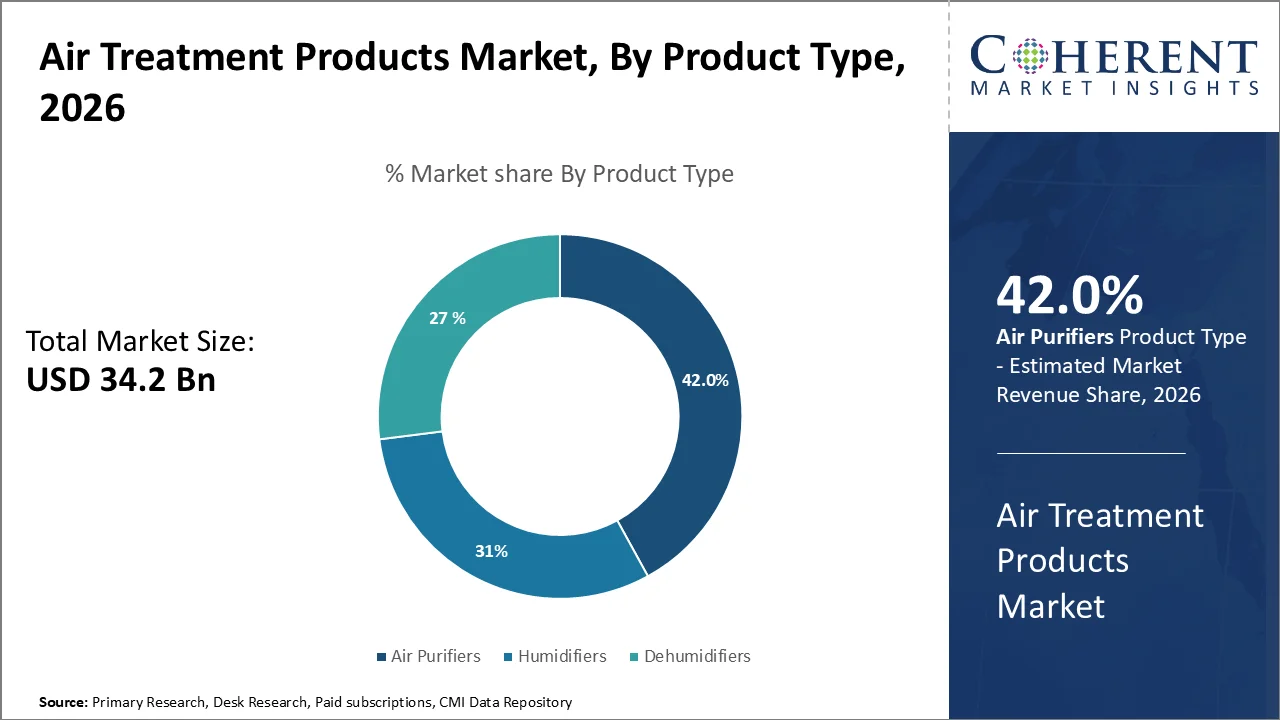
  • In 2026, air purifiers made up 42% of the Air Treatment Products Market, making them the most popular type of product. The EPA says that people spend about 90% of their time indoors, and that pollutants inside are often 2 to 5 times higher than those outside. HEPA filters can remove at least 99.97% of particles that are 0.3 microns or larger, which is why air purifiers are so popular. (US EPA)
  • By application, residential made up 48% of the market in 2026. The EPA says that people and the WHO says that about 2.1 billion people are still exposed to harmful household air pollution from polluting cooking methods. This shows that there is a huge demand for residential air treatment products. (WHO)
  • Based on Region, Asia Pacific has the largest share of the Air Treatment Products Market in 2026, with 38%. There are more than 2.2 billion people living in cities in the region, and about 2.2 billion people in the East Asia & Pacific region are exposed to dangerous levels of PM2.5. This strongly supports the need for indoor air treatment products. (ESCAP)

Segmental Insights

Air Treatment Product Market By Product Type

To learn more about this report, Download Free Sample

Air Purifier Segment dominates with 42% of market share in 2026

In 2026, air purifiers have the largest share of the Air Treatment Products Market, accounting for 42% of the market. They are the best because they directly deal with particulate pollutants in indoor spaces where people are most likely to be exposed. Testing done by the CDC in January 2026 found that two HEPA air cleaners that met EPA-recommended CADR levels cut aerosol exposure by up to 65%. When combined with universal masking, this number went up to 90%. (EPA)

People are becoming more worried about indoor air pollution, which is leading to more people using air purifiers in their homes and other indoor spaces. The World Health Organization (WHO) says that about 2.1 billion people are still breathing in harmful household air pollution. The combined effects of ambient and household air pollution cause about 7 million deaths each year. Sales are going up because people can choose products based on how well they work. The EPA says that during smoke events, a portable air cleaner should have a CADR that covers at least two-thirds of the room's area in square feet. The U.S. DOE sets standards for air-cleaner efficiency and CADR-based performance measurement. (WHO)

Dyson launched the HushJet Purifier Compact on September 4, 2025. They said it could capture 99.97% of pollutants at 0.3 microns and last five times longer than other filters. Blueair talked about the Blue Pure 211i Max on February 23, 2026. It has a CADR of 410 CFM and can cover 3,235 square feet in one hour. (Dyson)
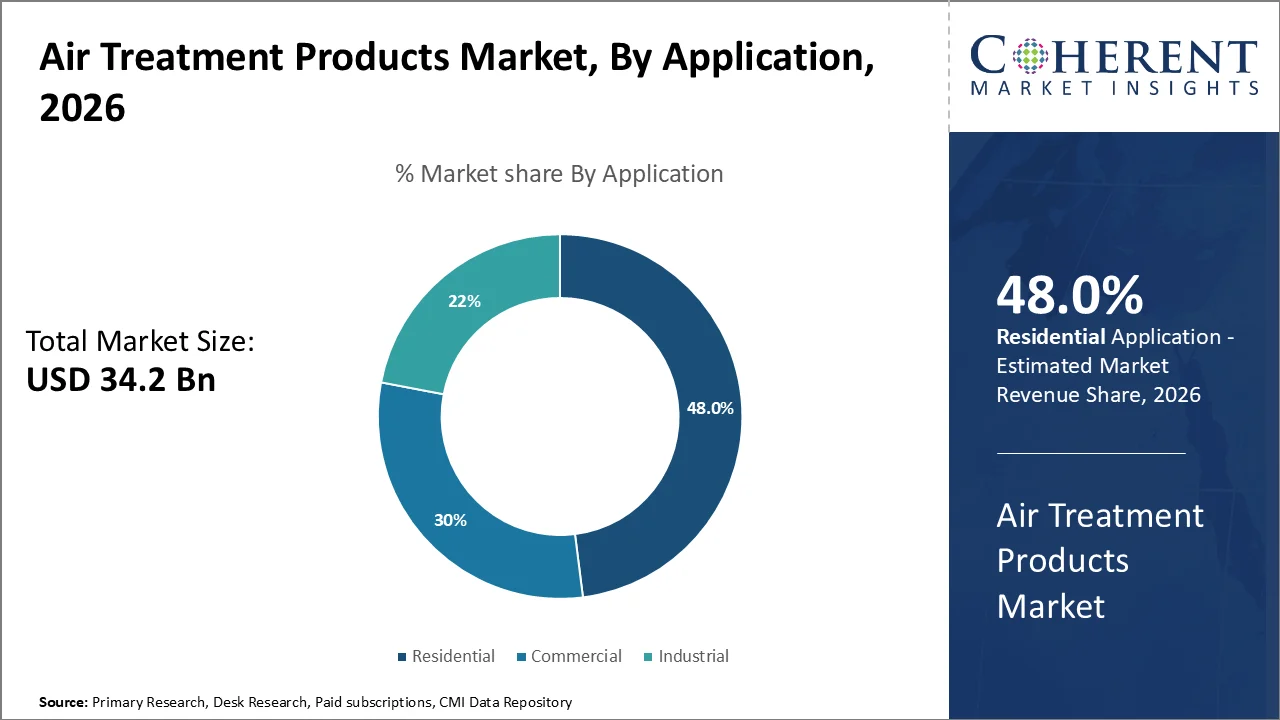
The Residential Segment dominates with 48% of market share in 2026

Air Treatment Product Market By Application

To learn more about this report, Download Free Sample

In 2026, the residential segment has the biggest share, 48%, making it the most common use of air treatment products. This is because most people are exposed to indoor pollutants at home. According to the U.S. EPA's February 2026 guide on home air cleaners, people spend about 90% of their time indoors, mostly in their homes. It also says that portable air cleaners and better HVAC filters can make the air in homes cleaner. (EPA)

More people are turning to home-based air treatment because they are worried about the health effects of household air pollution. The World Health Organization (WHO) says that household air pollution caused about 2.9 million deaths each year in 2021, and that ambient and household air pollution together cause 6.7 million premature deaths each year. Clearer advice for consumers and performance standards is making it easier for people to buy air cleaners for their homes. For example, the EPA's 2026 guide says to choose air cleaners based on the size of the room, and the California Air Resources Board says to choose devices whose CADR matches the space and to use certified low-ozone products. (WHO)

RGF released the Microcon 150 whole-home media filter with MERV 11 or MERV 13 options on February 11, 2026. Resideo launched the Honeywell Home Whole Home Dehumidifier on September 30, 2025. It had been tested for 150,000 hours of use in home HVAC systems. (RFG)

Air Treatment Products Market Trends

  • The Air Treatment Products Market is seeing a rise in demand for air purification products that focus on the home. The U.S. EPA's new 2026 guidelines say that people spend about 90% of their time indoors and that indoor pollution levels are often 2 to 5 times higher than outdoor levels. This keeps the demand for home purifiers high. Official CDC/NIOSH data also shows that using two HEPA air cleaners cut down on aerosol exposure by up to 65%, and by up to 90% when combined with universal masking. This makes portable air-cleaning products even more valuable. (EPA)
  • Another big trend in the market is designing products that work well and follow the rules. The U.S. Department of Energy's (DOE) new air-cleaner standards set a higher Tier 2 efficiency level that will go into effect in 2026. The deadline for compliance is December 31, 2025. The Environmental Protection Agency's (EPA) 2026 consumer guide says that one should choose a purifier with a smoke CADR that covers at least two-thirds of the room's area in square feet. California is also pushing the market toward safer devices by requiring that all portable indoor air cleaners sold in the state be CARB-certified and that electronic air cleaners not emit more than 0.050 ppm (50 ppb) of ozone. (Energy.gov)

Air Treatment Products Market Innovations

In 2026, new ideas in the Air Treatment Products Market are more and more focused on technologies that are safer, more efficient, and easier to measure. The U.S. Department of Energy's Tier 2 standards, which go into effect for products made after December 31, 2025, raise the minimum efficiency across the three air-cleaner classes to 1.9, 2.4, and 2.9 PM2.5 CADR/W. This pushes manufacturers to make air cleaners that produce more clean air per watt. At the same time, the EPA's 2026 guidance supports CADR-based product design. The CARB, on the other hand, still limits ozone emissions from electronic air cleaners to 0.050 ppm (50 ppb). RGF's Microcon 150 came out in February 2026 with a 4-inch MERV 11/MERV 13 whole-home filtration format, which shows how things have changed.

Current Events and Their Impact

Current Event

Description and its Impact

U.S. DOE energy-efficiency standards started shaping the 2026 air cleaner market

  • Description: The U.S. Department of Energy's standards for how well air cleaners work began to have a big effect on the market. This was because the new rules had to be followed for things made or brought into the country after the end of 2025.
  • Impact: People are paying more attention to making products that use less energy and are ready for certification because of this event. It is also making brands work harder to improve their current models, their technical positioning, and their ability to compete on product quality and compliant performance in regulated markets.

RGF launched a new whole-home filtration solution in February 2026

  • Description: The Microcon 150 Whole Home Media Filter is a new filter from RGF Environmental Group that can be used in homes and small businesses with HVAC systems. The launch shows that more and more businesses are focusing on solutions for improving the air quality in whole homes rather than just portable purifiers.
  • Impact: This event helps the market grow by adding air treatment systems that are related to HVAC and by increasing demand from contractors and retrofits. It also shows how manufacturers are expanding their product lines to attract customers who want all-in-one solutions for improving indoor air quality in homes and small buildings.

Uncover macros and micros vetted on 75+ parameters: Get instant access to report
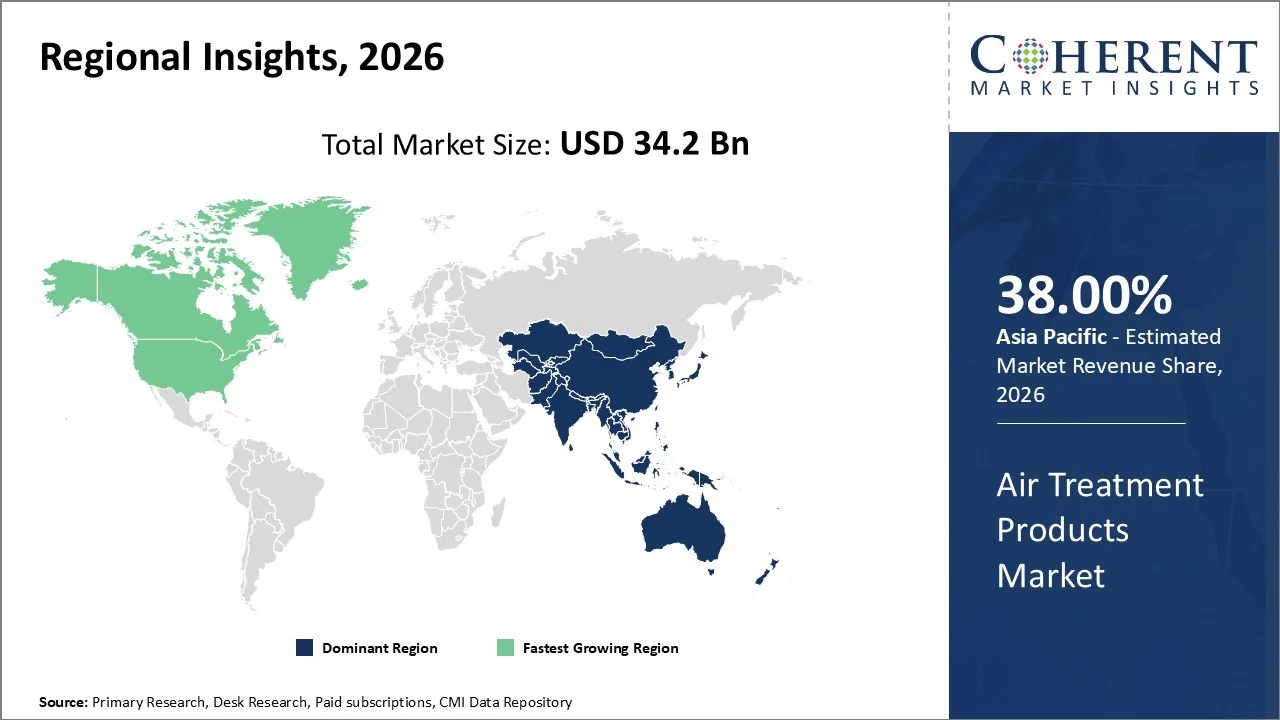
 

Regional Insights

Air Treatment Product Market By Regional Insights

To learn more about this report, Download Free Sample

Asia Pacific Leads the Market with 38% of the Market Share

Asia Pacific will have 38% of the market in 2026. According to the market data, Asia Pacific is the largest regional market. This is because it has a large urban population, a lot of exposure to pollution, and people are becoming more aware of the need for better indoor air quality. According to UN-Habitat, the region has more than 2.2 billion urban residents, which is 54% of the world's urban population. UNEP says that 70% of deaths caused by air pollution happen in Asia-Pacific. These structural conditions make more people want air purifiers, dehumidifiers, and other indoor air treatment systems in homes, businesses, and public buildings.

North America Drives Rapid Growth in Market

In 2026, North America is the fastest growing region with 21% share of the market. North America is the fastest-growing region because it has stricter rules about indoor air quality, more exposure to wildfire smoke, and faster adoption of better air-cleaning systems. The U.S. EPA says that people spend about 90% of their time inside, which makes air treatment for homes and businesses even more important. The U.S. Census also said in June 2025 that more than 37 million people were expected to be exposed to air quality that was "Unhealthy for Sensitive Groups" or worse because of smoke from Canadian wildfires that affected the U.S. This made more people want filtration and purifier products.

Country Analysis

China: Urbanization and pollution are putting pressure on demand

Because of its large cities and health problems caused by pollution, China is an important country in the Asia Pacific region. The National Bureau of Statistics of China said that by the end of 2025, 67.89% of the country's population lived in cities. The World Health Organization says that air pollution kills about 2 million people a year in China. These things keep demand for air treatment products for homes and businesses high, especially in big cities.

Awareness of wildfire smoke and indoor air quality in the United States drives adoption

The U.S. is a major growth engine in North America because people are becoming more worried about indoor air quality and occasional smoke events. The U.S. Environmental Protection Agency (EPA) says that Americans spend about 90% of their time indoors. The U.S. Census Bureau reported in June 2025 that over 37 million people were expected to be affected by unhealthy air conditions caused by Canadian wildfire smoke. This makes people want home and building-based air treatment solutions even more.

Market Report Scope

Air Treatment Product Market Report Coverage

Report Coverage Details
Base Year: 2025 Market Size in 2026: USD 34.2 Bn
Historical Data for: 2020 To 2024 Forecast Period: 2026 To 2033
Forecast Period 2026 to 2033 CAGR: 8.1% 2033 Value Projection: USD 58.9 Bn
Geographies covered:
  • North America: U.S., Canada
  • Latin America: Brazil, Argentina, Mexico, Rest of Latin America
  • Europe: Germany, U.K., Spain, France, Italy, Russia, Rest of Europe
  • Asia Pacific: China, India, Japan, Australia, South Korea, ASEAN, Rest of Asia Pacific
  • Middle East: GCC Countries, Israel, Rest of Middle East
  • Africa: South Africa, North Africa, Central Africa
Segments covered:
  • By Product Type: Air Purifier, Humidifier, Dehumidifier.
  • By Applications: Residential, Commercial, Industrial.
Companies covered:

Honeywell International Inc., Panasonic Corporation, Sharp Corporation, Samsung Electronics Co., Ltd., Winix Inc., De’Longhi S.p.A., Atlas Copco AB, AMFAH Group, Coway Co., Ltd., Koninklijke Philips N.V., Daikin Industries, Ltd., and Dyson Ltd.

Uncover macros and micros vetted on 75+ parameters: Get instant access to report

Who are the Major Companies in Air Treatment Products Market?

Major companies in the Air Treatment Products Market include Honeywell International Inc., Panasonic Corporation, Sharp Corporation, Samsung Electronics Co., Ltd., Winix Inc., De’Longhi S.p.A., Atlas Copco AB, AMFAH Group, Coway Co., Ltd., Koninklijke Philips N.V., Daikin Industries, Ltd., and Dyson Ltd.

Key News

In April 2026, Portronics entered India’s air purifier market with the launch of its AIR X smart HEPA air purifier.

Analyst Opinion

  • The Air Treatment Products Market is changing from a category of appliances that people can choose to a category of indoor air products that are based on performance. The best evidence comes from regulations and exposure data. The U.S. EPA says that Americans spend about 90% of their time indoors, where some pollutants are 2–5 times more concentrated than outdoors. The DOE's stricter Tier 2 standards now require air cleaners to be much more efficient. This is good for brands that have portfolios that are compliant, energy-efficient, and have a high CADR.

Market Segmentation

  • Global Air Treatment Products Market, By Product Type
    • Air Purifier
    • Humidifier
    • Dehumidifier
  • Global Air Treatment Products Market, By Application
    • Residential
    • Commercial
    • Industrial
  • Global Air Treatment Products Market, By Region
    • North America
      • U.S.
      • Canada
    • Europe
      • U.K.
      • Germany
      • Italy
      • France
      • Russia
      • Rest of Europe
    • Asia Pacific
      • India
      • China
      • Japan
      • ASEAN
      • Australia
      • South Korea
      • Rest of Asia Pacific
    • Latin America
      • Brazil
      • Argentina
      • Mexico
      • Rest of Latin America
    • Middle East and Africa
      • GCC
      • South Africa
      • Rest of the Middle East and Africa
  • Key Players
    • Honeywell International Inc.
    • Panasonic Corporation
    • Sharp Corporation
    • Samsung Electronics Co., Ltd.
    • Winix Inc.
    • De’Longhi S.p.A.
    • Atlas Copco AB
    • AMFAH Group
    • Coway Co., Ltd.
    • Koninklijke Philips N.V.
    • Daikin Industries, Ltd.
    • Dyson Ltd.

Sources

  • Primary Research Interviews
    • Interviews with air purifier manufacturers
    • Interviews with humidifier manufacturers
    • Interviews with dehumidifier manufacturers
    • Interviews with whole-home filtration manufacturers
    • Interviews with HVAC OEMs
    • Interviews with filter media suppliers
    • Interviews with distributors
    • Interviews with e-commerce sellers
    • Interviews with channel partners
    • Interviews with HVAC contractors
    • Interviews with facility managers
    • Interviews with indoor air quality consultants
    • Interviews with pulmonologists
    • Interviews with allergists
    • Interviews with environmental health specialists
    • Interviews with regulatory and standards experts
  • Databases
    • WHO Global Health Observatory
    • WHO Ambient Air Quality Database
    • U.S. EPA Indoor Air Quality resources
    • U.S. DOE air-cleaner standards database
    • ENERGY STAR certified air cleaners directory
    • AHAM Verifide directory
    • U.S. Census Bureau database
    • World Bank Data
    • UNData
    • National Bureau of Statistics of China database
  • Magazines
    • The ACHR News
    • HVACR Business
    • Cooling India
    • Appliance & HVAC Report
  • Journals
    • Indoor Air
    • Building and Environment
    • Environmental Science & Technology
    • Journal of Exposure Science & Environmental Epidemiology
    • Atmospheric Environment
    • Journal of Aerosol Science
  • Newspapers
    • Reuters
    • Financial Times
    • The Economic Times
  • Associations
    • Association of Home Appliance Manufacturers (AHAM)
    • ASHRAE
    • Indoor Air Quality Association (IAQA)
    • American Industrial Hygiene Association (AIHA)
  • Public Domain Sources
    • U.S. Environmental Protection Agency (EPA)
    • U.S. Department of Energy (DOE)
    • World Health Organization (WHO)
    • Centers for Disease Control and Prevention (CDC/NIOSH)
    • California Air Resources Board (CARB)
    • U.S. Census Bureau
    • UN-Habitat
    • UN ESCAP
    • United Nations Environment Programme (UNEP)
    • National Bureau of Statistics of China
  • Proprietary Elements
    • CMI Data Analytics Tool
    • Proprietary CMI Existing Repository of information for last 10 years

Share

Share

Missing comfort of reading report in your local language? Find your preferred language :

Frequently Asked Questions

In 2026, the global market for air treatment products will be worth USD 34.2 billion. The growth is helped by higher levels of air pollution, more people being aware of their health, and more people using smart indoor air quality solutions in homes and businesses.

The market is expected to grow at a rate of 8.1% and reach USD 58.9 billion by 2033. This growth is due to a greater focus on indoor air quality, new products, and a growing need for effective purification and filtration systems.

Some of the main factors driving growth are more exposure to indoor and outdoor air pollution, more people being aware of how air pollution affects their health, and more people wanting smart and energy-efficient air treatment devices. Regulatory standards and the need for certified low-emission products are also helping the market grow.

In 2026, the residential segment will have the largest market share, with 48%. This is mostly because people are becoming more aware of the air quality inside their homes, more people are using portable air purifiers and HVAC-integrated filtration systems, and people are spending more on home appliances that promote health.

The Asia Pacific region will have the most market share in 2026, with 38%. Rapid urbanization, high levels of pollution, a large number of consumers, and more people using air treatment products in densely populated residential and commercial areas all help the region's leaders.

Select a License Type

EXISTING CLIENTELE

Joining thousands of companies around the world committed to making the Excellent Business Solutions.

View All Our Clients
trusted clients logo
© 2026 Coherent Market Insights Pvt Ltd. All Rights Reserved.