Aircraft Electric Brake Control System Market Analysis & Forecast: 2026-2033

Aircraft Electric Brake Control System Market Size and Forecast – 2026 – 2033
The Global Aircraft Electric Brake Control System Market size is estimated to be valued at USD 1.45 billion in 2026 and is expected to reach USD 2.9 billion by 2033, exhibiting a compound annual growth rate (CAGR) of 10.5% from 2026 to 2033.
Global Aircraft Electric Brake Control System Market Overview
The aircraft electric brake control system market is driven by the growing demand for more-electric aircraft, increasing aircraft deliveries, and the aviation industry's focus on improving operational efficiency and safety. Airlines and aircraft manufacturers are increasingly adopting electric brake control systems due to their lower maintenance requirements, reduced weight, and improved braking performance compared to conventional hydraulic systems. Rising investments in commercial aviation, fleet modernization programs, and next-generation aircraft development are further supporting market growth. Additionally, stringent aviation safety regulations, advancements in brake-by-wire technology, and the increasing adoption of electric and hybrid-electric aircraft are accelerating demand for advanced electric brake control systems worldwide.
Key Takeaways
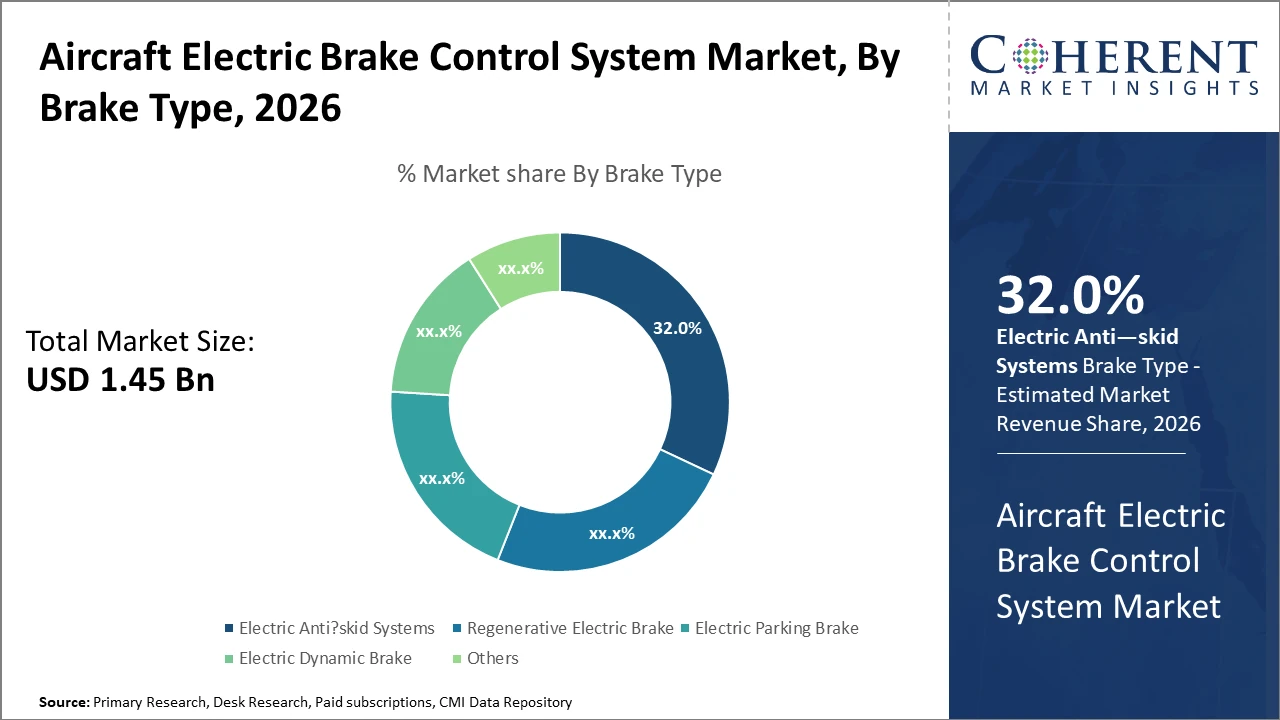
The Electric Anti-skid System segment currently dominates the market with a 32% share, supported by its essential role in enhancing aircraft braking safety and operational reliability in commercial aviation.
Retrofit and aftermarket services are witnessing strong growth potential as aging aircraft fleets undergo modernization to comply with evolving environmental standards and aviation safety regulations.
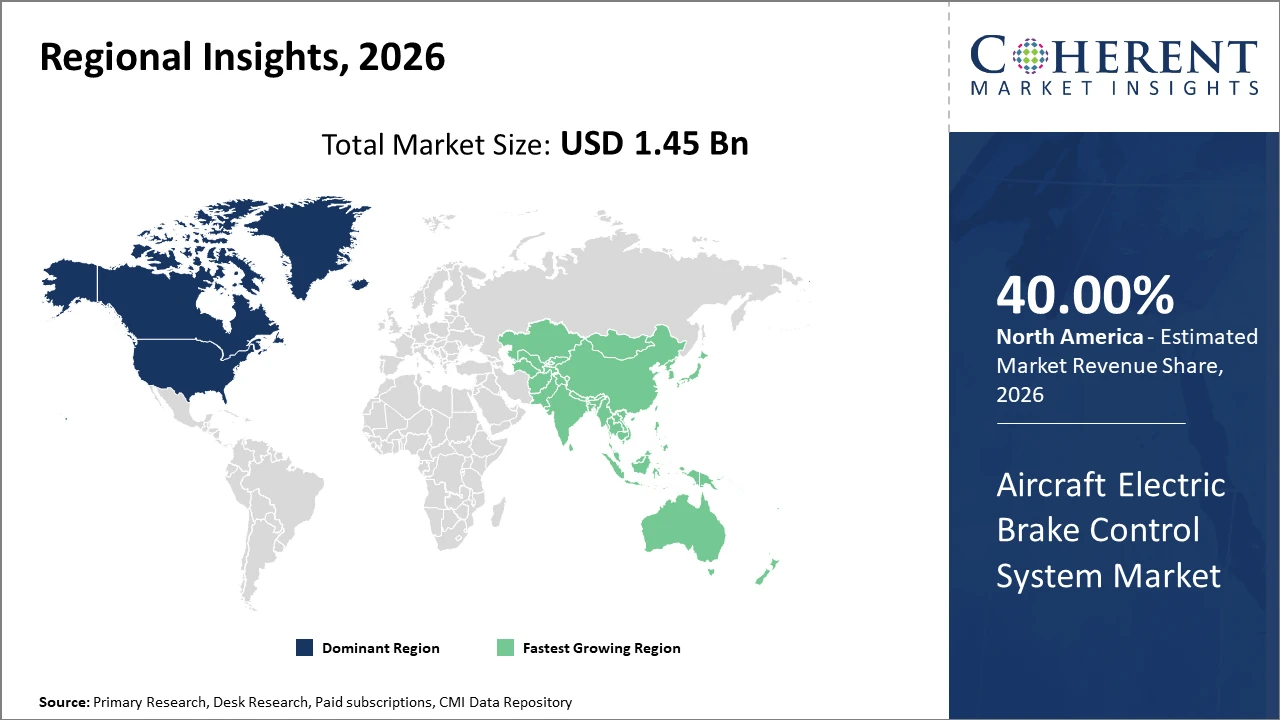
North America accounts for more than 40% of the market share due to its well-established aerospace manufacturing base, advanced technological capabilities, and supportive regulatory framework.
Asia Pacific is emerging as the fastest-growing regional market, expanding at a CAGR of nearly 12%, driven by rising aircraft deliveries, increasing air passenger traffic, and growing regional OEM manufacturing capacity.
Aircraft Electric Brake Control System Market Segmentation Analysis
To learn more about this report, Request Free Sample
Aircraft Electric Brake Control System Market Insights, By Brake Type
The Electric Anti-skid System dominates the Aircraft Electric Brake Control System market due to its essential role in preventing wheel skidding during aircraft landing and taxiing operations. Its widespread deployment across commercial and military aircraft is supported by strict aviation safety regulations and the need for reliable braking performance. Regenerative Electric Brake is emerging as the fastest-growing subsegment because it enhances braking efficiency while recovering energy during deceleration, supporting fuel efficiency and sustainability goals. Electric Parking Brake systems are increasingly adopted for automated ground operations and retrofit projects.
Aircraft Electric Brake Control System Market Insights, By Aircraft Type
Commercial Aircraft lead the Aircraft Electric Brake Control System market owing to the growing adoption of advanced electric braking technologies in modern passenger aircraft. Airlines are increasingly deploying these systems to improve fuel efficiency, reduce maintenance costs, and comply with stringent aviation safety standards. Military Aircraft are the fastest-growing segment, supported by rising defense modernization programs and demand for highly reliable braking performance in critical operations. Business Jets are steadily incorporating electric brake systems for enhanced operational efficiency, lower weight, and reduced noise. Helicopter applications remain limited but are expanding with urban air mobility developments, while drone platforms represent an emerging segment utilizing compact electric braking technologies.
Aircraft Electric Brake Control System Market Insights, By Application
New Aircraft Production dominates the Aircraft Electric Brake Control System market as aircraft manufacturers increasingly integrate advanced electric braking technologies into newly manufactured commercial and military aircraft. The segment benefits from rising aircraft deliveries, fuel efficiency requirements, and strict aviation safety standards. Retrofit & Aftermarket services are the fastest-growing segment due to growing investments in upgrading aging aircraft fleets with modern brake control technologies that improve operational performance and reduce maintenance costs. Maintenance & Repair applications remain important for ensuring system reliability, predictive diagnostics, and long-term operational efficiency. Other applications include research, testing, and experimental aerospace programs focused on next-generation electric aircraft innovations and advanced braking solutions.
Aircraft Electric Brake Control System Market Trends
The Aircraft Electric Brake Control System market is witnessing strong growth in system miniaturization and integration of digital monitoring technologies to improve operational efficiency and aircraft safety.
Advancements in sensor fusion algorithms introduced in 2025 enhanced predictive maintenance capabilities and reduced unexpected brake system failures by nearly 18%.
The emergence of electric air taxis and urban air mobility vehicles is creating new opportunities for innovative lightweight electric braking solutions, with manufacturers developing systems tailored for next-generation aircraft platforms.
North America holds more than 40% of the global market share due to its established aerospace manufacturing ecosystem, strong OEM presence, and supportive regulatory environment encouraging electric system adoption.
Asia Pacific is the fastest-growing region with an estimated CAGR of around 12%, driven by rising aircraft deliveries in China and India, increasing aerospace investments, defense modernization programs, and expansion activities by companies such as Safran and Parker-Hannifin.
Aircraft Electric Brake Control System Market Insights, By Geography
To learn more about this report, Request Free Sample
North America Aircraft Electric Brake Control System Market Analysis and Trends
North America dominates the Aircraft Electric Brake Control System market with a share of 40% due to its highly developed aerospace manufacturing ecosystem, advanced research capabilities, and continuous technological innovation in aircraft systems. The region benefits from the strong presence of major aerospace OEMs such as Boeing and Lockheed Martin, which actively invest in next-generation electric braking technologies. Strict aviation safety standards enforced by regulatory authorities, including the FAA, are encouraging widespread adoption of electric brake systems across commercial and military aircraft. In addition, strategic partnerships between component suppliers and aircraft manufacturers continue to strengthen regional market growth and revenue opportunities.
Asia Pacific Aircraft Electric Brake Control System Market Analysis and Trends
Asia Pacific represents the fastest-growing region in the Aircraft Electric Brake Control System market, driven by rapid expansion of commercial aircraft fleets across China, India, and Southeast Asia. Increasing passenger air traffic, rising airline investments, and strong demand for fuel-efficient aircraft are accelerating adoption of advanced electric brake technologies. Governments across the region are supporting aerospace infrastructure development through favorable policies, domestic manufacturing initiatives, and defense modernization programs. The region’s growth rate of nearly 12% CAGR is further supported by rising aftermarket service demand and production capacity expansions by major industry participants such as Honeywell and Liebherr.
Aircraft Electric Brake Control System Market Outlook for Key Countries
USA Aircraft Electric Brake Control System Market Analysis and Trends
The United States represents one of the most advanced and mature markets for Aircraft Electric Brake Control Systems, supported by significant investments in aerospace research, innovation, and manufacturing capabilities. Major industry participants such as Collins Aerospace and Honeywell are actively developing advanced electric anti-skid and regenerative braking technologies for commercial and military aircraft applications. In 2025, the U.S. contributed more than 35% of global market revenue due to high aircraft production volumes, rising defense spending, and strict aviation safety regulations mandating the integration of efficient electric brake systems across modern aircraft fleets.
Germany Aircraft Electric Brake Control System Market Analysis and Trends
Germany represents a significant market for Aircraft Electric Brake Control Systems due to its strong aerospace engineering expertise, advanced manufacturing infrastructure, and presence of leading aviation suppliers. The country benefits from rising investments in fuel-efficient aircraft technologies and increasing adoption of electric braking systems in both commercial and defense aviation sectors. Growing emphasis on lightweight aircraft components, sustainability targets, and predictive maintenance solutions is accelerating market demand. Germany also supports innovation through collaborations between aerospace companies and research institutions focused on next-generation electric aircraft technologies. Increasing participation in European aerospace programs and expanding aircraft modernization activities continue to strengthen the market outlook across the country.
Analyst Opinion
Rising demand for fuel-efficient aircraft is a major market driver, as electric brake control systems help reduce aircraft weight and improve energy management efficiency. In 2025, major airlines integrated electric braking systems into more than 30% of their fleets, achieving nearly 7% improvement in fuel consumption during take-off and landing operations.
Production capacity expansions by leading aircraft manufacturers increased market revenue growth, with aerospace facilities across North America and Asia raising output by around 20% in 2024 to meet growing demand for next-generation narrow-body aircraft equipped with electric brake technologies.
Increasing aircraft deliveries in emerging Asia Pacific markets boosted imports of electric brake components by approximately 14% in 2026, while the defense sector contributed to an 8% year-on-year market revenue increase through adoption of advanced braking systems for military aircraft.
Advancements in nano-scale sensor technologies significantly improved brake system responsiveness and predictive maintenance capabilities, attracting nearly USD 120 million in research investments during 2025 and supporting emerging applications in urban air mobility and electric aircraft platforms.
Market Scope
| Report Coverage | Details | ||
|---|---|---|---|
| Base Year: | 2025 | Market Size in 2026: | USD 1.45 billion |
| Historical Data for: | 2020 To 2024 | Forecast Period: | 2026 To 2033 |
| Forecast Period 2026 to 2033 CAGR: | 10.5% | 2033 Value Projection: | USD 2.9 billion |
| Geographies covered: |
|
||
| Segments covered: |
|
||
| Companies covered: | Safran SA, Honeywell International Inc., Moog Inc., Thales Group, Meggitt PLC, Textron Inc., BAE Systems, Eaton Corporation | ||
| Growth Drivers: |
|
||
Uncover macros and micros vetted on 75+ parameters: Get instant access to report
Aircraft Electric Brake Control System Market Growth Factors
Several factors are driving the growth of the Aircraft Electric Brake Control System market globally. Increasing aviation regulations focused on fuel efficiency and emissions reduction are encouraging aircraft manufacturers to adopt advanced electric braking technologies that improve energy management during landing and taxiing operations. Rising retrofit activities replacing traditional hydraulic braking systems with electric alternatives are also supporting market expansion as component costs continue to decline. In addition, growing military aircraft procurement programs are increasing demand for highly responsive and low-noise electric brake systems. Advancements in lightweight materials and durable component technologies are further enhancing system performance, reliability, and adoption across commercial and defense aerospace sectors worldwide.
Aircraft Electric Brake Control System Market Development
In November 2025, Tawazun Council for Defence Enablement, EPI (an EDGE Group company), and General Atomics Aeronautical Systems (GA-ASI) signed a framework agreement to manufacture Electronic Brake Control Units (eBCUs) for aircraft in the United Arab Emirates.
Key Players
Leading Companies of the Market
Safran S.A.
Honeywell International Inc.
Thales Group
Moog Inc.
Textron Inc.
Meggitt PLC
BAE Systems
Eaton Corporation
Leading companies in the Aircraft Electric Brake Control System market are emphasizing technological innovation and strategic collaborations to strengthen market position. In 2025, Safran and Collins Aerospace developed an integrated electric brake platform that reduced system weight by 15% and improved reliability by 10%. Parker-Hannifin expanded manufacturing operations in Asia, while Honeywell enhanced predictive maintenance services, extending brake system life cycles by nearly 12%.
Aircraft Electric Brake Control System Market Future Outlook
The future outlook for the Aircraft Electric Brake Control System market remains highly positive, driven by increasing aircraft production, growing demand for fuel-efficient aviation technologies, and continuous advancements in electric braking systems. Rising adoption of brake-by-wire technologies, predictive maintenance solutions, and lightweight components is expected to enhance aircraft operational efficiency and safety standards. Expanding urban air mobility projects and next-generation electric aircraft development will create additional growth opportunities for manufacturers. Emerging economies in Asia Pacific and the Middle East are anticipated to contribute significantly through increasing aircraft deliveries and aerospace investments. Ongoing defense modernization programs will further support long-term market expansion globally.
Aircraft Electric Brake Control System Market Historical Analysis
The Aircraft Electric Brake Control System market has experienced steady growth over the past decade, supported by advancements in aerospace electrification and increasing emphasis on aircraft safety and fuel efficiency. Initially, hydraulic braking systems dominated the aviation sector, but rising demand for lightweight and low-maintenance alternatives accelerated the adoption of electric brake technologies. Between 2018 and 2025, commercial aircraft manufacturers increasingly integrated brake-by-wire and electric anti-skid systems into next-generation aircraft programs. Growth in global air passenger traffic, military aircraft modernization, and stricter environmental regulations further strengthened market demand. Technological improvements in sensors, actuators, and predictive diagnostics also contributed significantly to market evolution.
Sources
Primary Research Interviews:
Aircraft brake system manufacturers, aerospace OEMs, avionics suppliers, airline maintenance managers, aircraft component distributors, and MRO service providers involved in electric brake control system integration and aftermarket services.
Aerospace engineers, aviation safety specialists, defense procurement authorities, regulatory consultants, sensor technology experts, and R&D directors specializing in brake-by-wire systems, electro-mechanical braking technologies, predictive maintenance, and aircraft electrification programs.
Magazines:
Aviation Week & Space Technology – Insights into aircraft braking innovations, aerospace manufacturing trends, and aviation technology developments.
Aerospace Manufacturing and Design – Coverage of aircraft system engineering, electric braking advancements, and aerospace supply chain trends.
FlightGlobal – Updates on aircraft deliveries, airline modernization programs, and aerospace technology adoption worldwide.
Journals:
Journal of Aerospace Engineering – Research on aircraft braking systems, aerospace materials, and aviation performance optimization.
Aerospace Science and Technology – Studies focused on aircraft electrification, brake control technologies, and next-generation aviation systems.
IEEE Transactions on Aerospace and Electronic Systems – Research related to sensors, avionics integration, and intelligent aircraft control technologies.
Newspapers:
Financial Times – Coverage of aerospace investments, aircraft manufacturing expansion, and aviation technology trends.
Reuters – Reporting on aerospace contracts, aircraft production updates, and regulatory developments in aviation systems.
Bloomberg – Insights into mergers, acquisitions, strategic partnerships, and global aerospace market developments.
Associations:
Aerospace Industries Association – Industry standards, aerospace manufacturing developments, and aviation technology initiatives.
International Air Transport Association – Insights into airline operational trends, aircraft safety requirements, and fleet modernization programs.
SAE International – Research standards, aerospace engineering innovations, and developments in aircraft electronic and braking systems.
Share
Share
Suraj Bhanudas Jagtap is a seasoned Senior Management Consultant with over 7 years of experience. He has served Fortune 500 companies and startups, helping clients with cross broader expansion and market entry access strategies. He has played significant role in offering strategic viewpoints and actionable insights for various client’s projects including demand analysis, and competitive analysis, identifying right channel partner among others.

Credibility and Certifications

860519526


9001:2015

27001:2022


Need a Custom Report?
We can customize every report - free of charge - including purchasing stand-alone sections or country-level reports
Customize NowJoining thousands of companies around the world committed to making the Excellent Business Solutions.
View All Our Clients