Bio-based Paints & Coatings Market Analysis & Forecast: 2026-2033

Bio-based Paints & Coatings Market Size and Forecast – 2026 – 2033
The Global Bio-based Paints & Coatings Market size is estimated to be valued at USD 9.02 billion in 2026 and is expected to reach USD 17.58 billion by 2033, exhibiting a compound annual growth rate (CAGR) of 10.0% from 2026 to 2033.
Global Bio-based Paints & Coatings Market Overview
Bio-based paints and coatings are formulated using renewable raw materials such as plant oils, starches, proteins, and natural pigments instead of traditional petroleum-derived chemicals. These coatings offer lower VOC emissions, reduced environmental impact, and improved indoor air quality, making them increasingly preferred for residential, commercial, and industrial applications. Products range from interior wall paints and wood coatings to protective industrial coatings. Advancements in bio-resins, such as alkyds and polyurethanes derived from biomass, are allowing manufacturers to deliver comparable performance in durability, adhesion, and weather resistance. Growing green-building initiatives and sustainability regulations are accelerating adoption.
Key Takeaways
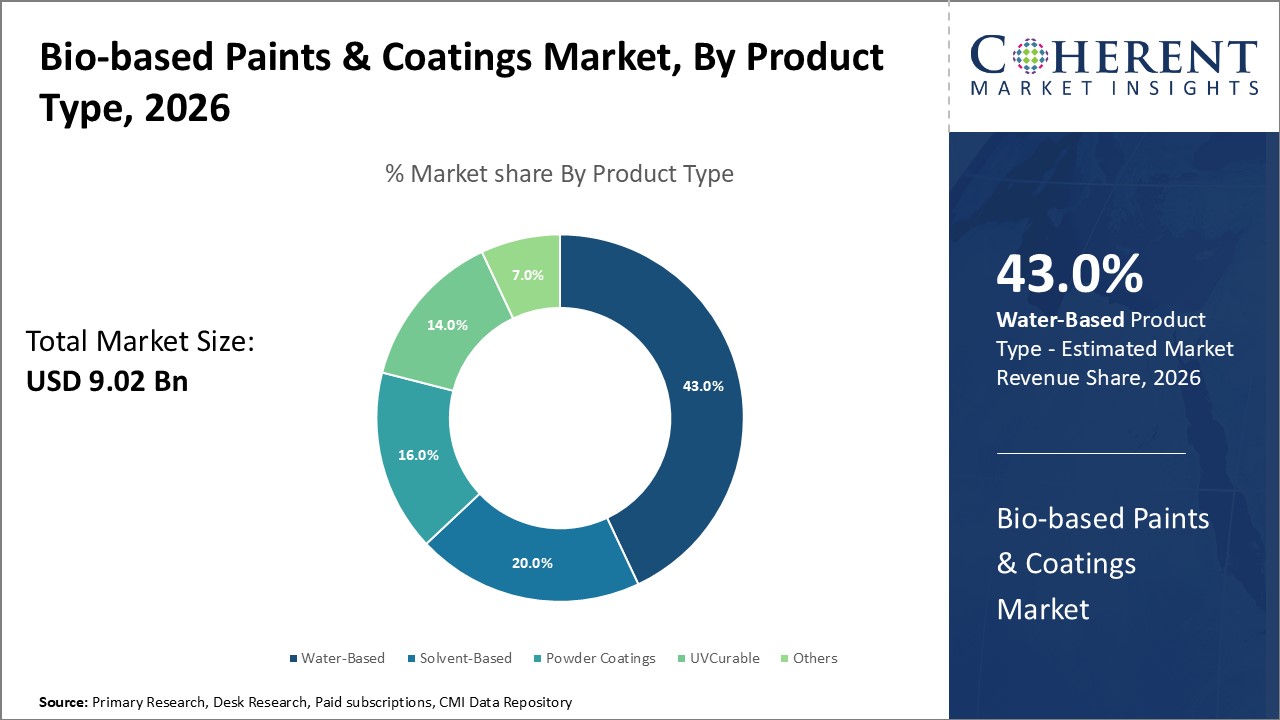
The water-based product segment dominates with 43% market share, driven by regulatory mandates and consumer preference for low-VOC finishes.
Architectural application holds significant revenue generation potential, attributed to increasing green building construction worldwide.
Asia Pacific is a crucial region delivering accelerated market growth due to expanding infrastructure projects aligned with sustainability goals and rising industrial activities.
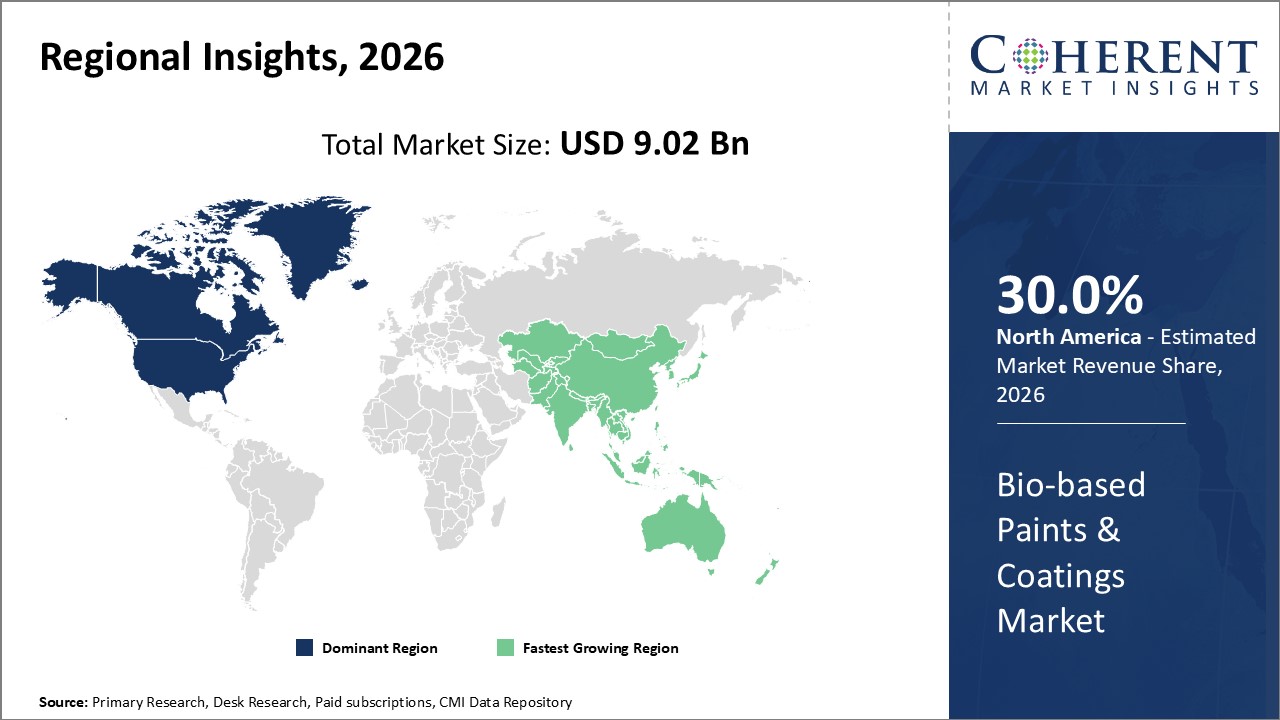
North America leads the market industry share with over 30%, supported by stringent environmental policies and well-established bio-resin manufacturing ecosystems.
Bio-based Paints & Coatings Market Segmentation Analysis
To learn more about this report, Request Free Sample
Bio-based Paints & Coatings Market Insights, By Product Type
Water-based dominates the market share with 43%. Water-based bio-coatings experience widespread acceptance due to their low volatile organic compounds, regulatory compliance, and adaptability across diverse end-use sectors. Their driving factor is the clean manufacturing process aligned with emission reduction mandates, which makes water-based bio-coatings prevalent in architectural and automotive applications. The fastest growing subsegment is UV Curable coatings, valued for rapid curing, enhanced durability, and reduced energy consumption, making them attractive for industrial and electronics applications where efficiency and precision are paramount.
Bio-based Paints & Coatings Market Insights, By Application
Architectural coatings dominate the share due to massive demand from green building projects and strict environmental standards, comprising the majority of bio-based paints & coatings revenue. Their growth is propelled by both residential and commercial construction activities, emphasizing sustainability and occupant health. The fastest growing subsegment is the Marine application, driven by growing needs for eco-compliant anti-corrosion and antifouling coatings that minimize environmental pollution in sensitive aquatic ecosystems. Automotive coatings follow a steady growth curve, supported by OEMs' commitment to sustainable materials and lightweight vehicle design.
Bio-based Paints & Coatings Market Insights, By Resin Type
Acrylic resin is emerging as the dominating subsegment in terms of market share due to its versatile performance characteristics and excellent environmental profile. Acrylic-based bio-coatings offer superior weather resistance and color retention, making them widely adopted in architectural and automotive segments. The fastest growing resin subsegment is Epoxy, appreciated for enhanced mechanical strength and chemical resistance, increasingly applied in industrial and marine coatings where durability is critical. Alkyd resins maintain relevance due to cost-effectiveness in low-end architectural applications, while Polyurethane offers premium functional properties, especially in automotive OEM finishes and aerospace uses.
Bio-based Paints & Coatings Market Trends
The bio-based paints & coatings market is witnessing several transformative trends.
Firstly, industry players are intensifying focus on circular bioeconomy principles by developing recyclable and degradable coatings, aligning with increasing regulatory emphasis on sustainability.
For example, 2025 marked a 26% rise in circular bio-based product patents, reflecting strong R&D activity.
Secondly, customization of bio-based formulations tailored for industrial sectors, including marine and aerospace, reflects diversification of applications beyond traditional architectural and automotive uses.
The growing demand for lightweight, eco-friendly coatings in aerospace directly raised market revenues by 13% in 2025.
Thirdly, digitalization and Industry 4.0 integration in manufacturing processes enhance production efficiencies of bio-based coatings, optimizing supply chain management and reducing operational costs.
Bio-based Paints & Coatings Market Insights, By Geography
To learn more about this report, Request Free Sample
North America Bio-based Paints & Coatings Market Analysis and Trends
In North America, the dominance in the Bio-based Paints & Coatings market is powered by strong regulatory frameworks like the U.S. EPA’s enhanced VOC restrictions and Canada’s green procurement policies. These factors, coupled with advanced bio-resin manufacturing hubs, contribute to North America holding over 30% industry share globally. Major companies such as Sherwin-Williams and PPG have leveraged these policies to introduce innovative bio-based products, significantly impacting regional market revenue.
Asia Pacific Bio-based Paints & Coatings Market Analysis and Trends
Meanwhile, the Asia Pacific exhibits the fastest growth with a CAGR exceeding 11%. Rapid urbanization, government initiatives like China’s Green Building Action Plan, and burgeoning industrial output in countries like India and South Korea accelerate demand for bio-based coatings. Notably, Asian Paints Limited and Kansai Paint have scaled up bio-based product lines targeting infrastructure and industrial coatings sectors, boosting market expansion extensively.
Bio-based Paints & Coatings Market Outlook for Key Countries
USA Bio-based Paints & Coatings Market Analysis and Trends
The USA’s market for bio-based paints & coatings is shaped by progressive environmental regulations, including California’s stringent air quality standards, which have driven a 20% growth in low-VOC bio-based coatings in 2025. Key players such as PPG Industries and Sherwin-Williams have aggressively invested in bio-based R&D facilities, resulting in expanded market share and innovation-led business growth. Additionally, the country’s focus on green construction and automotive sector transformation offers sustained demand growth trajectories.
Germany Bio-based Paints & Coatings Market Analysis and Trends
Germany’s market is buoyed by national commitments under the European Green Deal, mandating sustainable industrial practices, resulting in a 15% year-over-year increase in bio-based coatings adoption across construction and automotive sectors in 2025. Firms like BASF SE and AkzoNobel have propelled technological advancements and reinforced supply chains for bio-based resins, further strengthening Germany’s strategic position within Europe’s bio-based coatings ecosystem.
Analyst Opinion
The demand-side indicators for the bio-based paints & coatings market confirm a strong shift toward regulatory compliance, driving adoption. For instance, in 2025, the European Union accelerated its VOC emission targets, prompting a notable 17% increase in bio-based coatings usage across automotive manufacturing compared to 2023 data. This regulatory push is reflected in increased industry investments, projecting expansive market growth supported by end-user sectors.
Production capacity expansions by key chemical plants specializing in renewable raw materials have improved supply consistency, evidenced by a 12% annual increase in bio-resin output capacity in the Asia Pacific during 2025. This surge is critical in fulfilling growing demand without supply chain bottlenecks, underpinning potential market share growth for manufacturers focusing on sustainable inputs.
Pricing dynamics in the bio-based paints & coatings arena show increasing competitiveness; in 2026, bio-based coatings achieved price parity with conventional counterparts in North America, driven by innovation in feedstock procurement and process optimization. Such market dynamics reduce traditional cost restraints and accelerate substitution, especially in large-scale architectural and industrial applications.
Micro-market indicators reveal emerging niche applications, including marine and aerospace segments, where bio-based coatings gained traction with a 21% CAGR growth reported in 2025 due to enhanced functional properties like corrosion resistance and biodegradability. These niche developments present avenues for sustained business growth in otherwise specialized sectors.
Market Scope
| Report Coverage | Details | ||
|---|---|---|---|
| Base Year: | 2025 | Market Size in 2026: | USD 9.02 billion |
| Historical Data for: | 2020 To 2024 | Forecast Period: | 2026 To 2033 |
| Forecast Period 2026 to 2033 CAGR: | 10.0% | 2033 Value Projection: | USD 17.58 billion |
| Geographies covered: |
|
||
| Segments covered: |
|
||
| Companies covered: | Hempel A/S, Asian Paints Limited, Nippon Paint Holdings Co., Ltd., Wacker Chemie AG, Covestro AG, The Valspar Corporation, Kansai Nerolac Paints Ltd., Arkema S.A.,Dow Chemical Company, and Allnex Group. | ||
| Growth Drivers: |
|
||
Uncover macros and micros vetted on 75+ parameters: Get instant access to report
Bio-based Paints & Coatings Market Growth Factors
Market growth drivers emerging within bio-based paints & coatings include stringent environmental regulations mandating VOC and hazardous constituent reductions, which significantly stimulate demand for sustainable alternatives. Secondly, increasing consumer and industrial preference for green building materials across construction sectors supports persistent market expansion. Third, advancements in biopolymer technology enhance durability and performance characteristics, making bio-based coatings increasingly viable for high-performance applications such as automotive finishes. Lastly, rising investments in emerging economies to develop infrastructure aligned with sustainability goals provide broad market growth momentum, evidenced by over 20% year-on-year revenue growth in Asia Pacific regions during 2025.
Bio-based Paints & Coatings Market Development
In 2026, AkzoNobel expanded its sustainable coatings portfolio by launching USDA-certified bio-based wood coatings, developed using renewable raw materials to reduce carbon footprint while maintaining durability and aesthetic performance. The launch supported rising demand for eco-friendly solutions in architectural and furniture applications.
In 2026, BASF introduced biomass-balance automotive coatings in China, enabling automakers to lower Scope 3 emissions without compromising coating performance or production efficiency. The initiative aligned with China’s sustainability goals and BASF’s global commitment to circular and low-carbon manufacturing.
In 2023, PPG advanced its marine coatings portfolio with the launch of fouling-release coatings, designed to reduce biofouling, improve vessel fuel efficiency, and lower greenhouse gas emissions. The technology supports sustainable shipping by minimizing drag and reducing the need for biocides, reinforcing PPG’s position in high-performance marine protection solutions.
Key Players
Leading Companies of the Market
Hempel A/S
Asian Paints Limited
Nippon Paint Holdings Co., Ltd.
Wacker Chemie AG
Covestro AG
The Valspar Corporation
Kansai Nerolac Paints Ltd.
Arkema S.A.
Dow Chemical Company
Allnex Group
Several leading market companies have strategically invested heavily in bio-based resin development partnerships; for example, AkzoNobel’s collaboration with bio-polymer startups in 2025 accelerated their biodegradable epoxy range launch, resulting in a 16% increment in market share within architectural coatings. Similarly, BASF’s implementation of circular economy strategies, including recyclable raw material feedstock, improved its sustainability credentials and expanded its presence in European bio-based paint revenue streams by 19% in 2025.
Bio-based Paints & Coatings Market Future Outlook
In the future, bio-based coatings will experience strong demand as industries transition toward sustainable materials and carbon-neutral manufacturing. Major players are expected to expand their portfolios of plant-derived alkyds, polyurethanes, and acrylics, offering eco-friendly alternatives for wood finishes, architectural coatings, and industrial surfaces. Continued innovation in bio-solvents, natural pigments, and biodegradable additives will enhance performance characteristics, making bio-based coatings viable for heavy-duty applications. Increasing adoption of green building certifications and ESG-driven procurement will accelerate usage across corporate infrastructure, public projects, and residential housing. The Asia-Pacific region, driven by increasing environmental regulations, will become a major growth hotspot.
Bio-based Paints & Coatings Market Historical Analysis
The bio-based paints & coatings market emerged as a response to increasing environmental concerns, stricter emission regulations, and consumer demand for low-VOC, non-toxic finishing solutions. Historically, technological advancements in bio-resins derived from soybean oil, linseed oil, and other renewable sources allowed bio-based paints to compete with petrochemical-based products. The green building movement, particularly in Europe and North America, accelerated adoption across residential and commercial segments. Manufacturers invested in improving durability, UV resistance, and adhesion properties to meet industrial performance standards. Steady support from regulatory frameworks such as LEED, REACH, and eco-labeling initiatives strengthened market confidence and guided innovation.
Sources
Primary Research Interviews:
Coating Chemists
Sustainability Officers
Paint Manufacturers
Green Building Experts
Resin Technologists
Databases:
Euromonitor Paints Industry
UN Comtrade Chemical Coatings
OECD Environmental Data
World Bank Industrial Chemicals
Magazines:
Coatings World
European Coatings Journal
Sustainable Packaging & Materials
Paint & Coatings Industry Magazine
Green Building Magazine
Journals:
Journal of Coatings Technology
Progress in Organic Coatings
Green Chemistry Journal
Journal of Materials Science
Sustainable Materials Journal
Newspapers:
Financial Times (Sustainability)
The Hindu Business Line
Reuters Chemicals
The Guardian (Environment)
The Wall Street Journal (Industry)
Associations:
American Coatings Association
European Coatings Association
Green Building Council
Bio-based Industries Consortium,
Paint Research Association
Share
Share
Vidyesh Swar is a seasoned Consultant with a diverse background in market research and business consulting. With over 6 years of experience, Vidyesh has established a strong reputation for his proficiency in market estimations, supplier landscape analysis, and market share assessments for tailored research solution. Using his deep industry knowledge and analytical skills, he provides valuable insights and strategic recommendations, enabling clients to make informed decisions and navigate complex business landscapes.

Credibility and Certifications

860519526


9001:2015

27001:2022


Need a Custom Report?
We can customize every report - free of charge - including purchasing stand-alone sections or country-level reports
Customize NowJoining thousands of companies around the world committed to making the Excellent Business Solutions.
View All Our Clients