Cellulose Derivative Market Analysis & Forecast: 2026-2033

Cellulose Derivative Market Size and Forecast – 2026 – 2033
The Global Cellulose Derivative Market size is estimated to be valued at USD 12.5 billion in 2026 and is expected to reach USD 19.8 billion by 2033, exhibiting a compound annual growth rate (CAGR) of 7.1% from 2026 to 2033.
Global Cellulose Derivative Market Overview
Cellulose derivatives are modified forms of cellulose, a natural polymer found in the cell walls of plants. Cellulose itself is abundant, renewable, and biodegradable, but it has limited solubility and processability. To improve its properties, chemists chemically treat cellulose by replacing some of its hydroxyl groups with functional groups such as methyl, ethyl, or acetate. This produces derivatives like cellulose acetate, carboxymethyl cellulose, and hydroxypropyl cellulose. These materials are widely used in pharmaceuticals, food products, textiles, coatings, and biodegradable plastics. Cellulose derivatives enhance solubility, flexibility, stability, and film-forming ability, making them valuable in many industrial and commercial applications.
Key Takeaways
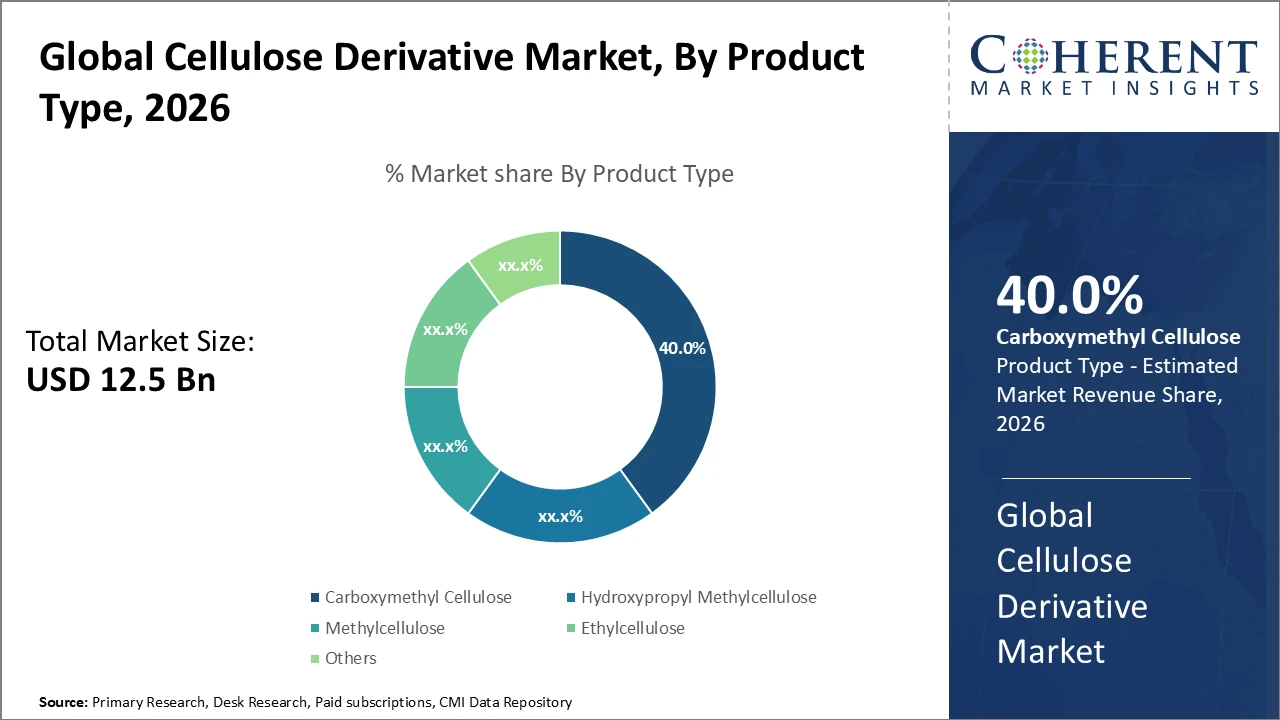
The Carboxymethyl Cellulose segment captures the largest market share with 40%, primarily dominating pharmaceutical and food sectors due to its superior viscosity control and stabilizing properties.
The Food and Beverages application segment leads the market, driven by increasing consumer demand for processed foods and clean-label products, particularly in North America, accounting for over 35% of industry revenue.
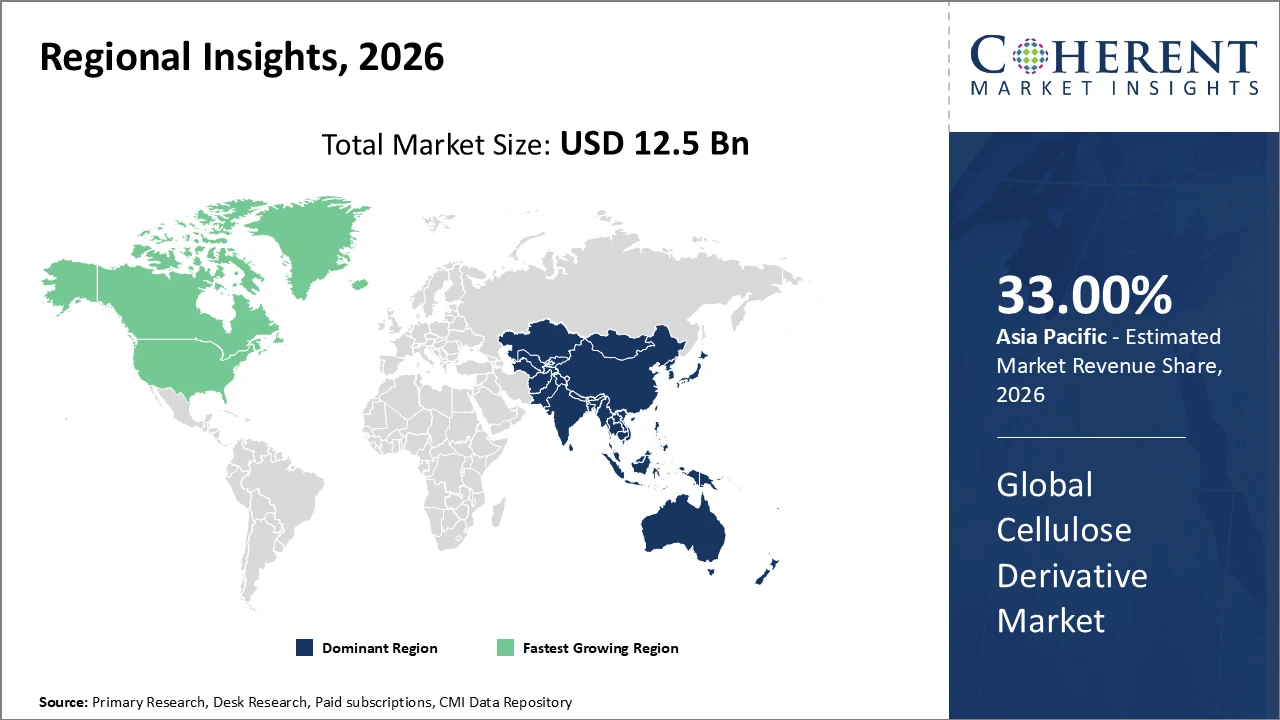
Asia Pacific emerges as the dominant region with a 33% market share, supported by rapid industrialization, rising disposable incomes, and growing government initiatives promoting bio-based chemicals.
North America is projected as the fastest-growing region with a CAGR of 7.8%, driven by stringent environmental regulations and an expanding pharmaceutical manufacturing base, especially in the United States.
Cellulose Derivative Market Segmentation Analysis
To learn more about this report, Request Free Sample
Cellulose Derivative Market Insights, By Product Type
Carboxymethyl Cellulose (CMC) dominates the market with a 40% share, driven by its widespread use in pharmaceuticals as a binder and disintegrant, and in food and beverages as a stabilizing agent, with 2025 data showing increasing adoption in oral and topical drug formulations. The fastest-growing subsegment, Hydroxypropyl Methylcellulose (HPMC), benefits from its versatility in film formation and controlled-release applications in pharmaceuticals, recording a 9% volume increase in 2026. Methylcellulose is widely used in construction as a rheology modifier, while Ethylcellulose is gaining traction in sustainable packaging. Other specialty cellulose derivatives serve niche applications with high functional specificity.
Cellulose Derivative Market Insights, By Application
Food and Beverages dominate the market with a 35% share, driven by growing demand for natural thickeners and stabilizers, with cellulose ether usage increasing by 12% in 2025. Pharmaceuticals follow closely, supported by rising demand for oral dosage forms and biocompatible binders, showing a 10% CAGR. The fastest-growing application is Personal Care, fueled by bans on synthetic microplastics and consumer preference for natural ingredients, recording an 11% annual increase. Construction employs cellulose derivatives for water retention and binding, while Others include niche segments such as textiles and paints, exhibiting steady but moderate growth.
Cellulose Derivative Market Insights, By Form Type
Powder dominates the market due to its ease of processing, uniform dispersion, and versatility across multiple end-use industries, holding the largest market share. Its widespread use in pharmaceuticals and food aligns with strong demand for standardized quality and consistency. The fastest-growing form is Solutions, driven by increasing adoption in personal care and specialty coatings, where ready-to-use formulations enhance manufacturing efficiency. Granules and Flakes show steady growth, primarily in construction and packaging applications, where their form factors impact handling, mixing, and application methods, supporting consistent performance across diverse industrial processes.
Cellulose Derivative Market Trends
Recent trends show a strong shift toward sustainable and high-performance cellulose derivatives, driven by stricter regulations and growing consumer awareness.
In 2025, North America recorded a 12% increase in bio-based cellulose derivative consumption, supported by federal environmental policies and expanding pharmaceutical production.
Asia Pacific continues to expand production capabilities, benefiting from government incentives promoting green and bio-based chemicals.
The region’s initiatives contribute to Asia Pacific holding a dominant 33% market share in the global cellulose derivative market.
Adoption of eco-friendly and high-performance derivatives is shaping innovation and competitive dynamics across key end-use industries.
Cellulose Derivative Market Insights, By Geography
To learn more about this report, Request Free Sample
Asia Pacific Cellulose Derivative Market Analysis and Trends
In Asia Pacific, the cellulose derivatives market is dominated by extensive manufacturing capabilities in China and India, supported by abundant raw material availability and favorable government policies. Strong downstream demand from pharmaceutical, food, and personal care industries further drives market growth. Leading companies such as Dow Chemical and CP Kelco have significantly expanded regional production capacity, investing in advanced technologies and sustainable processes to meet rising demand. These strategic initiatives reinforce the region’s competitive advantage, enabling it to capture approximately 33% of the global market share. Asia Pacific’s combination of resources, industrial scale, and investment continues to underpin its market leadership.
North America Cellulose Derivative Market Analysis and Trends
North America is the fastest-growing region in the cellulose derivatives market, driven by strict regulations encouraging alternatives to petrochemical-based products and expanding demand in pharmaceutical and personal care industries. The region is expected to achieve a robust CAGR of 7.8%, reflecting strong growth momentum. Innovation-led companies and established market players, such as Ashland and LyondellBasell, are key contributors, focusing on sustainable product portfolios, advanced cellulose derivative formulations, and increased R&D investments. These strategies enable the development of eco-friendly, high-performance derivatives that meet regulatory requirements and evolving consumer preferences, solidifying North America’s leadership in the global market.
Cellulose Derivative Market Outlook for Key Countries
USA Cellulose Derivative Market Analysis and Trends
The USA’s cellulose derivatives market is experiencing significant growth, fueled by dynamic pharmaceutical R&D and evolving regulations that promote biodegradable and sustainable materials. In 2025, the region accounted for over 25% of market revenue, with major companies investing in R&D facilities to develop specialty derivatives, including modified HPMC for advanced drug delivery. Regulatory focus on clean-label and eco-friendly products has accelerated the replacement of synthetic polymers in food and personal care sectors, driving demand for cellulose derivatives. Additionally, the United States hosts key manufacturing hubs that enhance supply chain efficiency and enable customization to meet precise industry requirements.
Germany Cellulose Derivative Market Analysis and Trends
Germany’s cellulose derivative market demonstrates steady growth underpinned by strong industrial demand from pharmaceuticals, automotive, and construction sectors. The country’s emphasis on sustainability and stringent European environmental regulations has accelerated adoption of bio‑based and biodegradable cellulose derivatives, particularly in coatings, adhesives, and specialty formulations. Innovation in high‑performance products, such as modified HPMC and advanced cellulose ethers, is supported by robust R&D activities and partnerships between chemical manufacturers and research institutions. Additionally, Germany’s well‑established chemical manufacturing infrastructure and focus on quality standards enhance competitive positioning, making it a key contributor to the broader European market and a hub for technological advancement in cellulose derivative applications.
Analyst Opinion
The surge in pharmaceutical applications is a key driver, accounting for over 30% of industry revenue in 2025. Cellulose derivatives serve as excipients in controlled drug release and as binders in tablets, showing a 9% year-over-year increase due to rising chronic disease prevalence and demand for sustained medication effects.
Supply-side trends indicate rising production capacity in Asia Pacific, particularly in China and India, contributing to a 15% increase in global output in 2024. This growth is supported by favorable government policies and investments in bio-based and green chemistry plants.
Demand in the food and beverage sector is diversified, with cellulose ethers dominating for their thickening and stabilizing properties. In 2026, the food-grade cellulose derivative segment grew 12%, driven by consumer preference for natural, clean-label ingredients and regulatory restrictions on synthetic additives.
Nano-scale cellulose derivatives are emerging as high-potential products, particularly in cosmetics and packaging. Biodegradable film applications saw an 18% production increase in 2025, fueled by environmental concerns and bans on single-use plastics.
Market Scope
| Report Coverage | Details | ||
|---|---|---|---|
| Base Year: | 2025 | Market Size in 2026: | USD 12.5 billion |
| Historical Data for: | 2020 To 2024 | Forecast Period: | 2026 To 2033 |
| Forecast Period 2026 to 2033 CAGR: | 7.1% | 2033 Value Projection: | USD 19.8 billion |
| Geographies covered: |
|
||
| Segments covered: |
|
||
| Companies covered: | CP Kelco, Nouryon, AkzoNobel N.V., FMC Corporation, Solvay S.A., The 3M Company, J.M. Huber Corporation, Ashland Global Holdings Inc., Dow Chemical Company, Domsjo Fabriker AB | ||
| Growth Drivers: |
|
||
Uncover macros and micros vetted on 75+ parameters: Get instant access to report
Cellulose Derivative Market Growth Factors
The growing emphasis on sustainability and demand for biodegradable materials is a major driver of cellulose derivative market growth, as eco-friendly derivatives increasingly replace synthetic polymers in packaging and personal care applications. Stringent regulatory frameworks, particularly in Europe and North America, are further accelerating this shift. Pharmaceutical applications are also expanding, fueled by rising production of oral solid dosage forms where cellulose derivatives improve drug stability and delivery. The food and beverage sector contributes significantly to growth, driven by increased consumption of processed foods requiring cellulose-based thickeners and stabilizers. Technological advancements in processing enable product customization, supporting diverse industrial requirements and business expansion.
Cellulose Derivative Market Development
In May 2025, Colorcon, a global leader in film coating systems, specialty excipients, controlled release formulations, and controlled atmosphere packaging for healthcare, announced an exclusive partnership with ASHA Cellulose, a leading supplier of organo-soluble ethyl cellulose polymers used in pharmaceutical and dietary supplement applications.
Key Players
Leading Companies of the Market
CP Kelco
Nouryon
AkzoNobel N.V.
FMC Corporation
Solvay S.A.
The 3M Company
J.M. Huber Corporation
Ashland Global Holdings Inc.
Dow Chemical Company
Domsjo Fabriker AB
Competitive strategies among leading cellulose derivative market players focus on capacity expansion and acquisition-driven growth. For example, Dow Chemical’s acquisition of a regional cellulose ethers plant in India in 2024 strengthened its presence in Asia Pacific, contributing to a 10% increase in market share. Similarly, Ashland has prioritized R&D investments in specialty cellulose derivatives, enabling enhanced product differentiation and allowing the company to command premium pricing in pharmaceutical applications. These strategic initiatives, combining regional expansion with innovation-focused development, help companies maintain competitive advantages, capture emerging opportunities, and meet evolving industry and regulatory demands globally.
Cellulose Derivative Market Future Outlook
The cellulose derivative market is poised for strong growth, driven by rising demand for sustainable, bio-based, and high-performance materials across pharmaceuticals, food and beverages, personal care, and packaging industries. Increasing regulatory emphasis on biodegradable and non-toxic ingredients, particularly in North America and Europe, will accelerate adoption of eco-friendly cellulose derivatives. Technological advancements in processing, including nano- and modified cellulose formulations, enable enhanced functionality, controlled-release drug delivery, and customized industrial applications. Emerging markets in Asia Pacific are expected to contribute significantly due to industrial expansion, government incentives, and growing consumer demand. Overall, innovation, sustainability, and regional growth will shape the market’s future trajectory.
Cellulose Derivative Market Historical Analysis
The cellulose derivative market has experienced steady growth over the past decade, driven by expanding applications in pharmaceuticals, food and beverages, personal care, and construction industries. Historically, synthetic polymers dominated as excipients, thickeners, and stabilizers, but increasing environmental awareness and regulatory pressures gradually shifted demand toward biodegradable and bio-based cellulose derivatives. Asia Pacific emerged as a key growth region due to abundant raw materials, industrial expansion, and government incentives, while North America and Europe focused on high-performance and specialty derivatives. Technological innovations in modified cellulose ethers and esters, along with rising pharmaceutical R&D, have historically shaped market dynamics and competitive strategies.
Sources
Primary Research Interviews:
Chemical industry analysts
R&D managers at cellulose derivative manufacturers
Coatings, paints, and textile production specialists
Food, pharmaceutical, and personal care formulation experts
Databases:
UN Comtrade Database
World Bank Industrial Data
Magazines:
Paint & Coatings Industry Magazine
Coatings World
Chemical Week
Textile World
Food Technology Magazine
Journals:
Dyes and Pigments Journal
Coloration Technology Journal
Journal of Coatings Technology and Research
Progress in Organic Coatings
Pigment & Resin Technology
Newspapers:
The Wall Street Journal (Industry & Chemicals)
Financial Times (Chemicals & Materials)
The Economic Times (Industry & Manufacturing)
The Guardian (Sustainability & Industry)
Chemical & Engineering News
Associations:
Society of Dyers and Colourists (SDC)
American Coatings Association (ACA)
European Coatings Association (ECA)
International Color Association (AIC)
World Chemical Organization
Share
Share
Kalpesh Gharte is a senior consultant with approximately 5 years of experience in the consulting industry. Kalpesh holds an MBA in Operations and Marketing Management, providing him with a strong foundation in market strategy and analysis. He has contributed to various consulting and syndicated reports, delivering valuable insights that support informed business decisions

Credibility and Certifications

860519526


9001:2015
27001:2022


Need a Custom Report?
We can customize every report - free of charge - including purchasing stand-alone sections or country-level reports
Customize NowJoining thousands of companies around the world committed to making the Excellent Business Solutions.
View All Our Clients